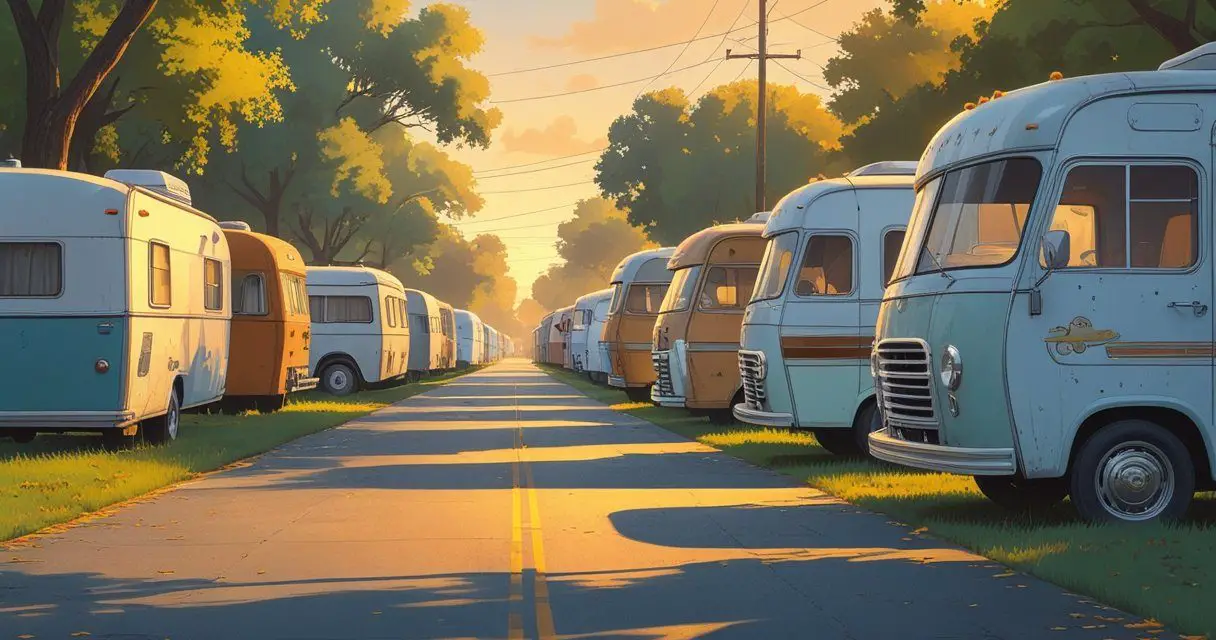
You’ve probably seen them parked along city streets—RVs that look like they haven’t moved in weeks, maybe months. But these aren’t vacation vehicles waiting for the next adventure. These are homes, permanent addresses for thousands of Americans who’ve found themselves caught in an impossible housing crisis. According to the 2024 Greater Los Angeles Homeless Count, over 6,800 RVs in Los Angeles County alone serve as full-time residences for people experiencing homelessness.
The RV you pass on your morning commute tells a story that’s far more complex than most people realize. It’s not about laziness, poor choices, or wanting a “free ride.” The reality involves job losses, skyrocketing rents, and an affordable housing shortage that’s pushing everyday working Americans into their vehicles.
This isn’t just a West Coast problem anymore—it’s spreading across the nation. From Seattle to San Diego, Oakland to Los Angeles, and increasingly in cities you’d never expect, vehicular homelessness has become one of the fastest-growing segments of America’s homeless population. The documentary below takes you inside this hidden crisis, showing you what life really looks like when an RV becomes your last option, not your vacation dream.
Would you like to save this article?
1. The Housing Math That Doesn’t Add Up: Why RVs Become the Only Option
You need to earn $33.63 per hour just to afford a modest two-bedroom apartment in America. That’s according to the National Low Income Housing Coalition’s 2025 “Out of Reach” report. Meanwhile, the federal minimum wage sits at $7.25—more than four times less than what you actually need.
Let’s break down the impossible math: A full-time minimum wage worker earns about $1,160 per month before taxes. The average two-bedroom apartment? Over $2,000 per month nationwide. In cities like Los Angeles, San Francisco, and Seattle, that number jumps to $3,000 or more.
Here’s where RVs enter the equation. A used RV might cost $5,000 to $15,000—expensive, yes, but still cheaper than first month’s rent, last month’s rent, security deposit, and the credit check you probably can’t pass anyway. For someone facing eviction or already sleeping in their car, an RV represents shelter, security, and a place to store belongings.
| Housing Option | Upfront Cost | Monthly Cost |
|---|---|---|
| Average 2-Bedroom Apartment | $6,000+ (deposits) | $2,000+ |
| Used RV Purchase | $5,000-$15,000 | Gas/parking only |
| Nightly Motel | $60-$100 per night | $1,800-$3,000 |
| Safe Parking Program | Usually free | $0-$50 |
According to research from the U.S. Interagency Council on Homelessness, people choose vehicles as shelter because they already own them or can purchase them more easily than securing rental housing. It’s not a lifestyle choice—it’s survival economics.
The reality check: Home prices have risen 60% nationwide since 2019, while rent has increased over 30% during the same period. Your wages? They haven’t kept pace. Not even close.
2. One Paycheck Away: How Job Loss Creates RV Residents Overnight
You’re probably closer to living in your vehicle than you think. Research published in the Journal of Social Distress and Homelessness in 2025 found that job loss plays a significant role in precipitating homelessness—and it happens faster than most people imagine.
The pattern looks like this: You lose your job. You burn through savings (if you have any) in 2-3 months. Your family and friends help for a while, but everyone has limits. Then comes the eviction notice. Once you’re out, good luck getting back in—most landlords require proof of income at 3x the rent, plus that background check showing no evictions.
Here’s the harsh truth: A 2021 University of Chicago study estimates that 53% of people in homeless shelters and 40% of unsheltered people were employed at the time of the count. Yes, you read that right—nearly half of homeless people are working. They’re just not earning enough.
In 2025 alone, over 1.75 million layoffs swept across American industries. Each one represents a potential domino effect: job loss → savings depletion → housing loss → vehicle living. The data shows that people who were evicted or forced to move had significantly higher rates of involuntary job loss, creating a vicious cycle.
The numbers that should worry you:
- Unemployment rates among people experiencing homelessness range from 57% to over 90%, compared to 3.6% for the general population
- Following wage decreases or job loss, people with savings remained housed only until those resources were exhausted
- 25-40% of the homeless population is employed at any given time but still can’t afford housing
Picture this: You’re working full-time at $15 per hour—which sounds decent, right? That’s $2,400 per month before taxes. After taxes, you’re looking at around $2,000. Now subtract rent ($2,000+), and you’re already underwater before buying food, gas, or that medication you need. An RV parked in a safe spot starts looking less like rock bottom and more like the only rational choice.
3. Who’s Really Living in These RVs? (Spoiler: It Might Surprise You)
Forget everything you think you know about who becomes homeless. The demographics of RV residents shatter stereotypes faster than a blown tire on the interstate.
According to data from Safe Parking Programs across California—communities that provide legal overnight parking for people living in vehicles—here’s who’s actually inside those RVs:
Santa Barbara Safe Parking Program:
- 84% are adults over age 55 (yes, seniors are the fastest-growing demographic)
- 70% are men
- One-third are currently employed
- Only a small percentage struggle with substance use disorders
- 20% of vehicles are RVs (the rest are cars and vans)
San Diego Safe Parking Program:
- 20% are families with children
- Nearly half are over age 50
- 70% reported this as their first experience with homelessness
- 15% have mental health challenges
- Most are newly homeless—not chronically unhoused
The reality check: These aren’t the stereotypical “homeless people” you’re imagining. They’re seniors on fixed Social Security income, working families between paychecks, middle-aged professionals who lost jobs, and veterans struggling to afford civilian housing.
| Demographic | Percentage | Why This Matters |
|---|---|---|
| Over Age 50 | 40-84% | Seniors are the fastest-growing homeless group |
| Employed | 25-40% | Working but can’t afford housing |
| Families with Kids | 10-20% | Children living in vehicles |
| First-Time Homeless | 70% | Not “chronically homeless” |
| Women | 30-40% | Often fleeing domestic violence |
In Oakland, California, vehicular homelessness increased 146% since 2015, reaching 3,655 individuals by 2019. In Seattle, an estimated 3,372 people were living in vehicles in 2018—representing 53% of the unsheltered population.
Here’s the part nobody talks about: Many RV residents are what researchers call the working poor. They have jobs. They show up on time. They pay what bills they can. They just can’t earn enough to escape the vehicle they’re trapped in.
4. The Daily Survival Struggle: What Life in an RV Really Looks Like
You wake up in your RV and immediately face challenges that housed people never consider. Where do you use the bathroom? How do you shower? What happens when your water tank is full and you have nowhere legal to dump it?
According to the U.S. Interagency Council on Homelessness report, people living in vehicles face a unique set of daily obstacles that go far beyond having a roof over their heads:
The basic human needs checklist:
- ✗ No consistent access to bathrooms (public restrooms close at night)
- ✗ No shower facilities (maybe once a week at a shelter, if you’re lucky)
- ✗ No legal place to dump wastewater (RV residents often get cited for dumping on streets)
- ✗ No electrical hookups (means no heating, cooling, or food refrigeration)
- ✗ No legal parking (constantly moving to avoid tickets and towing)
- ✓ A locked space (safer than sleeping on the street)
- ✓ Storage for belongings (can’t carry everything on your back)
- ✓ Some privacy and dignity (crucial for mental health)
The daily routine looks like this: You move your RV every 72 hours to avoid parking citations. You search for public bathrooms, which close at 6 PM. You ration your water because you can’t refill easily. You pay $60-$150 every time parking enforcement tows your vehicle—money you desperately need for gas, food, or repairs.
Some cities have responded with creative solutions. Seattle, for example, offers free mobile pump-out services for RVs to avoid leaking and street dumping. It’s a small acknowledgment that these residents need basic services, not just punishment.
The employment catch-22: Many shelters have curfews that make it impossible to work evening shifts. If you work nights (which many minimum-wage jobs require), you can’t use the shelter. Your RV becomes the only way to maintain employment—which is your only path out of homelessness.
Here’s what might shock you most: In a survey of people experiencing vehicular homelessness, the majority said they would prefer permanent housing to living in vehicles. This isn’t a lifestyle choice or “van life” Instagram fantasy. It’s survival, plain and simple.
5. When Your Home Has Wheels: The Legal Nightmare of Vehicle Residency
You’re breaking the law just by sleeping. In 50% of the 187 U.S. cities surveyed by the National Homelessness Law Center, there’s at least one law restricting living in vehicles. Between 2006 and 2019, these laws increased by 213%.
Let’s talk about what criminalization actually looks like on the ground:
The legal trap: Cities pass ordinances that make it illegal to:
- Sleep in your vehicle overnight (directly criminalizes homelessness)
- Park RVs in residential areas (eliminates safer parking options)
- Park in the same spot for more than 72 hours (even if it’s a legal spot)
- Park oversized vehicles on public streets (specifically targets RVs)
- Live in a vehicle that doesn’t meet “habitability” standards (catch-22: you’re too poor for housing but your RV is “too broken” to be legal)
What happens when you violate these laws? The penalties create a devastating cycle:
- Parking ticket: $60-$150 you can’t pay
- Unpaid fines accumulate: Now you owe $500+
- Vehicle gets towed: $300-$800 to retrieve it
- Can’t pay towing fees: You lose your RV—and your home
- Now you’re on the street with nowhere to store belongings or sleep safely
According to a Seattle University Law study, cities in Washington state average 10 separate ordinances that criminalize vehicle residency. Nearly one-third explicitly ban vehicle living without providing reasonable alternatives like shelter beds.
The financial death spiral: Emergency tows can cost $800 or more. Unpaid tickets lead to suspended licenses, making it illegal to drive to work. Impounded vehicles rack up daily storage fees. Within weeks, you can’t afford to retrieve your home, and you’re even worse off than before.
| Legal Action | Cost | Impact |
|---|---|---|
| Parking Citation | $60-$150 | Drains limited funds |
| Vehicle Tow | $300-$800 | May lose home entirely |
| Impound Fee (per day) | $50-$100 | Compounds daily |
| License Suspension | N/A | Can’t drive to work |
| Court Fines | $500+ | Creates debt trap |
The irony you can’t ignore: In Los Angeles, the 9th Circuit Court of Appeals overturned a city ordinance banning people from living in cars in 2014, calling it discriminatory. The city’s response? They rewrote the law to restrict parking times and locations instead—achieving the same result through different wording.
Some cities pair enforcement with services. San Diego passed an ordinance barring people from sleeping in vehicles near homes or schools—while simultaneously creating safe parking lots. But here’s the catch: Those safe parking programs have limited spaces and often have waitlists months long.
6. Safe Parking Programs: The Band-Aid on a Broken System
Imagine a parking lot where sleeping in your vehicle is actually legal. That’s the concept behind Safe Parking Programs—and they’re both a lifeline and a reminder of how far the system has fallen short.
The first Safe Parking Program launched in Santa Barbara in 2004. Today, approximately 30 programs exist nationwide, primarily in California and Washington, with a few scattered across Colorado, Minnesota, and Oregon.
What these programs typically offer:
- A legal place to park overnight (no more 3 AM police knocks)
- Security (reduces theft and assault)
- Portable toilets and handwashing stations (basic human dignity)
- Connections to case managers and housing services
- Sometimes: showers, Wi-Fi, food, and childcare
The harsh reality: Safe Parking Programs help hundreds of people—but thousands need them. In Los Angeles County alone, there are 6,800+ RVs serving as homes. Most Safe Parking Programs accommodate 20-100 vehicles maximum. Do the math.
Program costs and challenges:
- High operational expenses (24/7 staffing, security, sanitation)
- Community opposition (NIMBYism is real and powerful)
- Limited funding (most rely on nonprofit and faith-based organizations)
- Waitlists that stretch for months
Here’s the uncomfortable truth: Some communities use Safe Parking Programs as justification for increased enforcement elsewhere. The logic goes: “We provided safe parking spaces, so now we can ticket and tow anyone not using them”—even though those spaces are full with long waitlists.
According to research from USC Sol Price School of Public Policy, Safe Parking Programs work best when they:
- Lower barriers to entry (no background checks that exclude people)
- Provide flexible hours (some allow 24/7 access, not just overnight)
- Connect residents to housing-focused services (the goal is permanent housing, not permanent parking)
- Respect autonomy (people are more likely to engage when they don’t feel controlled)
The success metrics are mixed: San Diego’s program shows that participants often secure permanent housing within 3-6 months. But programs can only serve a tiny fraction of those in need, and many cities still don’t have any programs at all.
You want to know the most telling statistic? In Santa Clara County, California, the number of people living in vehicles increased 146% from 2015 to 2019—despite the presence of Safe Parking Programs. These programs help individuals, but they don’t address the root cause: America’s housing crisis.
7. The Root Cause Nobody Wants to Admit: We Don’t Have Enough Affordable Housing
Here’s the truth everyone dances around: RV homelessness exists because America doesn’t have enough affordable housing. Period.
The National Low Income Housing Coalition puts it bluntly: In zero U.S. states can a full-time minimum-wage worker afford a modest two-bedroom apartment. Zero. Not one.
The numbers tell a devastating story:
- Median rent hit $2,000+ for the first time in 2022 and has continued rising
- Rents have increased 15% year-over-year in many markets
- Home prices are up 60% nationwide since 2019
- Meanwhile, wages have grown approximately 3-4% annually—nowhere near enough
According to the U.S. Interagency Council on Homelessness, the lack of affordable housing is the primary cause of all forms of homelessness, including vehicular homelessness. When housing markets tighten (low vacancy rates, rising unemployment, increased poverty), the number of people living in vehicles increases predictably.
Harvard’s Joint Center for Housing Studies reports that a record-high 22.6 million renter households were cost-burdened in 2023—meaning they spend more than 30% of income on housing. Many spend 50% or more, leaving nothing for emergencies.
Here’s what happens in this environment: One financial shock—medical bill, car repair, job loss—and you can’t pay rent. You’re evicted. Now you have an eviction on your record, making it nearly impossible to rent anywhere else. Your credit score tanks. Landlords won’t touch you. Your vehicle becomes your only option.
The supply and demand crisis:
| Issue | Impact |
|---|---|
| 4-7 million housing unit shortage nationwide | Competition drives prices up |
| Median rent: $2,000+ | Unaffordable for minimum wage workers |
| “Housing wage” needed: $33.63/hour | 4x federal minimum wage |
| Eviction creates rental barriers | Can’t re-enter housing market |
| Limited new affordable construction | Supply can’t meet demand |
Cities respond with enforcement and towing—which costs taxpayers more than providing housing. Research from Los Angeles shows that vehicle-dwelling restrictions don’t reduce overall homelessness; they just move people around. One neighborhood’s enforcement becomes another neighborhood’s crisis.
Some communities are trying new approaches. Los Angeles launched an “RV-to-Home” program in 2022 that provides outreach, vehicle repairs, and housing placement—in exchange for people relinquishing their RVs. The program housed nearly 300 people and is now expanding citywide.
But here’s the bottom line: Safe parking programs, towing enforcement, RV-to-home initiatives—these are all band-aids. The only real solution is building more affordable housing and raising wages to livable levels. Everything else is just rearranging deck chairs on the Titanic.
As long as housing costs outpace wages by 300-400%, you’ll see more RVs parked on your street. Because for thousands of Americans, four wheels and an engine are the only roof they can afford.
Conclusion: The Crisis Hiding in Plain Sight
That RV you drove past this morning represents America’s failure to provide basic housing for working people. It’s not a choice, a vacation, or a lifestyle. It’s what happens when rent costs $2,000, wages pay $1,500, and the math simply doesn’t work.
The people inside those vehicles are seniors on Social Security, families with jobs, veterans, and workers who did everything right—and still ended up with nowhere to go but a parking lot at 3 AM, hoping the police don’t knock tonight.
RV homelessness will keep growing until the nation addresses the fundamental problem: affordable housing scarcity and wages that haven’t kept pace with cost of living. Every towing ordinance, every parking restriction, every “move along” order just shuffles the problem to the next street. It doesn’t solve anything.
The solution isn’t complicated—it’s just expensive and requires political will: Build affordable housing. Raise minimum wage to match actual living costs. Stop criminalizing poverty. Treat housing as a human right, not a luxury commodity.
Until then, expect to see more RVs parked in your neighborhood. Because for hundreds of thousands of Americans, those four wheels are the only home they have.
SOURCES
- Los Angeles Homeless Services Authority (LAHSA) – 2025 Greater Los Angeles Homeless Count Results
- U.S. Interagency Council on Homelessness – How Communities Are Responding to Vehicular Homelessness Report
- National Low Income Housing Coalition – Out of Reach 2025: The High Cost of Housing
- Harvard Joint Center for Housing Studies – State of the Nation’s Housing 2025
- National Alliance to End Homelessness – State of Homelessness: 2025 Edition
- Journal of Social Distress and Homelessness – Job Loss and Housing Precarity Among People Experiencing Homelessness
- University of Chicago Study – Employment Among Homeless Populations 2021
- National Homelessness Law Center – Housing Not Handcuffs 2019 Report
- USC Sol Price School of Public Policy – Smart Practices for Safe Parking Programs
- Los Angeles Times – Editorial: RV Towing and Homelessness
- NBC Los Angeles – LA 2025 Homeless Count Announcement
- American Progress – Build, Baby, Build: A Plan To Lower Housing Costs for All
- Los Angeles Mayor’s Office – RV-to-Home Program Expansion
- Just Knate YouTube Channel – The Homeless RV Epidemic Taking Over Los Angeles