
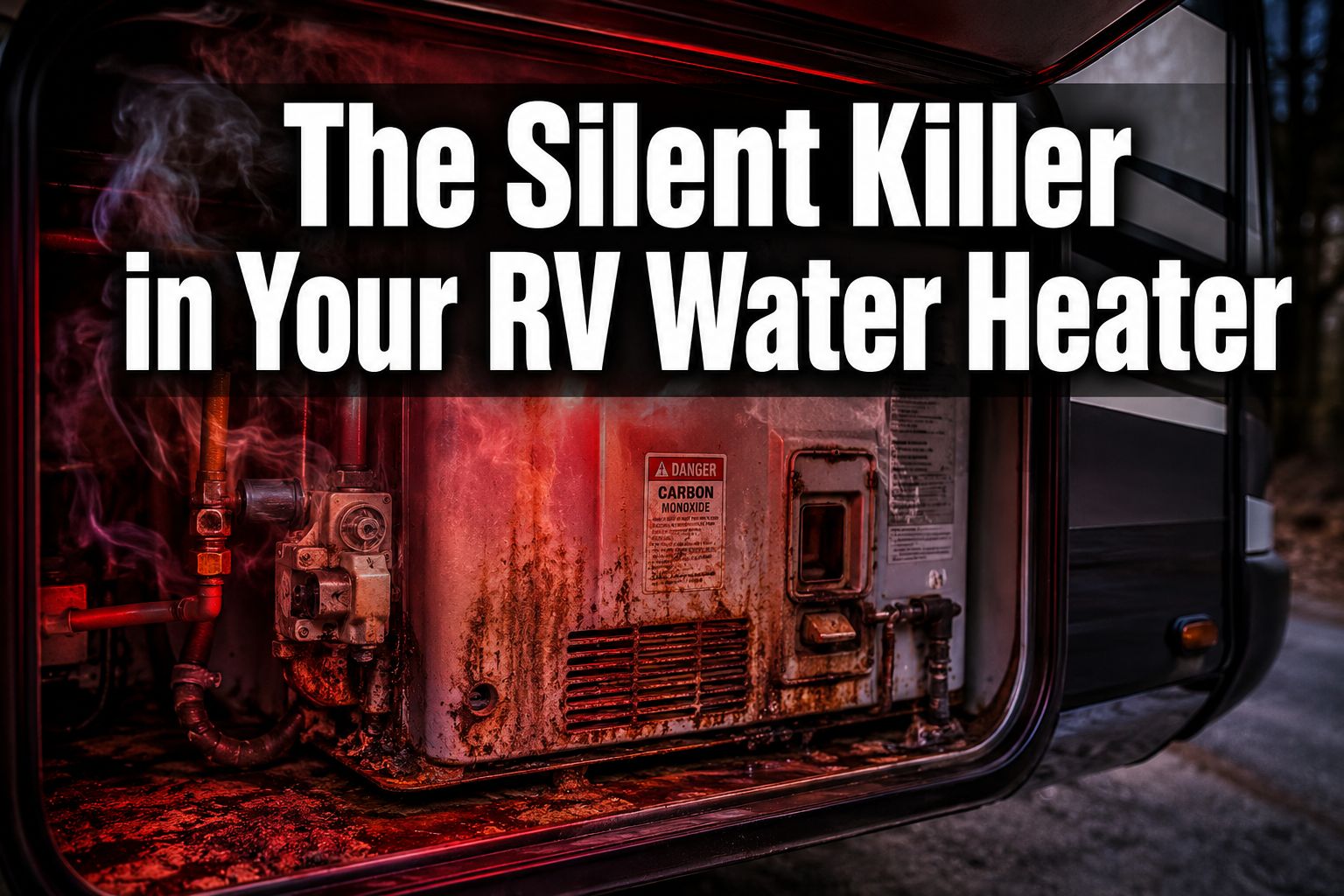
Every year, carbon monoxide sends thousands of people to emergency rooms — and a surprising number of those cases trace back to a small, overlooked appliance tucked into the side of an RV. The silent killer in your RV water heater is real, it is invisible, and it has no smell. That is what makes it so dangerous. This guide breaks down exactly what the threat is, how it happens, and — most importantly — how to stop it before it ever becomes a problem. 🚨
Key Takeaways
- Carbon monoxide (CO) from propane-powered RV water heaters is colorless and odorless — making it nearly impossible to detect without a detector
- Incomplete combustion caused by blockages, poor maintenance, or malfunctions is the main reason CO builds up [1]
- Electric water heaters do NOT produce CO — only gas/propane-powered units pose this risk [2]
- A working CO detector inside the RV is one of the most important safety tools any RV owner can have [4]
- Regular maintenance — including cleaning burner tubes, checking anode rods, and testing relief valves — can prevent most dangerous situations [3][8]
What Exactly Is the Silent Killer in Your RV Water Heater?
The phrase “the silent killer in your RV water heater” refers to carbon monoxide gas, or CO. This gas has no color. It has no smell. And it can make a person very sick — or worse — before they even realize something is wrong.
Here is the basic science, made simple:
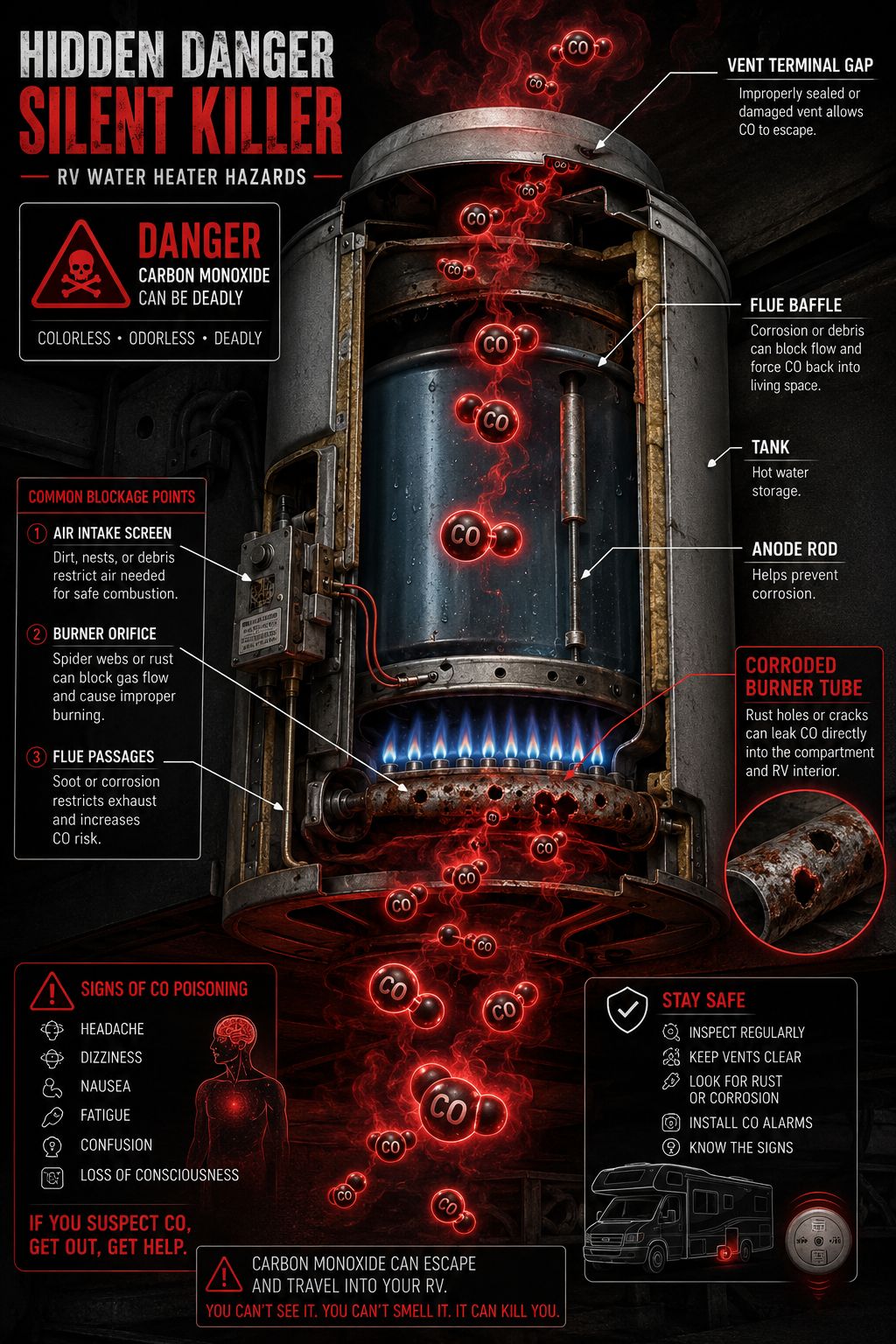
Propane burns cleanly when it gets enough oxygen. When it does NOT get enough oxygen, it makes carbon monoxide instead of carbon dioxide.
That is the core problem. When something blocks the airflow to a propane water heater — like a spider web, dirt, or a broken part — the burner cannot get enough oxygen. Instead of safe exhaust, it starts making CO.
Why Propane Water Heaters Are the Main Risk
Most RV water heaters run on propane, electricity, or both. The key fact is this: electric water heaters do not produce carbon monoxide because they do not burn any fuel [2]. There is no combustion happening inside an electric unit.
But propane-powered water heaters? They burn fuel every single time they heat water. And every time they burn fuel, there is a chance — if something goes wrong — that they could produce CO [1].
This is not meant to scare anyone away from propane. Millions of RVers use propane water heaters safely every year. The goal is to understand the risk so it can be managed properly.
How CO Gets Inside the RV
The water heater is mounted on the outside wall of the RV. It is designed to vent exhaust gases outward — away from the living space. But if the venting system is damaged, blocked, or improperly sealed, CO can sneak back inside through small gaps and cracks [7].
Even a tiny hole around the propane line entry point can let dangerous gas seep in slowly while everyone is sleeping [3].
Understanding the Danger: Symptoms and Real-World Warnings
What Carbon Monoxide Poisoning Feels Like
The tricky thing about CO poisoning is that early symptoms feel a lot like the flu or being tired from a long drive. Many people do not connect the dots until it is too late. Here is what to watch for [4]:
| Symptom Level | Signs to Watch For |
|---|---|
| 🟡 Mild | Headache, dizziness, slight nausea |
| 🟠 Moderate | Vomiting, weakness, chest pain, confusion |
| 🔴 Severe | Loss of consciousness, brain damage, death |
The scariest part? If CO levels rise slowly while someone is sleeping, they may never wake up. The body does not trigger a strong alarm response the way it does with smoke or a bad smell.
A Real-World Warning That Made Headlines
In December 2021, Australia’s consumer safety authority issued a serious warning about certain Suburban-branded water heaters found in RVs. These units could emit deadly carbon monoxide when used in gas mode. Owners were told to stop using them immediately and have them inspected [5].
This was not a small or obscure brand. Suburban is one of the most common RV water heater brands in North America and beyond. The recall was a wake-up call for the entire RV community.
💬 “If it can happen to a major brand, it can happen to any unit that is not properly maintained.”
The U.S. Consumer Product Safety Commission Weighs In
The CPSC specifically warns against using any fuel-burning appliance in an enclosed space like a camper or vehicle without proper ventilation [6]. Even portable heaters and camping lanterns fall into this category. The RV water heater is no different — it must be properly vented at all times.
How the Silent Killer in Your RV Water Heater Sneaks Up on You
There are several specific ways that CO problems develop in RV water heaters. Knowing these makes it much easier to prevent them.
1. Blocked Burner Tubes 🕷️
This is one of the most common culprits. Spiders and insects love to build nests inside the burner tube of a propane water heater. It is warm, sheltered, and quiet — perfect for a spider. But a nest blocks airflow, which leads to incomplete combustion, which leads to CO [3].
The fix: Clean the burner tube at least once a season, especially after storage.
2. Damaged or Missing Grommets
There is a rubber grommet (a small seal) around the propane line where it enters the water heater compartment. If this grommet is cracked, missing, or worn out, it creates a gap. CO or propane can travel through that gap directly into the RV’s living space [3].
The fix: Inspect the grommet every year and replace it if it looks damaged.
3. Poor Ventilation Design or Damage
The water heater is designed to push exhaust outside. But if the exterior vent cover is bent, clogged with debris, or damaged in a road incident, exhaust gases can back up. This is especially dangerous when parked in a tight spot or near a wall [7].
The fix: Check the exterior vent cover regularly for damage or blockages.
4. Malfunctions and Age
Like any appliance, water heaters wear out. Old ignitors, corroded burners, and failing thermostats can all contribute to incomplete combustion. An aging unit that has never been serviced is a much higher risk than one that gets regular checkups [1].
The fix: Have the unit professionally inspected every year or two, especially if it is more than five years old.
Protecting Your Family: The Essential Safety Checklist
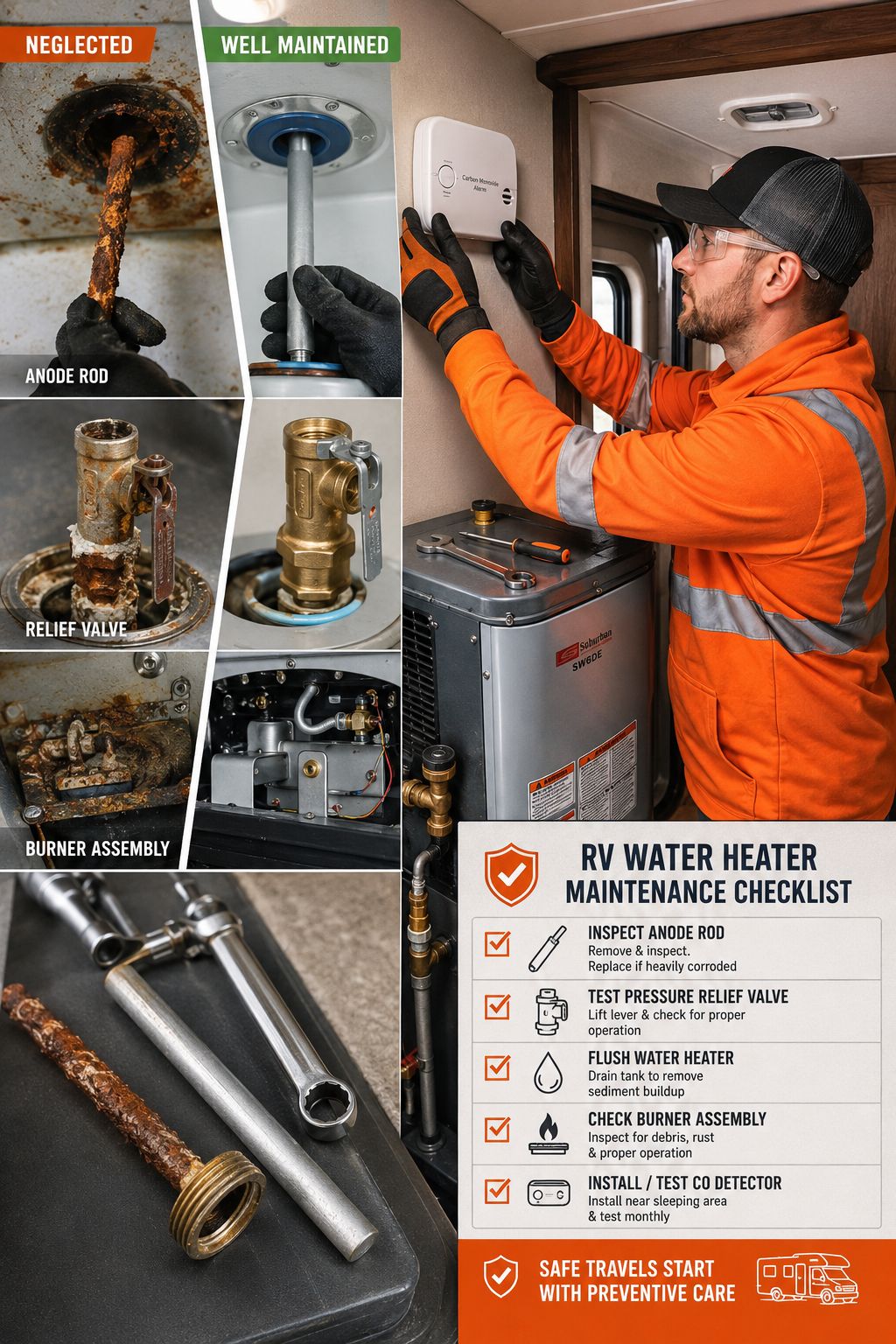
Here is a practical, easy-to-follow checklist for keeping the silent killer in your RV water heater from ever becoming a real threat. Print it out and keep it with the RV paperwork. ✅
🔴 Install a CO Detector — Right Now
This is the single most important step. A working carbon monoxide detector inside the RV can save lives. The CDC strongly recommends having one installed and tested regularly [4].
Tips for CO detectors:
- Place it near the sleeping area
- Test it monthly
- Replace batteries every six months
- Replace the entire unit every 5-7 years (they do expire!)
🔧 Annual Maintenance Tasks
These tasks should happen at least once a year — ideally before the camping season starts:
Burner and Combustion System:
- Clean the burner tube to remove spider webs, dirt, and debris [3]
- Inspect the ignitor for corrosion or damage
- Check all wire connections for fraying, looseness, or damage [3]
Seals and Venting:
- Inspect the grommet around the propane line entry point [3]
- Check the exterior vent cover for dents, clogs, or damage [7]
- Make sure no exhaust is being directed back toward any window or door
Tank and Pressure:
- Test the emergency pressure relief valve by pulling up on the handle — it should move freely and release water, then stop when released. If it is sticky or stuck, replace it immediately [8]
- Drain and flush the water heater tank at the end of every camping season to remove sediment buildup [8]
🔩 Every Six Months: Anode Rod Check
For Suburban water heaters (and many other brands), the anode rod is a sacrificial metal rod inside the tank that prevents corrosion. It slowly dissolves over time to protect the tank walls.
Check it every six months. If it has lost more than 75% of its original material, replace it right away [8]. A failed anode rod means the tank itself starts to corrode — and a corroded tank can develop leaks and other serious problems.
How to check the anode rod:
- Turn off the water heater and let it cool completely
- Turn off the water supply and release pressure
- Locate the anode rod plug on the outside of the heater
- Use a socket wrench to remove it
- Inspect the rod — if it is thin, pitted, or mostly gone, replace it
🌬️ Ventilation Rules to Live By
- Never run a propane appliance in a completely sealed RV without airflow
- Always make sure the water heater exterior vent is unobstructed before use
- Open a window slightly when using multiple propane appliances at the same time
- Never use portable camping heaters or lanterns inside the RV while sleeping [6]
Electric vs. Propane: A Quick Safety Comparison
Many RVers wonder if switching to an electric-only water heater would eliminate the CO risk entirely. The short answer is yes — for that one appliance.
| Feature | Propane Water Heater | Electric Water Heater |
|---|---|---|
| Produces CO? | ✅ Yes (if malfunctioning) | ❌ No [2] |
| Works off-grid? | ✅ Yes | ❌ Needs shore power or generator |
| Heating speed | 🔥 Fast | 🐢 Slower |
| Maintenance needs | Higher | Lower |
| CO detector needed? | Absolutely | Still recommended (other sources) |
Even with an electric water heater, a CO detector is still a smart idea. Other propane appliances in the RV — like the stove, furnace, and refrigerator — can also produce CO if they malfunction [1].
What to Do If the CO Alarm Goes Off
Stay calm. Act fast. Here is the exact order of steps to follow:
- Get everyone out of the RV immediately — do not stop to grab belongings
- Leave the door open as people exit to help air out the space
- Call 911 once outside
- Do not go back inside until emergency responders say it is safe
- Seek medical attention even if everyone feels okay — CO can have delayed effects [4]
⚠️ Never ignore a CO alarm and assume it is a false alarm. Treat every alarm as real until proven otherwise.
Seasonal Tips: Keeping the Silent Killer in Your RV Water Heater Away All Year
Before the Season Starts 🌸
- Run through the full maintenance checklist above
- Test the CO detector
- Clean the burner tube (spiders are especially active in spring)
- Check the anode rod
During the Season ☀️
- Do a quick visual check of the exterior vent before each trip
- Listen for unusual sounds from the water heater (popping, rattling, or irregular ignition)
- Pay attention to any yellow or orange flame instead of blue — this can signal incomplete combustion
End of Season ❄️
- Drain and flush the water heater tank [8]
- Bypass the water heater for winterization
- Cover the exterior vent to keep pests out during storage (but remember to uncover it before using the heater again!)
- Replace CO detector batteries before storing
Conclusion: Do Not Let the Silent Killer Catch You Off Guard
The silent killer in your RV water heater is not something to be afraid of — it is something to be prepared for. Carbon monoxide is dangerous precisely because it cannot be seen or smelled. But with the right knowledge, the right tools, and a simple maintenance routine, it is completely manageable.
Here are the most important action steps to take right now:
✅ Install a CO detector if there is not one already — do it today
✅ Clean the burner tube before the next trip
✅ Inspect the grommet around the propane line entry
✅ Test the pressure relief valve and check the anode rod
✅ Make a seasonal maintenance schedule and stick to it
The RV lifestyle is one of the best ways to explore the world. A little bit of attention to safety means more adventures, more memories, and more peace of mind on the road. Stay safe out there! 🏕️🚐
References
[1] Carbon Monoxide Poisoning In Rv – https://rvlife.com/carbon-monoxide-poisoning-in-rv/?utm_source=openai
[2] Can Electric Water Heaters Produce Carbon Monoxide – https://iere.org/can-electric-water-heaters-produce-carbon-monoxide/?utm_source=openai
[3] Inspect Water Heater – https://www.kz-rv.com/maintenance-tips/inspect-water-heater/?utm_source=openai
[4] Boating – https://www.cdc.gov/carbon-monoxide/about/boating.html?utm_source=openai
[5] Accc Warns Of Dangerous Rv Water Heaters – https://www.racq.com.au/articles/travel-tips/accc-warns-of-dangerous-rv-water-heaters?utm_source=openai
[6] Portable Heaters Camping Equipment – https://www.cpsc.gov/Safety-Education/Safety-Education-Centers/Carbon-Monoxide-Information-Center/Portable-Heaters–Camping-Equipment?utm_source=openai
[7] Does Flame From Rv Stovetop Create Carbon Monoxide Inside The Rig – https://www.rvtravel.com/does-flame-from-rv-stovetop-create-carbon-monoxide-inside-the-rig/?utm_source=openai
[8] Motorhome Water Heater Maintenance – https://www.rv.com/servicing-care/safety-maintenance/motorhome-water-heater-maintenance/?utm_source=openai