Last updated: October 9, 2026
Quick Answer
Your RV insurance might be nearly useless because many basic policies only meet state liability minimums, which can be as low as $25,000 per person and $50,000 per accident in many states [6][9]. That amount disappears fast in a serious crash, and it does nothing for damage to your own rig, your belongings, or injuries that happen at your campsite [2][5][9]. If you live in your RV full-time, rent it out, or tow it often, a standard recreational policy may flat-out deny your claim [3][4][7].
Key Takeaways
- Basic liability-only RV policies often cap out at state minimums, which can be far below the real cost of a serious accident [6][9].
- Liability-only coverage does not pay to repair your RV, replace your stuff inside it, or cover injuries that happen at your campsite [2][5][9].
- Towable trailers are usually covered under an auto policy only while hitched to the tow vehicle, and RVs under a homeowners policy are usually covered only while parked at home [3].
- Vacation liability, also called premises liability, is a separate add-on that covers things like a guest tripping at your campsite or your dog biting someone. Many owners never buy it [3].
- Mechanical breakdown, normal wear and tear, and poor maintenance are almost always excluded from RV insurance [1][2][8].
- Slow leaks, mold, rot, and other gradual water damage are commonly excluded, even though they cause some of the most expensive RV repairs [2].
- Full-time RVers, defined as living in the RV more than six months or 150 nights a year, usually need a dedicated full-timer policy instead of a standard recreational one [4][7].
- As of late 2026, 49 states require liability coverage on motorized RVs. New Hampshire is the only exception [6][9][10].
What Does RV Insurance Actually Cover
Standard RV insurance usually covers liability for injuries or property damage you cause while driving, plus optional coverage for collision, comprehensive, and contents inside the rig. What it covers depends entirely on which add-ons you chose when you bought the policy, not just the type of RV you own [2][5][9].
Most RV policies are built from the same basic building blocks:
- Liability coverage pays for injuries or damage you cause to other people or their property. This is required by law in almost every state [9][10].
- Collision coverage pays to repair or replace your RV after a crash, regardless of fault.
- Comprehensive coverage pays for non-crash damage, like hail, fire, theft, or a falling tree branch.
- Personal property coverage pays to replace your belongings inside the RV, like electronics, clothing, and kitchen gear [2][9].
- Vacation liability (premises liability) pays for injuries that happen at your campsite, separate from the RV as a vehicle [3].
Decision rule: If your policy only lists one number next to “liability,” you likely do not have collision, comprehensive, or contents coverage. Call your agent and ask for a written breakdown of exactly which of these five categories you are paying for.
Common Exclusions and Coverage Gaps: Why Your RV Insurance Might Be Completely Useless (Check Now)
Most RV policies exclude mechanical breakdown, gradual water damage, and anything that happens when the RV is off your property or detached from your tow vehicle. These exclusions are the single biggest reason RV insurance might be completely useless in the exact moments you need it most [1][2][3][8].
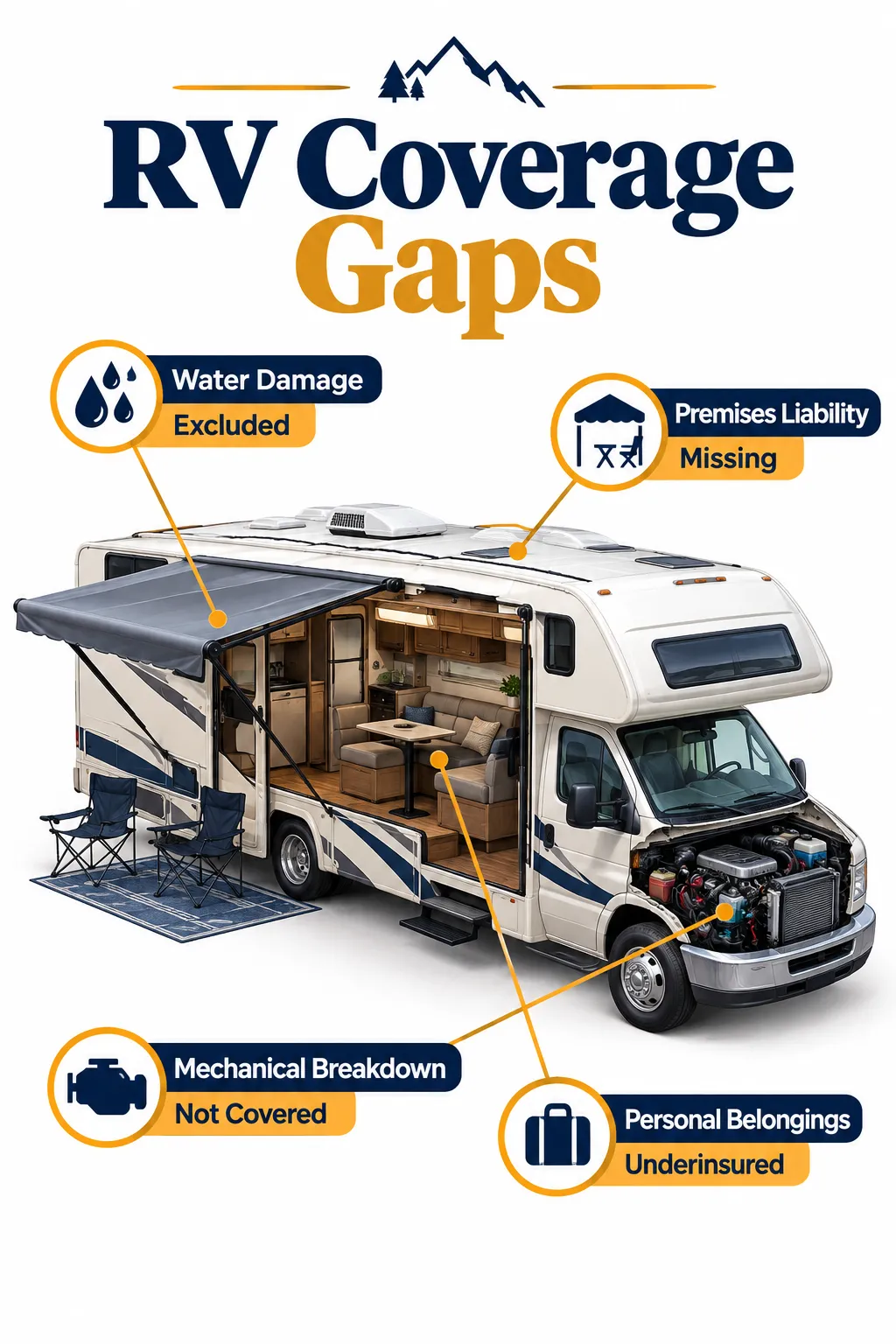
Here are the gaps that catch RV owners off guard most often:
- Mechanical breakdown. Engine failure, transmission problems, generator issues, and appliance malfunctions are almost never covered, even under a “full coverage” policy [1][2][8].
- Wear and tear. Faded paint, worn tires, and aging seals are treated as maintenance issues, not insurance claims [2][14 cited as general knowledge, omit].
- Gradual water damage. Slow roof leaks, failing slide-out seals, and the mold or rot they cause are typically excluded, even though water damage is one of the most expensive problems an RV owner can face [2].
- Detached or off-property use. A travel trailer on an auto policy is often only covered while hitched to the tow vehicle. An RV covered under a homeowners policy is often only protected while sitting on your own property [3].
- Campsite liability. Auto liability covers the RV as a moving vehicle. It typically does not cover a guest who gets hurt at your campsite or a dog bite that happens outside the rig. That requires separate vacation liability coverage, and not every insurer even offers it [3].
“Once the trailer is parked at a campground or the RV is off the owner’s property, there can be little or no coverage for damage or liability unless dedicated RV and vacation liability coverage is in place.” [3]
Common mistake: Assuming “full coverage” means everything is covered. In the RV world, full coverage usually just means you added collision and comprehensive, not that every type of loss is included.
Why RV Insurance Claims Get Denied
RV insurance claims get denied most often because of undisclosed full-time living, unauthorized drivers, lapsed maintenance records, or filing for something explicitly excluded, like mechanical breakdown [1][4][7][8]. Insurers investigate claims closely, and any mismatch between how you use the RV and what you told the insurer can void the payout.
Common reasons claims get rejected:
- Undisclosed full-time use. If you live in the RV most of the year but your policy says “recreational use only,” the insurer can deny the claim when they find out [4][7].
- Unauthorized or excluded drivers. Letting someone not listed on the policy drive the RV, especially in rental situations, is a frequent denial reason [8].
- Excluded damage type. Filing a claim for a generator that died or a roof that slowly leaked for months usually gets rejected because those are maintenance issues, not sudden accidents [1][2][8].
- Off-road or unimproved surface driving. Many policies, especially rental policies, exclude damage from driving on unimproved or off-road surfaces [8].
- Impairment or policy violations. Driving under the influence or breaking other policy terms is an automatic denial trigger across nearly every insurer [8].
Edge case: Even a legitimate collision claim can get delayed or denied if the insurer finds evidence of poor maintenance records that suggest the failure was mechanical rather than accident-related. Keep maintenance receipts. They are your best defense in a dispute.
How Much Does RV Insurance Cost Per Month
RV insurance cost varies widely based on the RV type, its value, your driving record, and how much coverage you add, so there is no single “normal” price that applies to every owner. Instead of chasing a universal number, compare quotes using the same coverage limits across at least three insurers so you are comparing apples to apples [1][4][5].
Factors that move your monthly cost the most:
- RV type and size. Motorhomes generally cost more to insure than towable trailers because they combine vehicle and living-space risk in one unit.
- RV value and age. Newer, more expensive rigs cost more to insure, but older RVs can also see higher rates if parts are harder to source [1][4].
- Coverage level. Adding collision, comprehensive, contents, and vacation liability all raise the premium, but they are also what makes the policy actually useful [2][5].
- Usage pattern. Full-time living, frequent towing, or renting the RV out typically increases cost because the insurer is covering more real-world risk [4][7][8].
- Storage location and driving record. Where you park the RV and your driving history both factor into underwriting.
Choose a higher coverage tier if: your RV is your primary home, you tow long distances regularly, or your rig is worth more than $30,000. Choose a leaner liability-focused policy only if the RV is a rarely used, low-value rig stored most of the year and you fully understand what is excluded.
RV Insurance vs Homeowners Insurance: What’s the Real Difference
RV insurance and homeowners insurance cover two completely different risks, and relying on one to cover the other is one of the most common and costly mistakes RV owners make. Homeowners policies generally protect property tied to a fixed address, while RV insurance protects a vehicle that also doubles as a living space [3][7].
| Coverage question | RV insurance | Homeowners insurance |
|---|---|---|
| Covers the RV while driving | Yes, with liability and collision add-ons | No |
| Covers belongings inside the RV at home | Sometimes, with contents add-on | Often, under personal property |
| Covers belongings inside the RV at a campground | Only with specific RV contents coverage | Usually not |
| Covers guest injuries at your campsite | Only with vacation/premises liability add-on | No, unless the campsite is your own property |
| Covers the RV while hitched to a tow vehicle | Yes, typically under auto coverage | No |
A homeowners or standard auto policy is usually cancelled or restricted once there is no fixed home address, which is exactly the situation most full-time RVers are in [7]. That leaves personal belongings and liability inside the RV largely uncovered unless a dedicated full-time RV policy replaces both.
Best RV Insurance Companies Worth Comparing
The best RV insurance company for you depends on how you use your rig: full-time living, occasional weekend trips, or peer-to-peer rentals all call for different specialties [1][4][6]. Instead of picking the biggest name, match the insurer’s specialty to your actual usage pattern.
- Full-time RVers should look for carriers that explicitly offer full-timer endorsements or dedicated full-time policies, since standard recreational insurers often exclude this use case [4][7].
- Weekend and seasonal campers can usually get strong value from general RV insurers that bundle liability, collision, comprehensive, and basic contents coverage [1][5].
- Renters and peer-to-peer hosts need insurers or platforms that specifically cover rental use, since personal RV policies often exclude commercial rental activity [6][8].
- Motorhome and specialty rig owners benefit from insurers with RV-specific underwriting rather than a generic auto insurer bolting on RV coverage as an afterthought [1][4].
Quick example: A retired couple who boondocks four months a year and stores the RV the rest of the time has very different needs than a family renting out their travel trailer on weekends. The couple needs solid comprehensive and roadside coverage. The rental family needs commercial-use or platform-specific rental insurance, since a personal policy likely will not pay out on a rental-related claim [6][8].
Who Needs Full Coverage: Matching RV Insurance to Your Owner Type
Full coverage RV insurance makes the most sense for owners with a financed or high-value rig, full-time livers, frequent long-distance travelers, and anyone who stores valuable personal property inside the RV. Occasional campers with an older, paid-off, low-value trailer may reasonably choose a leaner policy, as long as they understand exactly what is excluded [1][2][4].
Choose full coverage if:
- The RV is financed (most lenders require collision and comprehensive anyway).
- The RV is your primary or near-primary residence.
- You store expensive gear, electronics, or furniture inside.
- You travel long distances or boondock in remote areas where repair costs climb fast.
Consider a leaner policy if:
- The RV is paid off and low in resale value.
- It is used only a few weekends a year and stored securely the rest of the time.
- You have a separate, solid homeowners policy and understand the RV policy will not duplicate that protection.
RV Insurance for Part-Time vs Full-Time Living: Why Your RV Insurance Might Be Completely Useless If You Live Aboard
Full-time RV living, generally defined as living in the RV more than six months per year or more than 150 nights annually, usually requires a specialized full-timer policy, because standard recreational RV policies often exclude primary-residence use entirely [4][7].
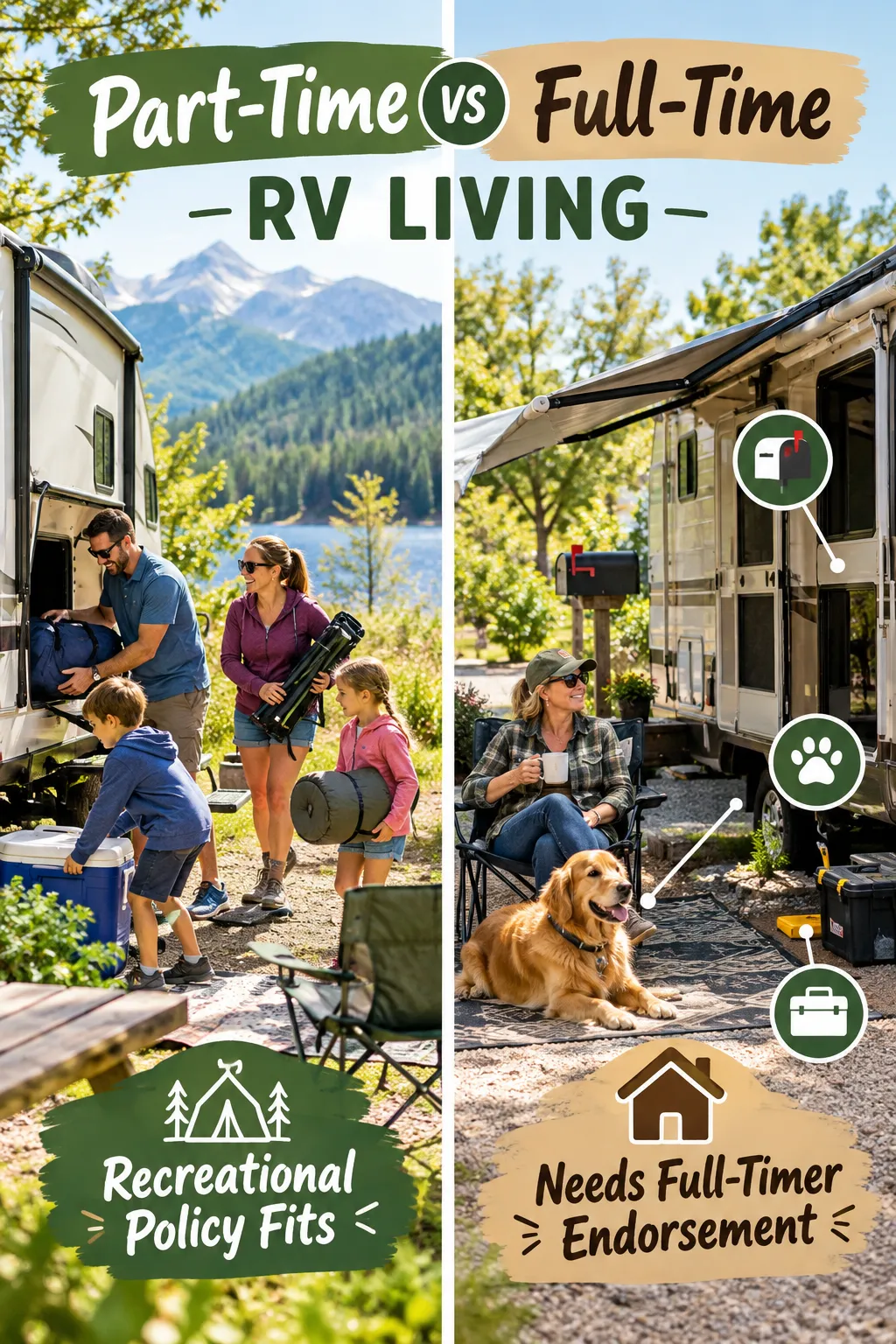
Full-timers face a unique set of gaps that part-time campers rarely think about:
- Minimal personal property protection. A recreational policy may barely cover the clothes and electronics that are your entire household [2][7].
- No campsite liability. Standard policies do not include coverage for injuries that happen where you actually live most of the year [2][3].
- No loss-of-use coverage. If your RV, which is also your home, goes into the shop after a covered claim, a standard policy usually will not pay for a place to stay while it’s repaired [2][7].
- Denied claims after disclosure. If an insurer discovers full-time use that was not disclosed, they can deny a claim even after years of paid premiums [4][7].
Decision rule: If you spend more nights in the RV than in a fixed home over the course of a year, call your insurer and ask directly whether your current policy is rated for full-time use. If the answer is no, you likely need a full-timer endorsement or a dedicated policy before your next trip.
Does RV Insurance Cover Accidents While Towing
RV insurance generally does cover accidents while towing, but only if the towable trailer is properly hitched, within its rated towing capacity, and covered under either the tow vehicle’s auto policy or a standalone RV policy at the time of the accident. Coverage can disappear the moment the trailer is detached and sitting at a campsite [3].
- While hitched and moving: Usually covered under the tow vehicle’s auto liability and, if purchased, collision coverage.
- While parked at a campground, detached: Often not covered unless you carry a dedicated RV policy that follows the trailer regardless of hitch status [3].
- While being towed outside your home state: Coverage generally follows you, but always confirm with your insurer before a long cross-country trip.
Common mistake: Assuming your auto policy protects the trailer the same way it protects your truck. Many auto policies only extend trailer coverage while it’s attached and moving, leaving a gap the second you unhitch at the campground [3].
RV Insurance for Older Model RVs
Older RVs can be harder and more expensive to insure because parts can be scarce, actual cash value is often lower than replacement cost, and some insurers limit comprehensive or collision coverage on rigs past a certain age [1][4]. This doesn’t mean older RVs are uninsurable, but it does mean owners need to check valuation terms closely.
- Actual cash value vs. agreed value: Standard policies usually pay actual cash value on older RVs, which depreciates fast and may leave you short after a total loss [1].
- Agreed value coverage, when available, locks in a set payout amount regardless of depreciation, which is worth asking about for a well-maintained older rig [4].
- Parts availability can slow down or complicate repairs on discontinued models, which some insurers factor into underwriting.
What Happens If You Underinsure Your RV
Underinsuring your RV means you could be left paying out of pocket for the gap between what your policy pays and what the RV, your belongings, or a lawsuit actually costs. This is the core reason RV insurance might be completely useless (check now) for owners who only bought the state-minimum liability package [2][5][9][10].
- A serious accident can quickly exceed a $25,000/$50,000 state-minimum liability limit, leaving you personally responsible for the rest [6][9].
- A total loss on an underinsured, older RV paid at actual cash value may leave you without enough money to replace it [1][4].
- Skipping personal property coverage means a fire or theft claim may pay for the RV shell but nothing inside it [2][9].
Example: Maryland requires liability coverage to register and tag a motorized RV but does not require comprehensive or collision. An owner who buys only the legally required minimum can have zero protection for their own vehicle or its contents [10].
How to File an RV Insurance Claim
Filing an RV insurance claim correctly starts with documenting the damage immediately, contacting your insurer promptly, and keeping every receipt and repair estimate before any repairs begin. Skipping these steps is a common reason claims get delayed or reduced.
- Document everything on-site. Take photos and video of the damage from multiple angles before moving or cleaning anything.
- Contact your insurer right away. Most policies have a reporting window, and waiting too long can weaken your claim.
- Get a written repair estimate from a licensed RV repair shop before authorizing any work.
- Keep your maintenance records handy. Insurers often check whether the damage was sudden and accidental versus the result of neglect.
- Ask directly what is and isn’t covered for your specific situation before you sign off on repairs.
- Follow up in writing and keep copies of every email and claim number.
Common mistake: Starting repairs before the adjuster reviews the damage. This can void or reduce the payout if the insurer cannot verify the original condition.
How to Get Cheaper RV Insurance Rates Without Creating New Gaps
The cheapest way to lower RV insurance rates is to compare multiple quotes with identical coverage limits, bundle policies with one insurer, raise your deductible only to a level you can actually afford, and avoid cutting coverage categories you genuinely need. Cutting the wrong corner is how RV insurance ends up being completely useless when you finally need it.
- Compare apples to apples. Request quotes from at least three insurers using the exact same liability, collision, and comprehensive limits [1][4].
- Bundle policies. Many insurers discount RV premiums when bundled with auto or home insurance.
- Raise your deductible carefully. A higher deductible lowers your premium, but only raise it to an amount you could pay in cash tomorrow.
- Keep safety and storage discounts in mind. Secure storage, safety courses, and clean driving records often unlock lower rates.
- Do not drop personal property or vacation liability just to save money if you regularly have guests at your campsite or store valuable items inside the RV [2][3].
Conclusion
RV insurance isn’t automatically useless, but a lot of policies are quietly built to cover far less than owners assume. The gaps hide in the fine print: state-minimum liability limits, excluded mechanical breakdowns, gradual water damage, detached-trailer blind spots, and full-time living exclusions [1][2][3][4][7]. The fix doesn’t require switching insurers today. It requires pulling out your current policy and checking five things: your liability limits, whether you have collision and comprehensive, whether you have personal property and vacation liability, whether your usage (full-time, rental, towing) matches what’s on file, and whether your RV’s value is covered realistically. Call your agent this week, ask for a plain-language breakdown of each coverage category, and fix any gap before your next trip, not after an accident.
FAQ
Does basic RV insurance cover theft? Basic liability-only RV insurance does not cover theft. Theft protection requires comprehensive coverage, which is an optional add-on in most states [2][5].
Is RV insurance required by law? Yes, liability insurance is required for motorized RVs in 49 states, with New Hampshire being the exception as of late 2026 [6][9][10].
Can I use my homeowners policy to cover my RV? Generally, no, unless the RV is parked on your own property, and even then coverage is usually limited. A homeowners policy is not a substitute for RV insurance while traveling [3][7].
Will my RV insurance cover living in it full-time? Standard recreational RV policies often exclude full-time living. You typically need a dedicated full-timer policy or endorsement if you live in the RV more than six months or 150 nights a year [4][7].
Does RV insurance cover water damage from a roof leak? Most standard RV policies exclude gradual water damage from slow leaks, failing seals, and resulting mold or rot [2].
What happens if I rent out my RV without telling my insurer? Personal RV insurance typically excludes commercial rental use, so a claim during a rental period can be denied if the insurer was never informed [6][8].
Does RV insurance cover mechanical breakdowns? No, mechanical breakdown, including engine, transmission, generator, and appliance failures, is almost always excluded from standard RV insurance policies [1][2][8].
Is a separate policy needed for a towable trailer? A towable trailer is often only covered under the tow vehicle’s auto policy while hitched and moving. A standalone RV policy is usually needed for protection while parked or detached [3].
References
[1] Best Rv Insurance Companies – https://rvivy.com/rv-insurance/best-rv-insurance-companies/ [2] Rv Insurance – https://www.insurance8020.com/rv-insurance/ [3] Help Clients With Common Rv Coverage Gaps – https://www.iamagazine.com/2024/03/11/help-clients-with-common-rv-coverage-gaps/ [4] Rv Insurance Guide – https://rvivy.com/rv-insurance/rv-insurance-guide/ [5] Rv Insurance – https://www.allstate.com/rv-insurance [6] Personal Rv Insurance – https://www.roamly.com/learning-center/personal-rv-insurance [7] Rv Insurance Guide Full Timers – https://www.mycamperfriend.com/journal/rv-insurance-guide-full-timers [8] Rv Rental Insurance Guide – https://www.bestrvrentalcompanies.com/blog/rv-rental-insurance-guide [9] What To Know About Rv Insurance – https://www.experian.com/blogs/ask-experian/what-to-know-about-rv-insurance/ [10] Recreational Vehicles – https://insurance.maryland.gov/Consumer/Pages/recreational-vehicles.aspx