
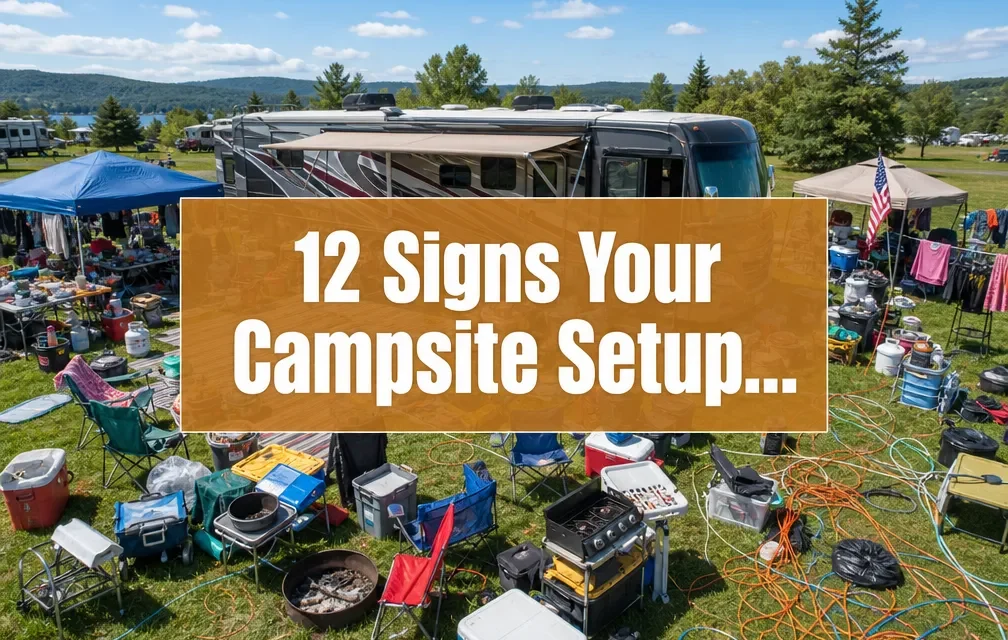
The average camper spends 47 minutes setting up camp, but overcomplicated setups can stretch that to three hours or more. If pulling into a campsite feels like assembling a small city, something has gone wrong. The 12 signs your campsite setup is way more complicated than it needs to be are surprisingly easy to miss, especially when each “helpful” item feels totally justified on its own.

This guide breaks down every warning sign in plain, simple terms. Whether you’re a weekend warrior or a full-time RV traveler, these red flags will help you spot the problem, and fix it fast.


Key Takeaways

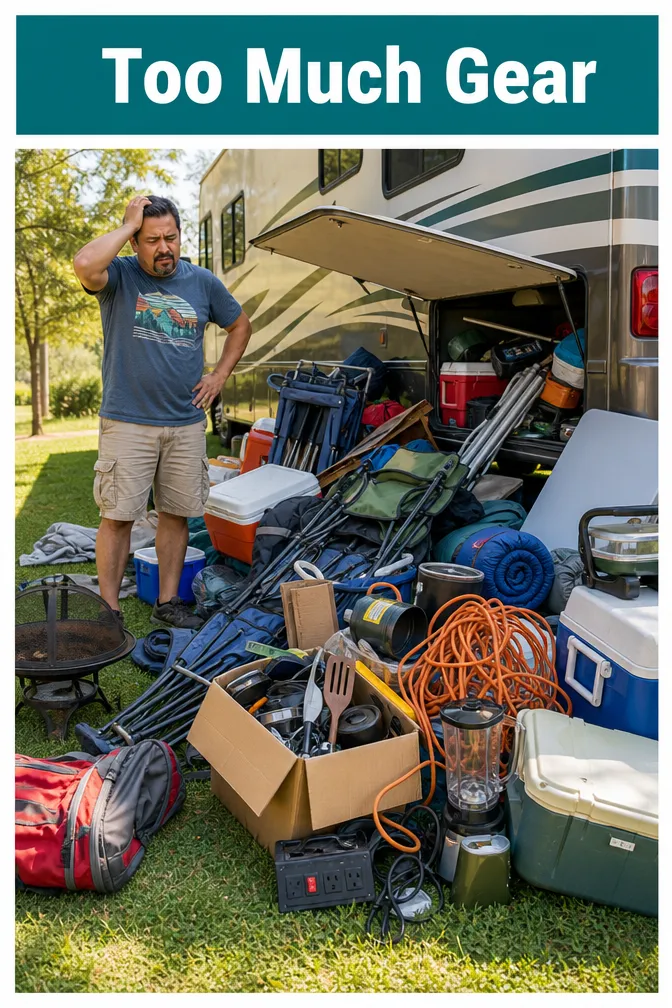
  • 🎒 Too much gear is the #1 cause of a messy, frustrating campsite
  • 🗺️ Poor planning before arrival leads to wasted time and disorganized spaces
  • 🪑 Excess furniture and elaborate cooking stations eat up valuable campsite real estate
  • 💡 Complicated lighting and shelter systems add stress without adding value
  • Simple, intentional setups make camping more fun and less work
Key Takeaways

Would you like to save this article?

We'll email this post to you, so you can come back to it later to read!

The First 6 Signs Your Campsite Setup Is Way More Complicated Than It Needs to Be

Sign 1: You’re Hauling More Gear Than You Actually Use 🎒

Walk through the campsite after setup. Count how many items haven’t been touched yet. If half the gear is still packed by the time you leave, that’s a big red flag.

Bringing too much equipment leads to a cluttered, inefficient campsite. Every extra item needs space, takes time to unpack, and has to be packed up again [1]. A good rule of thumb: if it hasn’t been used on the last three trips, leave it home.

Quick checklist, ask before packing each item:

  • Will this get used at least once per day?
  • Does something already packed do the same job?
  • Is it worth the setup and cleanup time?

If the answer to any of these is “no,” the item stays home.


Sign 2: Nothing Has a Specific Home 📦

Gear scattered everywhere is one of the clearest signs of an overcomplicated setup. When there are no defined storage zones, finding anything becomes a mini treasure hunt [2].

“A place for everything, and everything in its place.” This old saying is pure gold at a campsite.

Smart campers divide their site into clear zones:

Zone What Goes There
🍳 Cooking Zone Stove, fuel, utensils, food storage
🛏️ Sleeping Zone Bedding, pillows, personal items
🪑 Relaxation Zone Chairs, hammock, games
🔧 Gear Zone Tools, repair kit, extra supplies

When everything has a home, setup and teardown become much faster [2].


Sign 3: Site Selection Was an Afterthought 🗺️

Choosing a campsite without looking at the ground slope, drainage, or overhead hazards is a recipe for trouble. Waking up in a puddle because the site slopes toward a low spot, or getting hit by a falling branch, could have been avoided with a two-minute site check [3].

Before setting up, always check:

  • Is the ground level enough for sleeping?
  • Does water drain away from the site?
  • Are there dead branches overhead?
  • Is there enough shade or sun based on the weather forecast?

Ignoring site selection forces campers to make complicated fixes later, extra tarps, repositioned gear, emergency moves in the rain [3].


Sign 4: The Tent Takes Longer to Set Up Than Dinner 🏕️

Tents with dozens of poles, clips, and color-coded sleeves sound impressive in a store. At a campsite after a long drive, they’re a nightmare.

Complex tent assembly is one of the most common camping mistakes [4]. A tent that takes 45 minutes to pitch, especially in wind or fading light, adds unnecessary stress to the whole experience.

Signs the tent is too complicated:

  • The instructions are more than one page long
  • More than two people are needed to set it up
  • At least one pole gets mixed up every single time
  • The word “frustrating” comes to mind during setup

Modern pop-up and quick-pitch tents exist for a reason. Simpler is almost always better.


Sign 5: There’s No Setup Plan 📋

Arriving at a campsite without a clear layout plan leads to chaos. The RV gets parked, gear gets dumped, and then everyone figures it out as they go. The result? A disorganized mess that takes twice as long to fix [2].

A simple setup plan takes five minutes to sketch out but saves 30+ minutes of confusion. Think about:

  • Where does the RV or tent go?
  • Where’s the cooking area in relation to the fire pit?
  • Where do kids or pets have space to move freely?
  • Where does gear get stored out of the way?

Pro tip: 📝 Take a photo of a campsite layout that worked well. Use it as a template for future trips.


Sign 6: The Cooking Station Looks Like a Restaurant Kitchen 🍽️

A full spice rack, three cutting boards, a propane griddle, a camp oven, a coffee percolator, and a French press, all for a two-night trip?

Overcomplicated cooking arrangements waste time and space [5]. Multi-purpose cookware is the smarter choice. One good cast iron skillet can fry eggs, sear meat, and bake cornbread. A single pot can boil water for coffee, cook pasta, and heat soup.

Simple swaps that work great:

  • ☕ Instant coffee packets instead of a full coffee setup
  • 🥘 One-pot meals instead of multi-course cooking
  • 🔪 One good knife instead of a full knife block
  • 🍳 A single multi-use pan instead of a full cookware set

The goal is to eat well without turning the campsite into a catering operation [5].


Sign 6: The Cooking Station Looks Like a Restaurant Kitchen 🍽️

The Last 6 Signs Your Campsite Setup Is Way More Complicated Than It Needs to Be

Sign 7: There Are More Chairs Than People 🪑

It sounds funny, but it happens all the time. Three people arrive at a campsite and set up eight folding chairs, two camp tables, a hammock stand, and a side table for snacks.

Excess furniture clutters the campsite and makes movement difficult [6]. It also means more time setting up, more time breaking down, and more storage space used in the RV.

The simple rule: Bring one seat per person, plus one extra. That’s it.


Sign 8: Weather Was Never Factored In 🌧️

Setting up without checking the weather forecast is one of the most avoidable camping mistakes. Pitching a tent in a low-lying area during rain season, or parking an RV awning facing into strong winds, creates problems that are hard to fix mid-trip [3].

Weather-smart setup tips:

  • ✅ Check the 3-day forecast before leaving home
  • ✅ Face the RV door away from prevailing winds
  • ✅ Avoid setting up under trees during storm season
  • ✅ Keep a small tarp ready for unexpected rain

Failing to plan for weather often means scrambling to add complicated fixes, extra guy lines, emergency tarps, last-minute moves, that wouldn’t have been needed with a little forethought [3].


Sign 9: Critical Gear Is Buried or Blocked 🔧

If the water pump, electrical hookup, or propane valve is blocked by a stack of gear, that’s a problem waiting to happen. Overlooking maintenance access is a classic mistake in any mobile living setup [7].

When critical components aren’t easy to reach, small issues become big ones fast. A minor propane adjustment shouldn’t require moving six bags and a folding table.

Access points to always keep clear:

  • 🔌 Electrical connections and shore power hookups
  • 💧 Water inlet and outlet valves
  • 🔥 Propane tanks and regulators
  • 🔩 Tire access and leveling jacks

Keep a clear path to anything that might need attention during the trip [7].


Sign 10: The Lighting Setup Has More Wires Than a Concert Stage 💡

String lights along the awning, lanterns on every table, spotlights near the fire pit, and a headlamp charging on a solar panel, it adds up quickly.

Complex lighting systems take time to set up and often don’t deliver better light than a simple solution [6]. A single bright lantern in the center of the campsite handles most lighting needs. Clip-on book lights, rechargeable headlamps, and one good string of LED lights cover everything else.

Signs the lighting is too complicated:

  • Setup takes more than 10 minutes
  • There are more than three separate light sources
  • Extension cords are involved
  • Someone trips over a wire before dinner

Simple, battery-powered or rechargeable LED lighting is almost always enough [6].


Sign 11: Ventilation Was Never Considered 🌬️

This one catches a lot of RV campers off guard. Parking with no airflow consideration, or closing up a tent without thinking about condensation, leads to a stuffy, damp sleeping space [7].

Poor ventilation planning means waking up to wet gear, foggy windows, and that musty smell that takes days to air out.

Easy ventilation fixes:

  • Park the RV so cross-breezes can flow through open windows
  • Crack roof vents even on cooler nights
  • Avoid pitching a tent in a completely enclosed hollow
  • Use a small battery-powered fan inside the tent or RV

A little airflow planning at setup time prevents a lot of discomfort later [7].


Sign 12: The Shelter Setup Has No Clear Purpose 🏗️

A tarp over the picnic table, a second tarp over the gear pile, a canopy over the cooking area, and a shade sail between two trees, each one seemed like a good idea, but together they’ve turned the campsite into a maze.

Overly complex shelter configurations reduce usability and make the campsite feel cramped [3]. Before setting up any shelter, ask: What specific problem does this solve?

If the answer is vague, skip it. One well-placed tarp or canopy that covers the cooking and eating area is usually all that’s needed. Everything else is extra work for minimal benefit [3].


How to Simplify a Campsite Setup (Without Giving Up Comfort)

Recognizing the signs is step one. Here’s how to actually fix the problem:

🗂️ The “One Trip Rule”
Everything needed for the campsite should fit in one trip from the RV or car to the site. If it takes multiple trips just to unload, too much has been brought.

📦 Use a Gear Audit System
After every trip, set aside any item that was never used. Before the next trip, those items don’t get packed unless there’s a specific reason.

🗺️ Pre-Plan the Layout
Sketch a simple campsite layout before arriving. Assign zones for sleeping, cooking, relaxing, and storage. Stick to the plan.

🛠️ Invest in Multi-Use Gear
One item that does three jobs beats three items that each do one job. Look for cookware, tools, and furniture that serve multiple purposes.

⏱️ Time the Setup
Set a goal: full campsite setup in 30 minutes or less. If it’s taking longer, something needs to be cut or simplified.


Conclusion

The 12 signs your campsite setup is way more complicated than it needs to be are easy to overlook, especially when every piece of gear feels essential in the moment. But the best camping experiences come from simplicity, not complexity.

Here are the actionable next steps to take right now:

  1. Do a gear audit before the next trip, cut anything unused in the last three outings
  2. Sketch a campsite layout with defined zones before leaving home
  3. Check the weather forecast and plan the setup around it
  4. Replace multi-item solutions with one multi-use alternative
  5. Time the next setup and aim to cut it by 20 minutes

A simpler campsite means less stress, more fun, and more time doing what camping is actually about, relaxing, exploring, and enjoying the outdoors. Start small, cut one thing from the packing list, and see how much better the whole experience feels.


References

[1] Fix Heavy Messy Camping Setup – https://campinggears.ph/fix-heavy-messy-camping-setup/?utm_source=openai

[2] How To Organize A Campsite – https://campcomfortguide.com/how-to-organize-a-campsite/?utm_source=openai

[3] How To Set Up A Campsite – https://camphewn.com/articles/camping/campsite-setup/how-to-set-up-a-campsite/?utm_source=openai

[4] Common Camping Mistakes – https://www.advnture.com/how-to/common-camping-mistakes?utm_source=openai

[5] Campsite Organization – https://www.rei.com/learn/expert-advice/campsite-organization.html?related-style-id=C05341&utm_source=openai

[6] Campsite Organization – https://www.rei.com/learn/expert-advice/campsite-organization?related-style-id=229805&utm_source=openai

[7] 12 Common Campervan Conversion Mistakes And How To Avoid Them – https://thevanbuild.co.uk/blogs/campervan-conversion-faq/12-common-campervan-conversion-mistakes-and-how-to-avoid-them?utm_source=openai