
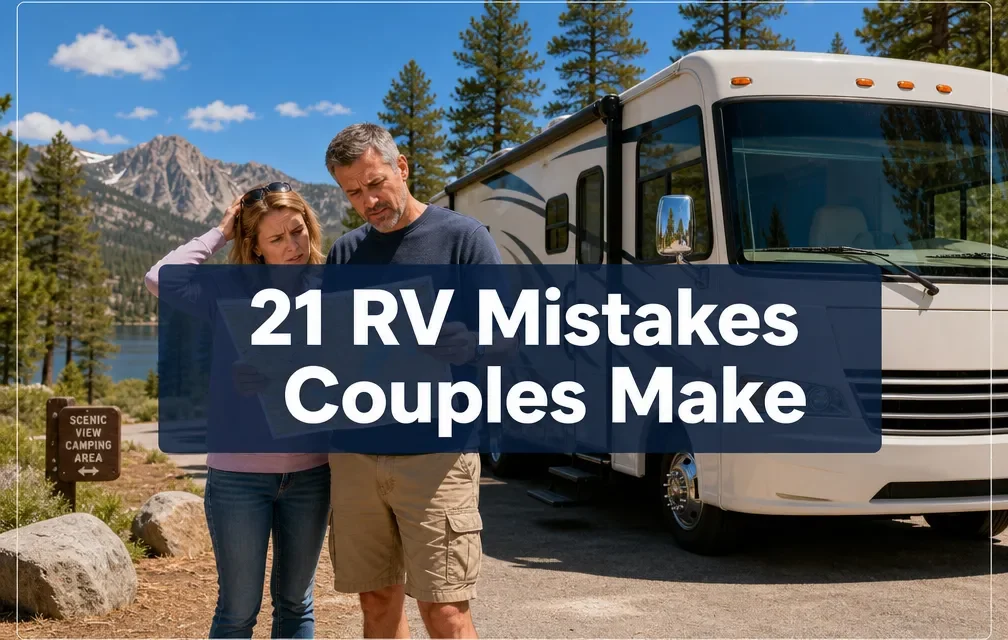
Nearly 40% of couples who try RV travel together say their first long trip caused serious tension, and most of those conflicts were completely avoidable. The open road sounds romantic. The reality? It can be a crash course in communication, patience, and logistics. The good news is that knowing the 21 RV mistakes couples make on their first long trip together can save a relationship AND a vacation.
This guide breaks down every major pitfall, from picking the wrong rig to forgetting the toilet paper, so couples can skip the drama and get straight to the adventure. 🚐💨
Key Takeaways
- Planning gaps cause most first-trip disasters, route, budget, and campsite reservations matter more than people think.
- Choosing the wrong RV size is one of the most common and costly mistakes new couples make.
- Dividing responsibilities before leaving home prevents most on-road arguments.
- Mechanical basics like tire pressure and water hookups should be learned BEFORE departure, not during.
- Flexibility and humor are the two most underrated tools any couple can pack.
Would you like to save this article?
The Planning Mistakes That Derail First Trips
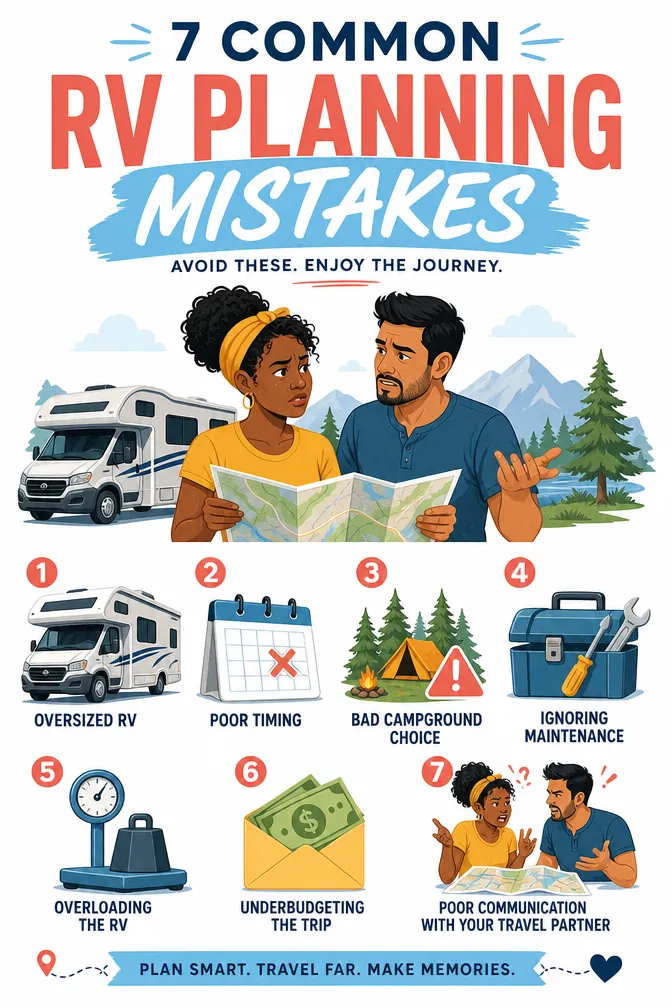
A huge chunk of the 21 RV mistakes couples make on their first long trip together happen before the engine even starts. Poor planning sets a trip up to fail fast.
Mistake 1: Picking an RV That’s Too Big (or Too Small)
This is the number one rookie error. A giant Class A motorhome sounds amazing until someone has to park it at a crowded campsite. On the flip side, a tiny van conversion feels cozy until day four when both people need space.
💡 Pro tip: Rent before buying. Try a 24-foot Class C for a first trip. It’s manageable to drive but still has real amenities.
Quick RV Size Guide:
| RV Type | Best For | Watch Out For |
|---|---|---|
| Class A (35-45 ft) | Long hauls, luxury | Hard to park, expensive |
| Class C (22-32 ft) | First-timers | Moderate driving skill needed |
| Travel Trailer | Budget-friendly | Need a tow vehicle |
| Van Conversion | Adventure seekers | Very limited space |
Mistake 2: Not Making Campsite Reservations
Showing up without a reservation at a popular campground in summer? That’s a recipe for sleeping in a Walmart parking lot. Top campgrounds book out months in advance.
Always reserve:
- National Park campgrounds (book 6 months ahead)
- State park sites near cities
- Holiday weekend spots
Mistake 3: Planning Too Many Miles Per Day
Many couples map out 400-mile driving days. After hour six, nobody is having fun. A good rule: 150-200 miles per day maximum on a first trip. This leaves time to explore, rest, and actually enjoy the journey.
Mistake 4: Skipping the Test Drive
Driving a 30-foot vehicle for the first time on a highway is terrifying. Practice in an empty parking lot first. Practice backing up. Practice turning. Seriously, do this.
Mistake 5: Ignoring Weight Limits
Every RV has a Gross Vehicle Weight Rating (GVWR). Overloading causes tire blowouts and brake failures. Weigh the loaded RV at a truck stop scale before the trip. This step saves lives.
Mistake 6: Not Setting a Realistic Budget
RV trips are not automatically cheap. Fuel, campsite fees, food, and repairs add up fast. Here’s a rough daily cost estimate for a couple:
| Expense | Estimated Daily Cost |
|---|---|
| Fuel | $40,$80 |
| Campsite | $30,$60 |
| Food & Groceries | $40,$60 |
| Activities | $20,$50 |
| Total | $130,$250/day |
Build in a 20% buffer for unexpected costs. RVs break down. It happens.
Mistake 7: Not Reading the RV Manual
The manual covers how to use the water pump, the generator, the slide-outs, and the black tank. Skipping it means learning everything the hard way, usually at 10 PM in the dark.
Mistake 8: Forgetting to Check Campground Height Restrictions
Bridges, tunnels, and campground entrances have height limits. A Class A motorhome can be 13 feet tall. Always check clearances on the route. Use a GPS app designed for RVs, like RV Trip Wizard or CoPilot RV.
Mistake 9: Packing Way Too Much Stuff
Every couple overpacks on the first trip. The RV has limited storage and limited weight capacity. Pack clothes for half the number of days planned, then do laundry. Leave the “just in case” items at home.
Things to leave behind:
- Full-size hair dryers (use the campground’s)
- Multiple sets of dishes
- Books (use a Kindle)
- Decorative items
Mistake 10: Not Having an Emergency Kit
Flat tires, dead batteries, and broken water lines happen. Pack a basic emergency kit:
- ✅ Jumper cables or jump starter
- ✅ Tire pressure gauge + portable inflator
- ✅ Basic tool kit (screwdrivers, pliers, duct tape)
- ✅ First aid kit
- ✅ Flashlight + extra batteries
- ✅ RV-specific fuses and light bulbs
The Relationship Mistakes That Cause On-Road Arguments
The second half of the 21 RV mistakes couples make on their first long trip together are all about people, not vehicles. Living in a tiny space 24/7 is a real test.
Mistake 11: Not Dividing Responsibilities Before Leaving
Who drives? Who navigates? Who sets up camp? Who cooks? Who handles hookups? If these questions aren’t answered before the trip, they become arguments during the trip.
Create a simple job chart:
| Task | Person A | Person B |
|---|---|---|
| Driving | ✅ | Backup |
| Navigation | ✅ | |
| Camp Setup | ✅ | ✅ (together) |
| Cooking | Alternate | Alternate |
| Hookups/Utilities | ✅ | |
| Grocery Shopping | ✅ |
Mistake 12: Assuming Both People Want the Same Itinerary
One person wants to hike every day. The other wants to sit by the campfire and read. This conflict ruins trips. Talk about priorities BEFORE leaving. Build in solo time and compromise activities.
Mistake 13: Not Establishing “Alone Time” Rules
Living in 200 square feet together is intense. Even couples who love each other need breathing room. Agree on signals for needing space, like a walk alone or headphones on = “I need quiet time.”
🗣️ “The couples who thrive on RV trips are the ones who talk about feelings before they become frustrations.”, Common advice from full-time RVers
Mistake 14: Fighting About Driving Style
One person drives too fast. The other brakes too hard. The passenger keeps gasping. This is extremely common and extremely annoying. Set ground rules: the driver drives, the passenger navigates calmly. No backseat driving.
Mistake 15: Not Learning Basic RV Systems Together
Both people should know how to:
- Connect water and electric hookups
- Empty the black and gray tanks
- Light the propane pilot light
- Use the leveling jacks
If only one person knows these things, the other feels helpless, and resentful.
Mistake 16: Neglecting the Black Tank Until It’s an Emergency
The black tank holds sewage. Ignoring it until it’s full is a nightmare. Check it daily. Empty it every 2-3 days at a dump station. Use RV-safe toilet paper only. Never put anything else down the toilet.
Black Tank Rules:
- ✅ RV-safe toilet paper ONLY
- ✅ Use tank treatment chemicals
- ✅ Empty before it hits 75% full
- ❌ No paper towels, wipes, or feminine products
Mistake 17: Skipping the Pre-Trip Walkthrough Together
Before driving away, both people should walk around the RV and check:
- All slide-outs are retracted
- Awning is rolled up
- All exterior compartments are latched
- Stabilizer jacks are up
- TV antenna is down
- Steps are retracted
Missing one of these causes expensive damage. Make a physical checklist and use it every single time.
Mistake 18: Relying Solely on Cell Service for Navigation
Cell service disappears in rural areas and national parks. Download offline maps (Google Maps, Maps.me) before leaving. Keep a paper atlas in the RV. Yes, a real paper atlas. It works everywhere.
Mistake 19: Not Budgeting for “Fun Money” Separately
Money fights are relationship killers. Set aside a shared trip fund AND give each person a small personal spending budget. This prevents arguments over “you spent $40 on souvenirs again.”
Mistake 20: Ignoring Weather Forecasts
RVs are not great in severe weather. High winds can flip a travel trailer. Lightning is dangerous at open campsites. Check the weather every morning. Have a backup plan. Know where the nearest solid shelter is.
Weather warning signs to watch:
- ⚠️ Wind gusts over 40 mph (especially for tall rigs)
- ⚠️ Flash flood warnings in canyon areas
- ⚠️ Tornado watches in the Midwest
- ⚠️ Ice on mountain roads
Mistake 21: Not Celebrating Small Wins Together
This one sounds soft, but it matters. Successfully backing into a tight campsite? Celebrate it. Made it through a mountain pass? High five. First successful dump station run? That’s a milestone. 🎉
Couples who laugh together on the hard moments bond faster than those who stress through them. The whole point of the trip is to make memories together.
Conclusion
Avoiding the 21 RV mistakes couples make on their first long trip together comes down to two things: preparation and communication. Most problems on the road start at home, with poor planning, unclear expectations, or skipped training.
Here are the most important next steps before hitting the road:
- Rent an RV first, try before buying to find the right size.
- Make a pre-trip checklist, and use it every single morning.
- Divide responsibilities clearly, write them down before leaving.
- Learn the systems together, both partners should know hookups and tank management.
- Build in flexibility, leave room in the itinerary for surprises.
- Talk about expectations, driving style, alone time, budget, and daily goals.
The first long RV trip as a couple will have bumps. That’s guaranteed. But with the right prep, those bumps become funny stories instead of relationship scars. Pack light, plan smart, and enjoy every mile. 🚐❤️
References
- Kampgrounds of America (KOA). (2023). North American Camping & Outdoor Hospitality Report. KOA.com.
- Recreation Vehicle Industry Association (RVIA). (2022). RV Industry Annual Report. RVIA.org.
- Outdoorsy. (2021). The State of RV Travel Report. Outdoorsy.com.
- Mortons on the Move. (2022). Full-Time RV Living Guide for Beginners. MortonsOnTheMove.com.
- National Park Service. (2023). Campground Reservation Guidelines. NPS.gov.


