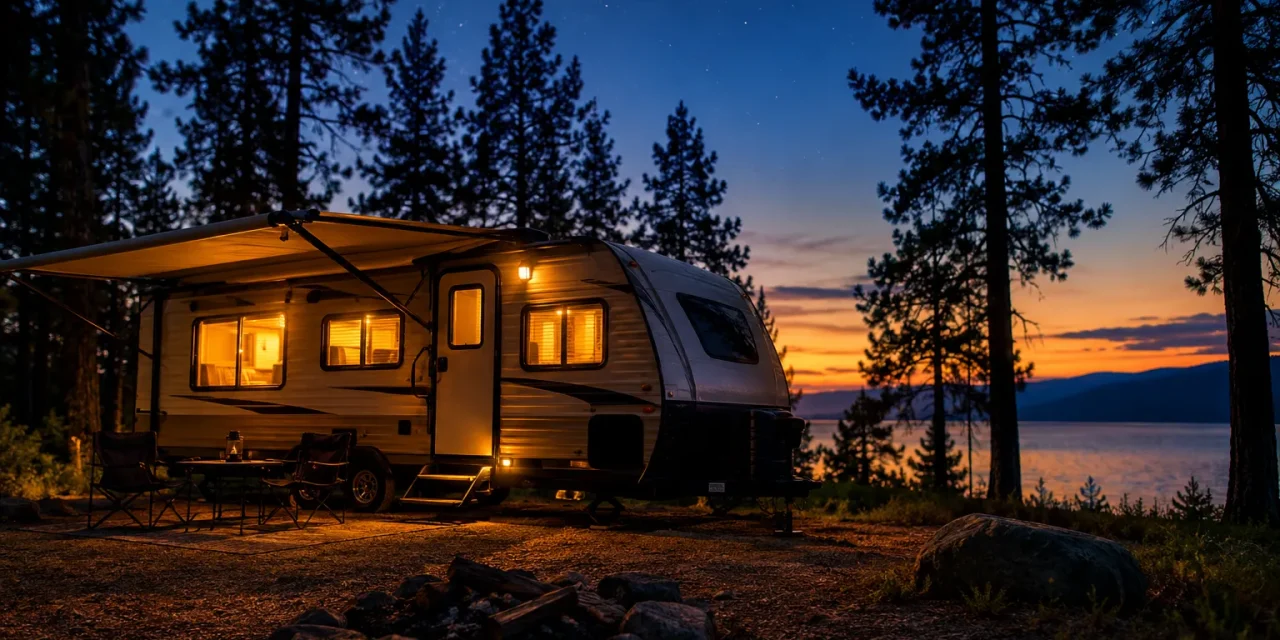
One out of every three RV trips runs late. A missed exit, a slow gas station line, or traffic on a two-lane highway can turn a 6 p.m. arrival into a 10 p.m. scramble. That single hour can mean the difference between a calm night under the stars and a stressful hunt for a gate code in the dark.
These 13 Late-Arrival Campground Tips That Save You From Instant Stress are built from real advice used by RV parks and campers across the country, and they work because they focus on one simple goal: get parked, get quiet, and get to sleep without waking anyone up.
Arriving late does not have to feel like an emergency. With a little planning, it can feel just as easy as pulling into your own driveway. This guide walks through exactly what to do before you leave, while you drive, and the moment you roll into the campground after dark.
Key Takeaways
- 📞 Call the campground the moment you know you’ll be late to get gate codes, quiet hours, and after-hours steps.
- 🗺️ Study your site map and route before dark so you never guess which turn to take with a big rig.
- 🔋 Pack strong, hands-free lights so you never have to use blinding headlights near sleeping neighbors.
- 🛏️ Do only “essential setup” at night, park, plug in, sleep, and finish leveling and hookups in the morning.
- 🧺 Always have 2-3 backup camping spots ready in case your first choice is full when you arrive.
What Makes Late Arrivals So Stressful for RV Campers
Late arrivals feel scary for a simple reason: everything is harder in the dark. Roads look different. Signs are harder to read. Neighbors are already asleep. And most campers feel guilty for showing up “too late,” even when it was not their fault.
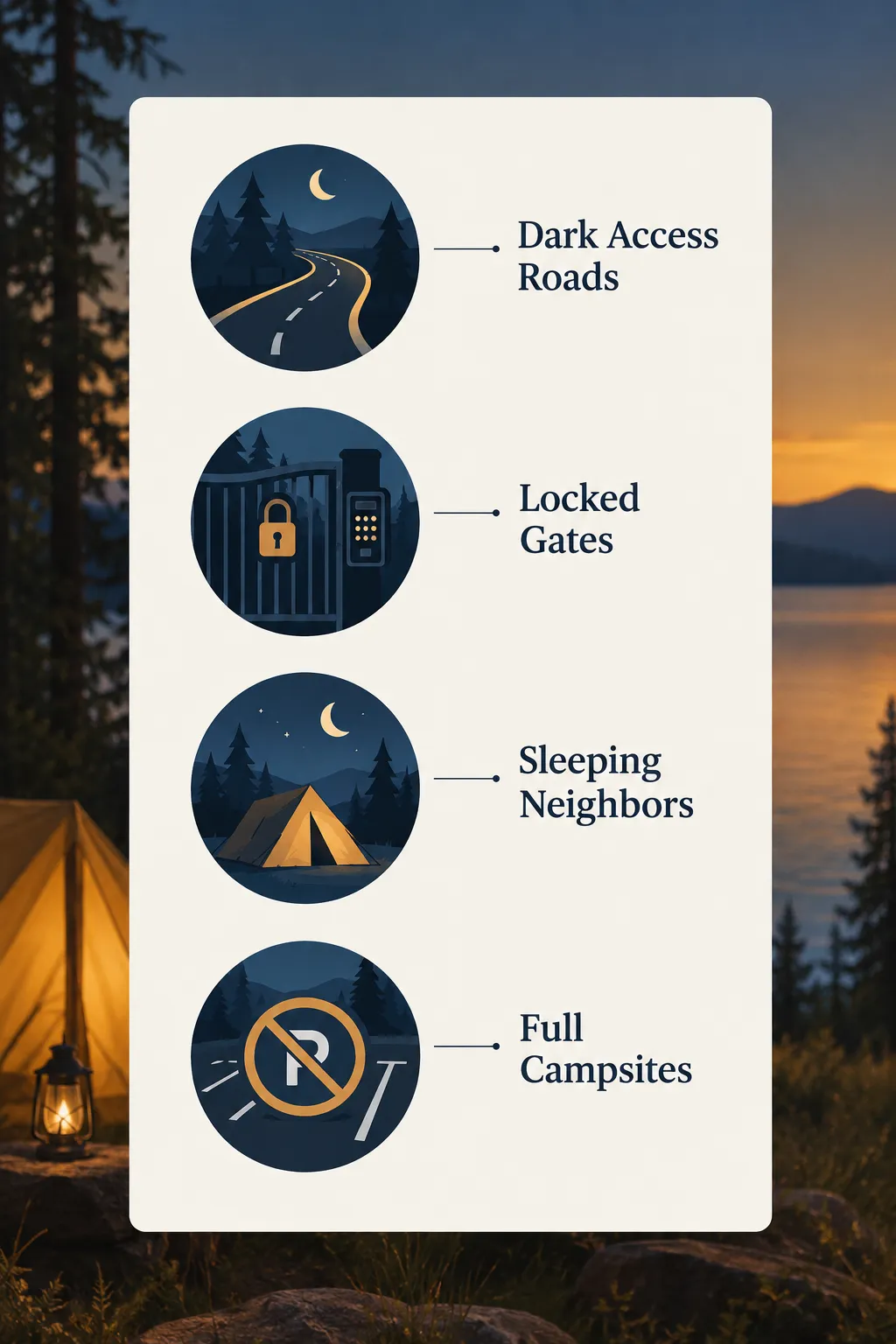
Campground guides agree that the biggest stress points are almost always the same four things: not knowing the check-in rules, not knowing the road, making too much noise, and not knowing where to sleep if the site is full [1][3]. The good news is that all four of these problems have simple fixes. Once you know the fixes, a late arrival becomes just another normal part of the trip, not a crisis.
“A late arrival is not a failure. It’s just a different kind of night, and it only takes a few extra steps to make it a smooth one.”
Below is the full list of 13 Late-Arrival Campground Tips That Save You From Instant Stress, grouped by when you should use them: before you leave, on the road, at the campsite, and as a backup plan.
The Full List: 13 Late-Arrival Campground Tips That Save You From Instant Stress
These tips are listed in the order you would actually use them, starting at home, before your wheels ever touch the road.
1. Call the Campground as Soon as You Know You’ll Be Late
The very first thing to do is pick up the phone. Do not wait until you are five minutes away. Call the moment you realize you might be behind schedule [4][6]. Ask about:
- The gate code or lock box code
- After-hours check-in steps
- Whether your site number might change
- Any self-registration forms you need to fill out
Campgrounds want this call. It helps them help you [1]. A quick five-minute phone call can erase an hour of confusion later.
2. Confirm Your Exact Arrival Window in Writing
Most booking confirmations, park websites, and pre-arrival emails now list a clear arrival window, such as “check-in after 2 p.m.” or “office closes at 9 p.m.” [5][9][10]. Read this window carefully before you leave home. If your trip will push you past that window, that’s your cue to call ahead (see Tip #1) and ask what to do instead of guessing.
Many campgrounds send a message two to three days before your stay that repeats these steps [5][9]. Do not skip reading it, even if you think you already know the rules.
3. Learn the Quiet Hours and Rules Before You Travel
Almost every campground has quiet hours, and many start around 10 p.m. [3]. Some parks even ban setting up a tent or RV after a certain hour completely. Others limit generator use or campfires at night [3].
Knowing these rules before you are standing in the dark saves you from breaking a rule you didn’t know existed. It also keeps you from waking up a camp host at 11 p.m. asking basic questions.
| Rule to Check | Why It Matters |
|---|---|
| Quiet hours start time | Avoids noise complaints |
| Generator use hours | Some parks ban night generator use |
| Campfire rules after dark | Many parks ask you to wait until morning |
| Office closing time | Tells you if self check-in is needed |
4. Download or Print Your Campground Map
Cell signal often disappears right when you need it most, deep in a forest or canyon. Before you leave, download or print a map of the campground [3][4]. Confirm your exact site number ahead of time so you are not circling loops in the dark looking for a number that doesn’t match your reservation.
5. Preview the Route for Tight Turns and Low Branches
Big rigs and tight campground roads do not always mix well. Review your driving route in daylight hours using satellite view or trip-planning apps [4]. Look for narrow bridges, sharp turns, and low tree branches that could scrape your roof.
6. Walk the Entrance First If You Arrive After Dark
If you pull up to a campground entrance after the sun is gone, put the rig in park and walk the road first [7]. A short walk with a flashlight lets you spot potholes, low branches, or narrow spots before you risk your RV on them. This single habit prevents most late-night driving accidents in campgrounds.
7. Pack Strong, Hands-Free Lighting Before You Even Leave Home
Headlamps beat flashlights because they leave your hands free to unlock doors and carry gear [2][3]. Pack:
- A headlamp with fresh batteries for each adult
- A backup lantern for the picnic table area
- Extra batteries stored somewhere easy to find
The goal is simple: never rely on your vehicle’s headlights to set up camp. Bright headlights pointed into a neighbor’s window at midnight is one of the fastest ways to start a trip on the wrong foot [2][3].
8. Practice Your Setup at Home in Daylight
This tip sounds simple, but it saves the most stress. Practice putting up your tent or running through your RV setup steps at home, in your own yard, in full daylight [2][4][6]. When you know the steps by heart, doing them in the dark takes half the time and none of the guesswork.
9. Do Only “Essential Setup” at Night
Here is the golden rule for any late arrival: only set up what you need to sleep. [4][6]
That means:
- Park the rig safely and level enough to sleep
- Plug into electricity if you need it for heat, AC, or lights
- Set up beds or sleeping bags
- Skip full leveling, sewer hookups, and water connections until morning
Everything else, awnings, full hookups, chair setups, outdoor rugs, can wait until sunrise when you can see clearly and everyone is well rested [2][4][6].
10. Keep Every Noise as Quiet as Possible
Turn off your engine the moment you’re parked instead of letting it idle [3][14 removed]. Skip power drills for stabilizers and use hand cranks instead [4][6]. Keep voices at a whisper, skip the music, and save the campfire and card games for the next evening [3][4][6].
A helpful trick: get kids changed into pajamas and brushing teeth before you reach the campground, while still in the vehicle [3]. This way, they can go almost straight from car seat to bed with barely a sound.
11. Secure Food and Scented Items Immediately
It is tempting to leave the cooler outside “just for tonight” and deal with it in the morning. Do not do this [3][9]. Wild animals are most active at night, and an unattended cooler or bag of snacks can turn into an unwanted visitor within minutes. As soon as you park:
- Move food, coolers, and trash into the RV or a bear box
- Store scented toiletries out of reach
- Zip tent doors and secure gear right away
12. Use the Campground’s Tech Tools to Speed Things Up
Many campgrounds now use automated gate codes, self-check-in kiosks, and digital reservation lookups that can pull up your booking in under 10 seconds [9][10]. Before you travel, make sure you know:
- Whether a code is texted or emailed to you
- If there is a kiosk for late walk-ins
- Whether staff pre-stage printed maps for late arrivals during busy afternoon check-in windows [10]
Using these tools instead of guessing saves precious minutes when you are tired and just want to park.
13. Keep 2-3 Backup Campground Options Ready
Especially at popular or first-come, first-served campgrounds, sites can fill up before you even arrive [8]. Always have two or three backup options mapped out, along with knowledge of nearby dispersed camping areas, such as public land boundaries where camping is allowed [8]. Checking user-reported camping apps ahead of time helps you avoid scrambling through unfamiliar terrain after dark [8].
A Quick-Reference Table for Late-Arrival Campground Tips
Keep this simple table handy on your phone for your next trip.
| Situation | What To Do |
|---|---|
| Running more than 1 hour late | Call the campground right away |
| Arriving after quiet hours | Skip music, tools, and full setup |
| No cell signal on arrival | Rely on your downloaded map |
| Kids are tired and cranky | Change them into pajamas in the car |
| Site is already taken | Use your backup list or dispersed camping option |
| Cooler still in the truck | Move it into secure storage immediately |
Backup Plans When Late-Arrival Campground Tips Aren’t Enough
Even with perfect planning, sometimes a site is simply gone by the time you arrive. This is where your backup list becomes priceless [8]. Keep addresses, phone numbers, and rough directions to two or three alternate campgrounds saved offline. If those are full too, knowing the boundaries of nearby public dispersed camping areas gives you one more safety net [8].
A few extra habits that help in a true “no site left” situation:
- 🚗 Never keep driving deep into unfamiliar dirt roads at night just to search for a spot.
- 🔋 Keep your phone charged with offline maps saved before you lose signal.
- 🏕️ If truly stuck, many rest stops and 24-hour big-box store lots allow safe overnight parking for one night in a pinch.
Why These 13 Late-Arrival Campground Tips That Save You From Instant Stress Actually Work
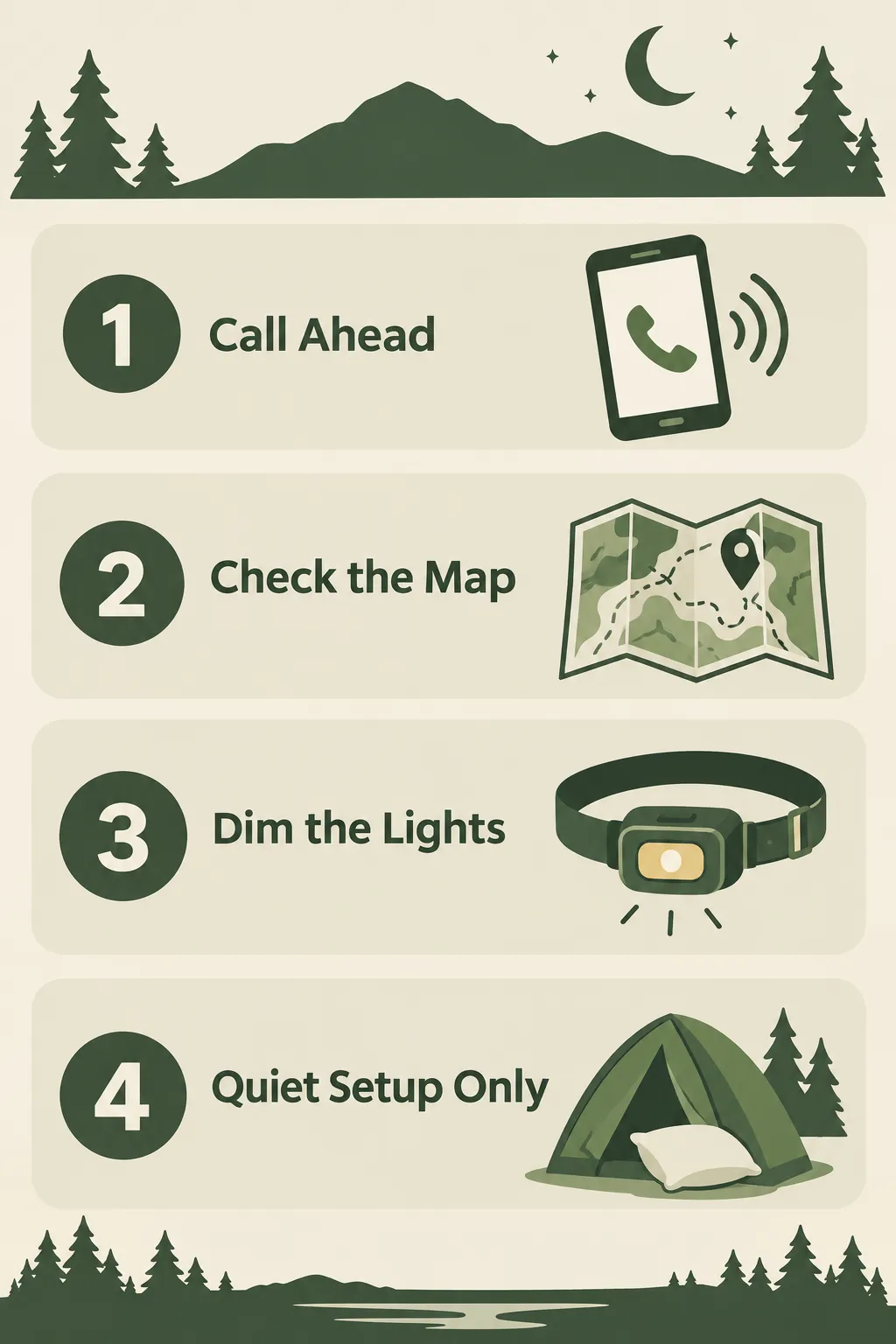
Every tip on this list follows the same four ideas that show up again and again in modern camping guides: call ahead, know the rules, keep setup small, and stay extra polite at night [3][4][6]. These four pillars work because they remove the guesswork that causes stress in the first place.
When you call ahead, you are never stuck outside a locked gate. When you know the rules, you never accidentally break one. When you keep setup small, you get to bed faster and rested for the morning. And when you stay quiet and polite, you protect the peaceful night that everyone else at the campground is also trying to enjoy.
Late arrivals will always happen. Traffic, weather, and long drives are part of RV life. But stress does not have to be part of the package. With this checklist saved on your phone, a 10 p.m. arrival can feel just as smooth as a 2 p.m. one.
Conclusion
Late arrivals are a normal part of RV travel, not a personal failure. The real secret is preparation done before you ever start the engine: knowing the rules, packing the right lights, practicing setup, and keeping a backup plan in your back pocket. Once those pieces are in place, a dark, quiet drive into camp becomes simple instead of stressful.
Before your next trip, save this list of 13 Late-Arrival Campground Tips That Save You From Instant Stress to your phone. Print the campground map, charge your headlamp, and pick two backup sites just in case. The next time you roll in after sunset, you will park, plug in, and sleep, calm, quiet, and ready for a great morning.
References
[1] Late Arrival At Campgrounds – https://letsrv.com/late-arrival-at-campgrounds/
[2] Night Camping Tips – https://tentcampingpro.com/night-camping-tips/
[3] Campsite Night – https://www.thorindustries.com/stories/campsite-night
[4] Late Arrival Rv Parks – https://rvlife.com/late-arrival-rv-parks/
[5] Campsite Late Arrivals Guide – https://www.campsuite.net/blog/2026/campsite-late-arrivals-guide/
[6] Late Night Campground Arrival – https://www.getawaycouple.com/late-night-campground-arrival/
[7] Late Night Campground Check In – https://rvliving.com/late-night-campground-check-in/
[8] Outsmart Summer Camping Crowds – https://www.doityourselfrv.com/outsmart-summer-camping-crowds/
[9] Essential Tips For Smooth Camping Check In And Check Out – https://gathergroundsresorts.com/essential-tips-for-smooth-camping-check-in-and-check-out/
[10] Campground Checkin How To Handle Peak Arrivals – https://www.pitchcampmanagement.com/docs/blogs/2026/campground_checkin_how_to_handle_peak_arrivals/