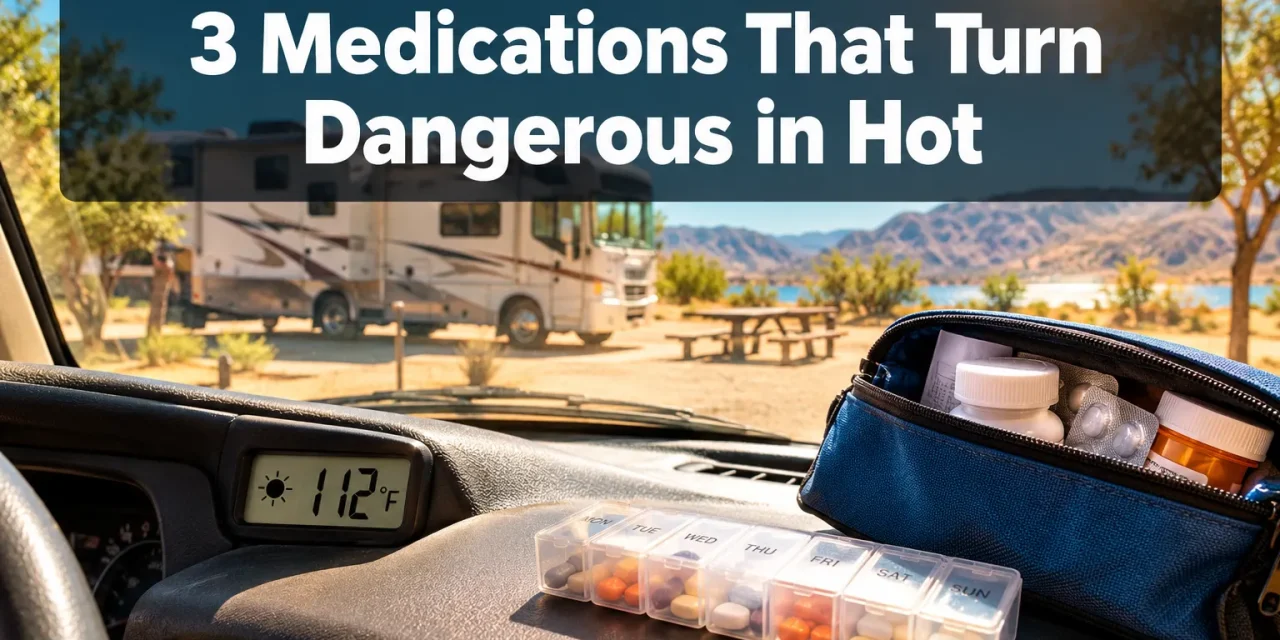
A closed-up RV can hit 150°F in under an hour, even on a mild 85°F day. That’s hotter than most ovens set to “warm.” Now picture a bottle of insulin sitting on the counter, or an EpiPen tucked in a glovebox drawer. Within minutes, these life-saving medications can start breaking down, and the person depending on them may never know it happened until it’s too late.
That’s the hidden danger behind 3 Medications That Turn Dangerous in Hot RVs. RV life means sunny days, long drives, and campgrounds far from the nearest pharmacy. But it also means medicine cabinets that heat up fast and cool down slow. This guide breaks down which medications are most at risk, why heat wrecks them, and exactly how to keep your family’s medicine safe on the road.
Key Takeaways
- 🌡️ RV interiors can reach damaging temperatures in under 15 minutes, even with windows cracked [1][5].
- 💉 Insulin, EpiPens, and inhalers are the top 3 medications that turn dangerous in hot RVs because heat breaks down their active ingredients or damages their containers [2][3].
- ⚠️ Heart, blood pressure, and some psychiatric medications can make the body worse at handling heat, a double danger for RVers [2][6].
- 🧊 Simple fixes like insulated bags, coolers, and dashboard shades can protect medications during travel and camp stops [4][9].
- 📞 If a medication gets too hot, call a pharmacist before using it, do not guess [3][6].
Why Hot RVs Turn Safe Medications Into Dangerous Ones
RVs are built for comfort, but they’re also basically greenhouses on wheels. Big windows, metal frames, and dark dashboards soak up sun and trap heat. Research on vehicle interiors shows temperatures can climb by 20 degrees or more in just 10 minutes, even when the outside air feels mild [5][10]. An RV parked at a scenic overlook for a lunch break can turn into a 140°F box before anyone notices.
Medications are made to be stored at specific temperatures, usually between 68°F and 77°F, according to pharmacy and travel health experts [3][9]. Go above that range, and the chemicals inside a pill, liquid, or injector can start to change shape or break apart. Some medications lose strength. Others can become harmful. And once a medication is heat-damaged, there’s often no way to tell just by looking at it [6].
This matters even more for RV travelers than for everyday drivers. RVs sit parked for hours at trailheads, beaches, and rest stops. Cabinets near windows get direct sun. Storage bins under slide-outs can trap heat for days. The CDC’s updated clinical guidance on heat and medications specifically calls out recreational vehicles and parked cars as high-risk storage spots because people often forget medicine is even inside [2].
The 3 Medications That Turn Dangerous in Hot RVs
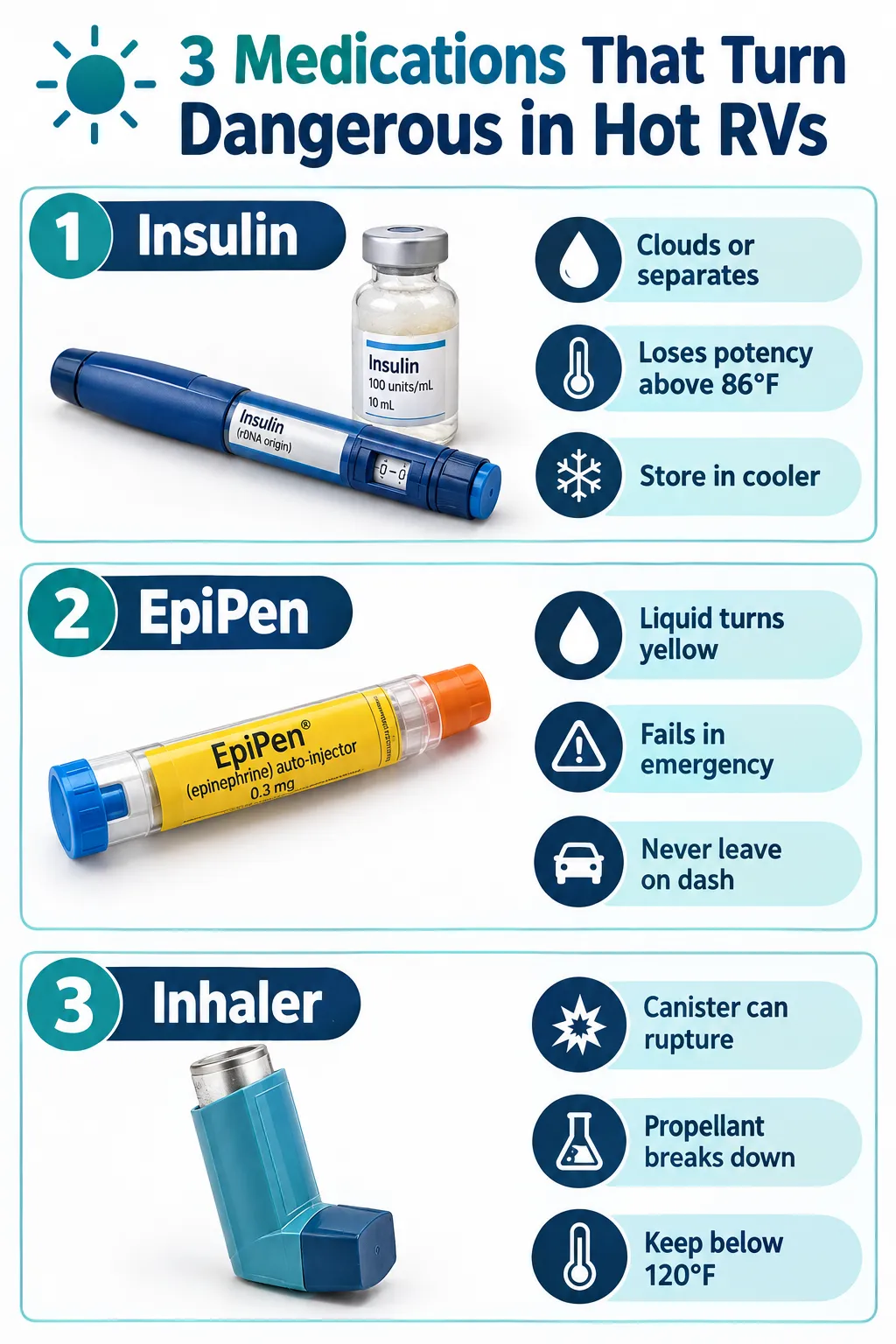
Not every medication reacts to heat the same way. But three categories stand out as the biggest concern for RV travelers, according to pharmacy researchers and health system advisories [1][6][8]. These are the 3 Medications That Turn Dangerous in Hot RVs that every RV traveler should know by name.
1. Insulin
Insulin is one of the most heat-sensitive medications people carry. It’s a protein-based drug, and proteins break down when they get too warm, similar to how an egg white changes when it hits a hot pan [3].
What heat does to insulin:
- Causes it to look cloudy, grainy, or clumpy
- Breaks down the molecules that control blood sugar
- Can make insulin stop working even if it still looks clear
Experts say insulin should never be stored above 86°F, and ideally stays between 36°F and 77°F for most products [3][6]. A cooler bag left on an RV dashboard during a hiking stop can easily blow past that limit. Using heat-damaged insulin can lead to dangerously high blood sugar, because the medicine simply isn’t doing its job anymore [1].
“If insulin looks cloudy, discolored, or has particles floating in it, do not use it, even if it’s not expired.” [3]
2. Epinephrine Auto-Injectors (EpiPens)
EpiPens are built for the worst moments, severe allergic reactions where seconds count. That’s exactly why heat damage is so scary. Epinephrine is a fragile compound, and manufacturers specifically warn against storing it above 86°F [1][8].
Signs an EpiPen may be heat-damaged:
- The liquid inside turns yellow or brown
- Visible particles appear in the window
- It’s been exposed to high heat for an extended period, even without visible changes
The dangerous part is that a degraded EpiPen may fail during an actual emergency, right when someone needs it most [1]. Many RV families keep an EpiPen in a door pocket, glovebox, or outside storage bay “just in case.” Unfortunately, those are some of the hottest spots in the entire rig [5].
3. Pressurized Inhalers for Asthma and COPD
Inhalers work using a pressurized canister that releases medicine in a controlled mist. Heat changes the pressure inside that canister, and that’s a real safety issue, not just an effectiveness one [8].
Why heat is risky for inhalers:
- High heat can cause the canister to rupture or leak
- The propellant that pushes out the medicine can break down
- Patients may get a weaker dose without realizing it
Health officials have specifically flagged inhalers in hot-car and hot-RV warnings because the canister itself can become a small pressurized hazard, not just a medicine that stops working [8][10]. Leaving an inhaler on a sunny dashboard during a scenic drive is one of the most common mistakes RV travelers make.
Other Medications That Can Turn Risky in RV Heat
While insulin, EpiPens, and inhalers top the list, they aren’t the only medications RV travelers should watch. Several common drug categories can either break down in heat or make the body handle heat worse, sometimes both at once [2][6].
| Medication Type | What Heat Does | Why It Matters in an RV |
|---|---|---|
| Benzodiazepines (anxiety meds) | Potency can drop sharply above roughly 98°F [7] | Lower effectiveness during stressful travel moments |
| Blood pressure medications | Can interfere with the body’s ability to sweat and cool down [2] | Raises risk of heat exhaustion on hot hiking days |
| Antidepressants and antipsychotics | Some reduce sweating or alter temperature regulation [2][6] | Increases heat stroke risk during RV park activities |
| Thyroid medications | Can degrade with repeated heat exposure [3] | Loses strength over a travel season |
| Liquid antibiotics | Can lose potency fast in heat [4] | Risk of under-treating an infection on the road |
This is why health advisories increasingly separate medications into two heat-related problems: drugs that get damaged by heat, and drugs that make a person more vulnerable to heat [2]. RVers on blood pressure medication, for example, might not sweat normally during a hot afternoon hike, which hides early warning signs of heat exhaustion until it becomes serious [6].
What To Do If a Medication Got Too Hot in Your RV
Every RV traveler eventually has this moment, walking back into the rig after a long stop and realizing the thermostat says 118°F. Here’s the step-by-step plan health experts recommend [3][6][9]:
- Check the medication’s appearance. Look for cloudiness, discoloration, crystals, or a strange smell.
- Do not use it if it looks different than normal, even slightly.
- Call the prescribing pharmacist or doctor before taking or injecting anything questionable.
- Note how hot it got and for how long, if possible. This helps the pharmacist judge the risk.
- Replace rather than risk it. Most pharmacies can issue an emergency refill for heat-damaged medication, especially for essentials like insulin or EpiPens.
- Never assume “it looks fine” means “it’s fine.” Some heat damage is invisible, especially in inhalers and insulin [3][8].
This is one of those situations where being cautious costs nothing, but being wrong can cost a lot. A quick phone call to a 24-hour pharmacy line is always worth it.
How to Protect Medications From Hot RV Temperatures
The good news: protecting medications in an RV doesn’t require fancy gear. It just takes a little planning before hitting the road [4][9].
Smart storage habits for RV travelers:
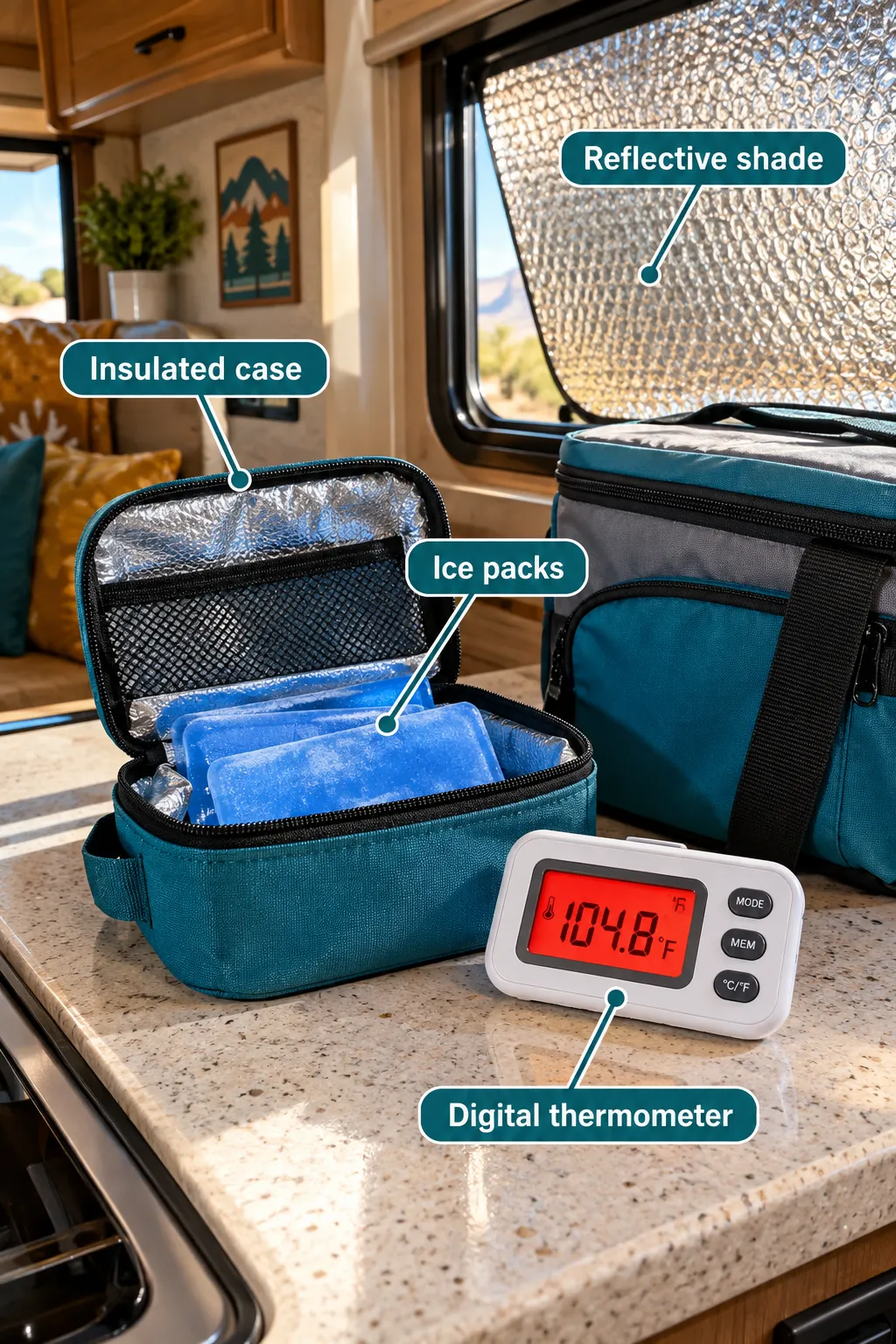
- 🧊 Use an insulated medical travel bag with reusable ice packs for insulin, EpiPens, and other sensitive drugs.
- 🚫 Never store medications on the dashboard, in the glovebox, or near windows, these spots heat up the fastest [5][10].
- 🪟 Use reflective window shades on the side of the RV where medicine storage sits.
- 🔋 Consider a 12-volt travel cooler for insulin during long summer trips, especially for off-grid boondocking stretches.
- 📝 Set a phone reminder to check medication storage spots during rest stops, especially after parking for more than 20 minutes.
- 🌡️ Keep a small thermometer in the storage area to track real temperatures, not guesses.
- 🧳 Pack a backup supply of critical medications stored separately in case one set gets damaged.
For RVers who dry camp or boondock in hot climates, a small 12-volt or battery-powered cooler is one of the best investments for medication safety [4][9]. It’s a lot cheaper than an emergency pharmacy run two states away from home.
Frequently Asked Questions About Hot RV Medications
Can medications in an RV get too hot even with the air conditioning running?
Yes. AC cools the main living space, but storage bins, dashboards, and cabinets near windows can still trap heat, especially when the RV is parked [5][9].
How fast can an RV interior become dangerous for medication storage?
Studies on vehicle interiors show temperatures can rise sharply within 10 to 15 minutes of parking in direct sun, even with mild outside temperatures [5][10].
Is it safe to store medication in an RV refrigerator instead?
For heat-sensitive drugs like insulin, a refrigerator is usually safer than room-temperature storage, as long as the fridge stays within the manufacturer’s recommended range and the medication doesn’t freeze [3][9].
What temperature is considered unsafe for most medications?
Many medications begin to lose stability above 77°F to 86°F, depending on the drug. Insulin and epinephrine are both flagged at the lower end of that range [1][3].
Should RV travelers tell campground staff about medication needs?
It’s not required, but letting a campground host know about a medical emergency item like an EpiPen can help if quick assistance is ever needed during a heat-related incident [2].
Conclusion
Hot RVs and sensitive medications simply don’t mix. The 3 Medications That Turn Dangerous in Hot RVs, insulin, EpiPens, and pressurized inhalers, sit at the top of the list because they’re also some of the most critical medications RV travelers carry. Add in heart, blood pressure, and psychiatric medications that make heat stress worse, and it’s clear that medicine storage deserves the same attention as tire pressure or propane levels.
The fix isn’t complicated. Pack an insulated bag. Skip the dashboard and glovebox. Keep a thermometer in the storage spot. Check medications after long stops. These small habits take minutes but can prevent a medical emergency hundreds of miles from the nearest hospital.
Before the next trip, take five minutes to walk through the RV and ask one simple question: where exactly does the medicine go, and how hot does that spot really get? That one check could make all the difference on the road.
References
[1] Heat Medications Dont Mix – https://www.bcm.edu/news/heat-medications-dont-mix
[2] Heat And Medications Guidance For Clinicians – https://www.cdc.gov/heat-health/hcp/clinical-guidance/heat-and-medications-guidance-for-clinicians.html
[3] Can Extreme Heat Or Cold Damage Your Medications – https://www.bannerhealth.com/healthcareblog/advise-me/can-extreme-heat-or-cold-damage-your-medications
[4] Medication Summer Safety – https://brandtcenter.rutgers.edu/news/medication-summer-safety
[5] Why You Should Not Store Meds In A Hot Car And Other Travel Tips For A Safe Healthy Trip – https://networkhealth.com/grow-in-the-know/2025/07/why-you-should-not-store-meds-in-a-hot-car-and-other-travel-tips-for-a-safe-healthy-trip
[6] Summer Heat And Your Medications What Every Patient Needs To Know – https://www.coxhealth.com/content-hub/summer-heat-and-your-medications-what-every-patient-needs-to-know/
[7] Default – https://wms.org/magazine/magazine/1183/Temperature-Stability/default.aspx
[8] Heres How Heat Can Affect Your Medical Devices And Prescriptions Health Officials Say – https://www.whro.org/environment/2025-08-06/heres-how-heat-can-affect-your-medical-devices-and-prescriptions-health-officials-say
[9] An Rx To Heat Proof Your Summer Medications – https://www.cedars-sinai.org/stories-and-insights/expert-advice/an-rx-to-heat-proof-your-summer-medications
[10] Common Things To Never Leave In Hot Car – https://www.jalopnik.com/2197095/common-things-to-never-leave-in-hot-car/