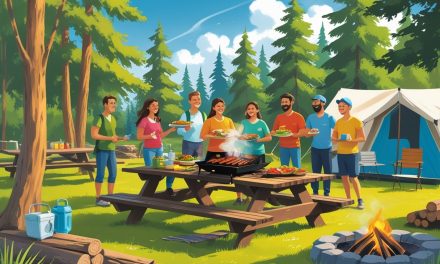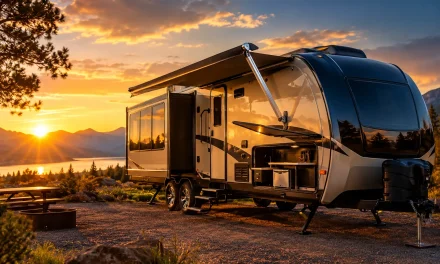
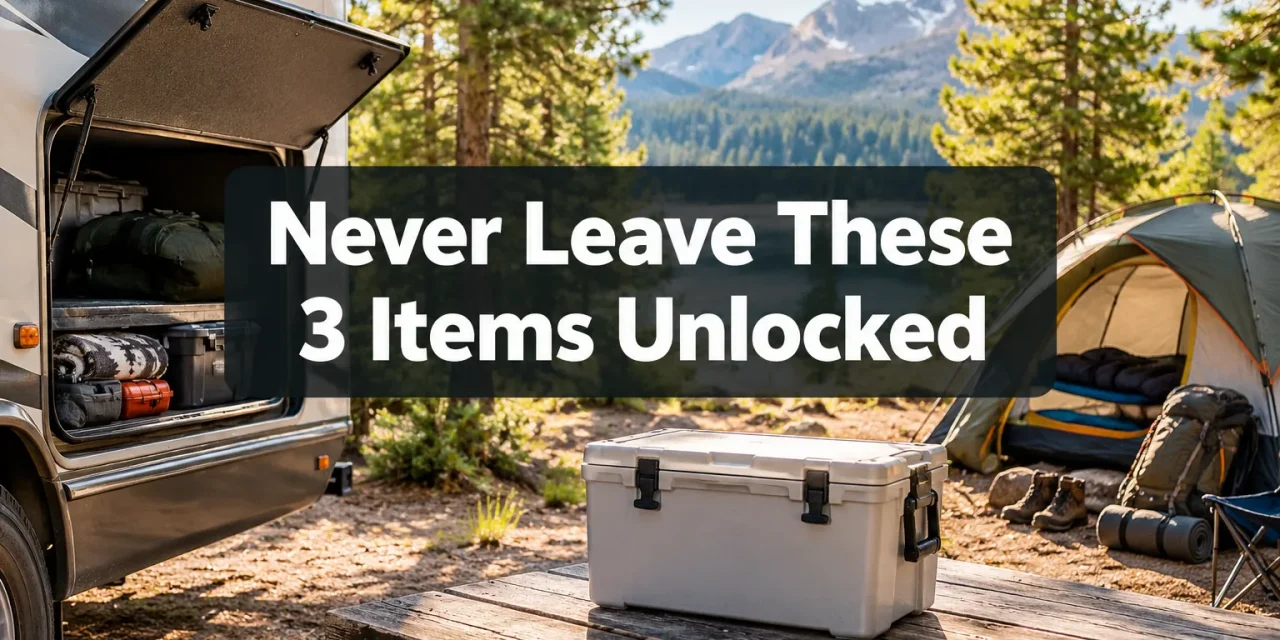
A single unlocked cooler can turn a peaceful campground into a bear encounter in under ten minutes. That is not an exaggeration, wildlife agencies across the country report that food left out, even in a closed-but-unlocked cooler, is one of the top reasons bears wander into campsites.[1][5] Add in rising campground theft reports, and it becomes clear: never leave these 3 items unlocked at your campsite if you want a safe, stress-free trip.
This guide breaks down exactly which three items need to be locked up every single time, why it matters, and how to build a simple nightly routine so you never have to think twice about it again.
Key Takeaways
- Food, coolers, and trash must always be locked inside a vehicle, RV, or bear-proof locker, never left in a tent or on a picnic table.[1][5][8][13]
- Valuables like wallets, phones, keys, and medications should never sit unlocked on a picnic table or inside an unlocked tent.[2][3][10][11]
- RVs, vehicles, and outdoor storage compartments (including propane tanks and tools) need to be locked every night and anytime you leave the site.[3][4][9][11]
- Campfires must never be left unattended or “unlocked” (uncontrolled), always fully extinguish before sleeping or driving away.[6][12][14]
- A simple rule to remember: if it has value or scent, lock it up.[1][2][3][5][8][10][11][13][15]
Why Never Leave These 3 Items Unlocked at Your Campsite Matters So Much
Campgrounds feel safe. That is exactly the problem. People relax, forget to lock the RV door, and leave snacks on the counter by an open window. But campgrounds attract more than friendly neighbors, they attract wildlife, opportunistic thieves, and fire risk all at once.[2][7]
Forest Service and National Park guidance both point to the same pattern: campers who skip basic locking habits are far more likely to deal with wildlife run-ins or stolen gear.[1][8] This is not about being paranoid. It is about building a two-minute habit that protects both your stuff and your safety.
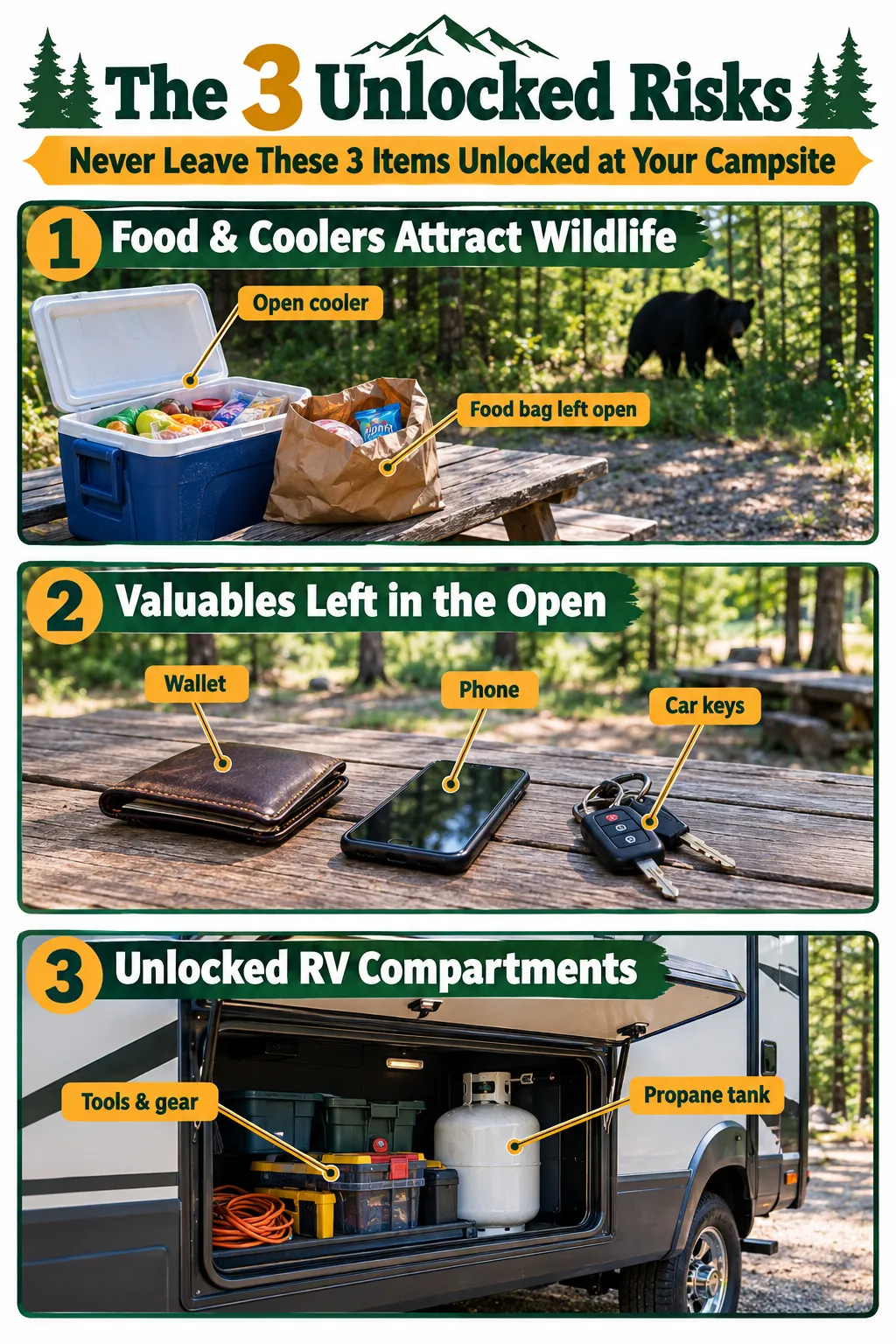
Here is the good news: once you know the three categories, locking up becomes second nature. Let’s go through each one.
Item #1: Food, Coolers, and Trash
This is the single biggest rule in all of outdoor camping. Food, garbage, and cooking gear should never be left out or unsecured at a campsite, because they draw in bears and other wildlife, raising the risk of dangerous encounters.[1][5][8][13]
That includes:
- Snacks in a tent (even sealed bags)
- Coolers left on a picnic table overnight
- Trash bags sitting by the fire ring
- Pet food bowls left outside
- Grease-covered grills and cooking tools
Even an empty cooler smells like food to a bear. Wildlife officials now say coolers, empty or full, should be treated exactly like food. Lock them inside a vehicle, RV, or a bear-proof locker. Never leave them loose at the campsite or inside a tent.[1][5][8][10][13]
Where food SHOULD go at night
| Storage Option | Safe? | Notes |
|---|---|---|
| Locked RV or vehicle | ✅ Yes | Best option at most campgrounds |
| Bear-proof locker (provided by park) | ✅ Yes | Common in bear country |
| Tent | ❌ No | Scent travels through fabric |
| Picnic table | ❌ No | Easy target for wildlife and raccoons |
| Truck bed (uncovered) | ❌ No | Still accessible to animals |
🐻 Pull Quote: “If it smells like food, it needs to be locked like food.”
Beverages, toiletries (yes, toothpaste counts), and trash all fall under this same rule. Recent wildlife-protection advisories are clear that everything with a scent, food, drinks, hygiene products, and garbage, belongs locked in a vehicle, RV, or bear locker, not left in the open air or inside an unlocked tent.[5][8][10]
Item #2: Valuables, Electronics, and Documents
The second item on the “never leave these 3 items unlocked at your campsite” list has nothing to do with wildlife, it is about people. Campgrounds are friendly, but they are also public spaces where strangers pass by all day and night.
Security experts recommend that wallets, medications, electronics, vehicle keys, and important documents never be left in an unlocked tent, on a picnic table, or in outdoor storage.[2][3][10][11] These items should only ever be:
- Locked inside your RV or vehicle
- Kept in a small portable lockbox bolted inside your rig
- Carried on your person if you’re away from the site briefly
Quick list: Valuables that should always be locked up
- 📱 Phones, tablets, laptops
- 🔑 Spare vehicle and RV keys
- 💳 Wallets, cash, and credit cards
- 💊 Prescription medications
- 📄 Passports, ID cards, and insurance paperwork
- 💻 Chargers and portable power banks (yes, even these get stolen)
Grab-and-go theft happens fast. Security-focused outdoor guidance notes that thieves can clear a picnic table in seconds, which is why items should be physically locked, not just “nearby” or tucked in an unlocked shelter.[7][2][15] A tent zipper is not a lock. A screen door is not a lock. If it can be unzipped or pulled open without a key, it is not secure.
Item #3: Vehicles, RV Compartments, and Outdoor Equipment
The third category covers your rig itself, and everything attached to it. Insurance and safety organizations consistently advise that vehicles, RVs, and every exterior storage compartment should be locked whenever you step away from the campsite or go to sleep.[3][11][15]
This includes:
- Your RV’s entry door and all exterior storage bays
- Tow vehicle doors and truck bed toolboxes
- Bike racks and hitch-mounted cargo carriers
- Propane tanks and connections
- Tools, generators, and maintenance gear
- ATVs, e-bikes, and other recreational equipment
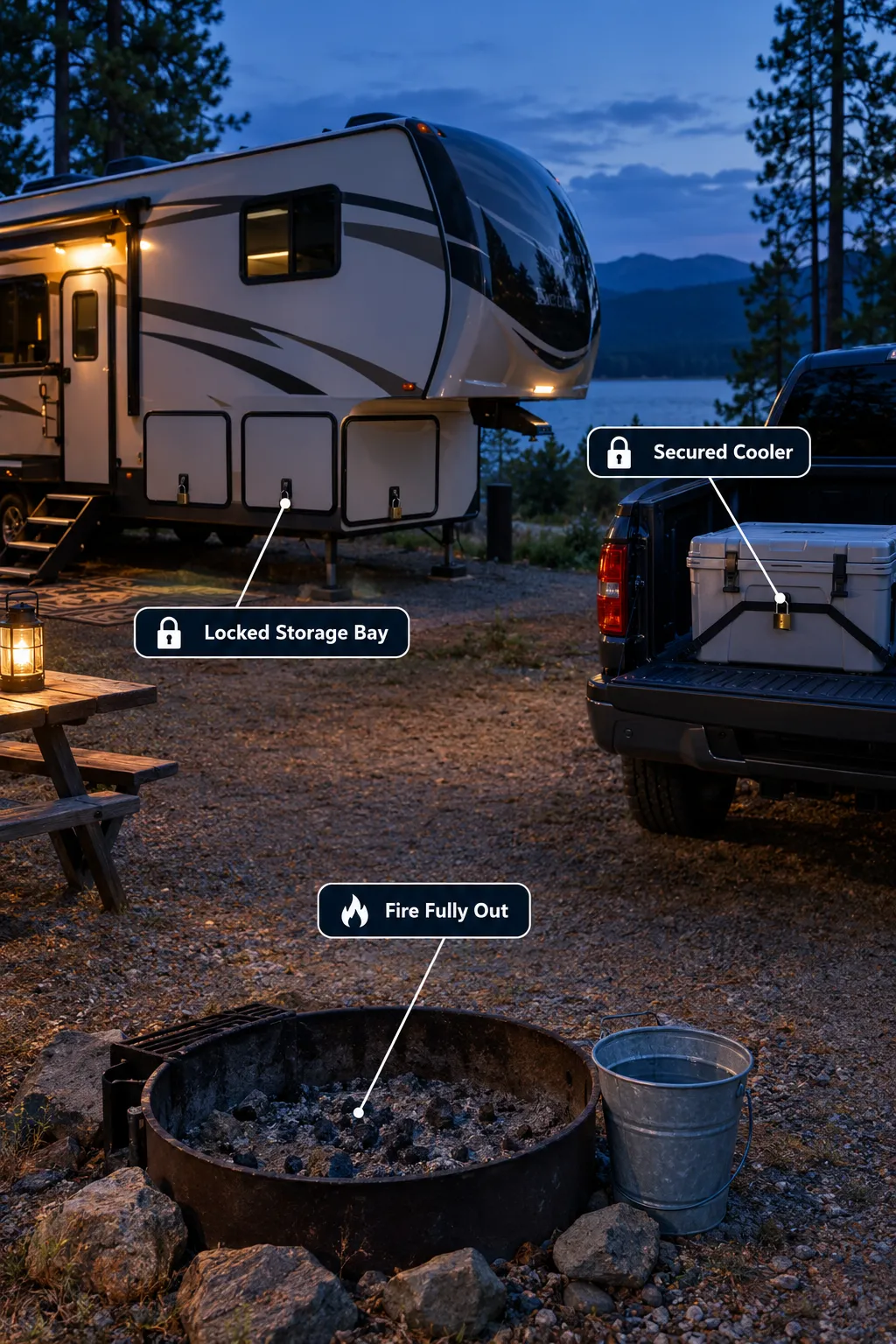
Updated campground-operator guidance points out that shared facilities and stored equipment, propane tanks, tools, ATVs, maintenance gear, are common theft and vandalism targets when left unlocked.[4][9] Many RVers assume a quiet, remote campground is “safe enough” to skip locking the storage bays. That assumption is exactly what opportunistic thieves count on.
Simple locking checklist before bed or leaving camp
- Lock the RV entry door
- Lock every exterior storage compartment
- Lock the tow vehicle (doors and tailgate)
- Chain or lock bikes, generators, and loose equipment
- Double-check propane tank connections are secure
A hitch lock and wheel lock add extra protection for trailers parked at remote or less-populated sites, especially overnight.[2][7]
The Bonus Rule: Never Leave Your Campfire “Unlocked” Either
While it is not a physical padlock situation, there is a fourth rule RVers should never skip: campfires must never be left unattended or uncontrolled at any time.[6][12][14] Think of it as leaving your fire “unlocked”, if it is not fully out, it is not secure.
- Always fully extinguish fires before sleeping
- Never leave a fire burning while you run to the store
- Stir ashes and check for heat before walking away
- Keep water or dirt nearby at all times
Red Cross and national fire-safety guidance both stress this point heavily, since unattended fires are a leading cause of campground injuries and wildfires.[6][12][14]
A Quick Campsite Security Checklist
Use this simple checklist every single night, no matter how tired you are after a long travel day:
- Food, drinks, and trash locked in RV, vehicle, or bear locker
- Cooler locked away, even if empty
- Wallets, phones, keys, and meds locked inside the rig
- RV door and all storage bays locked
- Tow vehicle locked
- Bikes, generators, and tools locked or chained
- Campfire fully extinguished
🔒 Pull Quote: “If it has value or it has scent, it belongs behind a lock.”
This one rule covers almost every safety guideline from national parks, state wildlife agencies, and camping insurance experts combined.[1][2][3][5][8][10][11][13][15]
Common Mistakes RV Campers Make With Unlocked Items
Even experienced RVers slip up sometimes. Here are the most common mistakes seen at campgrounds:
Mistake #1: “I’ll just lock it in the morning.”
Wildlife and thieves do not wait for morning. Lock up before bed, every time.
Mistake #2: Leaving the cooler on the picnic table “just for a minute.”
Minutes are all it takes for a raccoon, bear, or passerby to act.[1][5][13]
Mistake #3: Assuming a quiet campground means no risk.
Rural and remote sites can be just as vulnerable, sometimes more, since there are fewer eyes watching.[2][7]
Mistake #4: Trusting a tent zipper as “locked.”
Zippers keep bugs out. They do not stop people or wildlife.[10]
Mistake #5: Forgetting outdoor storage compartments.
RV exterior bays holding tools, propane, or gear are frequent, easy targets when left open.[4][9]
Frequently Asked Questions
Is it really necessary to lock an empty cooler?
Yes. Wildlife agencies say coolers hold onto food smells even when empty, so they should be locked in a vehicle, RV, or bear locker just like full ones.[1][5][8][13]
Can I leave my RV door unlocked if I’m staying in a gated campground?
No. Gated does not mean guarded. Insurance experts recommend locking RVs and vehicles regardless of how secure a campground seems.[3][11]
What should I do with trash overnight?
Store it in a locked vehicle, RV, or bear-proof locker. Never leave trash bags sitting outside, even for one night.[1][5][8]
Do I need to lock bikes and generators too?
Yes. Equipment like bikes, generators, and tools are common theft targets and should be locked or chained to something solid.[4][9]
What counts as “unattended” for a campfire?
If you cannot see or reach the fire, or if you are asleep, it is unattended. Fully extinguish it before either situation happens.[6][12][14]
Conclusion
Campground safety does not require fancy gear or expensive security systems. It comes down to one simple habit: never leave these 3 items unlocked at your campsite, food and coolers, valuables and documents, and the RV, vehicle, and outdoor equipment around the site.
Add the campfire rule on top, and a camper has covered nearly every major safety recommendation from national parks, wildlife agencies, and camping insurance experts.[1][2][3][5][6][8][10][11][12][13][14]
Before the next trip, print the checklist above and tape it inside a cabinet door. Make the nightly lock-up routine automatic, the same way seatbelts became automatic. A few extra seconds each night is a small price for a safer, more relaxed campsite, and one less reason to lie awake wondering what is wandering through camp.
References
[1] Camping – https://www.fs.usda.gov/visit/know-before-you-go/camping
[2] How To Secure An Outdoor Campsite Safely – https://www.bayhideaway.com/post/how-to-secure-an-outdoor-campsite-safely
[3] Simple Tips For Camping Safety – https://www.statefarm.com/simple-insights/auto-and-vehicles/simple-tips-for-camping-safety
[4] Camp Security – https://www.acacamps.org/resources/camp-security
[5] Protect Your Campsite Wildlife – https://cpw.state.co.us/protect-your-campsite-wildlife
[6] Camping Safety This Summer – https://www.redcross.org/local/washington/about-us/news-and-events/news/camping-safety-this-summer.html
[7] Secure Campsite Bugging – https://www.survivalsullivan.com/secure-campsite-bugging/
[8] Camping Safety – https://www.nps.gov/seki/planyourvisit/camping-safety.htm
[9] Everything You Need To Know To Secure And Protect Your Campground – https://www.roverpass.com/blog/everything-you-need-to-know-to-secure-and-protect-your-campground/
[10] Can You Leave Your Tent Unattended – https://www.propelrc.com/can-you-leave-your-tent-unattended/