
Nearly 62% of new RV owners report that their first night in their rig did not go as planned, and most of those problems were completely avoidable. The excitement of finally sleeping in your own home-on-wheels is real. But so is the panic when the water won’t flow, the AC won’t cool, or the whole rig is tilted like a funhouse floor. The 14 first-night-in-the-RV mistakes new owners make constantly are well-known in the RV community, yet new campers keep making them every single season.
This guide breaks down every one of those mistakes in plain, simple language. Read this before your first night, and you’ll sleep a whole lot better. 😴
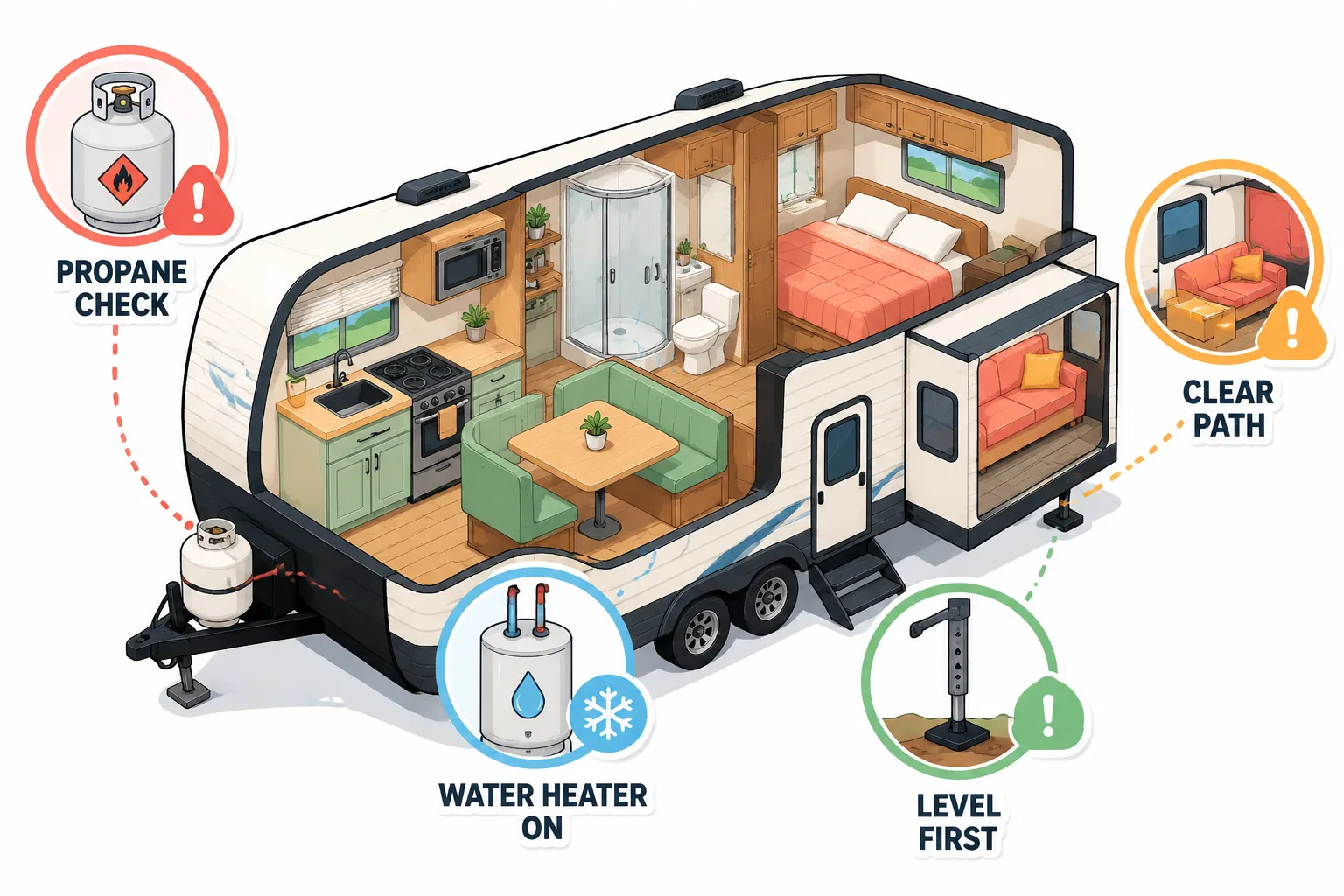
Mistake #1: Not Leveling the RV First 🏕️
This is the king of all first-night errors. Many new owners pull into a campsite, pop the door open, and start unloading gear, without ever leveling the rig.
Why it matters so much:
- An unlevel RV messes with your refrigerator’s cooling system
- Sleeping on a slant feels awful and ruins rest
- Slide-outs can bind or not seal properly on an unlevel surface
- Water drains poorly in the kitchen and bathroom
💬 “We slept on a slope all night and woke up with headaches. Turns out the fridge wasn’t cooling either. One bubble level would have fixed everything.”, Common RV forum story
Quick fix: Buy a basic bubble level or download a leveling app. Use leveling blocks under the tires before doing anything else.
Mistake #2: Skipping the Pre-Trip Walkthrough
The RV dealer gives a walkthrough when you buy the rig. Most new owners forget 80% of it by the time they get home. Then on the first night, they can’t find the water heater switch or figure out how to light the stove.
Do this instead:
- Record video of your dealer walkthrough on your phone
- Watch it again at home before your first trip
- Practice turning on every system in your driveway
Mistake #3: Not Testing Systems Before Leaving Home
This one causes the most frustration. New owners assume everything works because it’s new. But RVs have many systems, and any one of them can have a factory issue or shipping damage.
Systems to test at home:
| System | What to Check |
|---|---|
| Fresh water | Fill tank, run all faucets |
| Electrical | Plug in shore power, test all outlets |
| Propane | Light stove, check water heater |
| AC/Heat | Run both for 30 minutes |
| Slide-outs | Extend and retract fully |
| Leveling jacks | Raise and lower completely |
Test everything in your driveway. Fix problems at home, not at a campsite 200 miles away.
Mistake #4: Wrong Electrical Adapter (or No Adapter at All) ⚡
Campsite power comes in different sizes, 15-amp, 30-amp, and 50-amp. Many new owners show up without the right adapter and can’t plug in at all.
Know your RV’s power needs:
- Most small travel trailers use 30-amp connections
- Large fifth wheels and motorhomes often need 50-amp
- Many campgrounds only offer 30-amp or 15-amp at some sites
Must-have adapters to carry:
- 30-amp to 15-amp “dogbone” adapter
- 50-amp to 30-amp adapter (if you have a 50-amp rig)
- Surge protector (this is not optional, it protects your whole RV)
⚠️ Pro tip: A power surge at a campsite can fry your RV’s electronics. A good surge protector costs $50,$150. A new converter or inverter costs $500+.
Mistake #5: Forgetting to Turn On the Water Heater Early Enough 🚿
New RV owners often jump in the shower on their first night and get blasted with ice-cold water. The water heater needs time to warm up, usually 20 to 30 minutes on propane, and longer on electric.
Two types of RV water heaters:
- Propane: Faster to heat, uses propane tank
- Electric: Slower, uses shore power
Turn it on before you need it. Some owners turn it on during dinner so it’s ready by shower time.
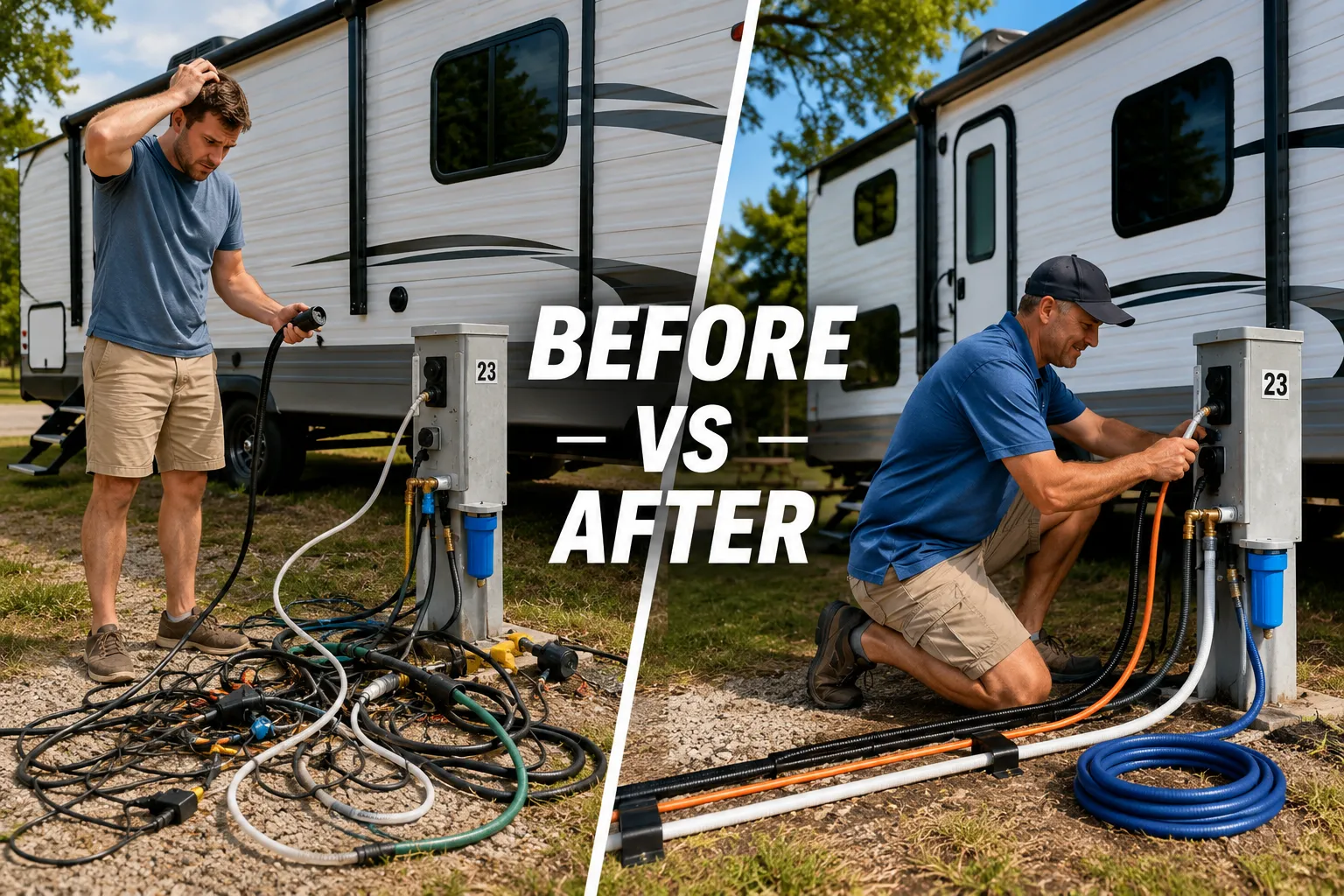
Mistake #6: Not Knowing How to Connect the Water Hose Properly
This sounds simple. It is not. New owners often:
- Use a regular garden hose (which can leach chemicals into drinking water)
- Forget a water pressure regulator (high campsite pressure can burst RV pipes)
- Skip the inline water filter
- Cross-thread the connection and cause a slow leak
What to bring and use:
- ✅ A white drinking-water-safe hose (never a green garden hose)
- ✅ A water pressure regulator (set to 40-50 PSI)
- ✅ An inline water filter
- ✅ Teflon tape for all threaded connections
Mistake #7: Leaving the Slides Out Without Checking Clearance
Slide-outs make the RV feel huge and roomy. But new owners sometimes extend them without checking what’s around the rig, trees, picnic tables, other campers, or power lines.
Before extending slides:
- Walk completely around the RV
- Check overhead for branches and wires
- Make sure the ground is level first (unlevel ground can damage slide seals)
- Never extend slides on a steep slope
Mistake #8: Running Out of Propane on Night One 🔥
Nothing says “first-timer” like running out of propane before dinner is done. New owners often pick up the RV with tanks that are only partially full, or they don’t know how to read the gauge.
Propane tips for night one:
- Always fill tanks completely before your first trip
- Carry a backup 1-lb propane canister for emergencies
- Know where your propane shutoff valve is
- Check the gauge before you start cooking
Mistake #9: Not Knowing the Sewer Hookup Order 💩
This is the mistake that haunts people. There is a very specific order for connecting and disconnecting sewer hoses. Get it wrong, and the results are messy, and smelly.
The correct order to connect:
- Connect the sewer hose to the RV first
- Then connect to the campsite sewer inlet
- Open the black tank valve only when dumping
- Open the gray tank valve last (it rinses the hose)
The correct order to disconnect:
- Close gray tank valve
- Close black tank valve
- Disconnect from campsite inlet first
- Then disconnect from RV
⚠️ Never leave the black tank valve open all the time. This causes “pyramid of doom” buildup inside the tank.
Mistake #10: Forgetting to Retract the Stabilizer Jacks Before Moving
This one can cause serious damage. Stabilizer jacks keep the RV from rocking when parked. They are not designed to lift the RV. New owners sometimes forget to retract them before driving away.
Driving with jacks down can:
- Rip the jacks completely off the frame
- Damage the RV’s underbelly
- Create a serious road hazard
Make a pre-drive checklist. Put “retract all jacks” at the top of it.
Mistake #11: Not Bringing a Basic Toolkit 🔧
The first night in an RV almost always involves something that needs tightening, adjusting, or fixing. New owners who show up without any tools are stuck.
Basic RV toolkit for night one:
- Flathead and Phillips screwdrivers
- Adjustable wrench
- Pliers
- Flashlight or headlamp (with extra batteries)
- Duct tape
- Zip ties
- Rubber mallet (for leveling blocks)
- Multimeter (for electrical issues)
This fits in a small bag and weighs almost nothing. Bring it every time.
Mistake #12: Ignoring the Smoke, CO, and LP Gas Detectors
RVs come with smoke detectors, carbon monoxide (CO) detectors, and LP gas detectors. Many new owners ignore the beeping low-battery warnings or don’t know where these detectors are located.
Why this is serious:
- Propane leaks inside an RV can be deadly
- CO from a generator or furnace can build up fast in a small space
- Smoke spreads quickly in an enclosed RV
Before your first night:
- Test every detector
- Replace batteries if needed
- Know where each detector is located
- Never run a generator inside or right next to the RV
Mistake #13: Overpacking for Night One 🧳
New RV owners often treat the first trip like a full move-in. They pack every piece of kitchen equipment, every towel, every blanket, and half their closet. Then they can’t move around inside the rig.
RV weight limits are real. Every RV has a GVWR (Gross Vehicle Weight Rating). Overloading causes:
- Tire blowouts
- Suspension damage
- Reduced fuel economy
- Braking problems
Pack smart for night one:
- Bring only what you need for 1-2 nights
- Use the RV’s built-in storage wisely
- Weigh your loaded RV at a truck stop scale before long trips
Mistake #14: Not Having a Printed Setup Checklist 📋
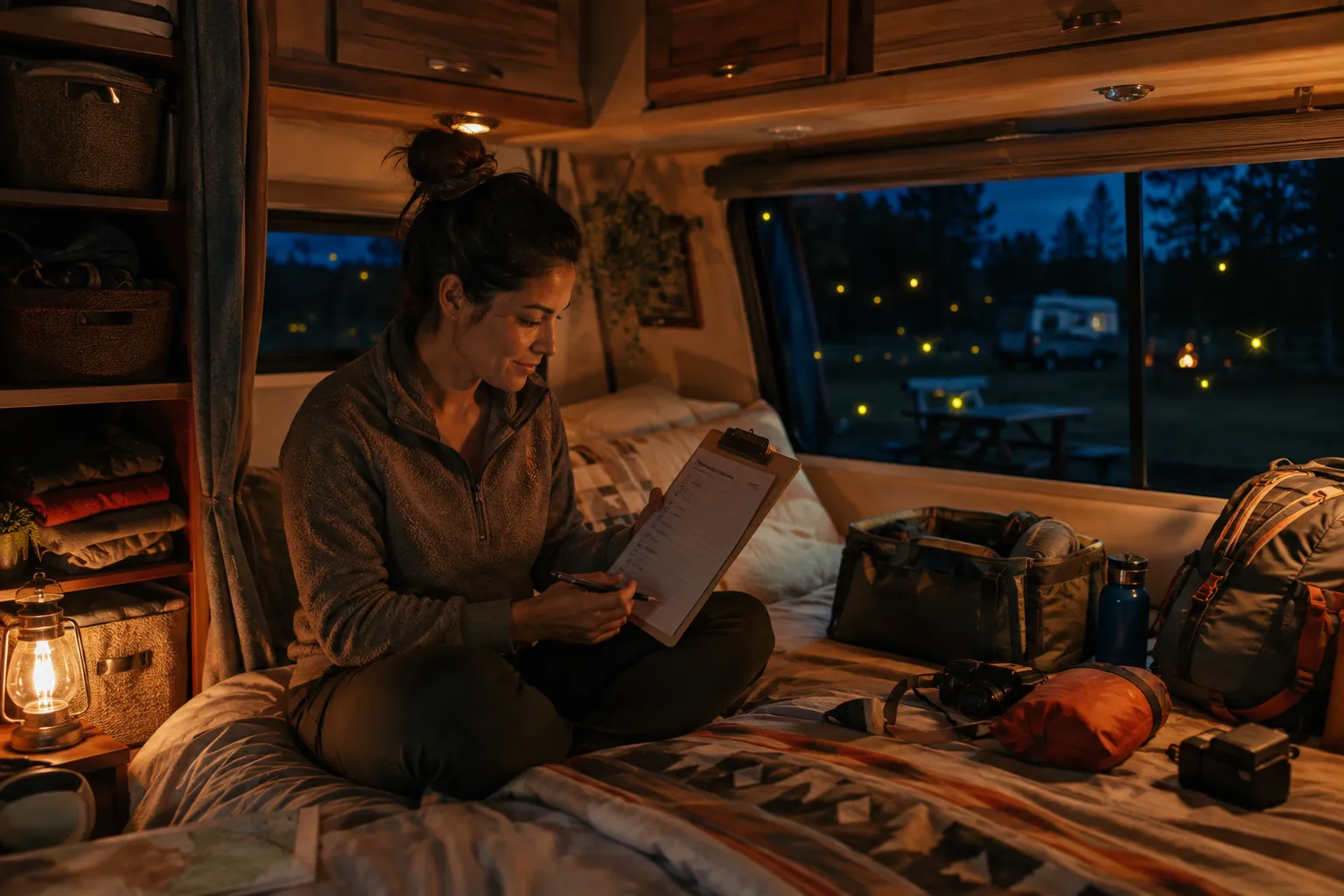
This is the simplest mistake on the list, and the most fixable. New owners rely on memory for setup and teardown. Memory fails, especially when tired, excited, or distracted by kids and pets.
A printed checklist takes five minutes to make and prevents almost every mistake on this list.
Sample first-night setup checklist:
- ☐ Level the RV
- ☐ Extend stabilizer jacks
- ☐ Connect shore power (with surge protector)
- ☐ Connect water hose (with pressure regulator and filter)
- ☐ Connect sewer hose (in correct order)
- ☐ Extend slides (check clearance first)
- ☐ Turn on water heater
- ☐ Test all detectors
- ☐ Check propane level
- ☐ Stow tow vehicle or unhitch trailer
Print this out. Laminate it. Keep it in the RV forever.
Why New Owners Keep Making These 14 First-Night-in-the-RV Mistakes Constantly
It’s worth asking: why do these same mistakes happen over and over? The answer is simple. RVs look simple but are actually complex systems. A new RV owner is essentially learning to operate a small house, a vehicle, a plumbing system, and an electrical system, all at once.
Dealers do their best to explain everything, but there’s too much to absorb in one afternoon. Online resources help, but most new owners don’t seek them out until something goes wrong.
The 14 first-night-in-the-RV mistakes new owners make constantly are not signs of being dumb or careless. They are signs of being new. Every experienced RVer made most of these same mistakes at some point. The difference is that experienced RVers now have checklists, habits, and muscle memory built up over many trips.
The fastest way to skip the learning curve:
- Join an RV owners group online (Facebook groups are very active)
- Watch YouTube walkthroughs for your specific RV model
- Spend one full night in your driveway before your first campsite trip
- Ask questions at the campground, most RVers love helping newcomers
How to Avoid These Common RV First-Night Mistakes in 2026
The good news is that avoiding the 14 first-night-in-the-RV mistakes new owners make constantly is completely doable with a little preparation. In 2026, there are more resources than ever to help new RV owners succeed.
Top preparation strategies:
🔹 Do a “shakedown trip”, Spend your first night in a campground close to home (within 30 minutes). If something goes wrong, you can easily get help or head home.
🔹 Take an RV basics class, Many RV dealers and campground associations offer free or low-cost orientation classes.
🔹 Use RV apps, Apps like Campendium, The Dyrt, and iOverlander show campsite reviews, hookup types, and tips from other campers.
🔹 Connect with your RV brand’s owner community, Most major RV brands have active owner forums where members share setup tips, common problems, and fixes.
🔹 Watch your specific model’s setup video, Search “[Your RV model] setup walkthrough” on YouTube. These videos are gold.
Conclusion
The 14 first-night-in-the-RV mistakes new owners make constantly are not scary, they’re just common. Every single one of them is preventable with the right preparation. Level the rig first. Test systems at home. Bring the right adapters. Know the sewer order. Make a checklist.
RV life is genuinely wonderful. Waking up in a new place, having your home with you wherever you go, sitting outside with a coffee while the world wakes up, it’s everything the brochures promise. But that magic is a lot easier to enjoy when the basics work right.
Actionable next steps for new RV owners:
- Print the setup checklist from this article and laminate it
- Schedule a driveway test night this week, run every system
- Buy the three essentials you might be missing: surge protector, water pressure regulator, and drinking-water-safe hose
- Join one RV Facebook group for your rig type and introduce yourself
- Book a shakedown campsite within 30 minutes of home for your first real night out
The RV community is one of the friendliest groups of people out there. Ask questions, learn fast, and enjoy every mile. 🚐✨