Every year, thousands of RV buyers pay tens of thousands of extra dollars for “luxury” upgrades — and then spend their first camping season deeply regretting it. A 2023 survey by the RV Industry Association found that over 60% of new RV owners felt their rig had at least one feature that did not live up to its price tag. That number should make anyone pause before signing on the dotted line.
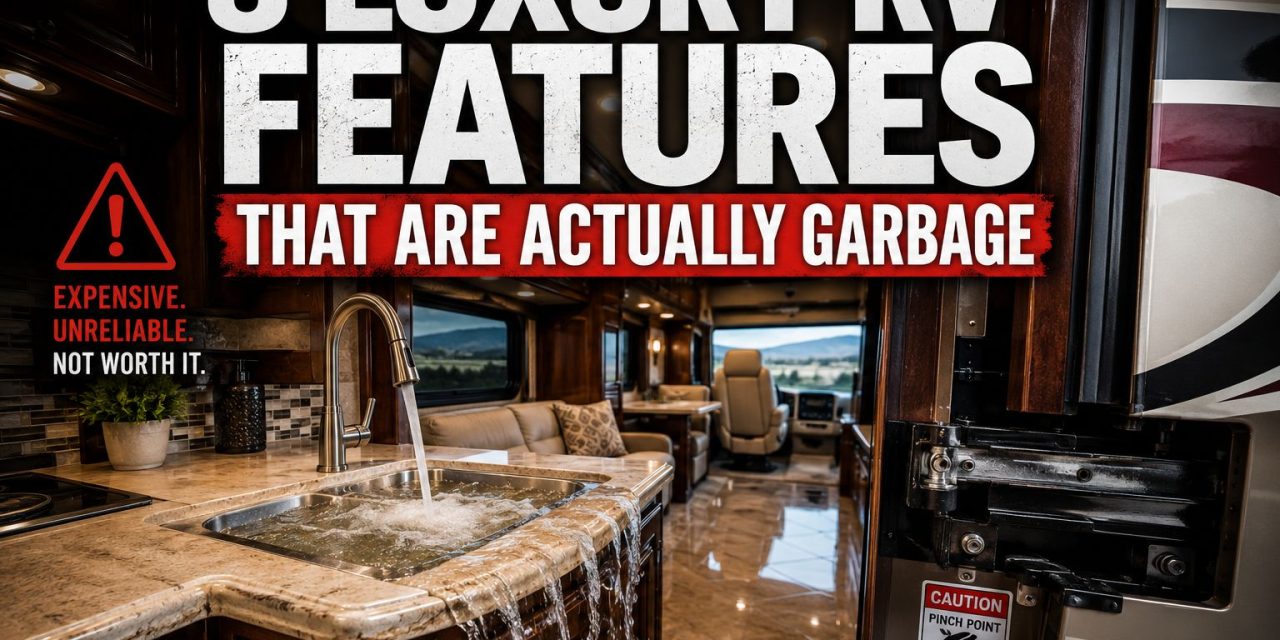
This article is here to call out the 3 “Luxury” RV Features That Are Actually Garbage — the ones that look amazing in the showroom, sound impressive in the brochure, and then fail you in the real world. Whether someone is shopping for their first rig or upgrading to something fancier, knowing these pitfalls can save a lot of money and frustration.

Key Takeaways
- 🚨 Not all “luxury” RV features are worth the price. Some are marketing gimmicks dressed up in fancy packaging.
- 🔧 Residential-style appliances look great but are not built for life on the road.
- 📦 Slideout rooms add space but also add serious maintenance headaches and leak risks.
- 📱 Fancy touch-screen control systems sound futuristic but break down fast and cost a fortune to fix.
- 💡 Always ask how a feature performs on the road — not just how it looks in the showroom.
Why RV “Luxury” Is Often Just a Marketing Trick
The RV industry is very good at one thing: making buyers feel like they are getting a high-end experience. Walk into any RV dealership and the salespeople will point to the granite countertops, the big residential fridge, the motorized slideouts, and the sleek digital control panel. They use words like “resort-style living” and “home away from home.”
But here is the truth: RVs are not homes. They are vehicles. They shake, rattle, and roll down highways at 65 miles per hour. They sit in freezing temperatures and baking heat. They run on limited power and water systems. Many features that work perfectly in a house simply cannot survive the demands of full-time or even part-time RV life.
💬 “The showroom is designed to sell you a dream. The campsite is where reality sets in.” — A common saying among experienced RVers
Manufacturers know this. But they also know that “luxury” sells. So they keep adding features that look impressive on paper, charge a premium for them, and leave buyers to figure out the problems later.
Here is a closer look at the 3 “Luxury” RV Features That Are Actually Garbage — and why smart RVers are starting to avoid them.
Feature #1: Residential-Style Refrigerators
The Sales Pitch
Walk into a high-end Class A motorhome or fifth wheel and the first thing a salesperson will show off is the big, beautiful residential refrigerator. These are the same style of fridge found in a regular home — French door, bottom freezer, stainless steel finish, sometimes even with an ice maker and water dispenser.
They look amazing. They hold a ton of food. And they make the whole RV feel like a real kitchen.
Why It Is Actually Garbage
Here is the problem: residential refrigerators are not designed to move. They are built to sit still on a level floor in a climate-controlled house. RVs do none of those things.
Let’s break down the issues:
| Problem | Why It Matters |
|---|---|
| Needs shore power or generator | Cannot run on 12V battery alone; drains power fast |
| Compressor struggles on uneven ground | Designed for level surfaces; road vibration causes wear |
| Cooling takes longer when warm | After a hot drive, it takes hours to cool back down |
| Ice makers leak | Road vibration loosens water lines over time |
| Repairs are expensive | Requires a residential appliance technician, not an RV tech |
| Shorter lifespan in RVs | Average lifespan drops significantly due to vibration and movement |
Traditional RV refrigerators — the kind that use propane and 12V power (called “absorption fridges”) — are specifically engineered for life on the road. They handle movement, temperature swings, and off-grid living much better.
Yes, absorption fridges are smaller and slower to cool. But they are far more reliable in an RV environment.
What Experienced RVers Say
Full-timers and long-haul travelers consistently report that residential fridges cause headaches. Common complaints include:
- 🧊 Ice maker lines that crack and leak inside the cabinetry
- 🔌 Massive power draw that kills the battery bank overnight
- 🌡️ Food spoiling during long drives because the fridge cannot keep up
- 💸 Repair bills that run into the hundreds or thousands of dollars
The bottom line: A residential fridge adds anywhere from $1,500 to $3,000 to the price of an RV. For most RVers, that money is much better spent on a quality battery system or a reliable absorption fridge.
Feature #2: Motorized Slideout Rooms
The Sales Pitch
Slideouts are the RV industry’s biggest selling point. Press a button, and a whole section of the RV slides outward, instantly adding several feet of living space. Some rigs have two, three, or even four slideouts.
In the showroom, this feels like magic. The living room suddenly feels like a real living room. The bedroom has room to walk around the bed. The kitchen has counter space. It is genuinely impressive.
Why It Is Actually Garbage
Slideouts are one of the most complained-about features in the entire RV world. And for good reason.
They leak. They jam. They fail. And when they do, the repair costs are brutal.
Here is a quick look at why slideouts cause so many problems:
🔩 Mechanical Complexity
Slideouts use either a rack-and-pinion gear system or a hydraulic system to extend and retract. Both systems have many moving parts. More moving parts means more things that can break.
💧 Water Leaks Are Almost Inevitable
The rubber seals around slideouts are the RV’s weakest point for water intrusion. Over time — sometimes very quickly — those seals crack, shrink, or get damaged. Water gets in. Mold follows. Structural damage can happen fast.
💬 “Ask any RV repair shop what their most common job is. Nine times out of ten, it’s slideout seal replacement.”
⚡ Power Drain
Electric slideouts pull a significant amount of power every time they operate. If the battery is low and the slideout jams halfway, the RV is stuck in a very awkward situation.
🏕️ Campsite Limitations
Not every campsite has enough room for slideouts. Pull into a tight spot in a state park or a city campground, and suddenly those slideouts cannot even be opened. The “extra space” disappears completely.
💰 Repair Costs
| Slideout Issue | Average Repair Cost (2026 estimates) |
|---|---|
| Seal replacement (one slide) | $200 – $800 |
| Motor replacement | $500 – $1,500 |
| Hydraulic pump repair | $1,000 – $3,000 |
| Water damage from leak | $2,000 – $10,000+ |
Those numbers add up fast. Many RVers report spending more on slideout repairs than they ever expected.
The Alternative
Many experienced RVers — especially full-timers — actually prefer rigs without slideouts. A well-designed floor plan without slides can be just as livable, far more reliable, and much easier to maintain. Brands like Airstream have built loyal followings partly because their trailers have no slideouts and are extremely durable.
The bottom line: Slideouts add square footage in the showroom and headaches on the road. For most RVers, especially beginners, a simpler rig without slides is the smarter choice.

Feature #3: Fancy Touch-Screen Control Systems
The Sales Pitch
Modern high-end RVs are increasingly coming with centralized touch-screen control panels. These systems let users control the lights, thermostat, water heater, tank levels, slideouts, awning, and more — all from one sleek screen mounted on the wall.
It looks like something out of a spaceship. It feels cutting-edge. And it is a huge selling point for tech-savvy buyers.
Why It Is Actually Garbage
Touch-screen control systems are one of the clearest examples of the 3 “Luxury” RV Features That Are Actually Garbage in action. They sound incredible. They work terribly.
Here is why:
📱 They Are Essentially Cheap Tablets
Most of these systems are built around low-cost tablet hardware running custom software. The hardware is not designed for the extreme temperature swings, vibration, and humidity that RVs experience. Screens crack. Software freezes. Systems crash.
🔧 When They Break, Everything Breaks
This is the big one. In a traditional RV, the thermostat is a thermostat. The light switch is a light switch. Each system is independent. If one breaks, the others still work.
With a centralized touch-screen system, everything runs through one point of failure. If the screen dies or the software crashes, the owner might not be able to:
- Turn on the heat or air conditioning
- Control the water heater
- Check tank levels
- Operate the slideouts
- Turn on the lights
That is a serious problem, especially in extreme weather.
💸 Repairs Are Extremely Expensive
Because these systems are proprietary — meaning they are made specifically for one brand of RV — replacement parts are hard to find and very expensive. A replacement touch-screen panel can cost $800 to $2,500 or more. And finding a technician who knows how to fix it is its own challenge.
📶 Software Updates Are Unreliable
Some of these systems require software updates, just like a smartphone. But RV manufacturers are not software companies. Updates are slow, buggy, and sometimes make things worse. Several RV owners have reported that a software update bricked their control panel entirely.
Real-World Complaints
Here is what RV owners are saying in forums and review sites in 2026:
- “The touch screen froze in the middle of winter and I couldn’t turn on the furnace.”
- “The system crashed and I had to manually override everything to get the slideout in.”
- “The repair shop had never seen this brand’s system before and couldn’t fix it.”
- “The replacement panel cost more than my first car.”
What Works Better
Older, simpler control systems — individual switches, analog thermostats, and basic digital displays — are far more reliable. They are easier to fix. Parts are widely available. And any RV technician can work on them.
Some RVers who buy rigs with touch-screen systems actually bypass them entirely, wiring in traditional switches and thermostats. That tells the whole story.
The bottom line: Touch-screen control systems are impressive in the showroom and unreliable in the real world. Simplicity wins every time in an RV.
How to Spot “Luxury” Features That Are Actually Garbage
Knowing about the 3 “Luxury” RV Features That Are Actually Garbage is helpful. But it is even more useful to know how to spot bad features before buying.
Here are some quick questions to ask at the dealership:
✅ The Smart Buyer’s Checklist
- “How does this feature perform after 50,000 miles?” — Salespeople love to talk about day one. Ask about year three.
- “What is the most common repair on this model?” — A good salesperson will be honest. A bad one will dodge the question.
- “Can this feature be repaired by a standard RV technician?” — Proprietary systems are a red flag.
- “What happens if this system fails on the road?” — For anything critical (heat, power, slideouts), there should be a manual backup.
- “Can I talk to an owner of this model who has had it for two or more years?” — Real-world feedback is gold.
🔍 Red Flags to Watch For
| Red Flag | What It Means |
|---|---|
| Residential appliances in an RV | Built for homes, not roads |
| Multiple slideouts | More complexity, more leaks |
| Single touch-screen for all systems | One point of failure for everything |
| Proprietary parts with no aftermarket | Expensive repairs, hard to find help |
| No manual backup for key systems | Stranded if the tech fails |
What Actually Makes a Great RV
Since the 3 “Luxury” RV Features That Are Actually Garbage have been covered, it is worth talking about what actually matters in a quality RV.
Experienced RVers consistently point to these features as genuinely valuable:
- 🔋 Quality battery system — A good lithium battery bank changes the RV experience dramatically.
- 🌬️ Reliable HVAC — A simple, well-built heating and cooling system beats a fancy one every time.
- 🚿 Good water filtration — Clean water on the road is a real luxury.
- 🛠️ Solid construction — Aluminum framing, quality seals, and good insulation matter more than any gadget.
- 🪟 Simple, well-designed floor plan — A smart layout without gimmicks is worth more than extra square footage.
- 🔧 Easy access to mechanicals — Being able to fix things without a specialist is priceless on the road.
Conclusion
The RV industry does an excellent job of making “luxury” sound irresistible. Gleaming residential fridges, sweeping slideout rooms, and futuristic touch-screen panels are designed to dazzle buyers in the showroom. But the 3 “Luxury” RV Features That Are Actually Garbage — residential refrigerators, motorized slideouts, and touch-screen control systems — consistently underperform in the real world, drain budgets on repairs, and cause unnecessary stress on the road.
Actionable Next Steps
- Before buying any RV, research owner forums like iRV2.com, RV.net, or Reddit’s r/GoRVing. Real owners tell the real story.
- Ask the dealer specifically about repair costs for any “luxury” feature. Get it in writing if possible.
- Consider a simpler model — sometimes the base trim with fewer gimmicks is the better long-term investment.
- Talk to a full-time RVer before buying. Their experience is worth more than any brochure.
- Prioritize reliability over flash. The best RV is the one that gets to the campsite and works when it gets there.
Happy camping — and may the slideouts stay sealed and the touch screens never freeze! 🏕️🚐
Tags: luxury RV features, RV buying tips, RV slideouts, residential RV refrigerator, RV touch screen problems, RV maintenance, RV upgrades to avoid, motorhome features, fifth wheel tips, RV ownership, RV repair costs, RV lifestyle
References
- RV Industry Association. (2023). Annual RV Consumer Survey Report. RVIA.
- Morley, J. (2022). The RV Handbook: Essential How-To Guide for the RV Owner. Trailer Life Books.
- iRV2 Forums. (2023). Slideout repair and maintenance community discussions. iRV2.com.
- Consumer Reports. (2022). RV reliability ratings and owner satisfaction survey. Consumer Reports.
- Kerr, M. (2021). Living the RV Life: Your Ultimate Guide to Life on the Road. Adams Media.