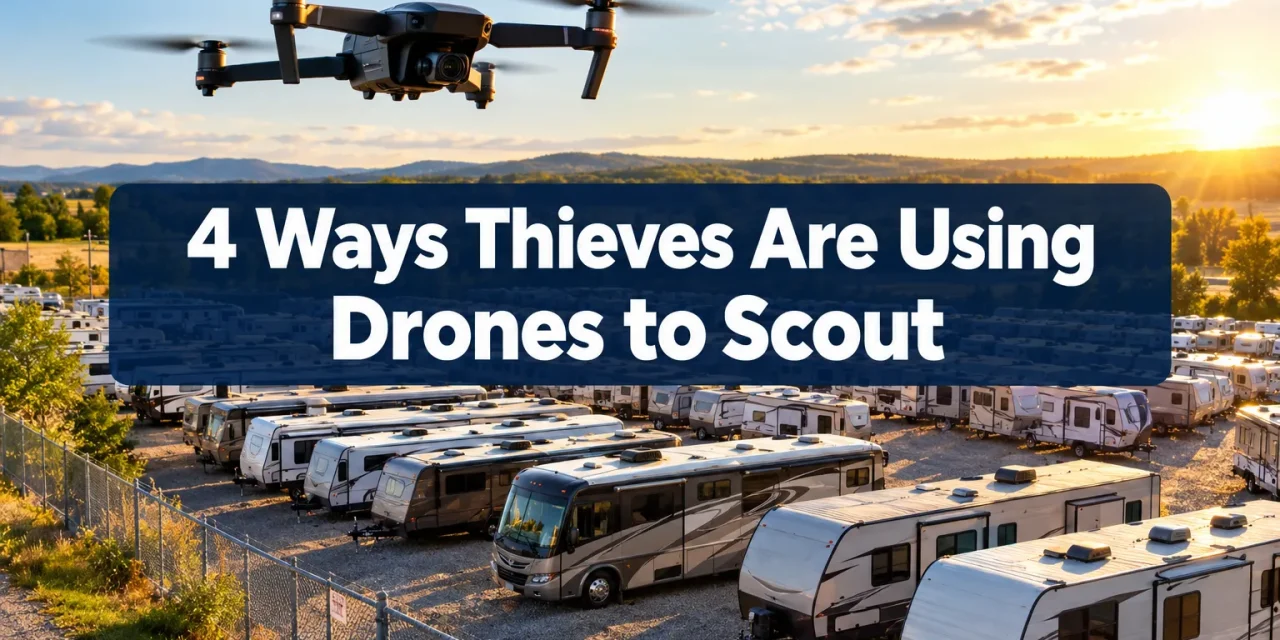
A $100 drone can now do what a thief used to need binoculars, a ladder, and a lot of nerve to do. Fly it over a fence, hover for sixty seconds, and a crook knows exactly where your RV sits, whether anyone is home, and how to get away clean. That is the uncomfortable truth behind 4 Ways Thieves Are Using Drones to Scout Your RV, and it is not science fiction. It is already happening to houses, farms, and storage yards across the country, and RVs are a natural next target.
This guide breaks down exactly how it works, what the research shows, and, most importantly, what RV owners can do about it today.
Key Takeaways
- 🚁 Criminal drone use for scouting property is well documented, with cases dating back to 2015 and still growing today.[1][7][8]
- 🏚️ Thieves use drones to watch rural and semi-rural properties, the same kind of settings where many RVs are stored.[9][14]
- 👀 Drones can check if someone is home using cameras and thermal sensors, timing break-ins for when owners are away.[1][4][10]
- 🗺️ Overhead footage helps thieves map driveways, fences, cameras, and escape routes before they ever step foot on the property.[7][8]
- 👮 Police are also using drones to fight back, including recovering stolen RVs in rural areas in 2026.[2][14]
Why Drones Have Become a Favorite Tool for RV Thieves
Drones used to be toys. Now they are tools. Cheap, quiet, and easy to fly, a basic reconnaissance drone can cost less than a tank of gas.[8][10] That low price tag matters, because it means both small-time thieves and organized crews can afford one.
Security researchers have tracked criminal drone use since at least 2015, and the pattern keeps growing stronger instead of fading away.[7][8][10] Reports describe burglars flying drones over homes, farms, and rural properties to find weak spots before they strike.[1][9][14]
RVs fit right into this picture. Most RVs sit in places that are easy to scout from the air:
- Rural and semi-rural storage lots
- Campground loops with wide-open sites
- Boondocking spots far from town
- Driveways and side yards at home
Law enforcement has already noticed the RV crime connection. Recent RV theft data for 2026 shows a rise in drone use by police to recover stolen units in rural areas, proof that drones and RV crime already share the same airspace.[2] The RV industry itself has described a troubling rise in theft, even calling it a “violent RV theft crime wave” in recent coverage.[5] Put those two facts together, and it is easy to see why RV owners need to pay attention now.
The 4 Ways Thieves Are Using Drones to Scout Your RV
Here are the four main tactics researchers and police have documented. Some are confirmed in home burglary cases. Others are a short, logical step away from RVs sitting in similar settings.
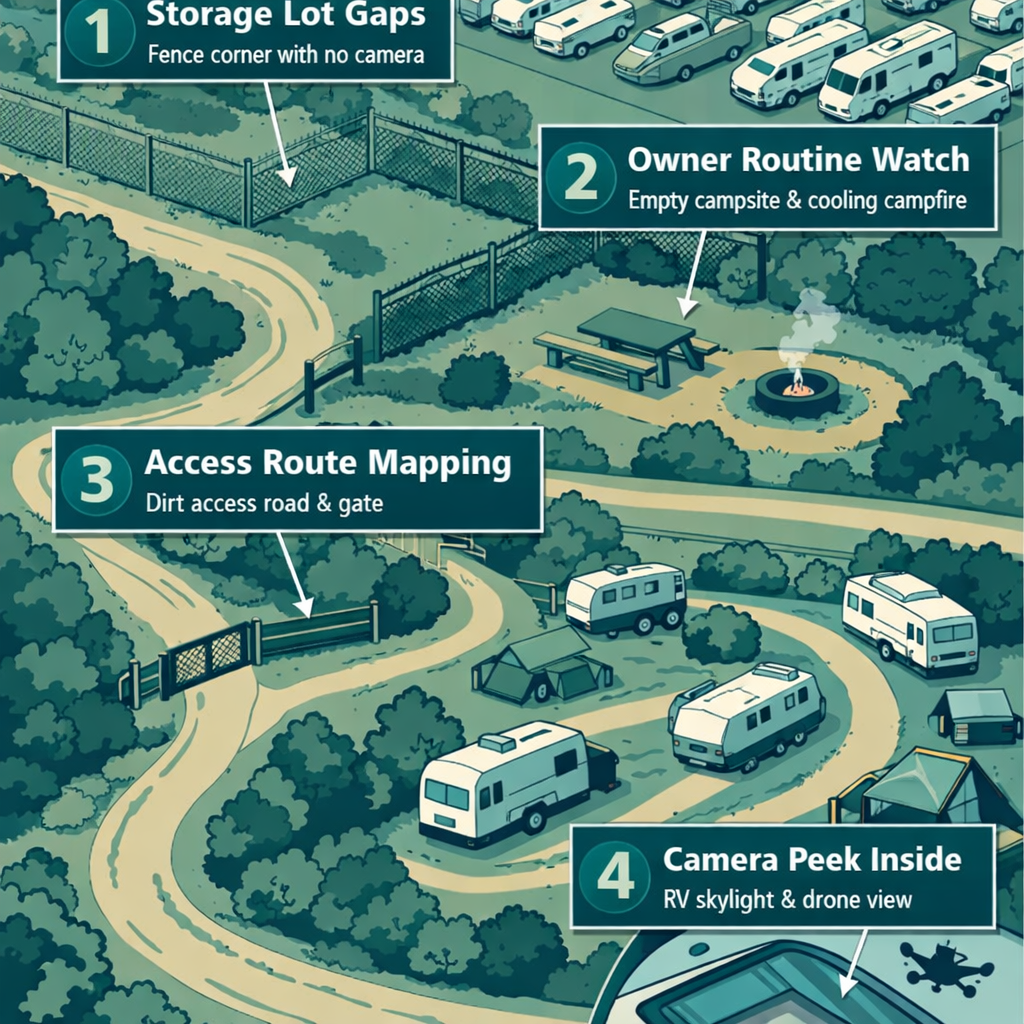
Way 1: Scouting RV Storage Lots and Campgrounds From the Air
Many RVs spend most of the year parked at storage lots, not driveways. These lots are often rural, fenced, and lightly staffed, exactly the kind of property that security experts say drones are built to exploit.[9][14]
From the sky, a thief can quickly spot:
- Gaps or weak spots in perimeter fencing
- Blind spots where security cameras do not reach
- Which RVs look newest, biggest, or most valuable
- Whether staff or security patrols are nearby
A drone can do this scouting in minutes, without the thief ever walking through the gate. Legal and security reports from the UK describe criminals using drones specifically because ground-level scouting is harder on rural and fenced properties.[9][14] A storage lot full of trailers and motorhomes is a near-perfect match for that description.
Way 2: Watching When You Leave and When You’re Home
This is one of the most well-documented drone tactics in criminal cases. Burglars have used drones to hover near expensive homes, watching for signs that the owner has left, lights going off, cars pulling away, no movement for hours.[1][4][11]
Reports from Spain describe burglary crews using drones to time break-ins for when homeowners were away at events.[4] Security incident databases confirm the same pattern across multiple countries, noting that drones let criminals watch a property without ever being seen.[1]
Applied to RV life, this tactic could easily mean:
- Watching a campsite to see when you leave for a hike or a day in town
- Checking if a storage lot RV has moved in weeks (a sign it is rarely visited)
- Timing a theft for the exact window when no one is around
“A drone gives a thief a bird’s-eye view of your routine, something no amount of fence or lock can hide.”
Way 3: Mapping Access Routes, Security Systems, and Escape Paths
Getting in is only half the job for a thief. Getting out matters just as much. Detailed criminal case reviews show burglars flying drones to film driveways, trace alarm wiring, and plan a path in and out that avoids cameras and motion sensors.[7][8]
This overhead view gives thieves something they cannot get from the ground: a full 3D picture of the property.[1][7] They can see:
- Where fences, gates, and locks are placed
- Which roads or trails offer a quick getaway
- Where a lookout vehicle should wait
- Which routes avoid known camera positions
For RVs parked at large storage lots or busy campgrounds, this same mapping tells a thief exactly how to approach a unit and slip away before anyone notices.[7][8]
Way 4: Peering Inside With Cameras, Night Vision, and Thermal Imaging
RVs are basically houses with giant windows and skylights. That is great for natural light on a sunny afternoon. It is not so great when a drone camera is hovering outside.
Research and policy briefings confirm criminals already use drone-mounted cameras to look behind fences and into homes and shops, checking whether lights are on, doors look secure, and valuables are visible.[7][10] Some criminal drones go even further, using thermal and night-vision sensors to tell whether anyone is inside a property, even in total darkness.[1][10]
For an RV, this could mean a thief parked a safe distance away can:
- See through windows or vents to spot electronics, bikes, or generators
- Use thermal imaging to check if the RV is occupied at night
- Watch for security patrols at large storage yards before moving in
None of this requires breaking a single lock. It all happens before the thief ever gets close.
How to Protect Your RV From Drone Surveillance
The good news? RV owners are not powerless here. A few smart habits make drone scouting far less useful to a thief.
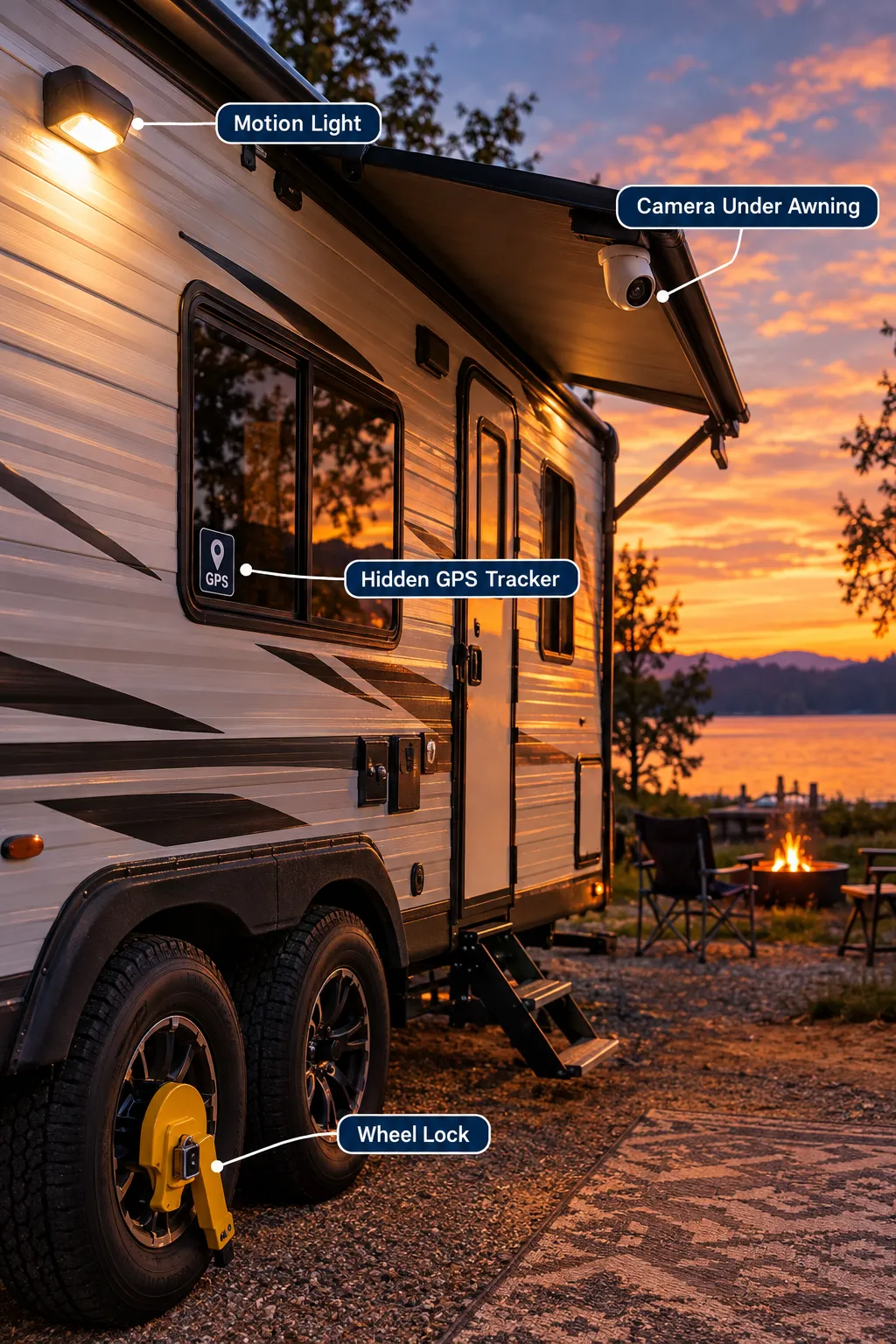
Try these steps:
- Close blinds and skylights when away. This blocks the easiest camera view into your RV.
- Use motion-activated lights. A light that flips on at night can make a drone operator think twice.
- Install a hidden GPS tracker. If your RV does get stolen, a tracker helps police find it fast, and drones are already helping recovery rates climb in rural areas.[2]
- Avoid posting real-time location on social media. Thieves do not need a drone if you hand them your location for free.
- Choose storage lots with strong fencing and active patrols. Legal experts note that well-secured rural properties are harder targets for drone scouting.[9]
- Use wheel locks, hitch locks, and door reinforcements. Even if a thief scouts your rig, physical barriers slow them down and buy time.
- Park near other RVs or high-traffic areas when possible. Isolation is exactly what makes a target attractive from the air.
None of these steps require expensive gear. They just remove the advantages a drone gives a thief.
What Law Enforcement Is Doing About Drone-Scouted RV Theft
It is not all bad news. Police departments are adopting drones too, and using them against the same tactics criminals rely on.
Rural policing programs are expanding drone use to patrol remote fields, barnyards, and large properties where thieves traditionally felt safe.[14] RV-specific theft data backs this up, showing that drone use by law enforcement has helped boost RV recovery rates in rural areas as of 2026.[2]
Regulators are also paying closer attention to drone misuse. Legal analyses warn that flying a drone for criminal surveillance can lead to confiscation of the device and serious legal penalties.[3][9] One notable U.S. case even involved a drone operator tied to drug trafficking activity receiving a 48-month sentence after pleading guilty to an unregistered-drone offense.[3] That case shows courts are willing to treat criminal drone use seriously, which may discourage some would-be RV thieves down the road.
Still, experts caution that drone technology keeps getting cheaper, faster, and more capable.[7][10] That means RV owners should expect drone-based scouting to grow, not shrink, in the coming years, making personal precautions even more important.
Frequently Asked Questions About 4 Ways Thieves Are Using Drones to Scout Your RV
Is drone scouting of RVs already common, or just a future risk? Right now, most confirmed cases involve homes, farms, and businesses rather than RVs specifically.[1][8][11] But RVs are often stored in the exact same rural and semi-rural settings thieves already target, so security experts see it as a natural extension of an existing trend rather than a brand-new threat.[9][14]
Can thieves really see inside my RV with a drone? Yes, in general terms. Documented cases show criminals using drone cameras to peek behind fences and into windows of homes and shops.[7][10][11] RVs with large windows, vents, and skylights could be viewed the same way.
Do drones really use night vision or thermal cameras? Some do. Security incident reports describe criminals equipping drones with thermal sensors to check if a building is occupied, even in the dark.[1][10]
What is the single best defense against drone scouting? Removing the advantage of isolation. Park in well-lit, high-traffic, well-secured areas, close up windows and blinds when away, and use a hidden GPS tracker so recovery is faster if theft does happen.[2][9]
Are police using drones to help RV owners, not just thieves? Yes. Rural law enforcement agencies are increasingly using drones for patrol and recovery, and RV theft data shows this has already improved recovery rates in rural areas.[2][14]
Conclusion
Drones have changed the math for property crime, and RV owners need to understand that shift. The 4 Ways Thieves Are Using Drones to Scout Your RV, scouting storage lots, watching owner routines, mapping escape routes, and peering inside with cameras and thermal sensors, are not far-fetched theories. They are extensions of tactics already proven against homes, farms, and businesses.[1][7][8][9][10][11]
The fix is not complicated. Close the blinds. Add motion lights. Hide a GPS tracker. Choose secure storage. Avoid broadcasting your location online. These small habits strip away the exact advantages a drone gives a thief.
RV life is supposed to feel like freedom, not vulnerability. A little awareness today keeps it that way tomorrow.
References
[1] Dronesec Ttps 2020 2021 – https://www.scribd.com/document/797996428/DroneSec-TTPs-2020-2021 [2] Rv Theft Statistics – https://wifitalents.com/rv-theft-statistics/ [3] The Legal Issues Flying Around The Evolving Drone Market Law360 Official Reprint – https://www.cov.com/-/media/files/corporate/publications/2023/07/the-legal-issues-flying-around-the-evolving-drone-market–law360-official-reprint.pdf [4] R1w7kztm1l – https://www.ynetnews.com/opinions-analysis/article/r1w7kztm1l [5] Violent Rv Theft Crime Wave – https://rvlifestyle.com/violent-rv-theft-crime-wave/ [6] R1w7kztm1l – https://www.ynetnews.com/article/r1w7kztm1l [7] Post Pn 0610 – https://www.aerosociety.com/media/13134/post-pn-0610.pdf [8] Thieves Using Commercial Drones – https://securityaffairs.com/37050/cyber-crime/thieves-using-commercial-drones.html [9] Drones Misuse Them And You Might Lose Them – https://www.dacbeachcroft.com/en/What-we-think/Drones-Misuse-them-and-you-might-lose-them [10] Drones Ing – https://www.prosegurresearch.com/dam/jcr:3ab869bb-2ffc-4d27-97d3-8c46ed9c7118/Drones_ING.pdf