Here’s a number that might sting a little: a brand-new RV can lose about 21% of its value the second it rolls off the dealer lot[5]. That’s before a single mile hits the odometer. Now add in a few “must-have” upgrades that owners swear by, and the value can drop even faster. The truth is, many popular RV options do not protect your investment. Some of them actively hurt it.
This article walks through the 6 “Must-Have” Options That Will Devalue Your RV, based on real resale data and expert advice from RV industry pros. If you love your rig and hope to sell it someday for a fair price, this list is for you. It’s also for anyone shopping for a used RV who wants to know what red flags to watch for.
Key Takeaways
- 🎨 Permanent decorating projects like painted walls and vinyl wallpaper are one of the fastest ways to scare off buyers[14].
- 🚿 Full kitchen and bathroom remodels rarely add value the way home renovations do, they usually do the opposite[12].
- ⚙️ Pricey add-on systems like hydraulic levelers and extra awnings almost never pay back their cost at resale[12].
- 🔨 Irreversible structural changes and custom cabinetry shrink your buyer pool and hurt resale price[9][10].
- 🐾 Smoking and heavy pet damage hurt value more than almost any hardware upgrade you could add[14].
What Makes an RV Lose Value Fast?
RVs are a bit like cars. They lose value the moment they’re used. But unlike cars, RVs also carry a “lifestyle” factor. Owners personalize them the way they would a house. The problem is, an RV is not a house. It’s a vehicle that needs to appeal to a wide range of future buyers.
Think about it this way: a home buyer might love a bold red accent wall. An RV shopper, though, usually wants something that feels neutral and familiar, almost like a rental car. They don’t want to inherit someone else’s taste, and they definitely don’t want to pay extra to undo it[14].
That mismatch between what owners think adds value and what buyers actually want is exactly why the 6 “Must-Have” Options That Will Devalue Your RV keep showing up on “avoid this” lists across the RV world. Owners install them with good intentions. Buyers see them as red flags.
“Just because you love it doesn’t mean the next owner will pay for it.”, a common warning among seasoned RV resellers
The 6 “Must-Have” Options That Will Devalue Your RV
Let’s break down each option one by one. These are the changes that feel like smart, personal upgrades in the moment but quietly chip away at resale price down the road.
1. Permanent Interior Redecorating
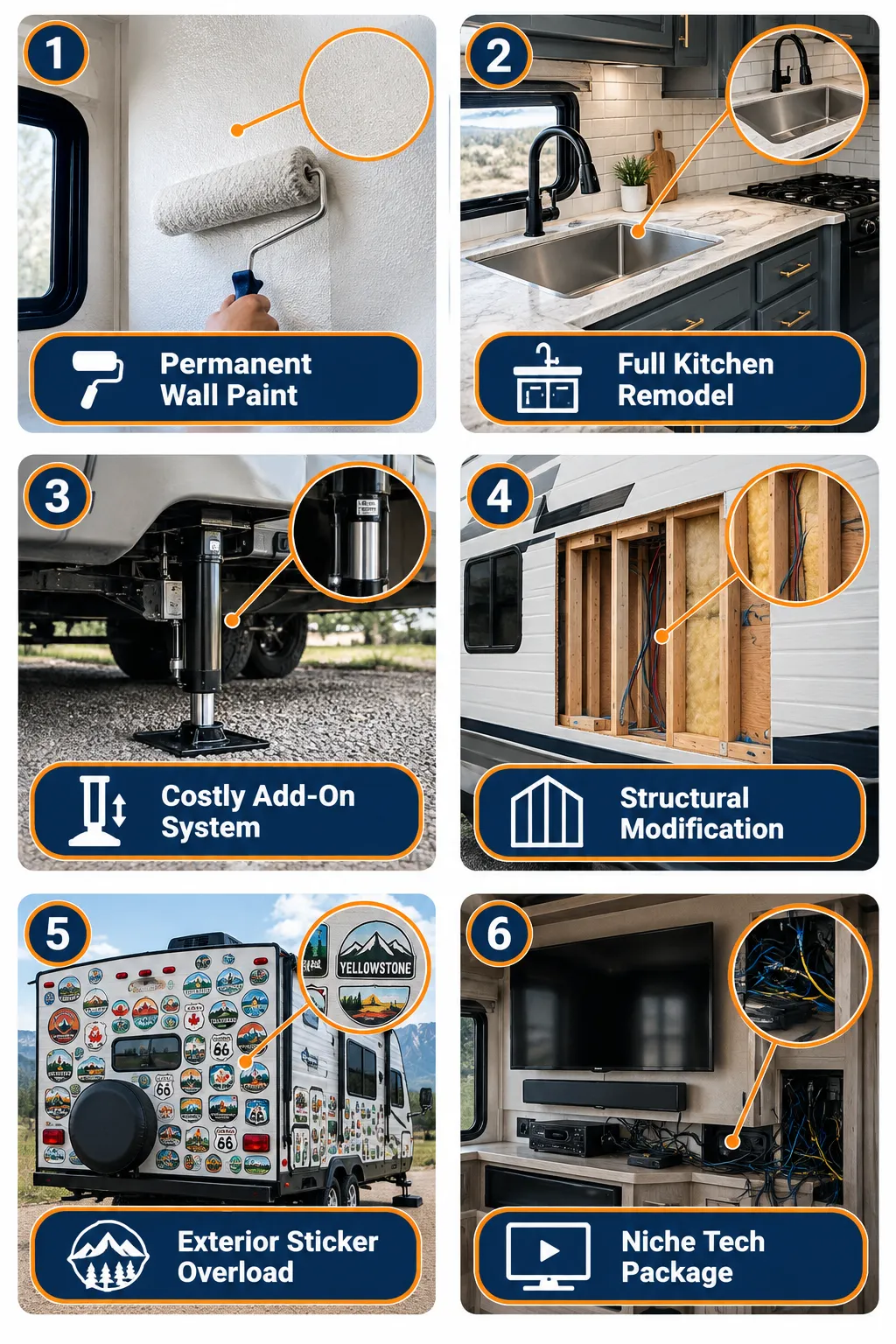
Painting the walls and ceiling. Hanging vinyl wallpaper. Adding fancy trim. Laying carpet over the factory vinyl flooring. These all feel like ways to make an RV feel more like home. Unfortunately, most buyers do not want a home. They want a clean, factory-standard RV they can move into without extra work[14].
RV LIFE’s resale guidance, first published in 2019 and updated again in September 2026, is blunt about this. It tells owners to skip permanent interior decorating projects entirely if resale value matters to them[14]. Once walls are painted or wallpapered, a buyer has to imagine tearing it all out. Most won’t bother. They’ll just walk away and look at a different listing.
Simple rule: If it’s hard to remove, don’t add it.
2. Full Kitchen or Bathroom Remodels
This one surprises a lot of new owners. In a house, a kitchen remodel almost always boosts resale value. In an RV, it’s often the opposite.
The Fun Times Guide puts it plainly: remodeling an RV kitchen or bathroom to look like a real house “will do nothing to increase RV resale value” and will “most likely” make the value go down[12]. That seems backwards, but it makes sense once you think about RV buyers. They expect a certain look and layout. Custom tile, upgraded cabinets, or a bathroom stretched out to feel bigger can throw off the balance of the whole rig, literally, in terms of weight, and figuratively, in terms of buyer expectations.
Remodels also tend to be very personal. A buyer might hate the exact tile pattern or cabinet color the seller loved. That personal mismatch shrinks the pool of interested buyers fast.
3. Expensive Add-On Systems That Never Pay Back
Hydraulic levelers. Extra awnings. High-end backup camera systems. Fancy solar arrays bolted on after the fact. These are often marketed as must-have comfort options, and they truly can make camping more enjoyable. But when it comes to resale, they rarely earn their money back.
The Fun Times Guide warns that these pricey add-on systems “will never regain their investment” and should only be added for personal enjoyment, not as a way to boost resale value[12]. That doesn’t mean they’re bad. It just means owners should think of them as a treat for themselves, not an investment.
Here’s a quick way to picture the mismatch between cost and payback:
| Add-On Option | Feels Like a Must-Have | Resale Reality |
|---|---|---|
| Hydraulic levelers | Convenience upgrade | Rarely recovers cost[12] |
| Extra awning | Comfort boost | Buyers won’t pay extra[12] |
| Custom lighting rig | Personal touch | Neutral at best |
| Premium sound system | Entertainment upgrade | Often seen as clutter |
4. Irreversible Structural Modifications
This is the big one. Cutting into walls to add a slide-out. Building custom cabinetry that doesn’t match the original layout. Changing the floor plan to fit a very specific lifestyle. These changes can feel amazing while living in the RV full-time. But they are some of the hardest things to undo, and buyers know it.
Roamly’s 2026 resale-value overview lists modifications that can’t be easily reversed as one of the top things that hurt resale value[9]. TrueRVs’ 2026 depreciation report backs this up, noting that even upgrades that seem desirable don’t reliably add dollar-for-dollar value[10]. In other words, spending $3,000 on a custom modification does not mean the RV is worth $3,000 more. Sometimes it’s worth less, because the next owner has to either live with a layout they didn’t choose or pay to change it back.
Why this matters so much: Structural changes also raise questions about safety, weight distribution, and insurance. A modified rig can be harder to evaluate and insure, which adds friction to any future sale[9].
5. Aggressive Exterior Personalization
National park stickers. Big travel decals. Custom murals or graphics that go beyond factory paint. These feel like a fun way to show off an adventurous life on the road. Many owners see them as a personal trophy case.
But RV LIFE’s September 2026 update is clear: putting national park stickers and similar travel badges on the exterior “will diminish the value” of the RV[14]. Buyers want a rig that looks close to factory condition, not one covered in someone else’s travel diary. Stickers can also leave sticky residue or faded outlines on the paint or fiberglass once removed, which creates even more work for a future owner.
If showing off travel history matters, a removable magnet or a sticker on a laptop is a much safer bet than one on the RV’s exterior.
6. Over-Customized Tech Packages
Smart owners love gadgets. Elaborate entertainment systems, niche electronics, and hard-wired smart-home style setups can make an RV feel ultra-modern. The problem is that tech ages fast. What feels cutting-edge today can feel outdated in just a couple of years.
Roamly notes that modified rigs, especially those with non-standard tech, can be harder to insure and evaluate[9]. TrueRVs adds that upgrades like solar or electrical changes may improve appeal, but they don’t guarantee a proportional increase in resale price[10]. Good Sam’s own upgrade guidance leans toward practical, broadly useful electronics rather than high-end niche systems, because simple setups appeal to more buyers[2].
A buyer shopping for a used RV usually wants systems that are easy to understand and easy to fix. A tangle of custom wiring for a niche entertainment setup does the opposite. It signals extra risk, not extra value.
Bonus Value Killers Worse Than Any Upgrade
Here’s something that might be even more important than the list above. Some of the biggest resale killers aren’t upgrades at all. They’re lifestyle choices that happen inside the RV every single day.
Smoking and Pet Damage
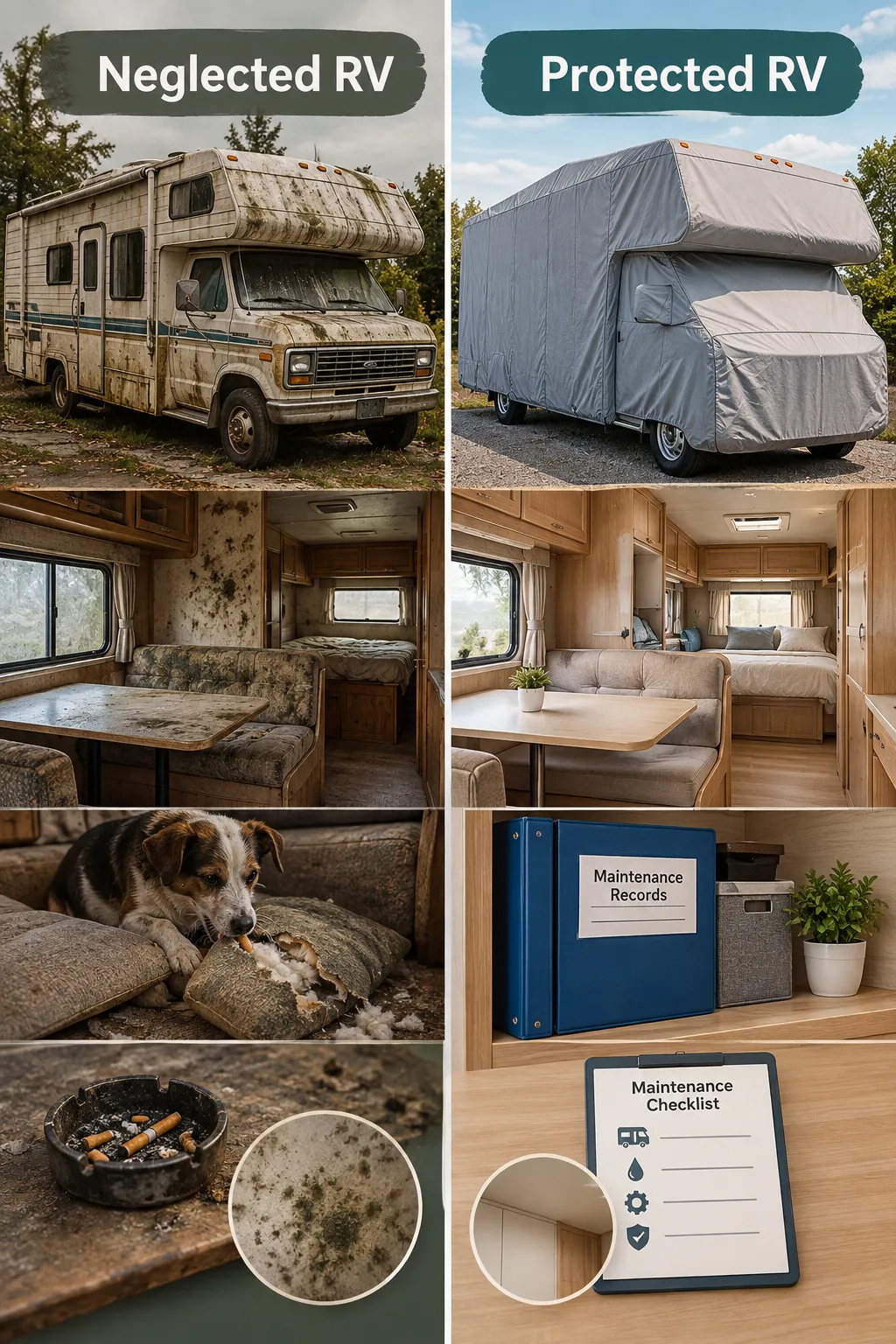
RV LIFE’s 2026 update names these as the number one and number two ways to destroy resale value, ahead of nearly every hardware upgrade on this list[14]. Smoking leaves behind smells and stains that are incredibly hard and expensive to remove. Pet damage, especially scratches, chewed trim, and accidents on carpet or upholstery, can do similar harm.
Neither of these shows up as a “must-have option” on a spec sheet. But they quietly do more damage to resale value than almost anything else an owner can add.
Quick tips to protect against this:
- Keep smoking strictly outside the RV, every time. 🚭
- Use washable, protective covers on furniture if traveling with pets. 🐶
- Clean up pet accidents immediately, not later.
- Consider pet-friendly flooring mats that can be removed before a sale.
Skipping Proper Storage and Maintenance
It’s easy to spend money on shiny new gadgets and forget the boring stuff, like covered storage or proper winterizing. But water intrusion and weathering are consistently named as the single biggest resale-value killers in the RV world[5][9][10].
No Bull RV’s research shows that new RVs lose roughly 21% of value right away, and poor storage habits make that decline worse over time[5]. Roamly agrees, pointing to water damage and deferred maintenance as top resale killers[9]. TrueRVs takes it a step further, saying that preservation, things like proper storage, complete maintenance records, and regular upkeep, matters more for value than most optional upgrades[10].
In short: a boring RV cover and a folder of maintenance receipts can protect resale value better than almost any “must-have” gadget.
What to Do Instead: Smart Upgrades That Protect Resale Value
None of this means owners should live in a bare, boring RV. It just means the smartest upgrades are the ones that are easy to remove or that appeal to almost anyone. Industry trend pieces from 2024 through 2026 increasingly separate “must-have gear” that doesn’t hurt resale from permanent changes that do[1][3][11].
National Vehicle, Camping World, and Extra Space Storage all point toward similar categories of safe, reversible upgrades[1][3][11]:
- LED lighting, easy to install, easy to remove, broadly liked by buyers[1].
- Solar prep or plug-and-play solar kits, useful without permanent rewiring[1].
- Better mattresses, a comfort upgrade that doesn’t touch the structure[11].
- Simple, neutral décor, think swappable throw pillows and curtains instead of paint[3].
- Fresh, neutral repainting done professionally, when it matches factory tones rather than bold personal color choices[3].
Here’s a simple side-by-side to keep in mind before making any changes:
| Type of Change | Effect on Resale Value |
|---|---|
| Removable gear (rugs, pillows, gadgets) | Usually neutral, doesn’t hurt value[1][3] |
| Neutral, factory-style repainting | Can help broad appeal[3] |
| Permanent wall paint or wallpaper | Hurts value[14] |
| Full kitchen/bath remodel | Hurts value[12] |
| Structural modifications | Hurts value, hard to reverse[9][10] |
| Proper storage and maintenance records | Protects value[5][9][10] |
The pattern is simple. Anything that can be swapped out in an afternoon is usually safe. Anything that’s bolted, painted, or built into the walls is risky.
A Simple Checklist Before Adding Any “Must-Have” Option
Before spending money on the next big RV upgrade, run through this short checklist:
- Can it be removed easily? If yes, it’s probably safe.
- Is it a personal taste choice (color, style, layout)? If yes, be cautious.
- Does it change the RV’s structure or layout? If yes, expect it to hurt resale.
- Will most buyers recognize and want this feature? If not, it may narrow the buyer pool.
- Is it protecting the RV (storage, maintenance) rather than decorating it? These almost always help.
This checklist won’t cover every situation, but it catches most of the traps hiding inside the 6 “Must-Have” Options That Will Devalue Your RV.
Conclusion
RVs are meant to be enjoyed, not treated like a museum piece. But there’s a real difference between upgrades that make life on the road better and upgrades that quietly drain resale value. Painted walls, full remodels, pricey add-on systems, permanent structural changes, sticker-covered exteriors, and complex tech packages might feel like must-haves in the moment. In reality, they’re some of the fastest ways to shrink an RV’s future selling price.
The good news is that protecting value doesn’t mean giving up comfort. Simple, reversible upgrades like LED lighting, better mattresses, and neutral décor can make an RV feel just as personal without scaring off buyers later. Add in good storage habits, clean maintenance records, and a no-smoking, pet-friendly approach, and an RV can stay both comfortable now and valuable later.
Next step: Before adding any new feature, ask whether it’s a personal comfort choice or a real investment. If it’s comfort, enjoy it fully, just choose the reversible version whenever possible. That one habit alone can save thousands of dollars down the road.
References
[1] 9 Valuable Upgrades For Your Rv Value – https://nationalvehicle.com/9-valuable-upgrades-for-your-rv-value/
[2] Rv Add Ons To Enhance Rv Value – https://blog.goodsam.com/rv-add-ons-to-enhance-rv-value/
[3] Rv Makeover Ideas – https://www.extraspace.com/blog/home-organization/rv-makeover-ideas/
[5] What Makes Your Rv Lose Value – https://nobullrv.ca/what-makes-your-rv-lose-value/
[9] What Are The Rvs With The Best Resale Value – https://www.roamly.com/learning-center/what-are-the-RVs-with-the-best-resale-value
[10] Rv Depreciation Explained In 2026 What Your Rv Is Really Worth – https://truervs.com/blog/rv-depreciation-explained-in-2026-what-your-rv-is-really-worth/
[12] Fun Times Guide RV Resale Value Guidance – https://www.thefuntimesguide.com/
[14] RV LIFE Resale Value Guidance (2019, updated September 2026) – https://rvlife.com/