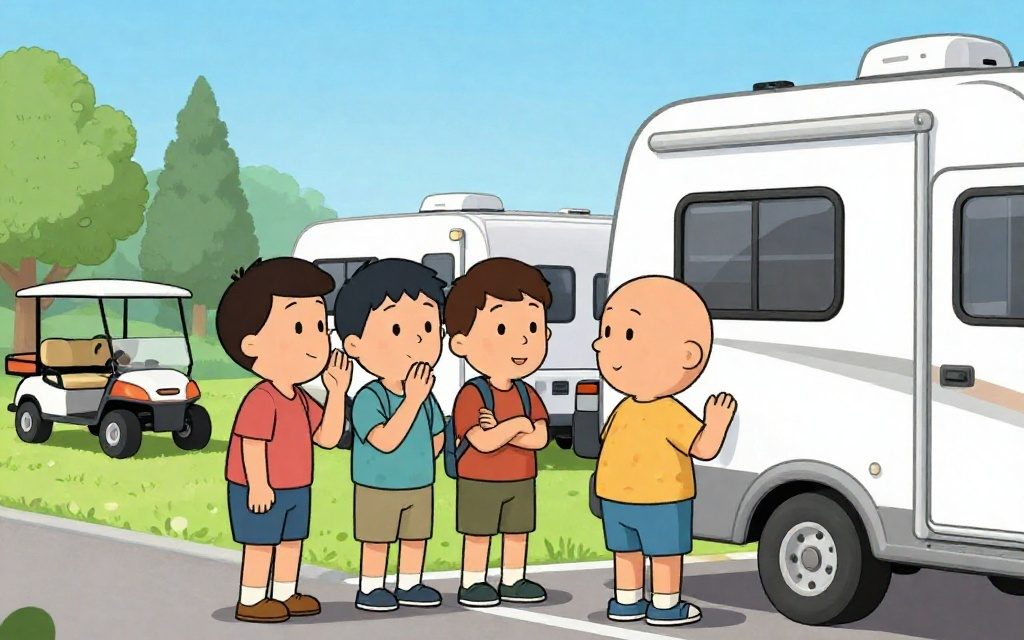
You roll into a peaceful campground at 3 PM, and you don’t speak to a single soul. But by 5 PM, Linda on site 47 somehow knows your truck payment amount, your retirement status, and that you missed backing into your spot by three feet.
Welcome to the wild world of campground rumors, where information travels faster than WiFi (which ironically, barely works). If you’ve ever wondered how complete strangers become FBI-level investigators the moment you pull in, buckle up. We’re diving into the eight most entertaining ways RV campers turn an innocent weekend getaway into a full-blown intelligence operation.
Would you like to save this article?
1. The Arrival Report: When Someone’s Full-Time Job Is Watching You Pull In
You’ve barely turned off your engine and already someone’s catalogued your entire existence. There’s always that one person at every campground whose primary occupation appears to be monitoring arrivals. They’re standing outside with a coffee mug—not drinking it, just holding it like it’s part of some official uniform. Within ten minutes, they’ve gathered more intel than your GPS, the dealership, and your own sense of direction combined.
Before you even locate your site number, they know where you’re from, how long you’re staying, and whether your truck is paid off. Meanwhile, you’re squinting at campground signs that look like they were made in 1987 by someone who genuinely despises clarity.
The wildest part? You never actually see the report being filed. There’s no clipboard, no tablet—just a slow sip of coffee, a knowing nod, and they disappear back to their campsite like a ghost. You haven’t even unpacked your leveling blocks, but somehow the entire campground has decided whether you’re staying two weeks or bolting by Sunday.
According to a survey by the RV Industry Association, approximately 11.2 million households own an RV in the United States, creating massive communities at popular campgrounds. With that many RVers on the road, it’s no wonder campground surveillance has become a full-contact sport.
2. The Mysterious Empty Site: When an Unoccupied Spot Becomes a True Crime Documentary
An empty campsite sitting vacant for more than 12 hours immediately triggers a full-blown conspiracy theory convention. People will stare at an empty picnic table and a reservation tag and create an entire season of a true crime podcast. By sunset, someone has decided there was a dramatic confrontation at the office. By breakfast, there are plot twists involving sheriffs and eviction notices.
Nobody has actual information—the “evidence” is literally just an empty site. But that won’t stop the campground detectives from cracking the case in under six hours. The same people who can’t figure out how to connect to the campground WiFi suddenly become Sherlock Holmes.
Here’s what actually happened: The family is stuck in traffic two exits away, wondering why their six-hour drive turned into nine. But at the campground, every vacant site is just one rumor away from becoming a national incident. People can’t help themselves—they need answers, even when there are no questions.
Data from the National Park Service shows that campground occupancy rates can fluctuate dramatically based on season and location, with some sites experiencing no-shows due to travel delays or cancellations. But don’t let facts ruin a perfectly good conspiracy theory.
3. The Golf Cart Information Network: America’s Backup Communication System
If the internet ever fails, golf carts will become the primary communication infrastructure of America. These slow-moving surveillance vehicles cruise around at 7 mph solving mysteries nobody asked them to solve. The drivers know everything: who left, who arrived, who bought a new camper, and who burned their hot dogs.
You can pull in at noon, and within minutes, someone in a golf cart already knows what state you’re from and that your awning looks suspiciously newer than the rest of your rig. These people gather information at speeds that shouldn’t be humanly possible. Amazon tracking says your package is still three stops away, but the golf cart network already knows it’s a new coffee maker.
They’re never in a hurry, just casually patrolling the grounds like friendly neighborhood spies. The FBI wishes they had surveillance this good. By the end of the weekend, golf cart operatives know more about your camping trip than your relatives back home. And if they ever get equipped with CB radios? Game over. We’re all finished.
4. The New Camper Investigation: When Your Shiny RV Makes You a Celebrity (Whether You Like It or Not)
Nothing attracts attention quite like a brand-new RV rolling into a campground. Pull in with something fresh off the lot and watch the energy shift instantly. People who were too tired to walk to the bathhouse five minutes ago suddenly get a burst of energy to stand on their picnic tables and stare like they’re witnessing a crime scene.
Everybody becomes an expert overnight. Campers who don’t even know how to winterize their own rig are suddenly analyzing factory build quality like they work for Consumer Reports. “Ooh, that’s the new model.” “Nah, I heard he paid too much.” “I heard those have issues.”
Nobody actually knows anything. It’s never based on specs or experience—just vibes and “something a guy who used to work at a dealership once said.” Meanwhile, the new camper owner is just trying to figure out which hose is for fresh water and which one’s going to ruin their weekend.
Every move gets analyzed: how you park, how long it takes to level, whether you put chocks down before you start doubting all your life choices. By the end of the first hour, the entire campground has formed a completely unofficial review. No ratings, no data—just pure speculation delivered with absolute certainty. And somehow, that’s more trusted than anything online.
The RV market has seen explosive growth, with industry reports showing shipments of over 600,000 units in 2021 alone, meaning there’s always fresh meat—er, fresh rigs—for the campground critics to dissect.
5. The Campground Whisper Chain: How “I’m From Ohio” Becomes a Netflix Series
One innocent camper mentions they’re from Ohio. That’s it. That’s the spark. By the time that simple fact makes one lap around the campground, it’s gained three side plots, a backstory, and a suspicious amount of emotional depth.
Three hours later, the rumor mill has decided they sold everything to live in their RV full-time. By morning, they’ve made millions in cryptocurrency. By lunch, they’re traveling across the country on a healing journey from a dramatic life event. By checkout, they’re somehow secretly related to Willie Nelson.
At no point does anybody stop and think, “Wait, that escalated quickly.” Every time the story passes a picnic table, it gains confidence and loses accuracy. Nobody knows how we got from Ohio to crypto-millions and a healing journey, but everybody agrees it sounds plausible enough to repeat anyway.
This phenomenon isn’t unique to campgrounds. Psychologists have long studied the “telephone game” effect, where information degrades and transforms as it passes from person to person. At campgrounds, though, this process happens at warp speed—probably something to do with all that fresh air and free time.
6. The Dog Scandal: When Two Barks Trigger a Community Investigation
Every campground has a dog rumor. Always. Doesn’t matter how peaceful the weekend is—at some point, a dog will bark twice and accidentally trigger a full-scale HOA-level investigation. Two barks. That’s all it takes. Not a bite, not a chase. Just a couple of completely normal, reasonable dog noises in the woods.
Suddenly, the campground transforms into a town hall meeting with folding chairs. Everybody gets involved, not because they were affected, but because they heard about it from somebody walking by. Within an hour, the dog has a reputation. Within three hours, it’s being described as a “pattern.” Someone’s actively documenting how many times the dog looks in a certain direction.
The funniest part? The dog owner has no idea. They’re over there making s’mores, thinking life is completely wonderful. At no point did anybody consider actually talking to them—that would be too simple. By the next morning, people are referencing “what happened last night with that dog,” but it was literally nothing. It was two barks.
According to the American Pet Products Association, millions of pet owners camp with their dogs annually, making canine campground drama practically inevitable. But the overreaction? That’s purely human creativity at work.
7. The Quiet Hour Incident: When One Loud Night Becomes Campground History
There’s always that one loud night. One. And it permanently alters the campground’s historical record. It’s not even that loud in the real world—just loud enough that site 14 looks up from their phone and thinks, “What the heck is happening?”
From that point forward, it’s no longer just “a night.” It’s an incident. By morning, it already has a title—not official, of course (campgrounds don’t do official), just something somebody heard at the dump station. Now it’s locked in forever.
The entire campground remembers the incident, even the people who slept through it perfectly fine. Details don’t matter anymore. In fact, accuracy is actively discouraged. The story improves every time it’s told. Somewhere along the way, it stops being “a loud night” and becomes “the weekend everything got out of control on site 22.”
Nobody actually agrees on what happened, but everybody agrees it was pretty bad. Five years from now, somebody’s going to bring it up like it was a historical event. “Remember what happened on site 22?” And a new generation of campers will lean in, hungry for the legend.
8. Checkout Day Reset: When Yesterday’s Main Character Gets Instantly Deleted
A funny thing happens when people leave: the rumors suddenly stop. The campground FBI loses its target. Just like that, the entire investigation resets. There’s no closure, no follow-up. The campers just vanish from the narrative like they were never there—except for the unofficial documentary everybody’s already assembled in their heads.
By noon, the same people who spent three days analyzing every move are completely focused on the next arrival. It’s like nothing ever happened. A new rig pulls in, and boom—full investigation mode activates. Old campers? Deleted from the memory banks.
It’s not personal. It’s just the system. Because let’s be honest: camping isn’t really about campfires, sunsets, or peace and quiet. It’s about watching complete strangers for three days and somehow feeling like you know their entire life story.
So the next time you pull into a campground, remember: you might think nobody’s paying attention. You might think you’re just another camper. You might think your arrival went completely unnoticed. But it didn’t. By the time you’re finished leveling, somebody’s already formed three opinions, two theories, and a completely inaccurate backstory. And honestly? That’s the fun part.
What’s Your Favorite Campground Rumor?
Campgrounds are the only place where complete strangers spend three days analyzing each other like it’s an Olympic sport. Have you ever been the subject of campground gossip? Or better yet, have you been the one stirring the pot?
Drop your funniest campground rumor in the comments—just remember, whatever story you’re about to share probably started with a guy in a golf cart holding a coffee mug.
SOURCES
- RV Industry Association – https://www.rvia.org/
- National Park Service Campground Data – https://www.nps.gov/
- American Pet Products Association – https://www.americanpetproducts.org/
- The Camping Loop YouTube Channel – https://www.youtube.com/@Thecampingloop