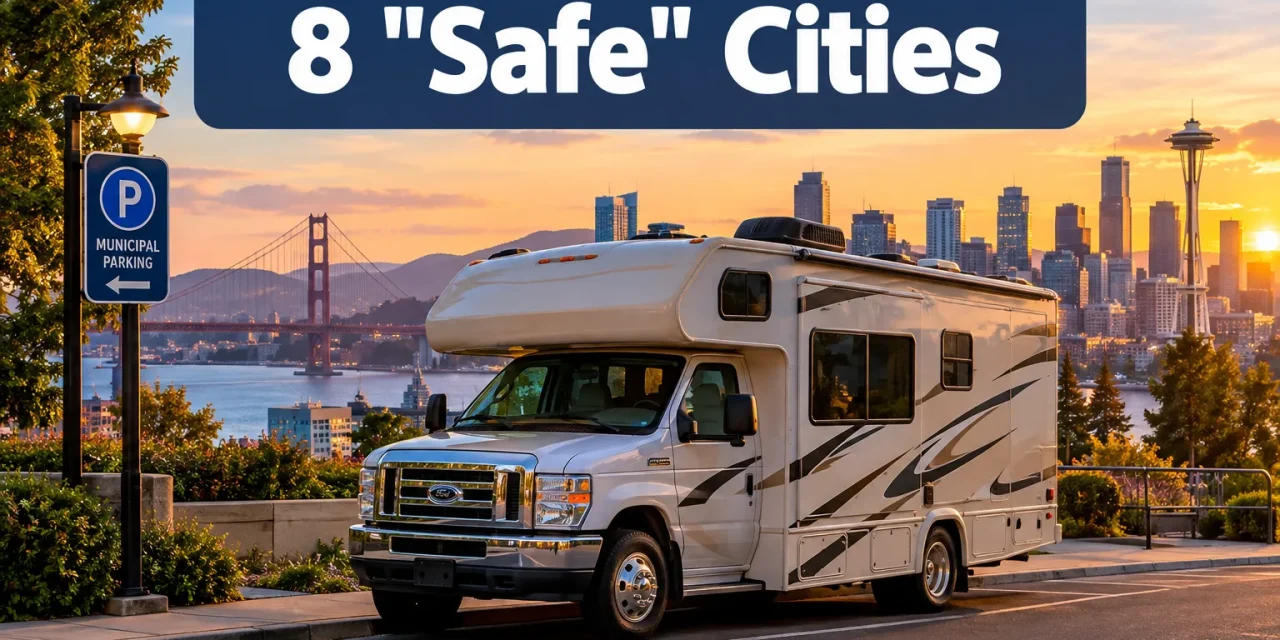
Nearly 7,000 tickets. That’s how many citations San Diego police handed out in just one year to RVers who thought they’d found a quiet, safe street to sleep on overnight.[6] This is not a story about sketchy back alleys or crime-ridden neighborhoods. These are cities with good lighting, friendly neighbors, and low crime rates. They feel safe. But “feels safe” and “is legal” are two very different things when it comes to overnight RV parking.
This guide breaks down 8 “Safe” Cities That Are Actually Dangerous for Overnight RV Parking in 2026. Some of these spots look perfect on paper, clean streets, nice views, close to attractions. But park your rig overnight and you could wake up to a $108 ticket, a tow notice, or worse, an empty parking spot where your RV used to be.[1]
Key Takeaways
- 🚨 “Safe” doesn’t mean “legal.” Many low-crime cities have strict overnight RV parking bans that have nothing to do with safety.
- 💰 Fines add up fast. San Francisco issues $108 citations for oversized vehicles, and San Diego has handed out nearly 7,000 tickets in a single year.[1][6]
- ⏰ Time limits are shrinking. Cities like San Francisco, Seattle, and several Bay Area suburbs now enforce 2-hour daytime limits and 2 a.m.,6 a.m. overnight bans.[1][3][10]
- 🏘️ Quiet suburbs aren’t safer legally. San Jose, Palo Alto, Fremont, and San Leandro all enforce tough oversized-vehicle rules, even in sleepy residential zones.[3][7][11]
- 🅿️ Truck stops and RV-friendly lots beat city streets. Industry safety guides now recommend assuming city street parking is illegal unless proven otherwise.[8][9]
Why “Safe” Doesn’t Mean Legal for Overnight RV Parking
Here’s the honest truth: RV travelers often judge a parking spot by how it feels. Good lighting? Check. Quiet street? Check. Close to a Target and a Starbucks? Check, check.
But cities don’t measure risk by how safe a block feels. They measure it with code enforcement officers, parking apps, and tow trucks. A 2026 policy review of RV overnight parking laws found that more and more cities are banning overnight RV parking outright, and the list of restrictive jurisdictions is “growing.”[2]
That means the nicest, most peaceful-looking street in a major metro can be the exact spot where an RV gets ticketed or towed before sunrise. This article unpacks the 8 “Safe” Cities That Are Actually Dangerous for Overnight RV Parking, why each one cracked down, and what smarter alternatives look like.
The 8 “Safe” Cities That Are Actually Dangerous for Overnight RV Parking
Below are the eight cities RV travelers keep getting burned in, even though each one has a reputation for being clean, friendly, and low-crime.
1. San Francisco, California
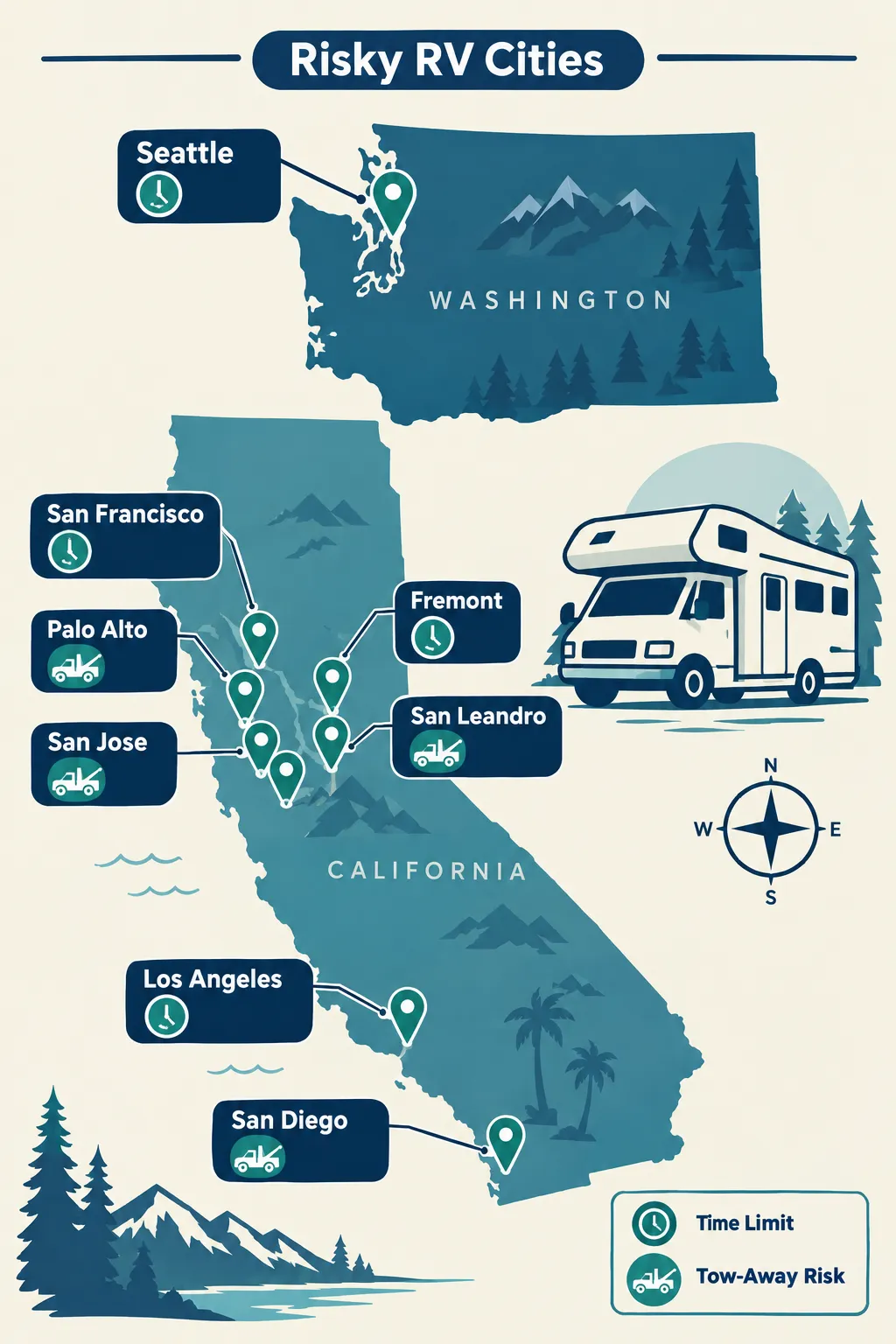
San Francisco looks like a dream for city-adjacent RV travel: iconic views, walkable neighborhoods, tons of amenities. But new rules rolled out in late 2025 and heavily enforced through 2026 ban any vehicle taller than 7 feet or longer than 22 feet from parking on city streets for more than two hours.[1][11][13]
Break that rule and you’re looking at a $108 fine, and your RV could get towed.[1]
On top of the two-hour limit, San Francisco enforces a 72-hour rule citywide and adds extra “sensitive zone” restrictions near schools, parks, hospitals, and critical infrastructure. Outreach teams post signage before enforcement begins, so a spot that seemed fine on day one can turn into a ticket by day three.[1][11]
Bottom line: Unless you’ve confirmed a legal RV-friendly lot, don’t plan on sleeping in your rig on San Francisco streets.
2. San Diego, California
San Diego’s sunny beaches and laid-back vibe make it feel like the perfect low-stress RV stop. It is not.
The city now bans overnight RV parking citywide between 2 a.m. and 6 a.m. unless you’re a resident with a special permit.[6][10][12] Local reporting shows nearly 7,000 tickets issued in a single year under this crackdown.[6]
It gets more serious: in May 2026, a federal judge sided with the city, confirming San Diego’s right to keep ticketing overnight RV parkers.[6] That ruling closed the door on legal challenges RVers had hoped might loosen the rules.
Even San Diego’s most scenic beach parking, like the lots around Mission Bay, close to vehicles from roughly 2 a.m. to 4 a.m. Any RV left behind can get cited.[12] That gorgeous sunset view comes with a hidden curfew.
3. Los Angeles & Venice, California
Los Angeles and its beachy Venice neighborhood are packed with RV travelers chasing palm trees and ocean air. But the city has expanded its “No Oversize Vehicle Parking” zones aggressively.
Many LA streets now ban overnight parking for vehicles longer than 22 feet and taller than 7 feet.[5][10] A 2026 city motion went even further, calling for increased ticketing and towing of RVs considered nuisances.[5][10]
The result? Streets that look well-lit, busy, and totally normal during the day can become high-risk zones the moment the sun goes down.
4. Seattle, Washington
Seattle has a reputation as a progressive, community-minded city, the kind of place RVers assume will be tolerant of overnight parking. That reputation doesn’t match the current rulebook.
In August 2026, the Seattle City Council unveiled a sweeping six-piece legislative package that includes a formal RV parking ban plus a two-hour daytime limit, echoing crackdowns already happening up and down the West Coast.[4][10]
Seattle already restricted overnight parking on many residential streets between roughly 1 a.m. and 6 a.m. With the new package, RVs that stay in the city overnight are increasingly pushed toward industrial zones just to avoid tickets.[10]
“The main danger in many ‘safe’ cities isn’t crime, it’s the knock on your door at 3 a.m. from a parking enforcement officer.”
5. San Jose, California
San Jose is a Bay Area suburb that feels worlds away from downtown San Francisco’s chaos, quieter streets, more families, less congestion. But the city has become one of the most aggressive enforcers of RV parking rules in the region.
San Jose layers temporary RV bans near schools, a 72-hour citywide limit, and strict 2 a.m.,6 a.m. bans on oversized vehicle parking in residential zones.[3][7][11]
The enforcement is working, for the city, anyway. Officials report that this combination of bans, towing unregistered vehicles, and targeted patrols near schools has reduced RVs on certain streets by about 60%.[7] That’s a clear signal: authorities are actively removing overnight RVs even in neighborhoods that feel completely safe and family-friendly.
6. Palo Alto, California
Palo Alto is one of the most affluent, manicured cities in the Bay Area. It’s exactly the kind of place an RV traveler might assume is “too nice” to bother with strict enforcement. Wrong assumption.
Palo Alto’s ordinance prohibits oversized vehicles, trailers, and camper shells from parking on streets or alleys in residential and public-facility zones between 2 a.m. and 6 a.m.[3] The city also runs enhanced towing for unregistered vehicles.
A quiet, tree-lined street in Palo Alto might look like the safest overnight spot in the Bay Area. In reality, it’s one of the most actively patrolled.
7. Fremont, California
Fremont rounds out the Bay Area’s cluster of deceptively strict suburbs. Like its neighbors, Fremont enforces layered oversized-vehicle rules: temporary bans near schools, citywide time limits, and strict overnight restrictions in residential zones during the same 2 a.m.,6 a.m. window used across the region.[3][7][11]
Fremont’s low crime rate and suburban calm make it tempting for overnight parking. But that calm is backed by consistent code enforcement, not a blind eye toward RVs.
8. San Leandro, California
San Leandro closes out this list of 8 “Safe” Cities That Are Actually Dangerous for Overnight RV Parking. Like San Jose, Palo Alto, and Fremont, it enforces the same pattern of rules now common across Bay Area bedroom communities: temporary RV bans, 72-hour limits, and overnight bans on oversized street parking in residential areas.[3][7][11]
Together, these four Bay Area suburbs show a clear trend: just because a city feels quieter and safer than its big-city neighbor doesn’t mean it’s more welcoming to overnight RVs. If anything, these “safe” bedroom communities have doubled down on enforcement to keep it that way.
How to Tell If a “Safe” City Is Actually a Parking Trap
Before trusting any city block for an overnight stay, run through this quick checklist:
| Warning Sign | What It Means |
|---|---|
| 🚧 Signs mentioning “oversized vehicle” rules | Likely a 2-hour or overnight ban in effect |
| 🕑 Posted hours like “2 a.m.,6 a.m.” | Classic West Coast overnight RV ban window |
| 🏫 Parking near a school, park, or hospital | Common “sensitive zone” enforcement area |
| 📅 “72-hour parking limit” signs | City tracks how long your RV has sat there |
| 🧹 Street cleaning schedules posted | Tow trucks often follow these schedules closely |
If you see two or more of these signs, treat the spot as a no-go for overnight RV parking, no matter how quiet or safe the block looks.
Safer Alternatives to Risky Overnight RV Parking in These Cities
Instead of gambling on a city street, lean on these tested alternatives. Industry safety guides updated in mid-2026 now advise RV travelers to assume street overnighting is illegal unless they’ve specifically confirmed otherwise.[8][9]
Here’s where to look instead:
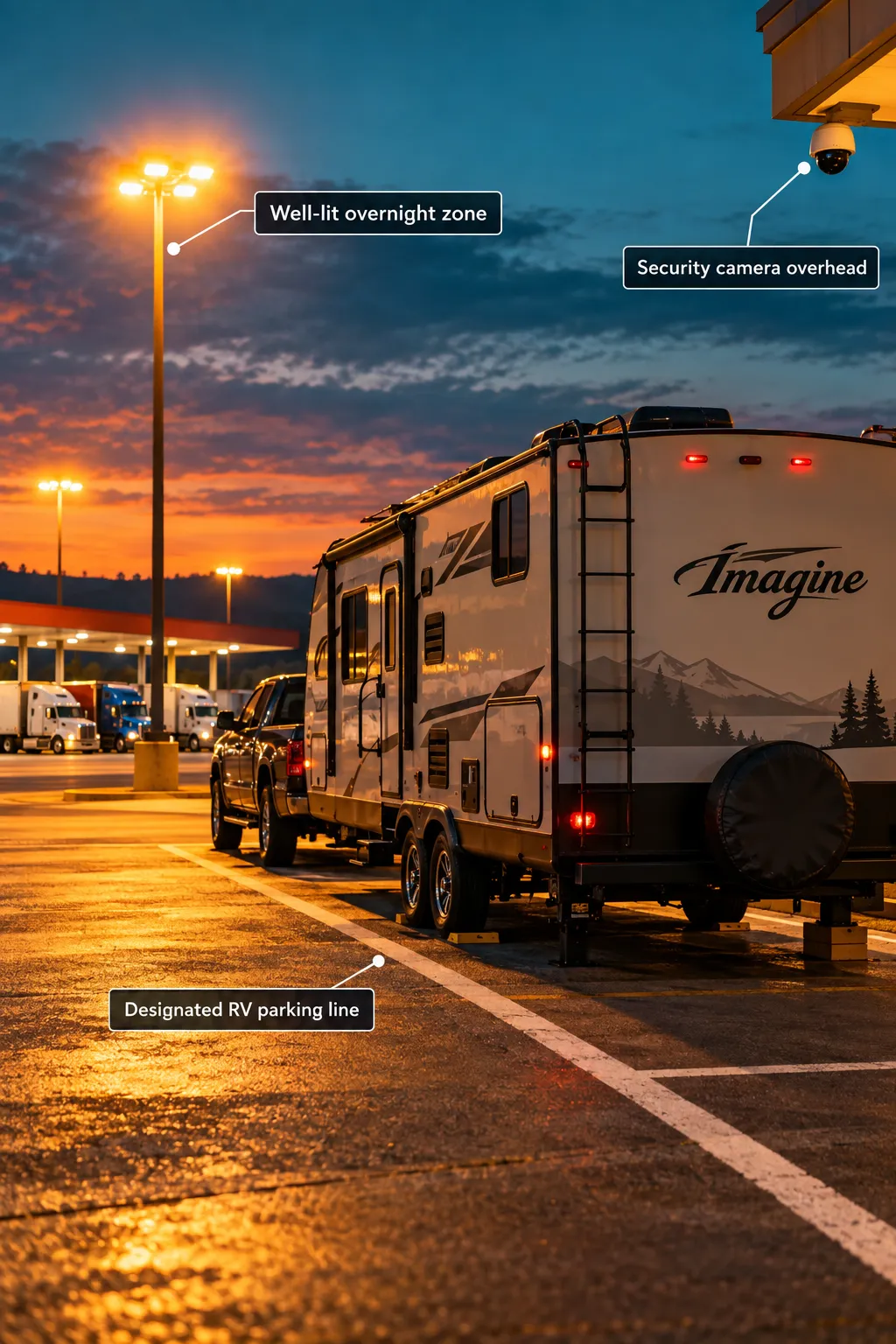
- Truck stops. Well-lit, high-traffic, and built for overnight stays. Security is usually solid, and staff are used to RVs.[8][9]
- Designated RV-friendly lots. Some grocery stores, casinos, and big-box retailers still allow overnight parking with permission. Always call ahead.
- State and county campgrounds. Slightly more planning required, but legal and often scenic.
- RV resorts and membership parks. Great for longer stays near big cities like San Francisco, LA, or Seattle.
- Boondocking apps and RV-specific tools. Use them to confirm current rules before you park, laws change fast in 2026.
Quick Tip: Always call the local police non-emergency line or check the city’s official parking page before settling in for the night. A five-minute phone call beats a $108 ticket.[1]
What Happens If You Get Caught Parking Overnight in These Cities
Getting cited for illegal overnight RV parking usually plays out one of three ways:
- A warning or citation. San Francisco’s fine sits at $108 per violation, and repeat offenses add up fast.[1]
- Towing. Many cities, including San Diego and Los Angeles, now prioritize towing oversized vehicles flagged as “nuisances.”[5][10]
- Court involvement. San Diego’s legal fight over its overnight ban reached a federal judge in May 2026, and the city won the right to keep enforcing it.[6]
None of these outcomes are worth the risk of a “free” overnight spot that looked safe on the surface.
Frequently Asked Questions About Overnight RV Parking in “Safe” Cities
Is it illegal to sleep in an RV on a city street?
In many cities on this list, yes, especially between roughly 2 a.m. and 6 a.m. Rules vary, so always check local ordinances first.[2][3]
Why are “safe” neighborhoods cracking down so hard?
Cities are responding to complaints about long-term RV dwelling, street congestion, and infrastructure strain, not necessarily crime. Enforcement is about code compliance, not neighborhood danger.[1][7]
Are truck stops really safer than quiet residential streets?
For legality and lighting, yes. Van-life and RV travel experts consistently recommend truck stops and designated lots over residential blocks, which are more likely to trigger towing tied to street cleaning schedules.[4][9]
Do these rules apply to all RVs, or just older/unregistered ones?
Most size-based rules (like the 7-foot height, 22-foot length limits) apply to any oversized vehicle, regardless of age or registration status.[1][5]
Final Thoughts on the 8 “Safe” Cities That Are Actually Dangerous for Overnight RV Parking
The cities on this list, San Francisco, San Diego, Los Angeles, Seattle, San Jose, Palo Alto, Fremont, and San Leandro, all share one thing in common: they feel safe, but they’re legally risky for overnight RV parking in 2026.
The smartest move is simple. Stop judging a parking spot by how it looks and start judging it by what the signs, city codes, and local rules actually say. Call ahead. Check posted signage. When in doubt, head for a truck stop or RV-friendly lot instead of rolling the dice on a quiet-looking street.
A little research before dark can save hundreds of dollars, and a whole lot of stress, before sunrise.
References
[1] San Francisco Rv Ban Daniel Lurie Housing Vouchers – https://missionlocal.org/2026/09/san-francisco-rv-ban-daniel-lurie-housing-vouchers/
[2] Rv Overnight Parking Laws By State – https://rvrove.com/blog/rv-overnight-parking-laws-by-state/
[3] City Stymied In Reducing Rv Parking – https://padailypost.com/2026/07/07/city-stymied-in-reducing-rv-parking/
[4] Overnight Parking Van Life Cities – https://www.vanyage.com/blog/overnight-parking-van-life-cities
[5] Rv Parking Venice Oversized Vehicles Tickets – https://spectrumlocalnews.com/ca/california/transportation/2026/08/27/rv-parking-venice-oversized-vehicles-tickets
[6] Sdpd Issues Nearly 7 000 Tickets In A Year Of Overnight Rv Parking Crackdown – https://www.10news.com/news/we-follow-through/sdpd-issues-nearly-7-000-tickets-in-a-year-of-overnight-rv-parking-crackdown
[7] Rv Bans In San Jose Reduces Vehicles On Streets By 60 – https://sanjosespotlight.com/rv-bans-in-san-jose-reduces-vehicles-on-streets-by-60/
[8] Overnight Rv Parking – https://www.bluettipower.com/blogs/power-solution/overnight-rv-parking
[9] Rv Overnight Parking Rules To Remember Helpful Resources – https://www.winnebago.com/lifestyle/winnebagolife/education/rv-overnight-parking-rules-to-remember-helpful-resources
[10] Seattle City Council Unveils Comprehensive Six Piece Legislative – https://www.westsideseattle.com/ballard-news-tribune/2026/08/11/seattle-city-council-unveils-comprehensive-six-piece-legislative