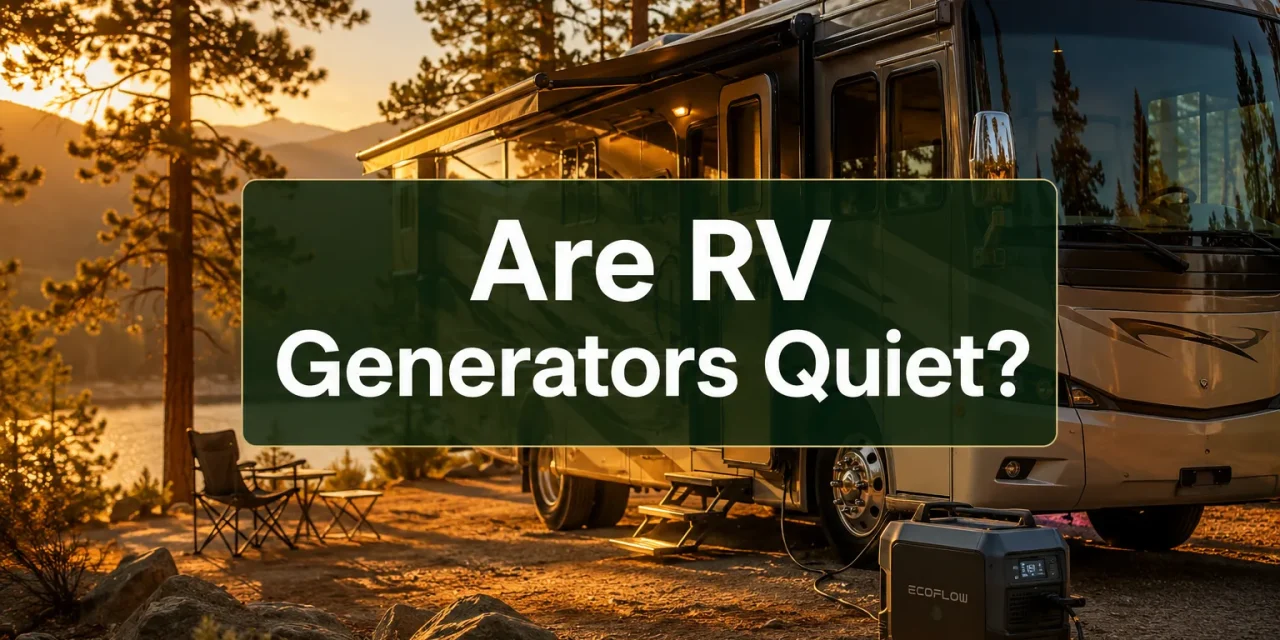
Every year, thousands of RV trips get ruined, not by bad weather or flat tires, but by a noisy generator that drives neighbors crazy at the campsite. So are RV generators quiet enough to use without causing drama? The answer depends entirely on the type of generator you bring. In 2026, the good news is that modern inverter generators have changed the game completely, with many models running as quietly as a normal conversation. This guide breaks down everything RV lovers need to know about generator noise.
Key Takeaways
- ✅ “Quiet” means 60 dB or less at 23-25 feet, about the volume of a normal conversation
- ✅ Inverter generators are the quietest option, often running at 48-58 dB
- ✅ Conventional generators are much louder (65-75+ dB) and often break campground rules
- ✅ Most campgrounds and national parks set noise limits around 50-60 dB
- ✅ Top quiet models in 2026 include the Honda EU2200i and Westinghouse iGen5000
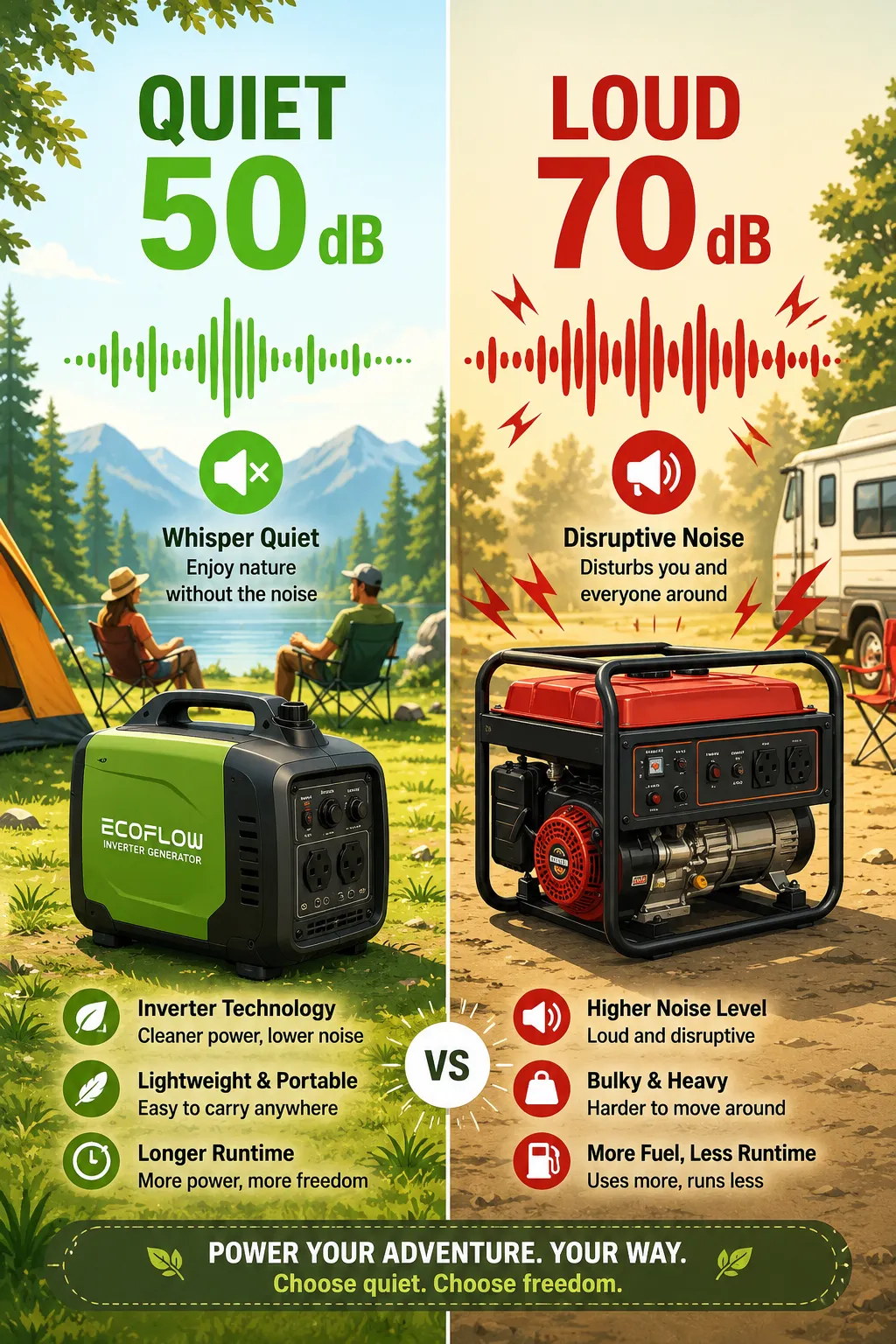
Are RV Generators Quiet? Understanding the Noise Scale
Before answering whether RV generators are quiet, it helps to understand how noise is measured. Generator noise is rated in decibels (dB). The higher the number, the louder the sound.
Here is a simple guide to common sounds and their dB levels:
| Sound | Decibel Level |
|---|---|
| Whisper | ~30 dB |
| Normal conversation | ~60 dB |
| Busy restaurant | ~70 dB |
| Lawn mower | ~90 dB |
| Rock concert | ~110 dB |
💡 Pull Quote: “A generator running at 60 dB sounds like two people chatting across a picnic table, totally manageable at a campsite.”
Generator noise is always tested at a distance of 23-25 feet. That is roughly the space between two campsites at a typical campground. [1] This matters a lot because sound gets quieter as you move farther away.
What Does “Quiet” Actually Mean for a Generator?
Most experts and campground guides agree: a generator is considered quiet when it runs at 60 dB or below at 23-25 feet. [1][4][5] Some ultra-quiet models go even lower, below 50 dB at light load. [2][5]
Here is how the three main generator types stack up:
- 🟢 Closed-frame inverter generators: ~48-58 dB (very quiet)
- 🟡 Open-frame inverter generators: ~55-65 dB (moderate)
- 🔴 Conventional open-frame generators: ~65-75+ dB (loud) [1][5][13]
So when someone asks “are RV generators quiet,” the honest answer is: it depends on which type you choose.
Why Campground Noise Rules Matter
Most campgrounds and national parks set strict noise limits. Many cap generator noise at 50-60 dB at 23-25 feet. Some parks allow up to 60 dB at 50 feet. [1][4][7] Going over these limits can lead to complaints from neighbors, or even fines. [2][4][7]
Quiet hours are especially important. Many campgrounds enforce complete generator silence between 10 PM and 6 AM. Breaking these rules can get an RVer kicked out of the park.
The Three Types of RV Generators: Which Is Quietest?
Not all RV generators are created equal. Understanding the three main types makes it much easier to pick the right one.
1. Closed-Frame Inverter Generators 🏆
These are the quietest generators available for RV use. They have a fully enclosed housing that muffles the engine noise. They also use inverter technology, which adjusts engine speed based on power demand. Less power needed = slower engine = less noise. [1][5]
Typical noise level: 48-58 dB at 25 feet
These are the gold standard for campground use. They meet, and often beat, campground noise limits. [1][2][5]
2. Open-Frame Inverter Generators
These use the same smart inverter technology but have an open frame design. The engine is more exposed, so more noise escapes. They are still quieter than conventional generators but louder than closed-frame models. [1][5][13]
Typical noise level: 55-65 dB at 25 feet
They can work at some campgrounds but may be too loud during quiet hours or at strict parks.
3. Conventional Open-Frame Generators
These are the loudest option. They run at a fixed engine speed no matter how much power is being used. This makes them noisy all the time. [1][5][13]
Typical noise level: 65-75+ dB at 25 feet
⚠️ Warning: Conventional generators are commonly described as “too loud” for close neighbors at campgrounds. [1][4][7][13][15] Many RV parks will ask users to turn them off.
Are RV Generators Quiet Enough for Campgrounds? Rules to Know
This is one of the most important questions for RV lovers. The short answer: modern inverter generators usually are quiet enough, conventional ones often are not.
Common Campground Noise Rules in 2026
- Most campgrounds limit generator noise to 60 dB or less at 23-25 feet [1][4][7]
- Some national parks are stricter, requiring 50 dB or below [4][12]
- Quiet hours typically run from 10 PM to 6 AM or 7 AM
- Breaking rules can result in warnings, fines, or being asked to leave [2][4][7]
Tips for Staying Within Noise Limits
Here are some simple ways to keep generator noise low at a campsite:
- Choose a closed-frame inverter generator, it is the easiest fix
- Place the generator away from neighbors, distance reduces sound
- Use a generator tent or sound deflector, these can cut noise by 5-10 dB
- Run the generator at lower loads, inverter generators get quieter under light use
- Check the campground’s specific rules before arrival [2][5][8]
Top Quiet RV Generators Worth Considering in 2026
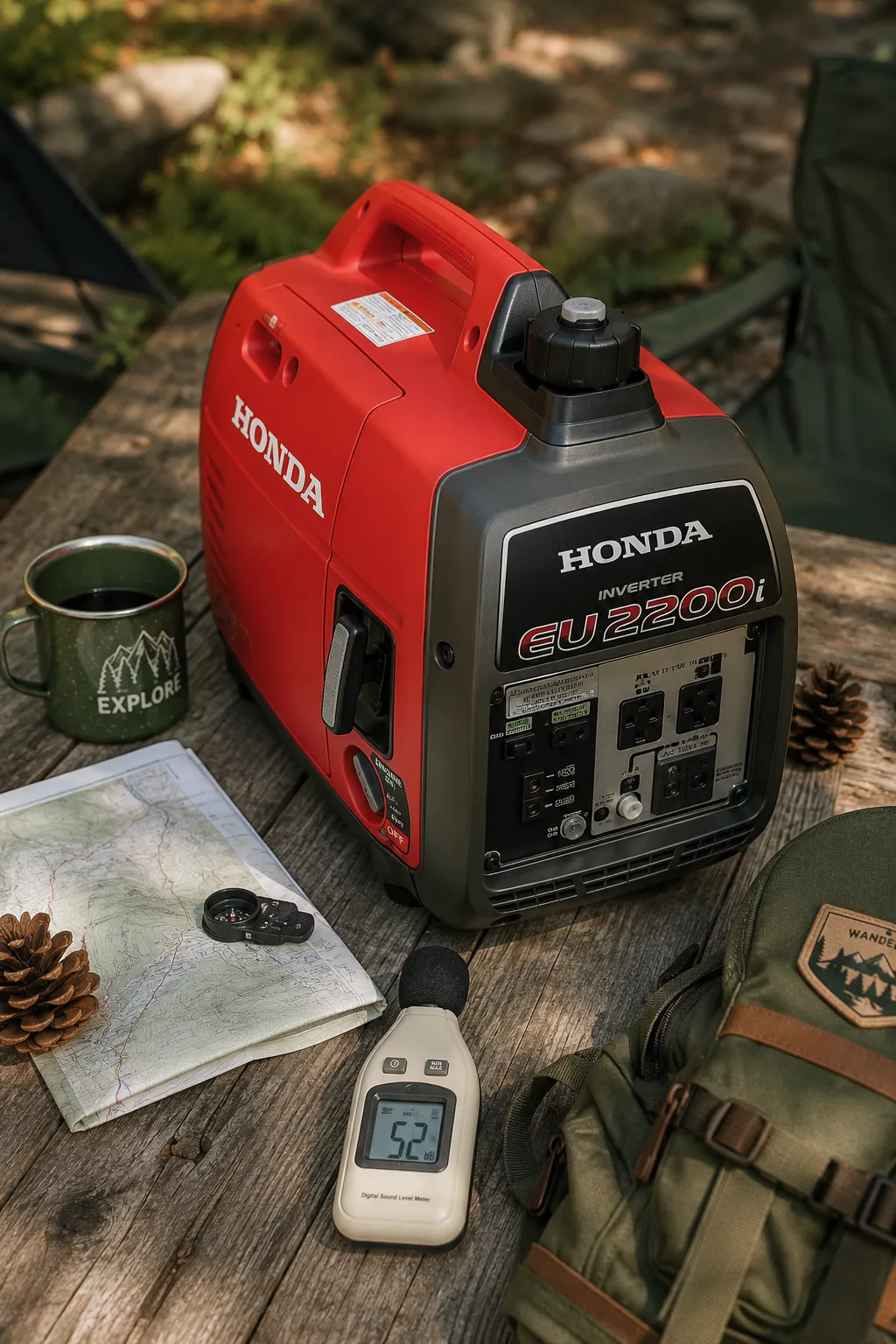
Buying guides in 2026 consistently highlight a handful of models as the best quiet options for RV use. Here are some top picks that RV lovers should know about. [7][8][13]
Honda EU2200i

The Honda EU2200i is one of the most popular quiet generators for RV use. It runs at just 48-57 dB while delivering 2,200 watts of power. [7][13] That is impressively quiet for a generator that can run an air conditioner or multiple appliances.
Key facts:
- Noise level: 48-57 dB at 25 feet
- Running watts: 1,800 W
- Peak watts: 2,200 W
- Fuel type: Gasoline
- Weight: ~47 lbs
Westinghouse iGen5000

For RVers who need more power without sacrificing quiet, the Westinghouse iGen5000 is a strong choice. It runs at around 52 dBA while delivering 3,900 running watts. [7][8] That is enough to power most RV air conditioners plus other appliances.
Key facts:
- Noise level: ~52 dBA at 25 feet
- Running watts: 3,900 W
- Peak watts: 5,000 W
- Fuel type: Gasoline
- Weight: ~104 lbs
Compact 2,000-2,300 W Inverter Models
Many budget-friendly inverter generators in the 2,000-2,300 W range also perform well in the low-50s dBA range. [5][8] These are great for RVers who do not need a lot of power but want to stay campground-friendly.
What to Look for When Buying a Quiet RV Generator
2026 buying guides strongly recommend focusing on these features: [2][5][8][12][13]
- ✅ Noise rating below 60 dB at quarter load
- ✅ Inverter technology for variable engine speed
- ✅ Closed-frame design for maximum noise reduction
- ✅ Parallel capability (run two small units instead of one big loud one)
- ✅ Eco mode to reduce speed and noise at low loads
How to Make Any RV Generator Quieter
Even a decent generator can be made quieter with a few smart tricks. Here are the best methods RV lovers use:
Use a Generator Enclosure or Quiet Box
A generator tent or sound-dampening box can reduce noise by 5-15 dB. These are portable, easy to set up, and make a big difference. Just make sure the enclosure allows for proper ventilation, generators need airflow to stay cool.
Point the Exhaust Away from Neighbors
The exhaust pipe is where most of the noise comes from. Pointing it away from the campsite and toward open space can noticeably reduce how much sound reaches neighbors.
Place the Generator on a Soft Surface
Hard surfaces like concrete or gravel reflect sound. Placing the generator on grass or a rubber mat absorbs some of the vibration and noise.
Use an Anti-Vibration Mat
Vibration travels through the ground and adds to overall noise. An anti-vibration mat under the generator helps reduce this effect.
Run Two Smaller Generators in Parallel
Instead of running one loud large generator, some RVers use two small inverter generators in parallel. This gives the same power output but at a much quieter noise level. [2][5]
Built-In RV Generators vs. Portable Generators: Which Is Quieter?
Many larger RVs come with a built-in generator (also called an onboard generator). These are mounted inside the RV’s frame and have built-in sound dampening. They tend to be quieter than portable conventional generators but can still be louder than a good portable inverter generator.
Built-In Generators
- Often run at 60-70 dB depending on the brand and model
- Convenient, no setup needed
- Usually run on the same fuel as the RV (propane or gasoline)
- Sound dampening is built in but varies by manufacturer
Portable Inverter Generators
- Top models run at 48-57 dB, often quieter than built-in units
- More flexible, can be positioned away from the RV
- Require setup and storage
- Can be used at home too
💡 Pro Tip: If a built-in generator is too loud, placing a portable inverter generator farther from the campsite and running an extension cord is a great workaround.
Common Myths About RV Generator Noise
There are a lot of misunderstandings about RV generator noise. Here are a few myths worth clearing up:
Myth 1: “All generators are equally loud”
False. There is a huge difference between generator types. A closed-frame inverter generator at 50 dB sounds about four times quieter than a conventional generator at 70 dB. [1][5] The decibel scale is logarithmic, so every 10 dB increase roughly doubles the perceived loudness.
Myth 2: “A bigger generator is always louder”
Not necessarily. Some large inverter generators are quieter than small conventional ones. Noise depends more on design than size. [5][8]
Myth 3: “Campgrounds don’t really enforce noise rules”
Wrong. Many campgrounds and national parks actively enforce noise limits. Complaints from neighbors are taken seriously, and repeat offenders can be asked to leave. [2][4][7]
Myth 4: “Running the generator inside the RV makes it quieter”
Dangerous and false. Never run a generator inside an RV, garage, or enclosed space. Carbon monoxide poisoning is a real and deadly risk. Always run generators outside with proper ventilation.
Frequently Asked Questions About RV Generator Noise
How many dB is considered quiet for an RV generator?
Most experts define “quiet” as 60 dB or below at 23-25 feet. [1][4][5] Ultra-quiet models go below 50 dB at light load. [2][5]
Can a loud generator be used at a campground?
It depends on the campground’s rules. Most parks set limits at 50-60 dB. Conventional generators running at 65-75+ dB will likely violate these rules. [1][4][7]
Do inverter generators get quieter at low load?
Yes! This is one of the biggest advantages of inverter generators. When less power is needed, the engine slows down, and noise drops. [1][5]
Is the Honda EU2200i quiet enough for camping?
Yes. At 48-57 dB, the Honda EU2200i is one of the quietest generators available and meets most campground noise limits. [7][13]
What is the quietest type of RV generator?
Closed-frame inverter generators are the quietest, typically running at 48-58 dB at 25 feet. [1][5][13]
Conclusion: Choosing a Quiet RV Generator in 2026
So, are RV generators quiet? The answer in 2026 is a confident yes, if the right type is chosen. Modern closed-frame inverter generators have made quiet camping power a reality. Models like the Honda EU2200i and Westinghouse iGen5000 prove that clean, powerful, campground-friendly energy is possible without disturbing the whole campground. [7][8][13]
Conventional generators, on the other hand, are still too loud for most campsite settings and will likely cause friction with neighbors or park rangers. [1][4][7]
Actionable Next Steps for RV Lovers:
- Check the noise rating of any generator before buying, look for 60 dB or below at 25 feet
- Choose a closed-frame inverter generator for the best combination of quiet and power
- Review the specific noise rules of planned campgrounds before each trip
- Use noise-reduction accessories like generator tents or anti-vibration mats
- Consider parallel operation with two small inverter units if more power is needed
A quiet generator means peaceful mornings, happy neighbors, and stress-free camping. That is worth every penny of the investment. 🏕️
References
[1] Rv Generator Noise Levels – https://erayakpower.com/blogs/rv-generator-guide/rv-generator-noise-levels
[2] Best Quiet Generator For Rv – https://www.greenerwisdom.com/blog/best-quiet-generator-for-rv
[3] 13 Best Quiet Rv Generators 2021 For Camping In Peace – https://www.thecrazyoutdoormama.com/13-best-quiet-rv-generators-2021-for-camping-in-peace/
[4] Best Quiet Generator For Camping – https://blog.campingworld.com/gear-and-accessories/best-quiet-generator-for-camping/
[5] Quietest Generator For Camping 2026 Guide – https://trailergeneratorguide.com/quietest-generator-for-camping-2026-guide/
[7] Best Rv Generators – https://www.talkofthehouse.com/best-rv-generators/
[8] Best Quiet Generators 2026 – https://generatoradvice.com/best-quiet-generators-2026/