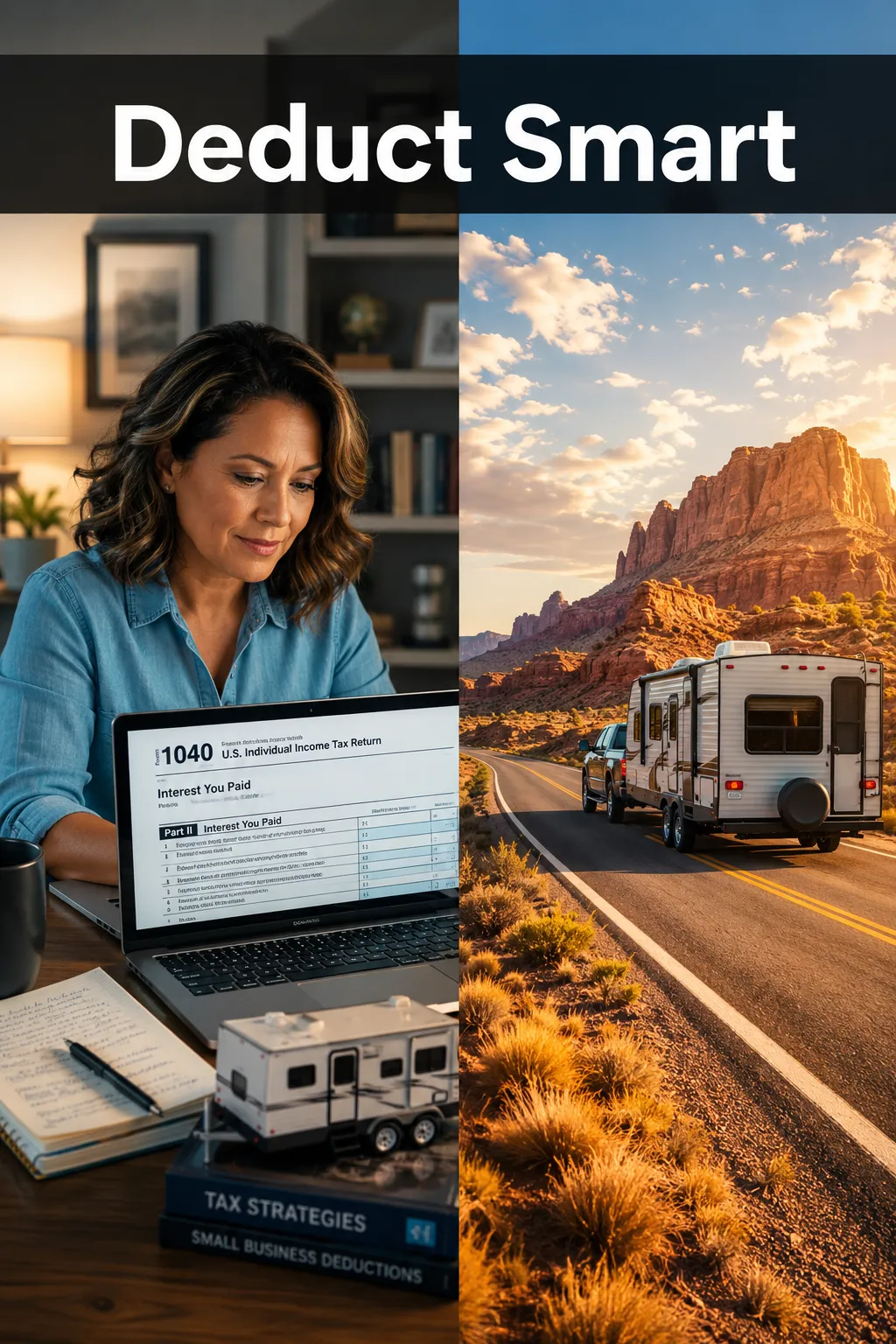
Over 11 million households in the United States own an RV, and a huge number of them financed that purchase with a loan. Yet most RV owners have no idea they could be saving money on their taxes every single year. So, are RV loans tax deductible? The short answer is: yes, in many cases they are, but the details matter a lot.
This guide breaks it all down in plain, simple language. No confusing tax jargon. Just clear answers so RV lovers like you can keep more money in your pocket. 🏕️
Key Takeaways
- RV loan interest can be tax deductible if the RV qualifies as a first or second home under IRS rules.
- The RV must have sleeping, cooking, and toilet facilities to qualify as a home.
- You can only deduct interest on one second home at a time.
- If you rent your RV out, different rules apply and may limit or change your deduction.
- Always consult a tax professional before claiming deductions, everyone’s situation is different.
Are RV Loans Tax Deductible? The Basic Answer
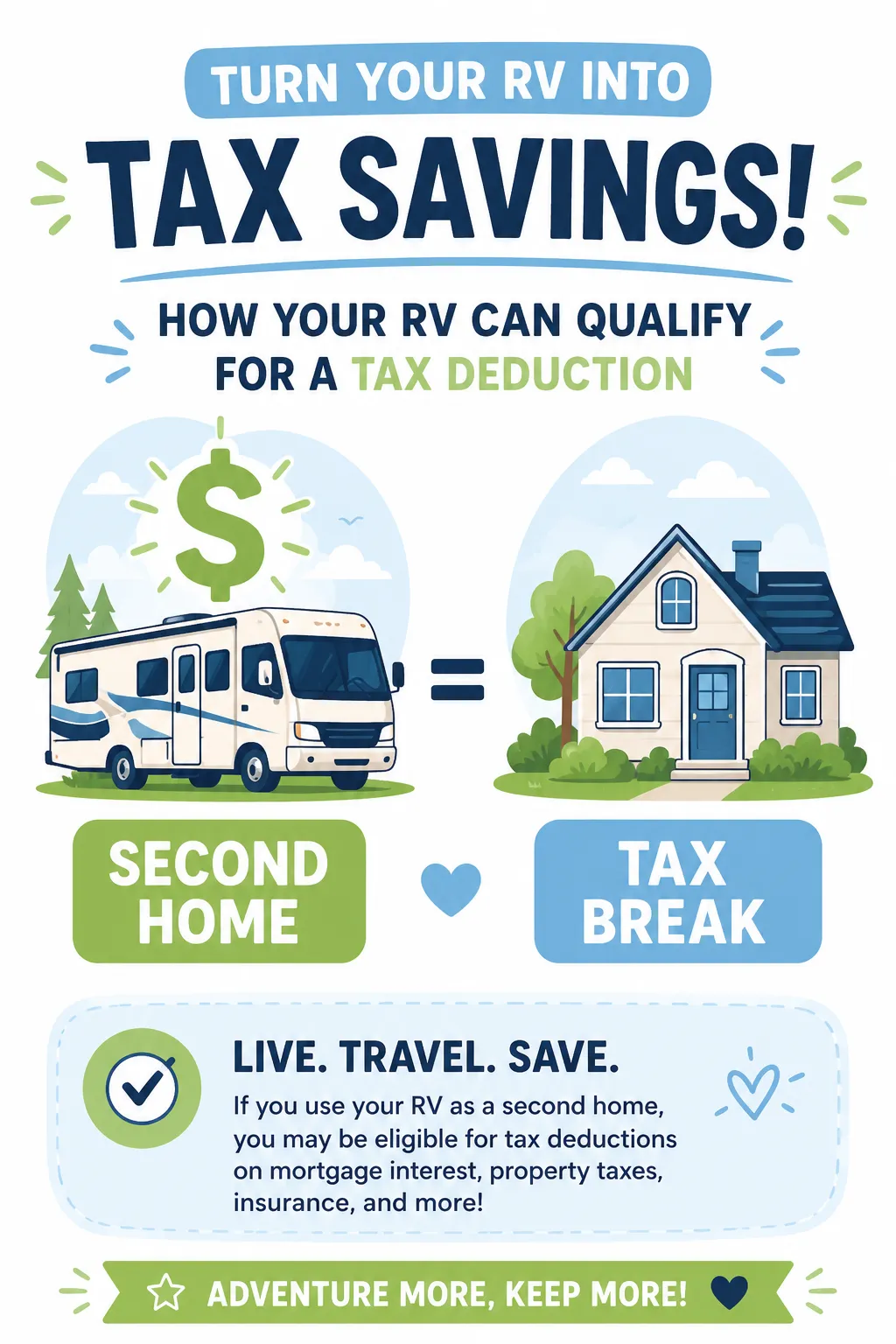
The IRS has a rule that makes this possible. It says that mortgage interest on a qualified home can be deducted from your taxable income. A “qualified home” does not have to be a house. It can be a boat, a condo, a mobile home, or yes, an RV.
Here is the key rule: the RV must have all three of these things:
- 🛏️ Sleeping area (a bed or sleeping space)
- 🍳 Cooking facilities (a stove or kitchen area)
- 🚿 Toilet facilities (a bathroom)
Most Class A, Class B, and Class C motorhomes meet this test. Many fifth wheels and travel trailers do too. A basic pop-up camper or small teardrop trailer likely does not qualify.
💡 Pull Quote: “If your RV has a bed, a kitchen, and a bathroom, it may qualify as a second home, and that means the loan interest could be tax deductible.”
What Does “Tax Deductible” Actually Mean?
When something is tax deductible, it means you can subtract that amount from your taxable income. A lower taxable income means you pay less in taxes. So if you paid $3,000 in RV loan interest during the year, and that interest is deductible, you could reduce your taxable income by $3,000.
This does not mean you get $3,000 back. It means you pay taxes on $3,000 less of your income. The actual savings depend on your tax bracket.
First Home vs. Second Home
The IRS allows you to deduct mortgage interest on:
- Your primary home (where you live most of the time)
- One second home (a vacation home, boat, RV, etc.)
If you already own a house and you buy an RV, the RV would be your second home for tax purposes, as long as it meets the three requirements above.
If your RV is your only home (you live in it full-time), it could qualify as your primary residence. This is great news for full-time RVers! 🎉
The Mortgage Interest Deduction: A Quick Overview
Here is a simple table to help you understand how the deduction works:
| Situation | Can You Deduct RV Loan Interest? |
|---|---|
| RV is your only home (full-time RVer) | ✅ Yes, qualifies as primary residence |
| RV is a second home, you own a house | ✅ Yes, qualifies as second home |
| RV does not have sleeping/cooking/toilet | ❌ No, does not qualify |
| You already deduct interest on two homes | ❌ No, only two homes allowed |
| RV is rented out most of the year | ⚠️ Maybe, special rules apply |
How to Claim the RV Loan Tax Deduction
Now that you know the basics, let’s talk about how to actually claim this deduction. The process is straightforward, but there are a few steps to follow.
Step 1: Make Sure You Itemize Deductions
This is the most important step. The mortgage interest deduction only works if you itemize your deductions on your tax return. You do this using Schedule A of IRS Form 1040.
Here is the thing: the IRS gives everyone a standard deduction. In 2026, the standard deduction amounts are:
- Single filers: approximately $15,000
- Married filing jointly: approximately $30,000
You should only itemize if your total deductions (including RV loan interest, state taxes, charitable donations, etc.) are more than the standard deduction. If they are less, just take the standard deduction, it is the smarter move.
💡 Quick Tip: Add up all your possible itemized deductions first. If they beat the standard deduction, itemizing makes sense. If not, skip it.
Step 2: Get Your Form 1098 (or Equivalent)
When you pay interest on a home loan, the lender usually sends you a Form 1098 showing how much interest you paid. This is what you report on Schedule A.
Some RV lenders are not traditional mortgage lenders, so they may not automatically send a Form 1098. In that case:
- Check your loan statements for total interest paid
- Ask your lender directly for a year-end interest summary
- Keep all your payment records just in case
Step 3: Report on Schedule A
On Schedule A, you will find a section for home mortgage interest. Enter the amount of RV loan interest you paid during the year. If your lender did not send a Form 1098, there is a special line for that too.
Step 4: Work With a Tax Professional
Tax laws can be tricky. A qualified CPA or tax advisor can help you:
- Confirm your RV qualifies as a home
- Make sure you are getting the maximum deduction
- Avoid any mistakes that could trigger an audit
Are RV Loans Tax Deductible When You Rent Out Your RV?
This is where things get a little more complex. Many RV owners rent out their vehicles on platforms when they are not using them. This can earn great extra income, but it also changes the tax picture. 🏡💰
The 14-Day Rule
The IRS has a rule for homes that are rented out. Here is how it works:
If you rent the RV for 14 days or fewer per year: The rental income is tax-free and you can still deduct the loan interest as a second home. This is a sweet deal!
If you rent the RV for more than 14 days per year: The IRS considers it a rental property, not a personal home. Different rules apply.
When the RV Becomes a Rental Property
If your RV crosses the 14-day rental threshold, here is what changes:
- You must report the rental income on your taxes
- You can deduct rental expenses (like maintenance, insurance, and depreciation)
- The mortgage interest deduction may shift to Schedule E instead of Schedule A
- You may need to split expenses between personal use and rental use
This is more complicated, but it is not necessarily bad. Rental property deductions can actually be very generous. Again, a tax pro is your best friend here.
💡 Pull Quote: “Renting your RV for 14 days or fewer per year? The income is tax-free AND you may still deduct the loan interest. That is a double win!”
Other RV-Related Tax Deductions to Know About
While the focus here is on whether RV loans are tax deductible, there are a few other deductions that RV lovers should know about. Every dollar saved counts! 💵
Sales Tax Deduction
When you buy an RV, you pay sales tax. In some states, this can be thousands of dollars. The IRS allows you to deduct state and local sales taxes on Schedule A, up to a combined limit of $10,000 (this is called the SALT deduction cap).
This can be especially helpful in the year you purchase your RV.
Business Use Deductions
Do you use your RV for business purposes? For example:
- A traveling salesperson who sleeps in the RV during work trips
- A contractor who uses the RV as a mobile office
- A content creator who films RV travel content as their business
In these cases, the business-use portion of your RV expenses may be deductible as a business expense. This includes a portion of loan interest, fuel, maintenance, and more.
You must keep detailed records of business vs. personal use to claim this.
State-Level Deductions
Some states offer their own tax deductions or credits related to RV ownership. These vary widely. Check with your state’s department of revenue or a local tax advisor to see what is available in your state.
Common Mistakes to Avoid
Even smart RV owners make tax mistakes. Here are the most common ones to watch out for:
❌ Assuming all RVs qualify, Remember, the RV must have sleeping, cooking, AND toilet facilities.
❌ Forgetting to itemize, The deduction only works if you itemize. Many people forget this step.
❌ Not keeping records, Save all loan statements, receipts, and lender documents.
❌ Claiming two second homes, The IRS only allows one second home deduction at a time. You cannot deduct interest on both a vacation cabin AND an RV in the same year (unless one is your primary home).
❌ Ignoring rental rules, If you rent your RV, make sure you understand the 14-day rule.
Full-Time RVers: Special Considerations
More and more people are choosing the RV lifestyle full-time. If this is you, there are some special things to think about. 🚐🌄
Domicile and State Taxes
Full-time RVers need to choose a legal domicile, a state where they are officially a resident. This affects:
- State income taxes
- Vehicle registration
- Driver’s license
- Mail and voting
Popular domicile states for full-timers include South Dakota, Texas, and Florida because they have no state income tax.
RV as Primary Residence
If your RV is your only home, it qualifies as your primary residence for the mortgage interest deduction. This is actually better than being a second home in some ways, because the deduction limits for primary homes are higher.
Health Insurance and Other Deductions
Full-time RVers who are self-employed may also be able to deduct health insurance premiums, home office expenses (if they work from the RV), and more. The tax picture for full-timers can be surprisingly favorable!
Frequently Asked Questions
Q: Can I deduct RV loan interest if I have bad credit and got a personal loan instead of an RV loan?
A: This depends. If the loan is secured by the RV (meaning the RV is collateral), it may still qualify. If it is an unsecured personal loan, it generally does not qualify for the home mortgage interest deduction.
Q: What if my RV loan is through the dealer?
A: Dealer financing works the same way as bank financing. As long as the loan is secured by the RV and the RV qualifies as a home, the interest may be deductible.
Q: Can I deduct RV loan interest AND home mortgage interest?
A: Yes! You can deduct interest on your primary home AND one second home (which could be your RV). Both deductions can be claimed on the same Schedule A.
Q: Does the RV need to be parked somewhere specific to qualify?
A: No. The RV can be mobile. It does not need to be in a fixed location. As long as it has the required facilities, it qualifies.
Q: Are RV loans tax deductible for state taxes too?
A: It depends on your state. Many states follow federal rules and allow a similar deduction. Others do not. Check your state’s specific tax rules.
Tips for Maximizing Your RV Tax Benefits in 2026
Here are some practical tips to help you get the most out of your RV tax situation this year:
✅ Track all interest payments throughout the year, do not wait until tax time.
✅ Ask your lender for a year-end interest statement every January.
✅ Compare itemized vs. standard deduction before filing, use tax software or a CPA.
✅ Keep a log of RV use, especially if you rent it out or use it for business.
✅ Research your state’s rules, some states offer extra benefits.
✅ Consider bundling deductions, if you are close to the standard deduction threshold, look for ways to push your itemized deductions higher.
✅ Work with a CPA who knows RV tax rules, not all tax preparers are familiar with RV-specific deductions.
Conclusion: Are RV Loans Tax Deductible? Yes, If You Play It Smart
The answer to “are RV loans tax deductible” is a clear yes for many RV owners, but only if you meet the right conditions and take the right steps.
Here is a quick recap of the most important points:
- Your RV must have sleeping, cooking, and toilet facilities to qualify as a home
- You must itemize deductions on Schedule A to claim the interest
- The RV can be your primary home or second home
- Renting the RV changes the rules, know the 14-day rule
- Other deductions like sales tax and business use may also apply
Your next steps:
- 📋 Check that your RV qualifies (sleeping + cooking + toilet = ✅)
- 📞 Call your lender and ask for a year-end interest statement
- 🧮 Add up your potential itemized deductions and compare to the standard deduction
- 👩💼 Schedule a meeting with a CPA who understands RV tax rules
- 🗂️ Start keeping better records NOW so next tax season is easy
The open road is calling, and with the right tax strategy, you can enjoy every mile knowing you are making the most of your investment. Happy travels! 🚐✨