Over 11 million American households own an RV, yet most of them never stop to ask whether that shiny rig in the driveway is actually helping or hurting their finances. So, are RV good investment choices, or are they just really expensive ways to sleep outdoors?
The answer is more nuanced than a simple yes or no, and understanding it could save thousands of dollars. This guide breaks it all down in plain language so any RV lover can make a smart, confident decision.
Key Takeaways
- 🚨 RVs depreciate fast, most lose 20-30% of their value in the first year alone.
- 💰 Rental income can offset costs, but only if the numbers are managed carefully.
- 🏕️ Lifestyle value is real, freedom, family memories, and flexibility have genuine worth.
- 📊 Used RVs are smarter buys, someone else absorbs the biggest depreciation hit.
- ✅ RVs are NOT traditional investments, but they can be financially smart tools when used the right way.
Understanding What “Investment” Really Means for an RV
Before diving into whether are RV good investment vehicles, it helps to define the word “investment” clearly.
In the traditional sense, an investment grows in value over time. Think stocks, real estate, or gold. You put money in, and later you get more money out.
An RV does NOT work like that. 🚗💨
RVs are depreciating assets. That means they lose value the moment they leave the dealership lot. This is similar to a car or a boat. The question is not whether an RV will lose value, it will. The real question is: can owning an RV still make financial sense?
The answer depends on how the RV is used.
The Three Ways People “Invest” in an RV
| Approach | Goal | Financial Outcome |
|---|---|---|
| Personal use only | Lifestyle enjoyment | Cost center, money goes out |
| Rental income | Offset ownership costs | Can break even or profit |
| Full-time living | Replace housing costs | Can save money vs. renting |
Each approach has a very different financial story. Understanding which category fits your situation is the first step to making a smart choice.
How Fast Do RVs Lose Value?
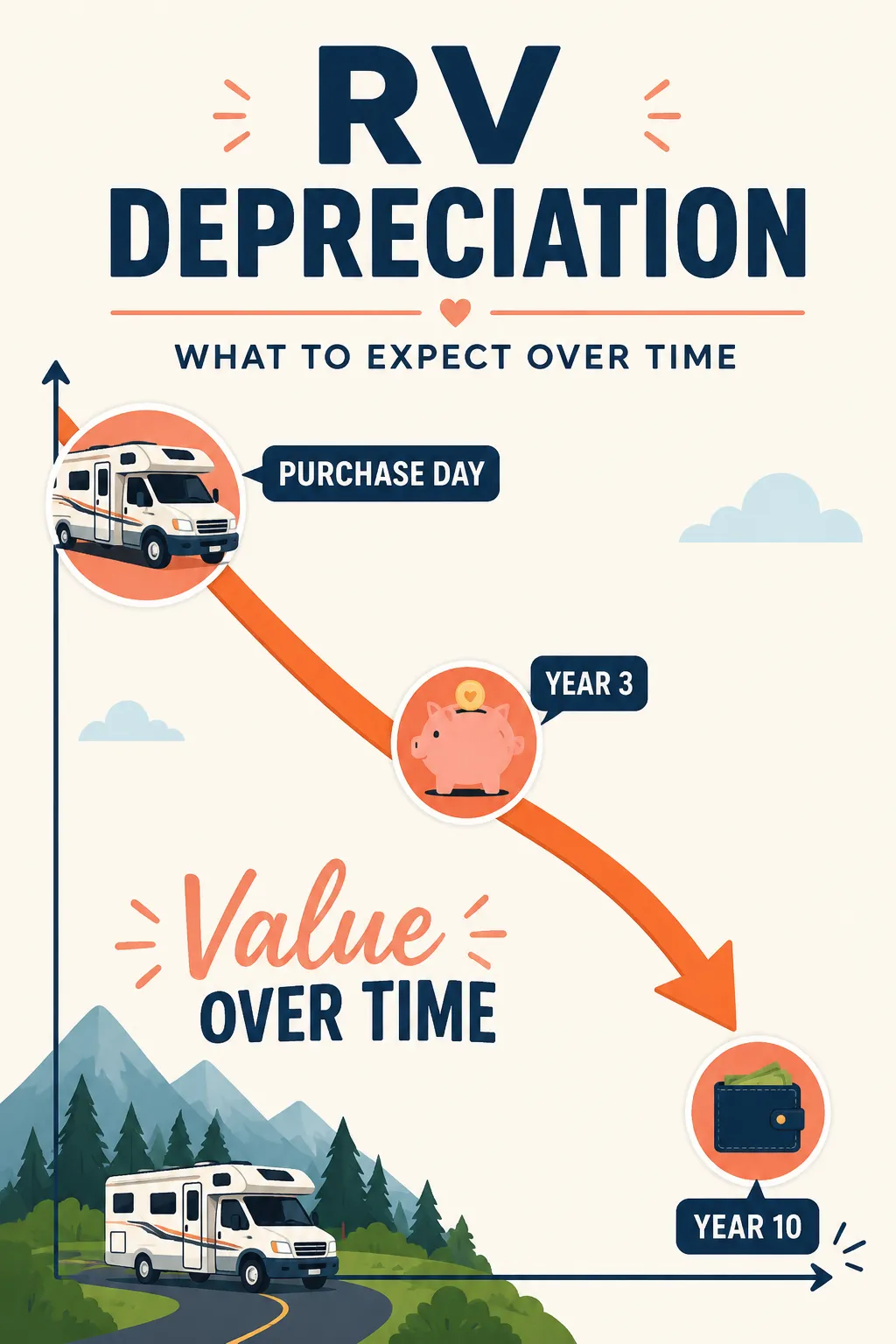
This is the big one. Depreciation is the number one reason people say are RV good investment questions deserve a “no” answer.
Here is what the typical depreciation curve looks like:
- Year 1: A new RV can lose 20-30% of its purchase price almost immediately.
- Years 2-5: Value continues to drop, usually around 5-10% per year.
- Years 6-10: Depreciation slows down, but the RV is now worth a fraction of its original cost.
- After 10 years: Some vintage or well-maintained models hold value better, especially popular brands.
💬 “Buying a brand-new RV and expecting it to hold value is like buying a new car and expecting the same. It just doesn’t work that way.”
What Types of RVs Depreciate Fastest?
Not all RVs are created equal when it comes to depreciation. Here is a quick breakdown:
- Class A Motorhomes, Highest purchase price, fastest dollar-amount drop, but percentage loss is similar to others.
- Class B (Campervans), Tend to hold value better due to high demand and lower supply.
- Class C Motorhomes, Middle ground in price and depreciation.
- Travel Trailers & Fifth Wheels, Often depreciate more slowly because they are cheaper to begin with and very popular.
- Pop-Up Campers, Lowest cost, slowest depreciation in dollar terms.
Pro tip: 🏆 Buying a used RV that is 2-3 years old is one of the smartest financial moves. Someone else already absorbed that brutal first-year drop.
The Hidden Costs That Hurt the “Investment” Case
Depreciation is not the only cost to watch. When asking are RV good investment options, these ongoing expenses matter a lot:
- Insurance: $500,$3,000+ per year depending on type and coverage
- Storage fees: $50,$500+ per month if not stored at home
- Maintenance & repairs: Older rigs can cost $1,000,$5,000+ per year
- Fuel: Diesel and gas costs add up fast, especially for Class A motorhomes
- Campsite fees: $20,$100+ per night at many parks
- Loan interest: Many buyers finance RVs at 6-10% interest rates
When all these costs are added together, owning an RV for personal use only can easily cost $10,000,$30,000 per year depending on the rig and how often it is used.
Can an RV Actually Make Money? Rental Income Explained

Here is where the story gets more interesting. 🌟
Platforms like Outdoorsy and RVshare have made it easier than ever to rent out an RV when it is not being used. This changes the financial math significantly.
How RV Rental Income Works
When an RV is listed on a peer-to-peer rental platform, owners can charge daily or weekly rates. Typical rental rates in 2026 vary widely:
- Pop-up campers / small trailers: $50,$100/night
- Travel trailers: $75,$175/night
- Class C motorhomes: $150,$250/night
- Class A motorhomes: $200,$400+/night
- Class B campervans: $150,$300/night (high demand!)
If an RV rents for just 15-20 nights per month, it can generate enough income to cover most or all of the ownership costs.
The Real Numbers: A Simple Example
Imagine a travel trailer purchased used for $30,000:
- Monthly loan payment: ~$500
- Insurance: ~$100/month
- Maintenance reserve: ~$100/month
- Storage: ~$75/month
- Total monthly cost: ~$775
If that trailer rents for $125/night and books 8 nights per month, it generates $1,000/month, more than covering all costs.
That is not a traditional investment return, but it turns a cost center into a potential income stream. 💵
Important Warnings About RV Rentals
Before getting too excited, there are real risks to consider:
- ⚠️ Wear and tear increases with renters, expect higher maintenance costs
- ⚠️ Damage claims can be stressful even with insurance
- ⚠️ Seasonality, most rentals happen in summer; winter months may sit empty
- ⚠️ Tax implications, rental income must be reported; consult a tax professional
- ⚠️ Time commitment, managing listings, cleanings, and handoffs takes real effort
The rental model works best for people who are organized, live in a high-demand area, and own a well-maintained, popular RV type.
Full-Time RV Living: The Surprising Financial Case
One of the most compelling arguments for are RV good investment purposes involves full-time RV living.
In 2026, average apartment rents in many U.S. cities range from $1,500 to $3,000+ per month. Full-time RV living, by contrast, can cost as little as $1,000,$2,000 per month all-in, including campsite fees, fuel, food, and maintenance.
For people who work remotely or are retired, this lifestyle can represent genuine financial savings compared to traditional housing.
Full-Time Living Cost Breakdown
Here is a rough monthly budget for a full-time RVer:
- Campsite fees (mix of free and paid): $300,$700
- Fuel: $200,$600 (depends on how much driving)
- Food & groceries: $400,$600
- RV maintenance: $100,$300
- Insurance: $100,$200
- Cell/internet: $100,$200
- Entertainment/activities: $100,$300
Total: roughly $1,300,$2,900/month
Compare that to renting a one-bedroom apartment in a major city plus utilities, and the savings become very real. 🏠➡️🚐
The Lifestyle Value: What the Numbers Cannot Capture
Here is something that pure financial analysis always misses: lifestyle value is real.
When thinking about are RV good investment choices, it is important to count the experiences, not just the dollars.
What RV Ownership Gives You
- 🏕️ Freedom to go anywhere, anytime
- 👨👩👧 Family bonding on road trips that create lifelong memories
- 🌲 Connection with nature that improves mental health and wellbeing
- 🗺️ Flexibility to explore national parks, beaches, and mountains
- 🤝 Community, the RV community is one of the friendliest around
Studies on happiness consistently show that experiences create more lasting joy than possessions. An RV is a possession that delivers experiences, which puts it in a unique category.
💬 “If a family spends $15,000 per year on their RV but replaces $8,000 in hotel, flight, and vacation rental costs, the net lifestyle cost is just $7,000, for unlimited adventures.”
This reframing matters. The RV is not just a depreciating asset. It is a vacation platform that can replace other travel spending.
Smart Buying Strategies to Improve the Financial Case
Whether the goal is rental income, full-time living, or weekend adventures, buying smart makes a huge difference.
Tips for Buying an RV That Holds Value Better
- Buy used, not new, Let someone else take the first-year depreciation hit 💡
- Choose popular brands, Thor, Airstream, Winnebago, and Forest River tend to have better resale markets
- Avoid overly complex rigs, More slides and gadgets = more things to break
- Get a pre-purchase inspection, A $300,$500 inspection can save thousands
- Buy at the right time, End of season (fall/winter) often brings better dealer deals
- Consider Class B vans, They hold value better than almost any other RV type
The Airstream Exception 🥈
Airstream travel trailers are famous for holding their value exceptionally well. A well-maintained vintage Airstream can actually appreciate in value, making it one of the rare RVs that behaves more like a traditional investment. However, they are expensive to buy and maintain.
Are RV Good Investment Compared to Other Assets?
Let’s put this in perspective with a quick comparison.
| Asset Type | Typical Annual Return | Liquidity | Enjoyment Factor |
|---|---|---|---|
| Stock market index fund | 7-10% average | High | Low |
| Real estate | 3-6% appreciation | Low | Medium |
| New RV | -15 to -25% (depreciation) | Medium | Very High |
| Used RV (with rentals) | Varies, can break even | Medium | Very High |
| Airstream (vintage) | 0-5% possible | Medium | Very High |
The honest truth: as a pure financial investment, an RV rarely beats stocks or real estate. But that is the wrong comparison for most RV lovers.
The better question is: compared to other ways of spending money on lifestyle and vacations, does an RV make sense? For many families, the answer is a clear yes. 🎉
Red Flags: When an RV Is Definitely NOT a Good Investment
Not every situation makes sense for RV ownership. Watch out for these warning signs:
- 🚩 Buying new with a large loan at high interest, the depreciation + interest combo is brutal
- 🚩 Planning to use it only a few times per year, the cost-per-use becomes very high
- 🚩 Buying more RV than needed, a $200,000 Class A for weekend camping is hard to justify
- 🚩 Living in a low-demand rental market, rental income won’t offset costs
- 🚩 Not budgeting for repairs, RVs break down; ignoring this is financially dangerous
- 🚩 Emotional buying, falling in love at the dealership and skipping research
Conclusion: Are RV Good Investment Choices for You?
The straight answer is this: RVs are not traditional investments, but they can absolutely be smart financial decisions when approached with clear eyes and a solid plan.
Here is the bottom line for 2026:
- If the goal is pure financial return, stocks and real estate will almost always win over a new RV.
- If the goal is lifestyle value + some financial offset, a used RV with a rental strategy can make excellent sense.
- If the goal is full-time living, RVs can genuinely save money compared to traditional housing.
- If the goal is unforgettable family adventures, the value is priceless, and that matters too.
Actionable Next Steps 🚀
- Define your “why”, Is this for lifestyle, income, or full-time living? Be honest.
- Run the real numbers, Calculate total annual cost vs. total annual benefit for your situation.
- Shop used first, Browse RVtrader or Facebook Marketplace for 2-3 year old models.
- Research rental demand in your area before counting on rental income.
- Get a pre-purchase inspection from a certified RV technician before any purchase.
- Talk to full-timers and rental owners in RV forums, real-world experience is gold.
The RV lifestyle is one of the most rewarding ways to spend time and money, as long as the decision is made with both the heart and the spreadsheet. 🏕️❤️