Imagine crossing state lines in your RV, enjoying the open road — and suddenly realizing you have no idea whether the firearm locked in your storage compartment is legal in the state you just entered. 🚨 For millions of RV travelers, this scenario is more common than most people think. The question of can you travel in an RV with a gun is not a simple yes or no. It depends on federal law, state-by-state rules, and whether your RV is moving or parked. Getting it wrong can turn a dream road trip into a legal nightmare.
Would you like to save this article?
Key Takeaways
- ✅ Yes, you can travel in an RV with a gun — but compliance with both federal and state laws is mandatory.
- 🔒 Federal law (FOPA) protects interstate transport of firearms when they are unloaded, locked, and stored separately from ammunition.
- 🗺️ State laws vary dramatically — what is perfectly legal in Texas may be a felony in New Jersey.
- 🏠 When an RV is parked and used as a residence, some states apply home carry rules rather than vehicle carry rules.
- 📋 In 2026, more states are tightening restrictions on firearm storage in mobile dwellings — staying current is essential.
Understanding the Legal Framework: Can You Travel in an RV With a Gun?
Before packing a firearm for an RV trip, every traveler needs to understand the two-layer legal system that governs this issue: federal law and individual state law. Both apply simultaneously, and neither cancels the other out.
Federal Protections Under FOPA
The Firearms Owners’ Protection Act (FOPA) provides a critical legal shield for travelers crossing state lines. Under FOPA, a person may lawfully transport a firearm through any state — even states with strict gun laws — as long as the following conditions are met [3][6]:
- The firearm is unloaded
- It is stored in a locked container (not the glove box or console)
- Ammunition is stored separately from the firearm
- The traveler is legally allowed to possess the firearm in both the origin and destination states
💬 “FOPA is your legal safety net on the road — but it only works if you follow every condition precisely.”
This protection is designed for travelers who are passing through a state, not stopping to conduct activities. If you make extended stops, the legal picture can change [6].
The Vehicle vs. Residence Distinction
Here is where RV law gets uniquely complex. An RV can be both a vehicle and a home, and the law often treats it differently depending on which role it is playing at the time [2].
| RV Status | Applicable Law |
|---|---|
| Moving on the road | Vehicle carry laws of the current state |
| Parked as a residence | Home/dwelling laws may apply in some states |
| Parked at a campground (not a residence) | Varies by state — often still vehicle laws |
For example, Florida law allows open or concealed carry without a permit inside a residence. When an RV is parked and being used as a home, some legal interpretations extend this protection to the RV [2]. However, this is not universal — other states do not recognize an RV as a legal dwelling for firearms purposes.
State-by-State Rules: The Biggest Challenge for RV Gun Travel
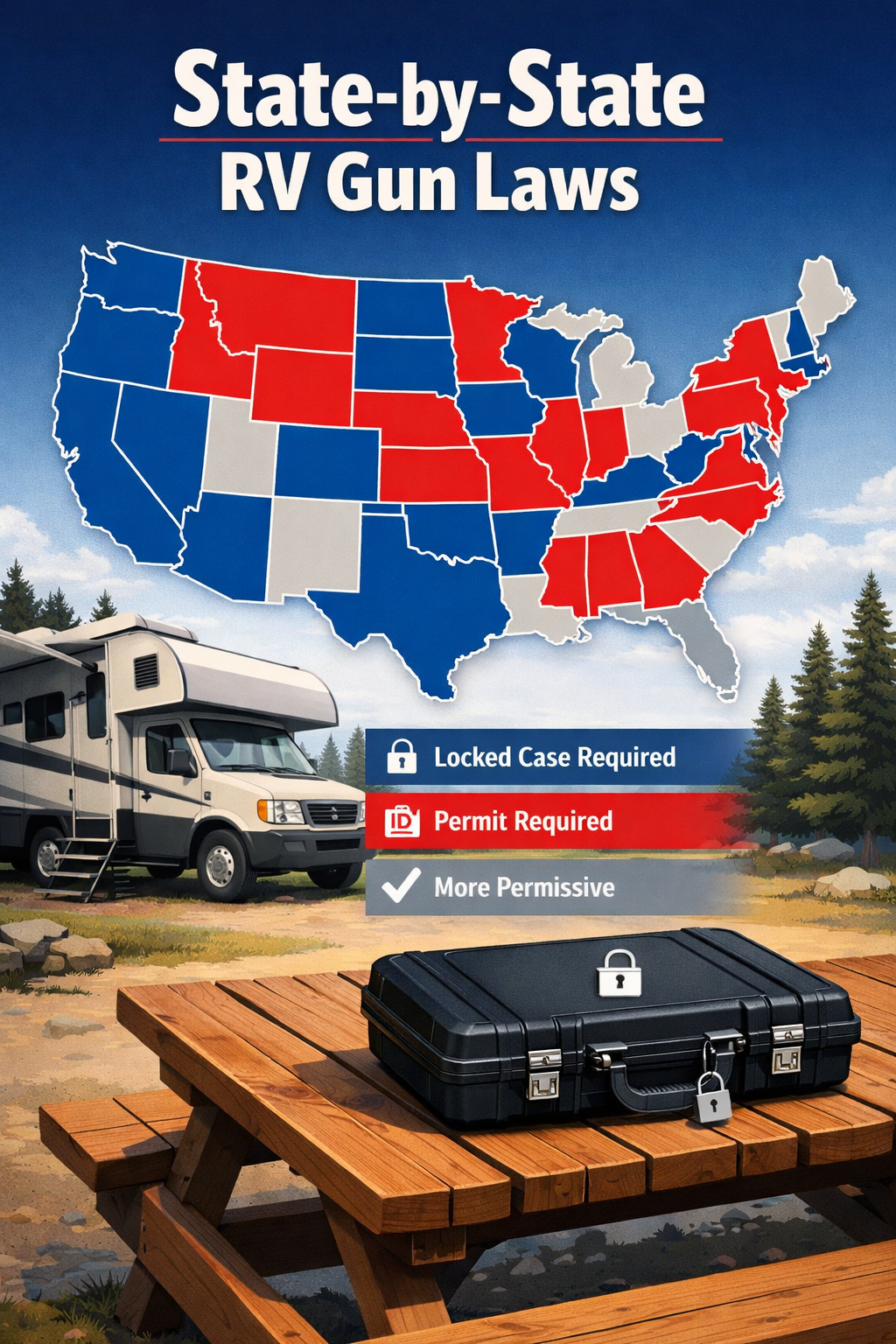
The most important thing to understand about traveling in an RV with a gun is this: there is no single national RV firearms law [4]. Every state has its own rules, and the patchwork of regulations across 50 states is the biggest compliance challenge RVers face.
How State Laws Differ
State laws vary across several key dimensions:
- Concealed carry permits: Some states honor permits from other states (reciprocity); others do not
- Open carry rules: Legal in many states, prohibited in others
- Storage requirements: Some states require firearms to be locked and inaccessible from the driver’s seat [4]
- Loaded vs. unloaded: Requirements differ widely
- Permit requirements: Some states require a permit even to transport a firearm in a vehicle
High-Risk States to Watch
Certain states are known for having particularly strict firearm transport laws. Traveling through these states without proper preparation can result in serious criminal charges:
- 🔴 California — strict storage and transport rules; limited reciprocity
- 🔴 New York — among the strictest in the nation; FOPA protections have been tested in courts here
- 🔴 New Jersey — felony-level penalties for violations; very limited exceptions
- 🔴 Hawaii — requires registration and has strict transport rules
- 🟡 Illinois — requires a FOID card; specific transport rules apply
⚠️ What is perfectly legal in one state can be a felony in another. Ignorance of state law is not a legal defense.
The 2026 Regulatory Trend
As of 2026, there is a growing trend of states increasing restrictions on firearm storage and transport in mobile dwellings like RVs [4]. This makes it more important than ever for RV travelers to research current laws before each trip, not just once. Laws that were valid last year may have changed.
Practical State Research Tips
- Use resources like handgunlaw.us, which publishes detailed RV-specific carry guides [1][7]
- Check the attorney general’s website for each state on your route
- Consider consulting a firearms attorney if your route passes through high-restriction states
- Join RV forums and communities where members share updated legal information
How to Stay Compliant: RV Firearms Best Practices
Whether traveling through gun-friendly or restrictive states, following a consistent set of best practices protects RVers in all situations.
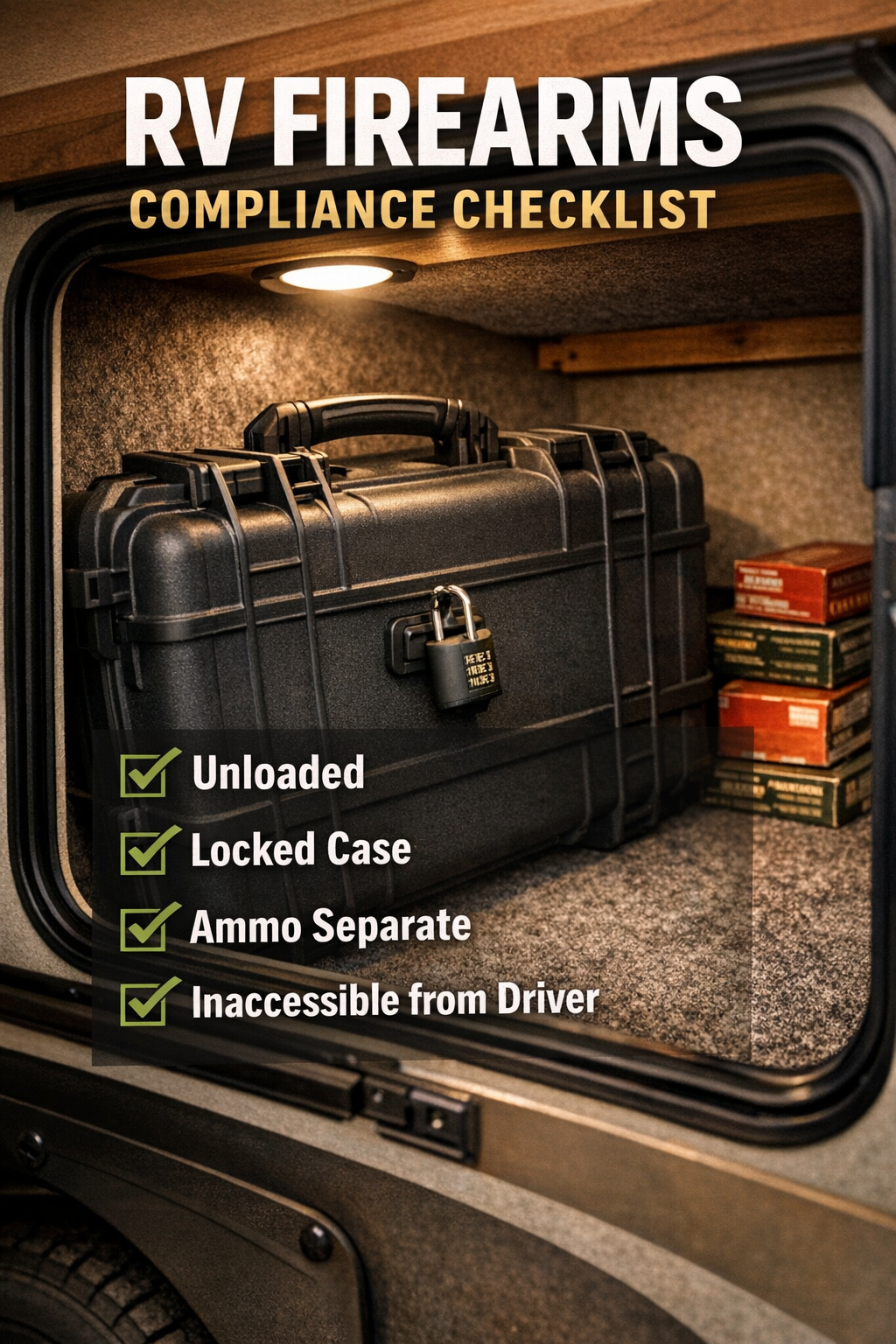
The Gold Standard Compliance Checklist ✅
- Keep the firearm unloaded at all times while the RV is in motion
- Store it in a locked hard-sided case — soft cases may not meet legal requirements in some states
- Store ammunition separately — in a different compartment or locked container
- Ensure the firearm is inaccessible from the driver’s seat [4]
- Carry documentation — your carry permit (if applicable), firearm purchase records, and a route plan
- Research each state on your route before departure
- Update your knowledge regularly — laws change, especially in 2026
Choosing the Right Storage Solution
The type of storage used inside an RV matters legally and practically. Consider these options:
- Biometric gun safes — fast access, secure, and meet locked-container requirements
- Hard-sided lockable cases — the minimum standard for FOPA compliance
- Mounted vehicle safes — bolted to the RV structure for added security
- Rear storage compartments — physically distant from the driver’s seat, which helps meet accessibility requirements [4]
When Your RV Is Parked
When the RV is parked and serving as a residence, the rules may shift. Some states apply home carry laws, which can be more permissive [2]. However, this is a nuanced area of law. Do not assume home carry rules apply automatically — verify the specific state’s position on RVs as dwellings before making that assumption.
Frequently Asked Questions
Q: Do I need a concealed carry permit to travel in an RV with a gun?
It depends on the states you are traveling through. FOPA protects unloaded, locked transport without a permit, but having a valid permit that is recognized by the states on your route adds a significant layer of legal protection [3][6].
Q: Can I carry a loaded firearm in my RV?
In some states, yes — particularly if the RV is parked and classified as a residence. While moving, most states require the firearm to be unloaded [2][4].
Q: What happens if I am stopped by police in a strict state?
Cooperate fully, disclose the firearm if required by state law, and rely on your FOPA compliance documentation. Having the firearm properly stored significantly strengthens your legal position [3].
Conclusion: Travel Smart, Stay Legal
The answer to can you travel in an RV with a gun is a confident yes — provided travelers do their homework and follow the rules. The key is treating firearm compliance as a non-negotiable part of trip planning, just like route mapping or campsite reservations.
Actionable next steps for every RV traveler with a firearm:
- 📋 Audit your storage setup — ensure it meets locked, unloaded, and inaccessible standards
- 🗺️ Map your route and research each state’s laws before departure
- 📞 Consult a firearms attorney if your route includes high-restriction states
- 🔄 Stay updated in 2026 — sign up for alerts from firearms law resources
- 🤝 Connect with RV communities for real-world compliance tips from experienced travelers
The open road is one of America’s greatest freedoms. Protecting that freedom means traveling responsibly, legally, and with full knowledge of the rules that apply every mile of the journey.
References
[1] Usrvcarcarry 1 – https://www.handgunlaw.us/documents/USRVCarCarry-1.pdf
[2] Carrying A Firearm In An Rv – https://www.thefirearmfirm.com/blog/2022/may/carrying-a-firearm-in-an-rv/
[3] Firearms Compliance For Rvers – https://www.rv.com/lifestyle-travel/life-on-the-road/firearms-compliance-for-rvers/
[4] Watch – https://www.youtube.com/watch?v=frSBsznAaoY
[5] Watch – https://www.youtube.com/watch?v=BqUboXwQ3Ic
[6] Interstate Transportation Of Firearms – https://www.defensivestrategies.org/firearms-the-law/interstate-transportation-of-firearms
[7] Usrvcarcarry 1 – https://www.handgunlaw.us/documents/USRVCarCarry-1.pdf