Nearly 60% of full-time RVers report slide-out problems as one of their top maintenance headaches — yet many reach for the same yellow can sitting in their toolbox without knowing whether it will help or cause serious damage. So, can you use WD‑40 on RV slides? The answer is: it depends entirely on which part of the slide you’re treating. Get it right and your slides will glide like butter. Get it wrong and you could destroy rubber seals, fry electronics, or create a dust-magnet mess that makes things worse.
Let’s break it all down so you know exactly what to do. 🛻
Key Takeaways
- ✅ WD-40 Specialist Dry Lube with PTFE is excellent for metal slide components like rack-and-pinion gears and exposed tracks.
- ❌ Standard WD-40 and petroleum-based products will degrade rubber slide seals — use 303 Aerospace Protectant instead.
- ⚡ Never spray WD-40 near electronic components — it can permanently damage wiring and control boards.
- 🌡️ WD-40 products work across a wide temperature range (-50°F to 500°F), making them suitable for most camping climates.
- 🧹 In dusty environments, use WD-40 sparingly — it can attract grime if over-applied.
Can You Use WD‑40 on RV Slides? Understanding the Different Parts
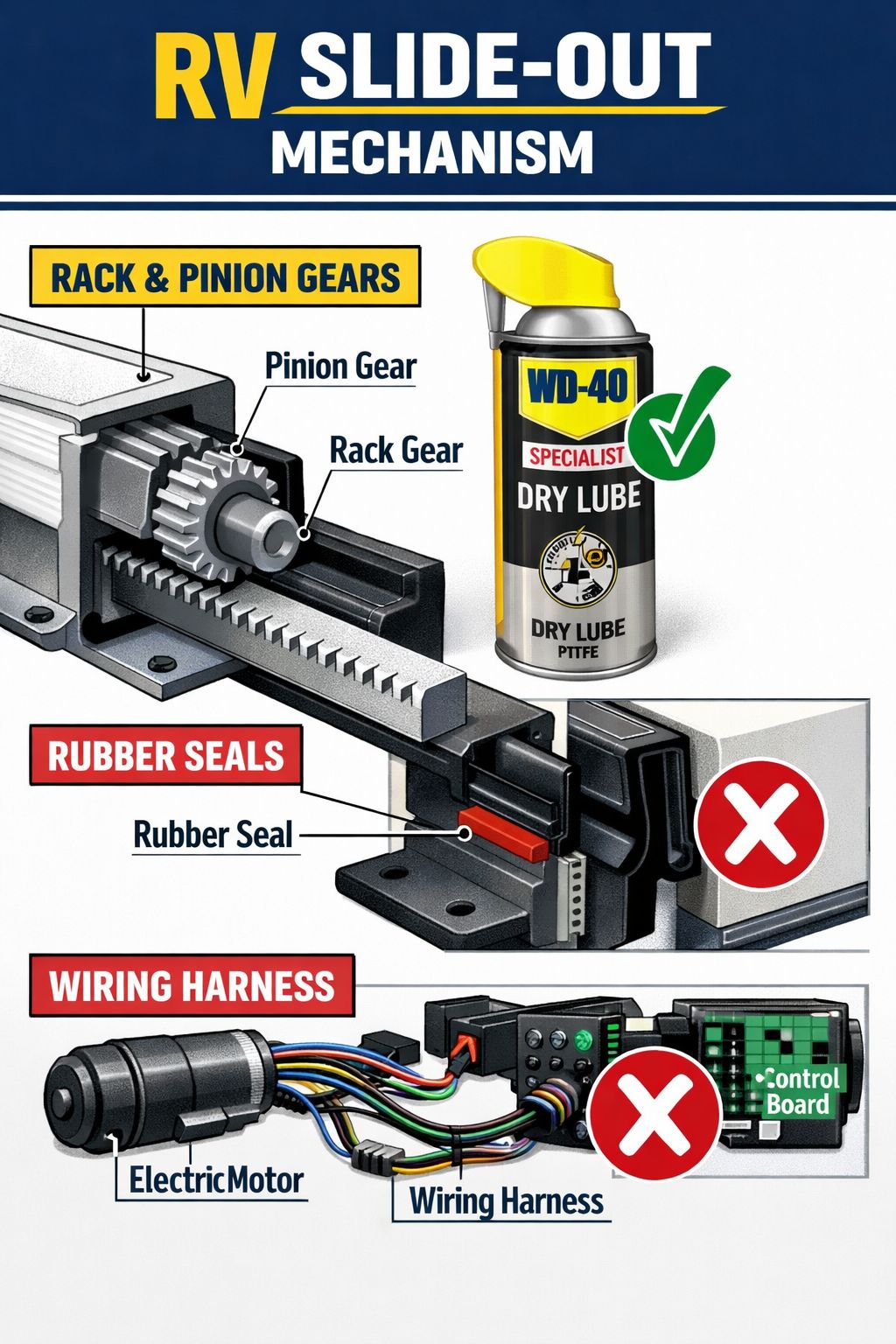
RV slide-outs are not a single component — they are a system made up of several very different materials. Metal gears, rubber seals, plastic trim, and electronic motors all live in close proximity. Each material reacts to WD-40 differently, which is why a blanket “yes” or “no” answer misses the point entirely.
✅ Metal Components: Where WD-40 Shines
For the metal parts of your slide — especially rack-and-pinion systems and exposed gears — WD-40 Specialist Dry Lube with PTFE is genuinely one of the best options available [1].
Here’s why it stands out:
- 5x the wear protection compared to some competing products [1]
- 4x longer lubrication life, meaning fewer applications over time [1]
- Dries completely clear with no white residue left behind [1]
- Non-stick formula that resists dust and debris accumulation better than many alternatives [1]
💬 “The dry formula is the game-changer — it doesn’t attract the grit and dust that wet lubricants do, which is critical for slide mechanisms that operate close to the ground.”
The temperature performance is also impressive. WD-40 products remain effective from -50°F to 500°F [1], which means whether you’re camping in the Arizona desert in summer or the Colorado Rockies in winter, the product won’t freeze up or break down on you.
What to apply it to:
| Component | WD-40 Specialist Dry Lube? |
|---|---|
| Rack and pinion gears | ✅ Yes |
| Exposed metal slide rails | ✅ Yes |
| Slide motor housing (exterior) | ✅ Yes |
| Rubber seals and gaskets | ❌ No |
| Electronic wiring/control boards | ❌ Absolutely not |
| Clear plastic trim panels | ❌ No |
❌ Rubber Seals: Keep WD-40 Far Away
This is where many RVers make a costly mistake. Petroleum-based products — including standard WD-40 — will break down rubber over time [3]. Slide seals are made from rubber compounds that are specifically vulnerable to petroleum exposure. Applying the wrong product can cause:
- Cracking and hardening of the seal
- Loss of the watertight barrier
- Expensive seal replacement jobs
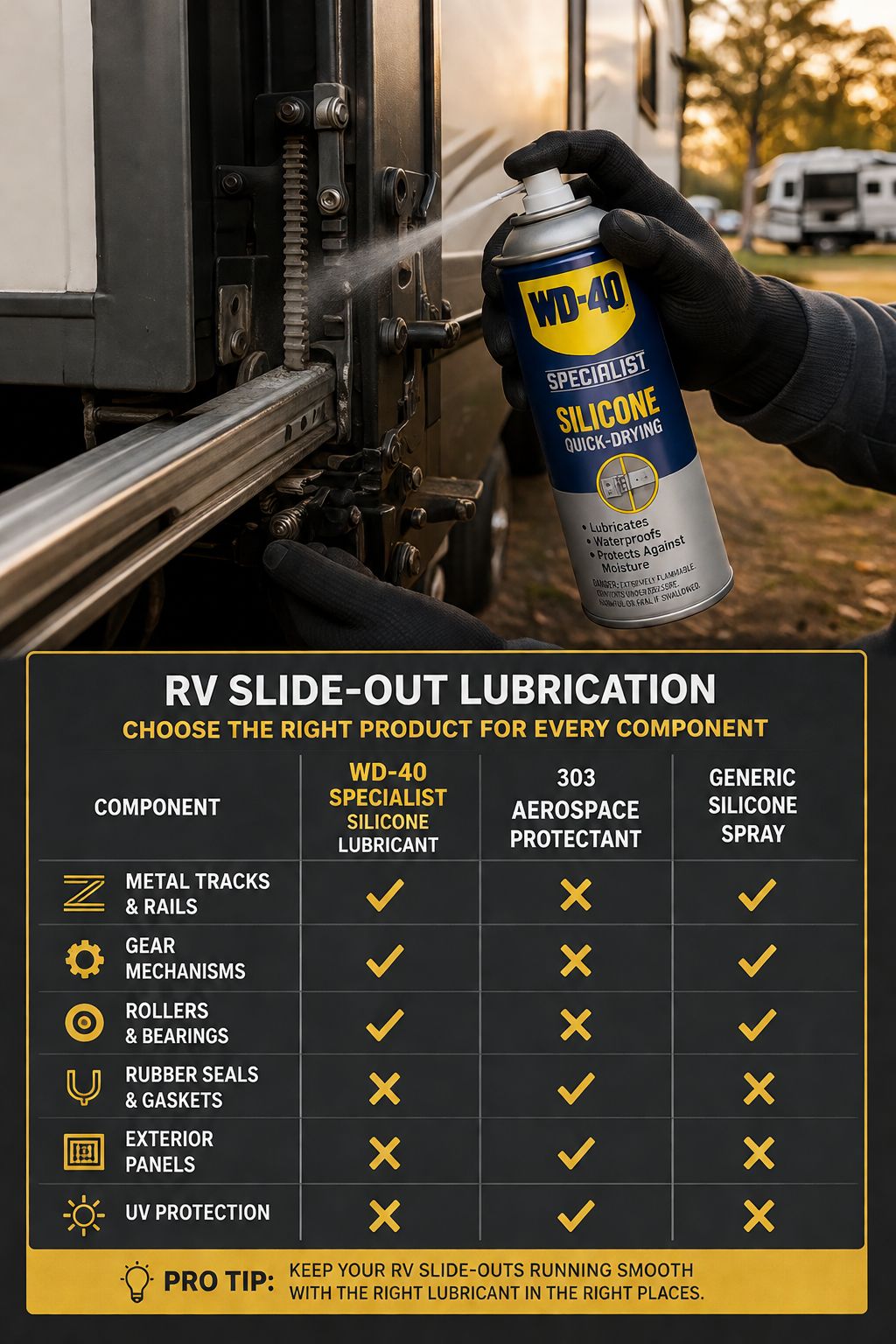
What to use instead: Products like 303 Aerospace Protectant are specifically formulated for rubber seals and slide gaskets [3]. They condition the rubber, keep it pliable, and extend its lifespan without causing chemical breakdown. A little goes a long way — apply it with a clean cloth along the full length of the seal.
⚡ Electronics: A Hard No
Can you use WD-40 on RV slides near the motor or wiring? Absolutely not. WD-40 can severely damage electronic components and render them completely unusable [2]. RV slides often have:
- Electric motor assemblies
- Control wiring harnesses
- Limit switches and sensors
Even overspray from a nearby application can cause problems. Always mask off or cover electronic components before lubricating any nearby metal parts.
🧴 Clear Plastics: Proceed With Caution
WD-40 should be kept away from polystyrene and polycarbonate plastics [2]. Some slide trim pieces and interior panels use these materials. When in doubt, skip the WD-40 and use a plastic-safe silicone spray instead.
How to Properly Lubricate Your RV Slide-Outs (Step-by-Step)
Now that the question “can you use WD‑40 on RV slides?” has a clear, nuanced answer, here’s a practical routine to keep your slides operating smoothly all season long. 🔧
What You’ll Need
- ✅ WD-40 Specialist Dry Lube with PTFE (for metal parts)
- ✅ 303 Aerospace Protectant (for rubber seals)
- ✅ Clean microfiber cloths
- ✅ Soft brush or old toothbrush (for cleaning gear teeth)
- ✅ Painter’s tape or plastic sheeting (to protect electronics)
Step-by-Step Application
Step 1: Extend the slide fully
This gives full access to the gear rack and slide rails.
Step 2: Clean before you lubricate
Use a dry brush to remove dirt, old grease, and debris from metal components. Never lubricate over grime — it just traps it.
Step 3: Apply WD-40 Specialist Dry Lube to metal parts
Spray along the full length of the gear rack and rails. Let it dry for a few minutes before retracting the slide.
Step 4: Treat rubber seals separately
Apply 303 Aerospace Protectant to a clean cloth and wipe along all rubber seals. Do not spray directly onto seals.
Step 5: Cycle the slide
Extend and retract the slide two or three times to distribute the lubricant evenly across the mechanism.
Step 6: Wipe away excess
Remove any drips or pooling product with a clean cloth to prevent dust accumulation.
⚠️ Pro Tip: In dusty campgrounds or desert environments, use WD-40 products sparingly on metal parts. While the dry formula resists dust better than wet lubricants, over-application in high-debris areas can still lead to buildup [2].
How Often Should You Lubricate RV Slides?
| Usage Level | Recommended Frequency |
|---|---|
| Weekend warrior (occasional use) | Every 3–4 months |
| Seasonal camper | Start and end of each season |
| Full-time RVer | Monthly inspection; lubricate as needed |
| After heavy rain or dusty conditions | Inspect and re-apply if needed |
Quick Reference: WD-40 on RV Slides — Yes or No?
| RV Slide Component | Use WD-40? | Best Product |
|---|---|---|
| Metal rack and pinion gears | ✅ Yes | WD-40 Specialist Dry Lube |
| Slide rails and tracks | ✅ Yes | WD-40 Specialist Dry Lube |
| Rubber seals and gaskets | ❌ No | 303 Aerospace Protectant |
| Electronic motors/wiring | ❌ Never | Nothing — keep dry |
| Clear plastic trim | ❌ No | Plastic-safe silicone spray |
Conclusion: Smart Lubrication Keeps Slides Running Smoothly
So, can you use WD‑40 on RV slides? Yes — but only on the right parts, with the right formula. WD-40 Specialist Dry Lube with PTFE is a genuinely excellent product for metal slide components, offering superior wear protection, long-lasting lubrication, and a clean, dust-resistant finish [1]. But it has no business anywhere near rubber seals, electronics, or clear plastic trim [2][3][4].
Your action plan:
- 🛒 Pick up WD-40 Specialist Dry Lube and 303 Aerospace Protectant — keep both in your RV toolkit.
- 📅 Set a reminder to inspect and lubricate slides at the start and end of every camping season.
- 🔍 Before any application, identify the material you’re treating — metal, rubber, or plastic.
- 🧹 Always clean before lubricating to avoid trapping dirt in the mechanism.
A well-maintained slide-out can last the life of your RV. A neglected or improperly lubricated one can fail at the worst possible moment — usually when you’re parked at a full campground with no mobile repair service in sight. Take 20 minutes now to do it right, and your slides will thank you for years to come. 🏕️
References
[1] Watch – https://www.youtube.com/watch?v=sro3d5xfQ64
[2] Reason Bring Wd 40 Next Rv Trip Camping – https://www.explore.com/1376530/reason-bring-wd-40-next-rv-trip-camping/
[3] community.goodsam – https://community.goodsam.com/discussions/motorhomesforum-board/lubricate-slideout-seal/2014850
[4] Do Not Use Wd 40 On These Parts Of Your Rv – https://www.rvtravel.com/do-not-use-wd-40-on-these-parts-of-your-rv/
[5] Lubrication Of Slides – https://www.irv2.com/threads/lubrication-of-slides.1621614/