
You’re cruising along a scenic mountain highway in your beloved RV, admiring the breathtaking views, when suddenly your engine starts struggling, your refrigerator won’t stay cold, and you’re wondering if that headache is from the excitement or something else entirely. Does altitude affect RVs? The short answer is absolutely yes—and in more ways than most RV owners realize.

Whether you’re planning your first mountain adventure or you’re a seasoned high-altitude traveler, understanding how elevation impacts both your RV and your body can make the difference between a memorable trip and a mechanical nightmare. Our 2026 poll of RV enthusiasts reveals fascinating insights about altitude comfort levels, with over half of respondents willing to take their rigs to any elevation. But should they? Let’s dive into what really happens when you take your home-on-wheels to the mountains.

Key Takeaways

  • Engine performance decreases by approximately 3% for every 1,000 feet of elevation gain due to reduced oxygen levels, affecting both power and fuel efficiency
  • 54% of RV owners surveyed feel comfortable traveling to any altitude, while only 8% prefer staying at sea level
  • Multiple RV systems require adjustments at high altitude, including propane regulators, refrigerators, generators, and tire pressures
  • Human bodies experience physiological changes above 8,000 feet, with the autonomic nervous system adapting to reduced oxygen availability [1]
  • Proper preparation and understanding can make high-altitude RVing safe and enjoyable for most travelers with the right precautions

Understanding How Does Altitude Affect RVs Mechanically
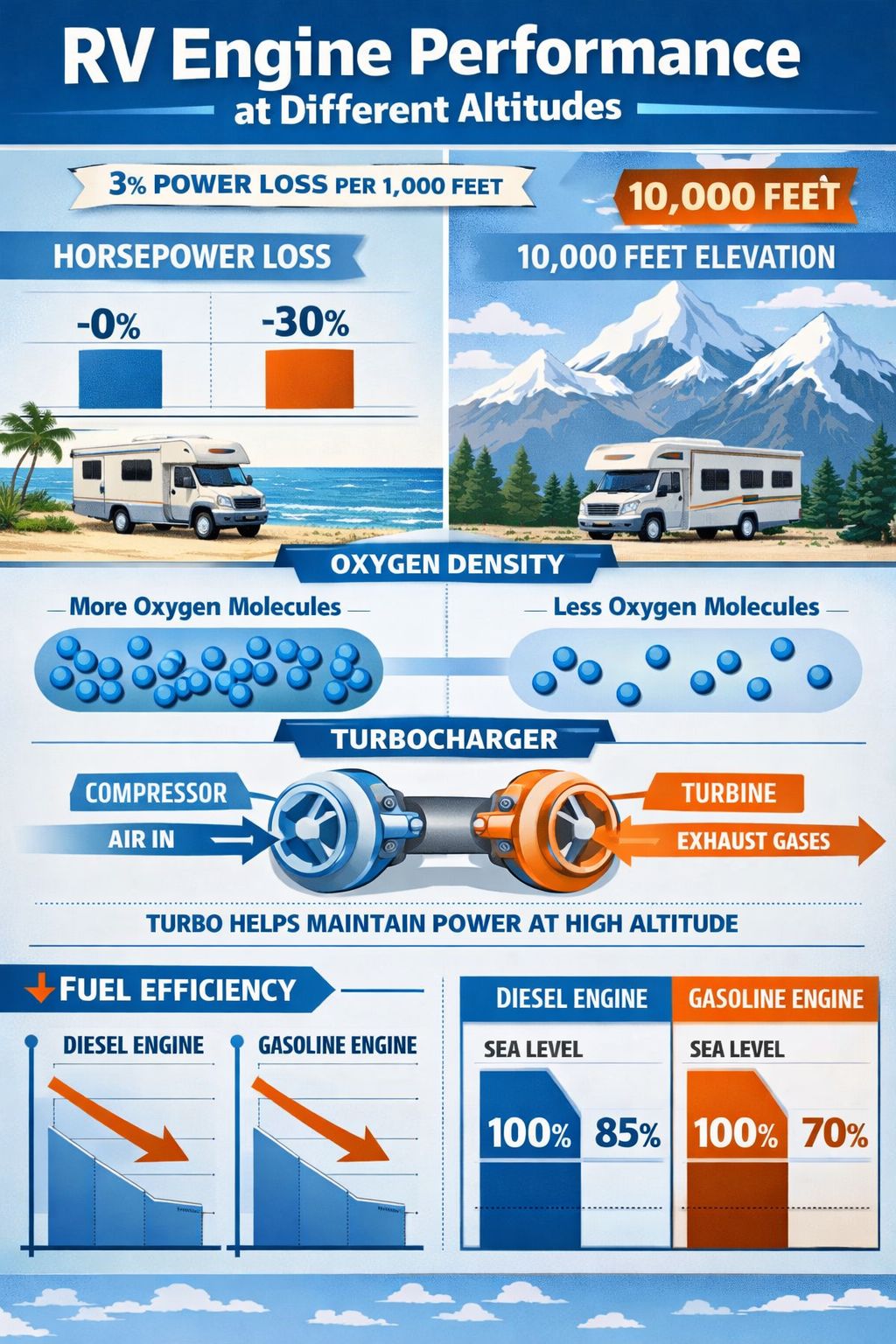
Portrait/Pinterest format (1024x1536) detailed infographic showing RV engine performance comparison at different altitudes, split-screen vis
  • Save on Pinterest

Would you like to save this article?

We'll email this post to you, so you can come back to it later to read!

When you drive your RV up into the mountains, you’re not just changing the scenery—you’re fundamentally changing how your vehicle operates. The thinner air at higher elevations creates a cascade of mechanical challenges that every RV owner should understand.

Engine Performance and Power Loss

Your RV’s engine needs three things to run properly: fuel, air, and spark. At higher altitudes, the air pressure drops significantly, meaning there’s less oxygen available for combustion. This creates noticeable power loss that becomes more dramatic the higher you climb.

Here’s what happens at different elevations:

Elevation Approximate Power Loss What This Means
Sea Level 0% Full engine power
5,000 feet 15% Noticeable on hills
8,000 feet 24% Significant struggle
10,000 feet 30% Major performance issues

Diesel engines typically handle altitude better than gasoline engines because they rely on compression rather than spark ignition. However, both types will experience reduced performance. Turbocharged engines also fare better than naturally aspirated ones since the turbo helps compensate for the thinner air.

Fuel Efficiency Changes

Along with losing power, your RV will also consume more fuel at higher elevations. This happens for two reasons:

  1. The engine works harder to maintain speed with less oxygen
  2. You’ll likely downshift more frequently on mountain roads

Expect fuel economy to drop by 10-20% when traveling above 5,000 feet. This means more frequent fuel stops and higher costs during mountain trips.

Cooling System Challenges

Water boils at a lower temperature as altitude increases. At sea level, water boils at 212°F (100°C), but at 10,000 feet, it boils at just 194°F (90°C). This affects your RV’s cooling system in important ways:

  • Coolant may boil more easily, potentially causing overheating
  • Radiator caps rated for sea level may not provide adequate pressure
  • Engine temperatures may run higher even under normal conditions

Many RV owners don’t realize their engine is running hotter than normal until they see the temperature gauge climbing on a steep mountain pass.

Propane System Adjustments

Your RV’s propane system faces unique challenges at altitude. Propane regulators are typically set for sea level operation, and above 8,000 feet, they may need adjustment to maintain proper gas pressure.

Signs your propane system needs attention:

  • 🔥 Appliances won’t stay lit
  • 🔥 Yellow flames instead of blue
  • 🔥 Soot buildup on burners
  • 🔥 Reduced heat output from furnace

Some modern RVs come with altitude-adjustable regulators, but older models may require manual adjustment or replacement.

Does Altitude Affect RVs’ Onboard Systems? Critical Components to Monitor

Beyond the engine, numerous RV systems behave differently at higher elevations. Understanding these changes helps you prepare properly and avoid frustrating breakdowns.

Refrigerator Performance Issues

RV refrigerators, especially absorption-style models, are notoriously finicky at altitude. These units rely on precise airflow and combustion, both of which are affected by thinner air.

Common refrigerator problems above 5,000 feet:

  • Food doesn’t stay cold enough
  • Freezer section doesn’t freeze properly
  • Burner won’t stay lit (on propane mode)
  • Excessive frost buildup

Solution: Many RV refrigerators have altitude adjustment settings. Check your owner’s manual for instructions on switching to high-altitude mode, which typically adjusts the air-fuel mixture for the burner.

Generator Performance

Portable and built-in generators experience the same oxygen-deprivation issues as your RV’s main engine. At high altitude, generators produce:

  • Reduced wattage output (approximately 3.5% loss per 1,000 feet)
  • Increased fuel consumption
  • Potential overheating

A generator rated for 4,000 watts at sea level will only produce about 3,200 watts at 8,000 feet—a significant reduction that could leave you without enough power for air conditioning or multiple appliances.

Tire Pressure Variations

Air pressure inside your tires increases as you climb in elevation, then decreases as you descend. This happens because the external air pressure changes while the air inside your tires expands or contracts.

For every 1,000 feet of elevation change, tire pressure changes by approximately 0.5 PSI. This might not seem like much, but climbing from sea level to 10,000 feet could add 5 PSI to your tires—enough to affect handling and tire wear.

Best practice: Check and adjust tire pressure at your destination elevation, not before you leave sea level.

Water System Considerations

High altitude affects your RV’s water system in subtle but important ways:

  • Water boils faster when cooking (requiring longer cooking times)
  • Water pump may work harder due to air pressure differences
  • Hot water heater may take longer to reach desired temperature

Additionally, if you’re camping above the freezing line, remember that water freezes at the same temperature regardless of altitude, but the thinner air means temperatures can drop more dramatically at night.

What the Poll Results Tell Us: Does Altitude Affect RVs and Their Owners?

Our 2026 survey of RV enthusiasts reveals interesting patterns about altitude preferences and comfort levels. The results show that most RV owners are surprisingly adventurous when it comes to elevation.

Breaking Down the Numbers

What’s your RV altitude comfort level?

  • 🏖️ Sea level only: 8%
  • ⛰️ Up to 5,000 feet: 23%
  • 🏔️ Up to 8,000 feet: 15%
  • 🚀 Any altitude: 54%

The data reveals that 54% of respondents feel comfortable taking their RVs to any altitude—a testament to either confidence, experience, or perhaps a lack of awareness about altitude challenges. Only 8% prefer staying at sea level, suggesting that the vast majority of RV owners are willing to venture into higher elevations.

What These Numbers Really Mean

The 23% who limit themselves to 5,000 feet may be the most pragmatic group. This elevation represents a sweet spot where:

  • Engine performance remains relatively strong
  • Most RV systems function normally without adjustments
  • Altitude sickness is rare for most people
  • Popular destinations like Denver, Colorado (5,280 feet) are accessible

The 15% who cap their travels at 8,000 feet are pushing into territory where mechanical adjustments become more necessary, but they’re still below the elevation where serious altitude sickness becomes common for healthy individuals.

The Fearless 54%

The majority who answered “any altitude” fall into several categories:

  1. Experienced mountain travelers who know how to prepare their rigs
  2. Newer RV owners who haven’t yet encountered altitude problems
  3. Adventure seekers willing to deal with challenges for stunning destinations
  4. Those with newer, well-equipped RVs designed for varied conditions

This group likely includes owners of diesel pushers, turbocharged vehicles, and modern RVs with altitude-compensating systems already built in.

Regional Differences Matter

It’s worth noting that comfort with altitude often correlates with geography. RV owners who live in:

  • Mountain states (Colorado, Wyoming, Montana) are naturally more comfortable with elevation
  • Coastal regions may have less experience and more hesitation
  • Midwest flatlands might view mountains as exotic destinations requiring extra preparation

How Does Altitude Affect RVs’ Human Occupants?

Portrait/Pinterest format (1024x1536) vibrant pie chart visualization displaying poll results with four distinct colored segments: 8% sea le
  • Save on Pinterest

While mechanical issues can be frustrating, the effects of altitude on your body are equally important to understand. Research shows that high-altitude exposure triggers significant physiological responses in the autonomic nervous system [1].

Understanding Altitude Sickness

Altitude sickness, also called Acute Mountain Sickness (AMS), occurs when you ascend too quickly to high elevations. The reduced oxygen availability causes your body to work harder, leading to uncomfortable symptoms.

Common symptoms include:

  • 🤕 Headache (most common)
  • 😴 Fatigue and weakness
  • 🤢 Nausea or vomiting
  • 😵 Dizziness or lightheadedness
  • 💤 Difficulty sleeping
  • 🫁 Shortness of breath

Studies show that the autonomic nervous system undergoes significant changes during high-altitude exposure, affecting heart rate variability and cardiovascular function [2]. These changes are your body’s attempt to adapt to the reduced oxygen environment.

Who’s Most at Risk?

While anyone can experience altitude sickness, certain factors increase your risk:

  • Rapid ascent (driving from sea level to 10,000 feet in one day)
  • Pre-existing heart or lung conditions
  • Age over 50 (though children are also susceptible)
  • Previous history of altitude sickness
  • Dehydration or alcohol consumption

Research indicates that cardiovascular adaptations occur differently in people with chronic altitude exposure versus those experiencing acute changes [4]. Long-term mountain residents develop physiological adaptations that visitors don’t have.

Cognitive Effects at Elevation

Beyond physical symptoms, altitude affects your mental performance and decision-making. Studies have documented cognitive changes at high elevations, including [6]:

  • Slower reaction times
  • Reduced memory function
  • Impaired judgment
  • Decreased concentration

These effects are particularly important for RV drivers navigating challenging mountain roads. The combination of reduced cognitive function and difficult driving conditions can be dangerous.

Prevention and Acclimatization

The good news is that most people can adapt to moderate altitudes with proper preparation:

Best practices for altitude adaptation:

  1. Ascend gradually – Spend a night at intermediate elevations
  2. Stay hydrated – Drink more water than you think you need
  3. Avoid alcohol for the first 24-48 hours
  4. Eat light meals – Heavy foods are harder to digest at altitude
  5. Rest frequently – Give your body time to adjust
  6. Consider medication – Acetazolamide (Diamox) can help prevent AMS

Research shows that autonomic nervous system responses normalize with acclimatization, typically within 3-7 days at a given elevation [1].

When to Descend

Severe altitude sickness can progress to life-threatening conditions like High Altitude Pulmonary Edema (HAPE) or High Altitude Cerebral Edema (HACE). Descend immediately if you experience:

  • ⚠️ Severe, persistent headache
  • ⚠️ Confusion or altered mental state
  • ⚠️ Difficulty walking or loss of coordination
  • ⚠️ Chest tightness or persistent cough
  • ⚠️ Extreme fatigue that doesn’t improve with rest

The beauty of RV travel is that your home is mobile—if altitude becomes a problem, you can simply drive to a lower elevation.

Practical Tips for High-Altitude RV Adventures

Armed with knowledge about how altitude affects both your RV and your body, you can prepare properly for mountain adventures. Here are actionable strategies for successful high-altitude RVing.

Pre-Trip Mechanical Preparation

Before heading to the mountains:

Service your engine – Fresh oil, clean air filter, and proper coolant levels are essential

Check your brakes – Mountain descents put extreme stress on braking systems

Inspect cooling system – Look for leaks, worn hoses, and proper coolant concentration

Test your generator – Ensure it’s running properly before you depend on it

Verify propane system – Check for leaks and ensure regulators are functioning

Review owner’s manuals – Learn which systems have altitude adjustments

Driving Strategies for Mountain Roads

Operating an RV at altitude requires different techniques than flatland driving:

Climbing hills:

  • Downshift early to maintain momentum
  • Watch your temperature gauge closely
  • Pull over if the engine overheats
  • Accept slower speeds—power loss is normal

Descending:

  • Use lower gears to control speed (engine braking)
  • Avoid riding your brakes continuously
  • Pull over to let brakes cool if they smell hot
  • Watch for brake fade on long descents

System Adjustments at Altitude

Once you arrive at your high-altitude destination:

Refrigerator: Switch to high-altitude mode if available, or adjust the burner according to manufacturer instructions

Propane appliances: Check flame color—blue is good, yellow means adjustment needed

Tire pressure: Recheck and adjust to recommended PSI at your current elevation

Generator: Reduce electrical load to compensate for reduced output capacity

Campsite Selection Considerations

Not all high-altitude campsites are created equal:

Look for:

  • 🏕️ Gradual elevation changes (not jumping from 2,000 to 10,000 feet overnight)
  • 🏕️ Accessible medical facilities nearby
  • 🏕️ Cell phone coverage for emergencies
  • 🏕️ Level sites (your RV systems work better when level)
  • 🏕️ Adequate ventilation for propane appliances

Health and Comfort Strategies

Make altitude adjustment easier:

💧 Hydration is critical – Aim for 3-4 liters of water daily

🍽️ Eat carbohydrate-rich foods – They require less oxygen to metabolize

Limit caffeine and alcohol – Both contribute to dehydration

😴 Rest on arrival – Don’t plan strenuous activities your first day

🚶 Exercise lightly – Gentle walks help acclimatization better than sitting still

🌡️ Monitor symptoms – Keep track of how everyone in your group feels

Emergency Preparedness

Pack these essentials for high-altitude travel:

  • 🩹 First aid kit with altitude sickness medications
  • 📱 Charged phone and backup power bank
  • 🗺️ Offline maps (cell service can be spotty)
  • 🔧 Basic tools for minor mechanical adjustments
  • 💊 Extra prescription medications
  • 🚨 Emergency contact information for roadside assistance

Regional Destinations: Where Altitude Matters Most

Understanding which popular RV destinations involve significant elevation helps you plan appropriately.

High-Altitude RV Hotspots

Rocky Mountain National Park, Colorado

  • Elevation: 7,500-12,000+ feet
  • Challenges: Severe altitude, steep grades, limited services
  • Preparation level: Advanced

Yellowstone National Park, Wyoming

  • Elevation: 6,000-8,000 feet
  • Challenges: Moderate altitude, wildlife, weather changes
  • Preparation level: Intermediate

Great Smoky Mountains, Tennessee/North Carolina

  • Elevation: 1,000-6,600 feet
  • Challenges: Minimal altitude issues, steep winding roads
  • Preparation level: Beginner to Intermediate

Lake Tahoe, California/Nevada

  • Elevation: 6,200 feet
  • Challenges: Moderate altitude, winter weather
  • Preparation level: Intermediate

Pike’s Peak, Colorado

  • Elevation: 14,115 feet at summit
  • Challenges: Extreme altitude, weather, road conditions
  • Preparation level: Expert only

Seasonal Considerations

Altitude challenges multiply in winter when you add:

  • ❄️ Snow and ice on mountain roads
  • 🌡️ Extreme cold affecting RV systems
  • 💨 High winds at exposed elevations
  • 🚫 Road closures and limited services

Summer travel at altitude brings different concerns:

  • ☀️ Intense UV radiation (sunscreen essential)
  • ⛈️ Afternoon thunderstorms (especially in Rockies)
  • 🔥 Wildfire season and air quality
  • 🦟 Insects at certain elevations

Conclusion: Embracing High-Altitude RV Adventures Safely

Portrait/Pinterest format (1024x1536) comprehensive checklist infographic for high-altitude RV preparation, illustrated items including prop
  • Save on Pinterest

So, does altitude affect RVs? Absolutely—in ways that impact both mechanical systems and human health. But as our poll results show, with 54% of RV owners comfortable traveling to any altitude, these challenges are far from insurmountable.

The key to successful high-altitude RVing lies in preparation, knowledge, and respect for the environment. Understanding that your engine will lose power, your refrigerator may need adjustment, and your body requires time to acclimatize allows you to plan accordingly rather than being caught off guard.

Whether you’re part of the cautious 8% who prefer sea level, the moderate 23% who stick to 5,000 feet, or the adventurous 54% willing to tackle any elevation, the most important factor is knowing your limits—both your RV’s and your own.

Your Action Plan for High-Altitude Success

Before your next mountain adventure:

  1. Research your destination’s elevation and plan your route with gradual ascent
  2. Service your RV with special attention to engine, brakes, and cooling systems
  3. Review owner’s manuals for altitude-specific adjustments
  4. Pack emergency supplies including altitude sickness medication
  5. Plan for extra time – everything takes longer at altitude
  6. Listen to your body and be willing to descend if symptoms develop
  7. Start with moderate elevations if you’re new to mountain RVing

The mountains offer some of the most spectacular RV destinations in the world. With proper preparation and realistic expectations, you can safely enjoy breathtaking vistas, cooler summer temperatures, and unforgettable adventures—regardless of the altitude. The question isn’t whether altitude affects RVs, but rather how well you prepare for those effects.

Happy (and safe) high-altitude travels! 🏔️🚐


References

[1] Autonomic nervous system responses to high-altitude exposure – https://www.frontiersin.org/journals/physiology/articles/10.3389/fphys.2025.1696346/full

[2] Cardiac variability patterns in acute versus chronic altitude exposure – https://pmc.ncbi.nlm.nih.gov/articles/PMC12883122/

[4] Cardiovascular adaptations in high-altitude residents – https://academic.oup.com/eurheartj/article/39/17/1546/4799041

[6] Cognitive and health effects of altitude exposure – https://onlinelibrary.wiley.com/doi/10.1002/brb3.70883