Full-time RV living looks like the ultimate dream—traveling to stunning destinations, waking up to breathtaking views, and living life on your own terms. But behind the Instagram-worthy sunsets and scenic campgrounds lies a reality that many RV enthusiasts don’t talk about.
Larry from the “Downsizing Makes Cents” YouTube channel recently shared his deeply personal story about how full-time RV life contributed to his divorce after 40 years of marriage with Alice. His honest account sheds light on the real challenges that can test even the strongest relationships on the road.
While RV life offers incredible freedom and adventure, it also brings unique stressors that can amplify existing relationship issues or create entirely new ones. From constant mechanical failures to the emotional toll of downsizing, the RV lifestyle demands more than just a love for travel—it requires resilience, adaptability, and rock-solid communication.
According to research on full-time RV living, monthly expenses can range from $1,600 to $5,000, with unexpected repairs often costing thousands of dollars, adding financial stress to an already demanding lifestyle.
Would you like to save this article?
This isn’t about scaring anyone away from RV living. Instead, it’s about providing an honest look at the challenges so you can prepare yourself mentally, emotionally, and financially. Let’s dive into the seven realities that pushed Larry and Alice to their breaking point.
1. The Never-Ending Battle With RV Repairs and Maintenance
Larry’s journey was plagued with mechanical nightmares from the start. His RV spent significant time at the Lippert repair facility, dealing with issues that left him stranded and frustrated. From slideout problems to electrical failures, the repairs seemed endless. The stress of waiting weeks or even months for repairs while living out of a broken home-on-wheels takes a massive toll.
When you’re living in a traditional house and something breaks, you can call a repairman and continue your normal life. But when your home AND vehicle break down simultaneously, you’re stuck. You can’t just check into a hotel indefinitely—that defeats the purpose and drains your bank account faster than a leaky fresh water tank.
According to the 2025 RV Repair Cost Index, RV owners face some of the most common and expensive repairs including slideout mechanisms ($500-$3,000), refrigerator units ($800-$2,000), and electrical system failures ($300-$1,500). Budget experts recommend setting aside $100-$200 monthly for maintenance, plus a $5,000 emergency fund for unexpected repairs.
| Common RV Repairs | Average Cost Range | Typical Wait Time |
|---|---|---|
| Slideout Mechanism | $500 – $3,000 | 2-6 weeks |
| Refrigerator Replacement | $800 – $2,000 | 1-4 weeks |
| Electrical System | $300 – $1,500 | 1-3 weeks |
| Tire Replacement (Set) | $600 – $1,200 | Same day – 1 week |
| HVAC System | $1,000 – $3,500 | 2-8 weeks |
Here’s the kicker: You’ll probably argue with your partner about whose fault it is that you didn’t check the tire pressure, ignored that weird noise, or chose “that cheap campground” that destroyed your suspension. Nothing says romance like blaming each other while sitting in a 100-degree RV with no AC waiting for a repair technician who’s “definitely coming tomorrow.”
2. Flat Tires and Highway Hazards That Test Your Patience
In his video, Larry discussed dealing with flat tires on the road—a common but incredibly stressful experience for full-time RVers. Imagine cruising down the highway when suddenly you hear that dreaded THUMP-THUMP-THUMP as your tire disintegrates at 65 miles per hour. You’re pulling a house behind you, trying to find a safe spot to pull over while traffic whizzes by.
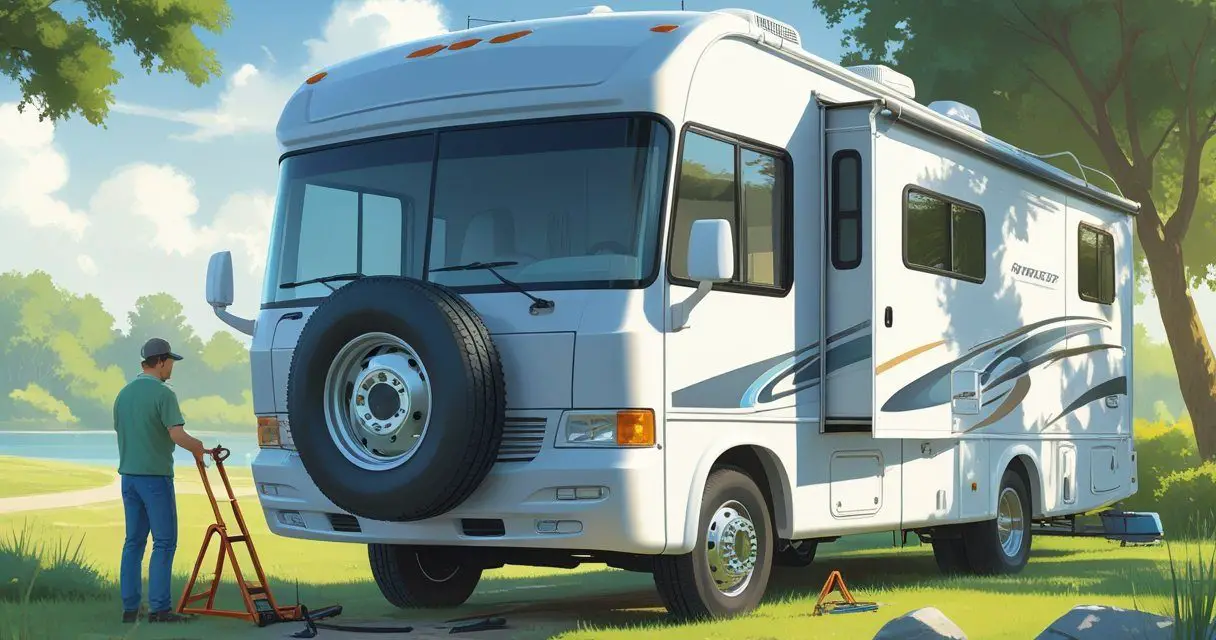
Changing an RV tire isn’t like changing a car tire. These beasts require special tools, incredible strength, and often professional assistance. If you’re traveling with a partner, this becomes a test of your communication skills, patience, and ability not to scream “I TOLD YOU WE SHOULD HAVE CHECKED THE TIRES!”
According to RV maintenance experts, tire-related incidents cause approximately 30% of RV accidents. Proper tire maintenance includes checking pressure before every trip, inspecting for wear and cracks monthly, and replacing tires every 3-5 years regardless of tread depth. The average cost to replace all six tires on a Class A motorhome ranges from $2,400 to $3,600.
You’d think a flat tire would bring couples closer together as they work as a team to solve the problem. Instead, you’ll discover exactly how much your partner enjoys standing on the side of a busy highway in 95-degree heat while you jack up a 20,000-pound vehicle. Spoiler alert: they don’t enjoy it. At all.
3. Health Issues Hit Harder When You’re Living on the Road
Larry underwent neck surgery during his full-time RV journey—a serious medical situation that becomes exponentially more complicated when you don’t have a permanent address. Finding quality healthcare providers, scheduling appointments, and recovering in a tiny RV space creates challenges that people in traditional homes never face.
When you need medical care on the road, you’re often dealing with unfamiliar doctors, different insurance networks, and the logistical nightmare of staying in one location long enough to receive treatment. Recovery time in a small RV means limited mobility, cramped conditions, and dependency on your partner for basic needs. This can strain even the strongest relationships.
Research from RV living communities shows that medical emergencies and chronic health issues are among the top reasons couples quit full-time RV living. The emotional burden of being a caregiver in close quarters while also managing the RV lifestyle can lead to burnout, resentment, and relationship breakdown.
Recovering from surgery in an RV sounds peaceful until you realize your bed is two feet from the refrigerator that runs constantly and your bathroom requires you to navigate three stairs. Your partner becomes your nurse, chef, driver, and mechanic all at once. That’s not partnership—that’s a reality TV show nobody wants to be on.
4. The Crushing Weight of Downsizing and Letting Go
Before hitting the road, Larry and Alice had to downsize from a traditional home to approximately 250-400 square feet of RV living space. This process isn’t just about getting rid of stuff—it’s about letting go of memories, identities, and the life you built together. According to counseling psychologists specializing in life transitions, downsizing ranks among the top emotional stressors in the RV lifestyle.
Every item you decide to keep or discard becomes a negotiation. Do we keep Grandma’s china or the photo albums? What about the kids’ artwork or the furniture we bought for our first home? These decisions can reveal fundamental differences in what each partner values, creating conflict and resentment.
Relationship experts in the RV community identify this as “Tension of the Opposites”—experiencing excitement about the new adventure while simultaneously grieving the loss of your old life. This emotional paradox is perfectly normal but often catches new RVers off guard. Many report experiencing anxiety, panic attacks, and depression during the first six months of full-time RV living.
You’ll have heated debates about whether you “really need” that bread maker, stand mixer, or collection of 47 coffee mugs. Then you’ll hit the road, realize you actually needed more kitchen storage, and passive-aggressively remind your partner that you told them so. Every. Single. Day.
5. Living in 200 Square Feet Magnifies Every Relationship Issue
The average RV provides 200-400 square feet of living space—roughly the size of a small bedroom. There’s nowhere to escape during arguments, no separate spaces to cool down, and absolutely zero privacy. Larry mentions this challenge implicitly as he navigates his post-divorce life, adjusting to being alone after decades of partnership.
When you lived in a house, you could retreat to different rooms during conflicts. In an RV, you’re literally within arm’s reach of each other 24/7. That snoring that was mildly annoying in a king-size bed? Now it’s reverberating through a space smaller than your old bathroom. Those little habits that used to be cute? They’re now magnified into relationship-ending annoyances.
According to research from RV couples, the proximity forces immediate conflict resolution. You can’t ignore problems or give each other the silent treatment effectively when you’re both trying to make dinner in a kitchen where you can’t stand side-by-side. Psychology experts note that while this can improve communication skills, it can also accelerate relationship breakdown if couples lack healthy conflict resolution strategies.
| Aspect | House Living | RV Living |
|---|---|---|
| Personal Space | Separate rooms available | 200-400 sq ft total |
| Conflict Resolution | Can take space, cool down | Immediate proximity forces immediate resolution |
| Storage | Closets, garage, attic | Minimal built-in storage |
| Privacy | Multiple bathrooms, bedrooms | One bathroom, open floor plan |
| Work Space | Home office possible | Dining table doubles as desk |
Imagine trying to work from your dining table while your partner watches TV three feet away. Then add the fact that your “office” also serves as your kitchen, living room, and bedroom. You’ll discover your partner’s every quirk—how they chew, breathe, and apparently believe that “indoor voice” is just a suggestion.
6. Financial Stress From Unexpected Costs Destroys Peace of Mind
While many people assume RV living is cheaper than traditional homeownership, the reality is far more complex. Larry’s experience with extensive repair bills and unexpected expenses highlights a critical challenge: RV living comes with unpredictable costs that can devastate your budget and create massive financial stress.
Monthly RV living expenses typically range from $1,600 to $5,000, including campground fees ($25-$120 per night), fuel costs ($300-$500 monthly), food and groceries ($500-$1,000), RV insurance ($100-$200 monthly), and maintenance. But those unexpected repairs? They’re budget killers. A transmission failure could cost $4,000-$8,000. Roof leaks might run $1,000-$3,000 to fix properly.
Financial stress is one of the leading causes of divorce in general, and the RV lifestyle adds unique monetary pressures. When your home breaks down, you’re not just paying for repairs—you’re paying for a place to stay, lost travel plans, and the emotional toll of uncertainty. Many couples report fighting about money more frequently on the road than they did in traditional housing.
Nothing tests a marriage like watching your savings account drain because your leveling jacks failed and now you’re living in a tilted house for two weeks while waiting for parts. You’ll debate whether to splurge on a campground with hookups or save money by boondocking without working AC. Romance!
7. The Emotional Toll of Isolation and Identity Loss
Perhaps the most profound challenge Larry faces—and one he discusses openly—is the loneliness and identity shift that comes with full-time RV living. After his divorce, Larry must navigate solo RV life and rediscover who he is outside of his 40-year marriage. But even couples experience this identity loss together.
When you leave your career, community, and familiar social circles, you lose a significant part of your identity. You were somebody—a manager, a church member, a neighbor, a PTA parent. On the road, you’re often “just” an RVer. Research from full-time RV communities shows that identity loss and redefinition is one of the most challenging emotional adjustments, particularly in the first year.
Leaving friends and family behind creates profound grief. You can’t meet friends for coffee, attend family dinners, or be present for important life events. When family members get sick or face crises, the guilt of being absent can be overwhelming. Psychology experts note that the combination of isolation, identity loss, and guilt creates a perfect storm for relationship strain.
According to counseling psychologists, approximately 40% of new full-time RVers experience significant emotional challenges including anxiety, depression, and relationship conflicts during their first six months. Those who don’t prepare mentally and emotionally for these transitions have higher rates of quitting RV life or, as in Larry’s case, relationship dissolution.
You’ll make video calls to family gatherings where everyone’s together except you. You’ll watch your friends’ social media posts about girls’ nights and golf outings, remembering when you were part of that community. Your partner will be your only consistent social contact, which sounds romantic until you realize they’re also the person who forgot to empty the black tank. Again.
What Can We Learn From Larry’s Story?
Larry’s honest account of his divorce after 40 years isn’t meant to discourage people from RV living—it’s a wake-up call about the realities beneath the surface. Full-time RV living can be an incredible adventure that strengthens relationships, but only when couples prepare for the real challenges, not just the Instagram version.
Successful full-time RV couples emphasize several key factors:
- Strong communication skills before hitting the road
- Realistic budgets that include substantial emergency funds
- Individual hobbies and interests to maintain separate identities
- Regular breaks from the road to reconnect with family and friends
- Couples counseling or coaching to navigate major transitions
- Trial periods with extended RV trips before committing full-time
If you’re considering full-time RV living with a partner, ask yourselves: How do we handle stress together? Can we communicate effectively in tight spaces? Do we have the financial cushion for unexpected disasters? These conversations before hitting the road can make the difference between living your dream and living your nightmare.
Final Thoughts
Larry’s journey—from 40 years of marriage to navigating solo RV life after divorce—is a powerful reminder that full-time RV living isn’t a fairy tale. It’s real life compressed into a tiny space, amplifying both the joys and challenges of any relationship. While many couples thrive on the road, others discover that the lifestyle reveals incompatibilities they could ignore in a traditional setting.
The RV lifestyle is incredibly rewarding for those who are prepared. But preparation means more than just buying the right equipment and planning your route. It means honest conversations about expectations, deliberate strategies for managing conflict, and realistic understanding of the financial and emotional costs.
To Larry and Alice—and to everyone navigating similar challenges—thank you for sharing your story. Your honesty helps others make informed decisions about whether this lifestyle is right for them. The road ahead may look different than you planned, but it can still be beautiful.
SOURCES
- Downsizing Makes Cents YouTube Channel – Did Full Time RV life cause our divorce after 40 years together?
- EcoFlow – Full-Time RV Living in the US: How Much Does It Really Cost
- Follow Your Detour – Taking Your Marriage on the Road: How Full-Time RVing Impacted Our Marriage
- More Than A Wheelin’ – 7 Challenges and Coping Tips for Full Time RV Living
- Happy Campers Store – RV Repair Cost Index 2025: What Owners Are Really Paying
- Jackery – How Much Does RV Living Cost? (A Quick Breakdown)
- Outdoorsy – The Cost of RV Living: Complete Guide
- Living50+ – Downsizing to an RV Full-Time: Pros and Cons
This article is formatted for easy copying and pasting into WordPress Visual Editor.