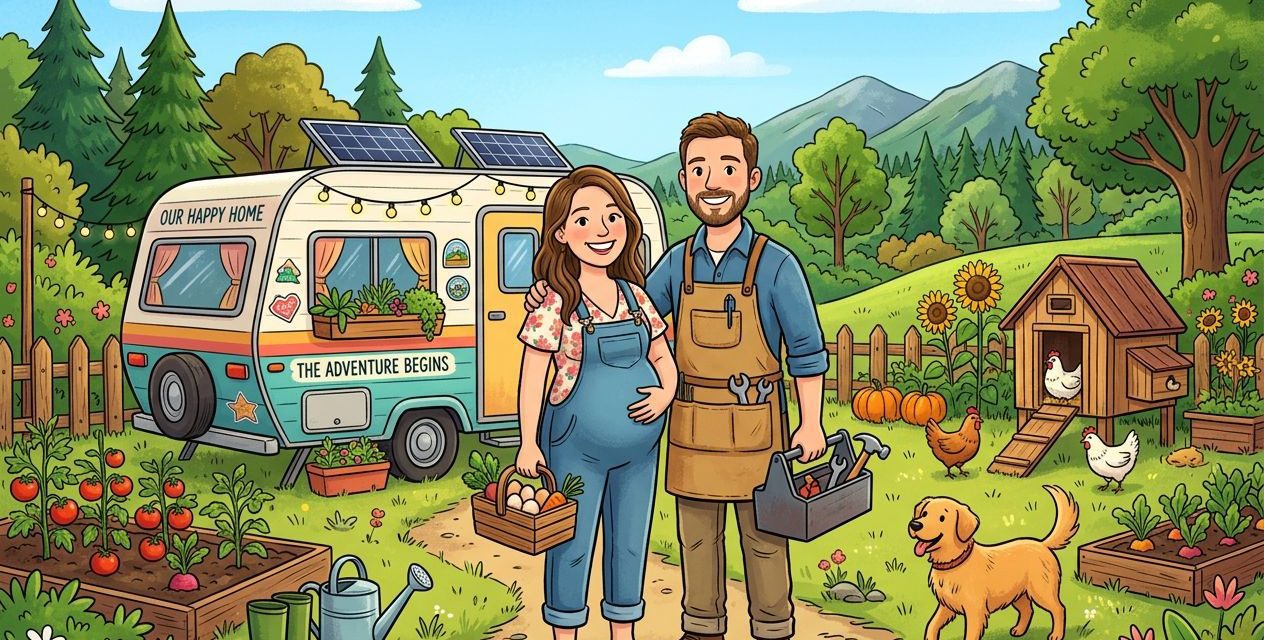
You’ve probably watched countless YouTube videos of RV couples living their best lives and wondered, “How do they afford all this?” Well, buckle up, because the story behind HappilyEverHanks will completely change how you think about money, debt, and building wealth in your 30s. This couple went from drowning in $260,000 of debt to purchasing a 20-acre abandoned Florida homestead—all while working as travel nurses and building a YouTube empire.
Their journey isn’t about trust funds or lucky breaks. It’s about peanut butter and jelly sandwiches, brutal honesty, and learning to embrace the suck. Ready to discover the seven money strategies that transformed their financial destiny?
1. They Faced Their Financial Monster Head-On: $260,000 in Debt
When Kyle and Renee combined finances after getting engaged, they discovered a terrifying truth. Between student loans, a house, car payments, and credit card debt, they were staring down $260,000 in debt.
That’s not a typo—a quarter of a million dollars hanging over their heads.
The Real Kicker? Renee was already working two jobs as a nurse in the ER and on an ambulance. She was paying for gas on credit cards despite pulling double shifts. Kyle was working as an EMT while grinding through nursing school.
According to Ramsey Solutions, the average American household carries around $145,000 in total debt, including mortgages. These two millennials were nearly double that amount before they even got married.
You might think having a nursing degree automatically equals financial stability. Wrong! The more money you make, the more you spend—unless you wise up fast. These two were living proof that a six-figure income means nothing if you’re hemorrhaging cash on takeout, Christmas gifts bought on credit, and negative equity car loans. Sometimes your biggest obstacle isn’t your income—it’s looking in the mirror.
2. They Discovered Dave Ramsey (Then Mixed Up the Baby Steps—Accidentally Genius)
About three months into their first travel nursing assignment in 2017, Kyle and Renee stumbled upon Dave Ramsey’s podcast. They became obsessed with listening to people call in about their financial disasters.
Here’s where it gets interesting: Renee accidentally started with the wrong baby step. She thought step one was saving 3-6 months of living expenses (that’s actually step 3 or 4). But this “mistake” forced them to sit down and calculate their actual monthly spending.
The Shocking Discovery: They were dropping nearly $2,000 per month on eating out alone.
According to the Bureau of Labor Statistics, the average American household spends about $3,000 annually on dining out. Kyle and Renee were spending that amount every six weeks.
| Category | Their Spending | National Average |
|---|---|---|
| Dining Out (Monthly) | $2,000 | ~$250 |
| Annual Dining Out | $24,000 | ~$3,000 |
If you’ve ever justified expensive takeout because “you earned it” after a hard shift, you’re not alone. Travel nurses make great money, but lifestyle inflation is the silent dream killer. When everyone around you is ordering DiMaggio’s at 3 AM in the break room, it takes serious willpower to pull out that squished PB&J from your spouse’s purse. But that’s exactly the kind of unsexy decision that changes everything.
3. They Ate PB&J for Four Years Straight (No, Seriously)
Once Kyle and Renee committed to the debt snowball method, they went all in. For four straight years working ER shifts, they packed peanut butter and jelly sandwiches while their coworkers ordered out every single day.
They’d cheers their sad sandwiches in the break room while everyone else enjoyed restaurant meals. They budgeted just $200 per month for dining out (which would need to be $500+ in today’s economy).
Their Strategy:
- Picked up every overtime shift available
- Chased hospital incentive bonuses
- Threw every extra dollar at their smallest debts first
- Celebrated each small win to build momentum
The debt snowball effect worked like magic. Pay off a $1,500 student loan, then roll that payment into the next $3,000 credit card debt, then tackle the parent PLUS loans Renee’s family took out for nursing school.
Here’s a truth bomb: delayed gratification tastes better than instant gratification. When you only allow yourself $200 a month to eat out, those rare restaurant meals become celebrations instead of mindless habits. The couple actually enjoyed dining out more because it was special again. Meanwhile, their coworkers were going broke eating overpriced hospital cafeteria food, wondering why their bank accounts never grew.
4. They Became Debt-Free by 2020 (Just Before COVID Changed Everything)
By late 2020, after grinding for nearly three years, Kyle and Renee sold their Pennsylvania house (which had been sitting empty while they traveled) and made their final debt payment.
They were officially 100% debt-free with $20,000 in savings.
Then COVID hit. And the “most stable job in America”—nursing—proved it wasn’t stable at all. They got laid off. Every travel nursing position across the entire country dried up overnight because hospitals couldn’t afford premium pay after canceling elective surgeries.
According to data from Business Insider, 84% of Americans say living debt-free is a core component of achieving the American Dream. Yet only about 43% of U.S. households carry no unsecured debt. Kyle and Renee joined the minority at the perfect (or worst?) time.
Getting laid off when you’re debt-free with savings hits differently than getting laid off while drowning in payments. While most Americans would panic, these two saw opportunity. With no debt strangling their monthly budget and $20K in the bank, they could take risks. That cushion gave them permission to bet on themselves instead of scrambling for the next paycheck.
5. They Went All-In on YouTube (And Almost Went Broke Doing It)
With $20,000 to their name and no nursing jobs available, Kyle and Renee made a wild decision: start a YouTube channel full-time.
Their coworkers had been telling them for months to document their travels. So in June 2020, they launched HappilyEverHanks and treated it like a full-time career, releasing videos weekly.
The Brutal Reality:
- It took 6 months to hit 1,000 subscribers (required for monetization)
- Their first paycheck was literally pennies—enough to fill up a gas tank
- They watched their $20K savings dwindle rapidly
- They sold Renee’s car for $10,000 to extend their runway
- By April 2021, they were cutting it dangerously close to zero
According to YouTube’s creator guidelines, once you hit 1,000 subscribers and 4,000 watch hours, you can monetize. But the average YouTube channel earns between $10-$30 per 1,000 views from ads alone. When you’re starting from scratch, that’s barely enough for ramen noodles.
Starting a business while bleeding your savings account is terrifying, but youth gives you one superpower: bounce-back time. Kyle and Renee were in their 30s with no kids and nursing licenses as a safety net. They could afford to take risks that would be reckless for someone with three kids and a mortgage. Timing isn’t everything, but it’s definitely something.
6. They Mastered the “Make Your Money Work FOR You” Philosophy
By 2024-2025, Kyle and Renee’s YouTube channel was generating consistent income. They became obsessive savers, banking every extra dollar while maxing out retirement accounts.
But here’s where they leveled up: they stopped blindly following Dave Ramsey’s “never use credit cards” rule. Once debt-free, they realized credit cards are powerful tools when you have self-control.
Their Strategy:
| Old Way (In Debt) | New Way (Debt-Free) |
|---|---|
| Avoid credit cards completely | Use rewards credit cards strategically |
| Buy depreciating assets (new RV) | Invest in appreciating assets (land, equipment) |
| Shop at Walmart reluctantly | Shop at Walmart proudly |
| Spend whatever you make | Live below your means permanently |
Example: Instead of buying a $100,000-200,000 new RV (depreciating asset), they bought a John Deere skid steer with three attachments, a $13,000 brush cutter, and a gooseneck trailer—all for the same price. These are tools that will help develop their 20-acre property and appreciate in value.
The best financial flex isn’t showing off what you bought—it’s showing off what you didn’t buy. Kyle and Renee still drive the same truck from years ago, still live in the same beat-up RV trailer from 2019, and still shop at Walmart despite having money to burn. Real wealth whispers while broke screams. The neighbors buying McMansions and brand-new RVs? They’re usually drowning in payments while Kyle and Renee are stacking assets.
7. They Chose the Grind Over Easy (Buying an Abandoned Homestead in the Florida Heat)
In 2024, Kyle and Renee had a choice: buy a move-in-ready house or take on a 20-acre abandoned homestead in Florida covered in junk, with squatters’ remnants and three massive structures to demolish.
They chose chaos. And they chose it in the worst possible time—90-100°F with brutal humidity, while Renee was pregnant.
Why? Because easy doesn’t create the same dopamine rush as earning it.
According to SEE Change Magazine, millennials are increasingly drawn to homesteading and land ownership. The median age of RV owners has dropped from 53 in 2021 to 49 in 2025, with 46% of owners now in the 35-54 age range. Millennials and Gen Z now represent 38% of the 11.2 million RV-owning households in America.
Kyle wanted to build something with his hands, like his grandfather’s generation did. He wanted to be able to tell his future kids: “Dad built this land with his own hands.”
Buying the worst property in the best location is a classic wealth-building strategy, but most people avoid it because it’s hard. While their friends were buying turnkey houses and posting Instagram stories, Kyle and Renee were sweating in the Florida wilderness, removing junk and clearing brush. The difference? In 10 years, their “fixer-upper” land will have appreciated massively while those turnkey houses have depreciated. Hard now, easy later. Easy now, hard forever.
The Bottom Line: Gratitude, Grit, and YouTube Changed Everything
Kyle and Renee’s biggest message? Thank you. Without people watching their videos every week, leaving comments, sharing knowledge, and participating in their journey, none of this would be possible.
YouTube doesn’t just hand out money. According to Business of Apps, YouTube generated $36.1 billion in revenue in 2024, with 2.74 billion monthly users. But only creators who engage communities and provide consistent value earn meaningful income. Kyle and Renee built a community that supports them.
Their Core Principles:
✅ Embrace the grind and enjoy the suck
✅ Delayed gratification is more satisfying than instant pleasure
✅ Debt-free living opens doors you can’t imagine
✅ Make your money work for you, not against you
✅ Hard work + transparency + consistency = sustainable success
✅ Community support is everything
Final Thoughts
You’ve just witnessed how two millennials went from $260,000 in debt to owning 20 acres debt-free by age 30-something. No trust fund. No inheritance. Just peanut butter and jelly sandwiches, brutal budget discipline, strategic career moves, and a willingness to bet on themselves.
Their story proves that financial freedom isn’t about how much you make—it’s about how much you keep, how you invest, and whether you’re willing to delay gratification long enough to build something real.
So next time you watch a young RV couple living large on YouTube, don’t just assume they’re trust fund kids. They might be eating PB&J behind the scenes, working double shifts, and making sacrifices you’d never guess. The secret to affording “all this”? Living like no one else will, so later you can live like no one else can.
SOURCES
Recreational Vehicle Industry Association (RVIA) – Millennials and Gen Z Reshaping RV Industry
https://www.rvia.org/news-insights/millennials-and-gen-z-reshaping-rv-industry
RVIA – 2025 Go RVing RV Owner Demographic Profile
https://www.rvia.org/2025-go-rving-rv-owner-demographic-profile
Condor Ferries – Latest RV Statistics 2025
https://www.condorferries.co.uk/rv-statistics
Emergency Assistance Plus – RV Statistics for 2025
https://www.emergencyassistanceplus.com/resources/rv-statistics/
Nightingale College – Travel Nurse Salary By State & Nationally [2025]
https://nightingale.edu/blog/travel-nurse-salary-by-state.html
Vivian – Average Travel Nurse Salary by State & Nationally
https://www.vivian.com/nursing/travel/salary/
Investopedia – How to Achieve the American Dream: Living Debt-Free
https://www.investopedia.com/living-debt-free-is-an-american-dream-11795959
PR Newswire – Only 1-in-10 Americans Living Their Definition of ‘Financial Freedom’
https://www.prnewswire.com/news-releases/only-1-in-10-americans-are-living-their-definition-of-financial-freedom-achieve-survey-finds-301906121.html
Ramsey Solutions – Average American Debt
https://www.ramseysolutions.com/debt/average-american-debt
Business of Apps – YouTube Revenue and Usage Statistics (2026)
https://www.businessofapps.com/data/youtube-statistics/
Business Insider – Why Millennials Are Giving up City Life to Start Homesteading
https://www.businessinsider.com/why-millennials-people-are-homesteading-control-uncontrollable-food-feel-safe-2024-1
SEE Change Magazine – Why Millennials Are Going Back to the Land
https://www.seechangemagazine.com/why-millennials-are-going-back-to-the-land/
Our Simple Homestead – Homesteading a Growing Trend Among Millennials
https://oursimplehomestead.com/homesteading-a-growing-trend-among-millennials/