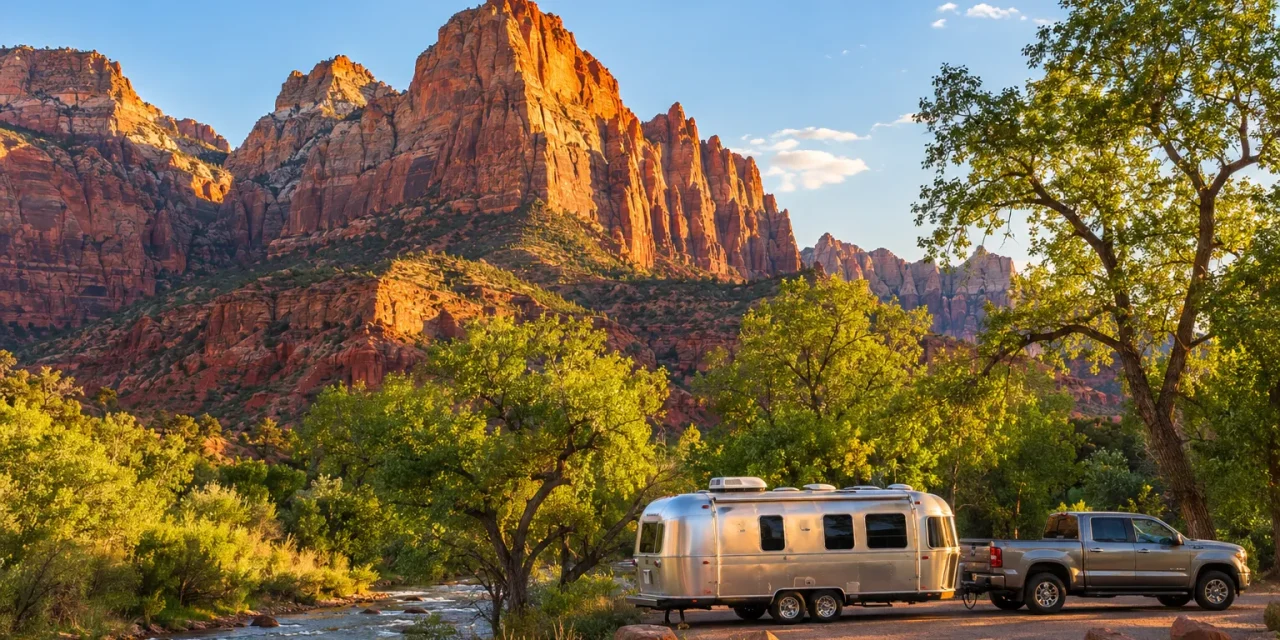
Only two campgrounds inside Zion National Park allow RVs at all, and one of them shuts down completely for part of the year. That’s a tight squeeze for a park that welcomes millions of visitors annually. If a plan isn’t in place before arrival, an RV trip to Zion can turn into a frustrating scramble for a place to park.
This guide breaks down everything needed for smart RV Camping in Zion National Park: How to Navigate Zions Park Utah and Nearby RV-Friendly Campgrounds, from booking the right in-park site to dodging the new road restrictions that catch big rigs off guard every season.
Key Takeaways
- 🏞️ Only Watchman Campground and South Campground inside Zion allow RVs, and both fill up fast during peak season [6].
- 🚧 New size restrictions on the Zion-Mt. Carmel Highway mean some large RVs need an escort or must avoid the tunnel entirely [2][3].
- 🌙 The Zion-Mt. Carmel Tunnel has nighttime closures planned for September 2026 that will affect evening travel plans [4][8].
- 🛠️ Ongoing SR-9 construction and fiber-optic work are causing delays throughout the 2026 travel season [1][7][9].
- 🏕️ Springdale and other gateway towns offer reliable RV-friendly campgrounds with full hookups when in-park sites are booked solid [5].
Choosing Where to Stay: RV Camping in Zion National Park Inside the Park
For anyone hoping to wake up steps from the canyon, camping inside the park is the dream. But RV space is limited, and knowing exactly what’s available saves a lot of headaches.
Watchman Campground sits near the South Entrance and Visitor Center, and it’s the more RV-friendly of the two park campgrounds. It offers roughly 190 sites, including loops with electric hookups designed for RVs and trailers, plus a section for tent and dry camping [6][10]. This campground stays open year-round, which makes it the go-to choice for anyone traveling outside the busy summer months.
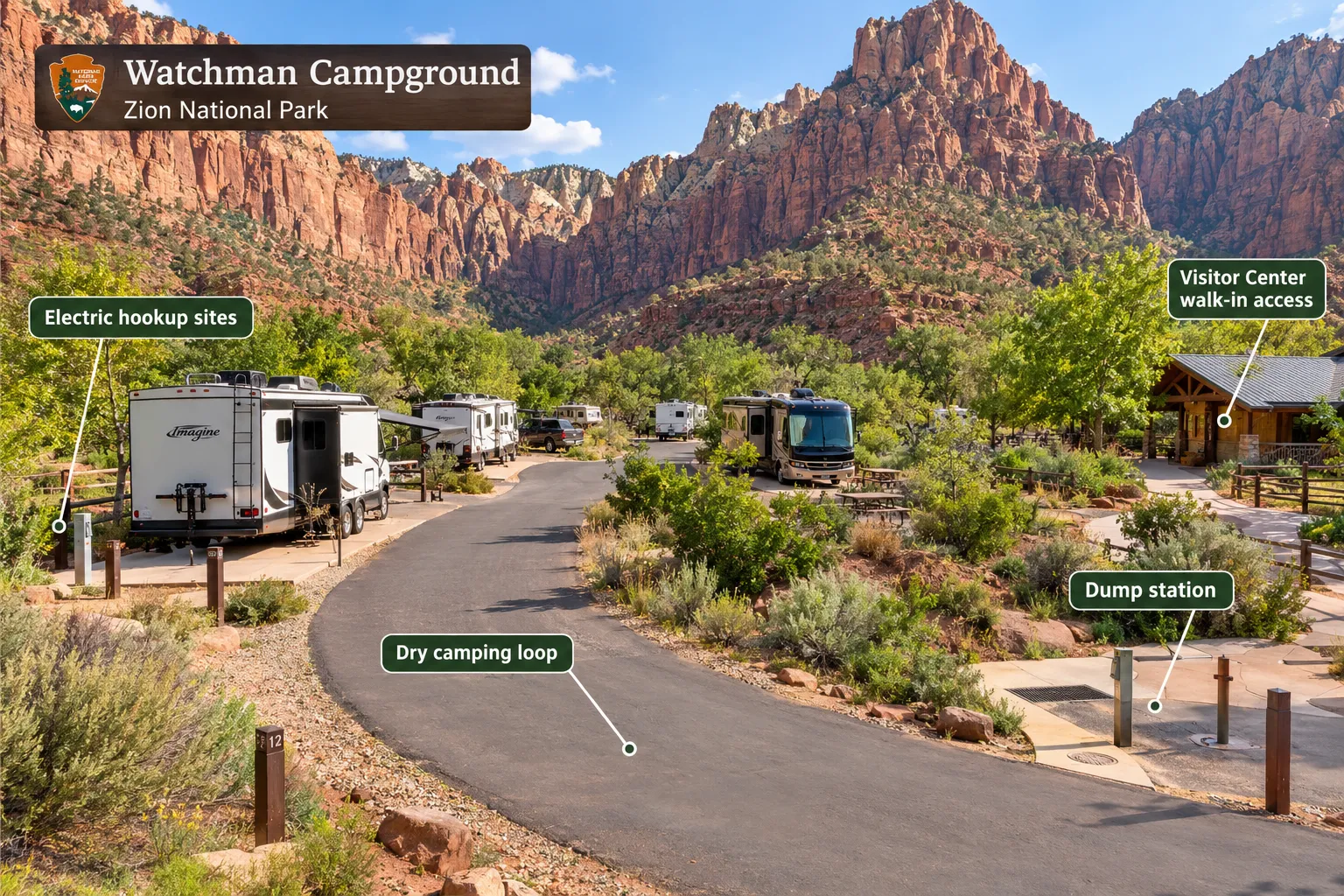
South Campground, on the other hand, is seasonal. It has around 117 sites and does not offer hookups, so it’s better suited to smaller RVs, van campers, or rigs with solid solar and battery setups [6]. Generator use is restricted to certain hours, so quiet-hour rules matter here more than at Watchman.
A few quick facts worth remembering:
- Reservations are required for both campgrounds well in advance through the national reservation system [6][10].
- Lava Point Campground, the park’s third campground, is not RV-appropriate. The access road and site sizes are built for tents and small vehicles only.
- Sites at Watchman with hookups book out months ahead during spring and fall shoulder seasons, which are the most comfortable times to visit Zion.
- Neither campground offers dump stations that support constant use, so planning fresh water and gray/black tank management ahead of arrival is smart.
Anyone building a broader Southwest road trip should also check out other RV camping destinations worth pairing with a Zion stop, since several other national parks in the region have similarly tight RV capacity.
RV Size Limits and Road Rules for Navigating Zions Park Utah
This is the part of the trip that trips up even experienced RVers. Zion isn’t just about finding a campsite, it’s about getting there safely in a large vehicle.
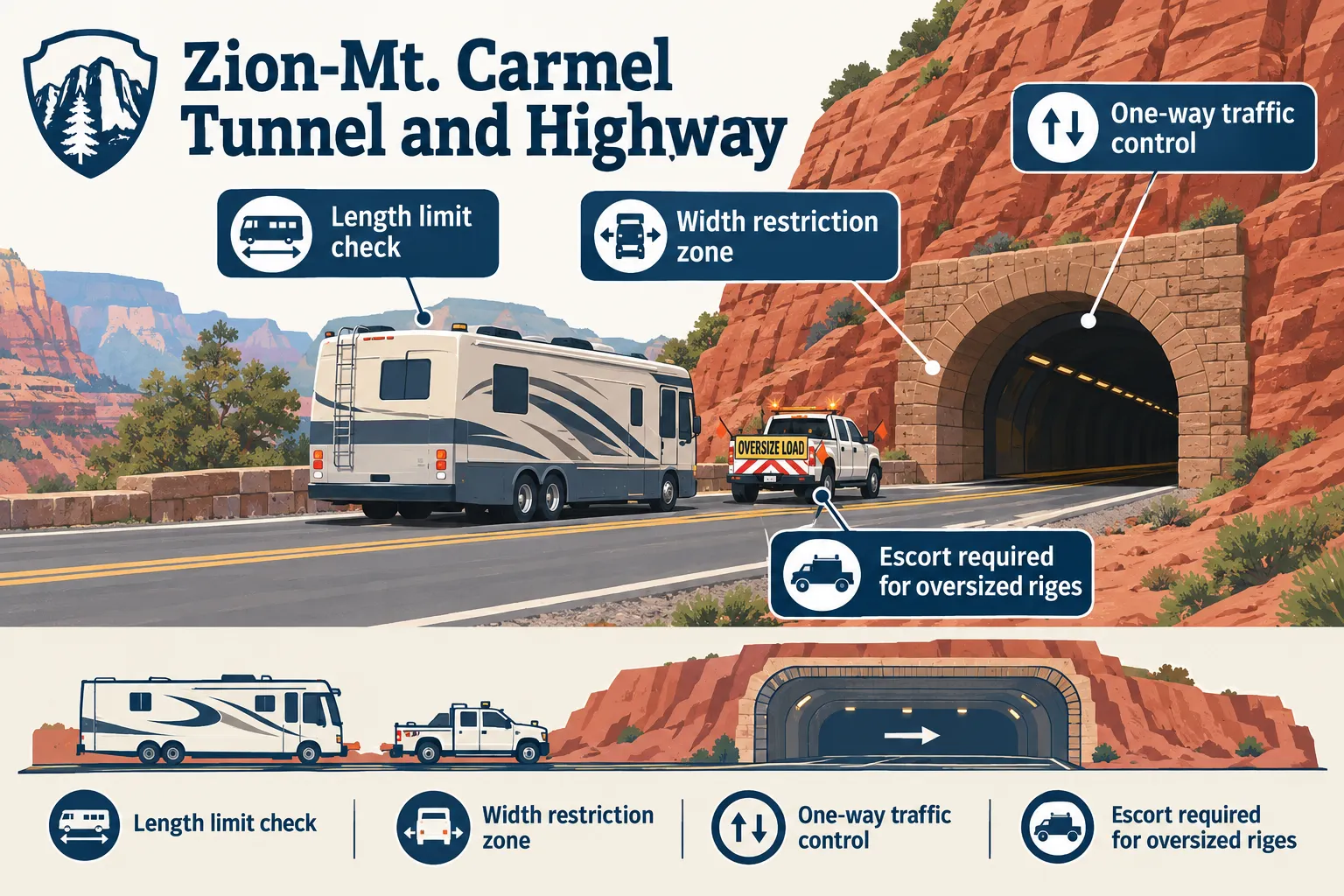
The Zion-Mt. Carmel Highway, which includes the historic tunnel connecting the park’s east and south sides, has updated restrictions on large vehicles. Certain oversized RVs and combination rigs now face limitations or must arrange for an escort through the tunnel corridor [2][3]. This isn’t a new rule dreamed up to slow traffic, the tunnel was carved through solid rock nearly a century ago and simply wasn’t built with modern 40-foot fifth wheels in mind.
“The tunnel is a historic structure, not a modern highway corridor, and that mismatch is exactly why size restrictions exist.”
Here’s what to check before driving toward the tunnel with a larger rig:
- Confirm current size limits through the Utah Department of Transportation’s Zion area traveler resources before departure [3][9].
- Call ahead or check online for escort requirements, some oversized vehicles need a scheduled pilot vehicle to pass through safely [2].
- Have a backup route planned. Many large RVs simply bypass the tunnel altogether and approach the park from the south entrance near Springdale instead.
- Double-check width and height, not just length. The tunnel’s rounded ceiling catches taller rigs that would otherwise clear a standard highway.
Skipping this step isn’t just inconvenient, it can be dangerous. Getting stuck or scraping a tunnel ceiling turns a vacation into an emergency repair bill. For a broader look at why some campgrounds and routes deserve extra caution, this rundown of dangerous RV campgrounds is a good reminder that terrain and infrastructure matter just as much as the destination itself.
It’s also worth thinking through what rig is even the right fit for a trip like this. Not every RV handles narrow mountain roads and older infrastructure equally well, and reviewing RV models with near-perfect reliability scores can help decide what to bring, or what to upgrade to, before tackling a route like the Zion-Mt. Carmel Highway.
Best Nearby RV-Friendly Campgrounds Near Zion National Park
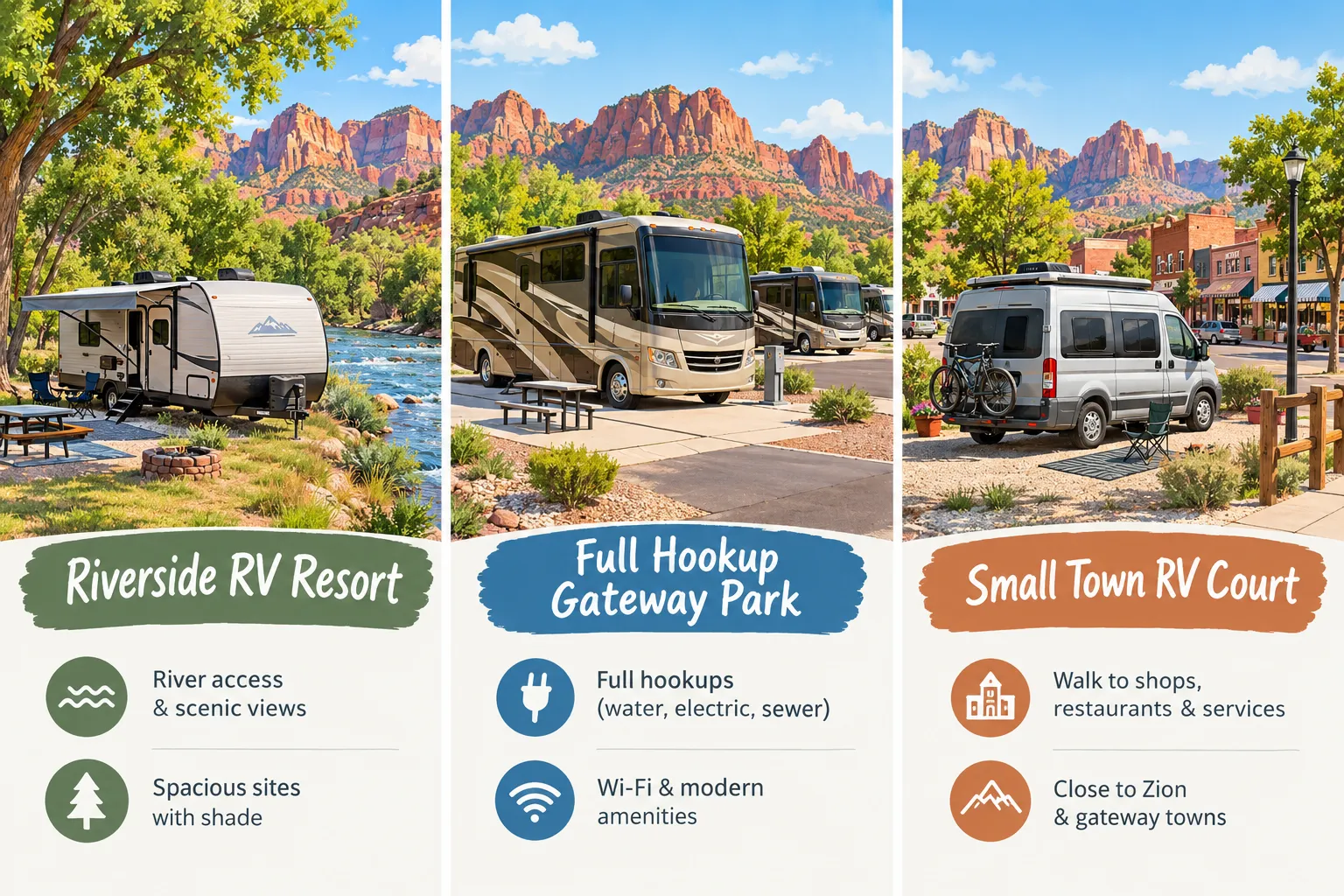
When in-park campgrounds are booked or a rig is too big for park roads, the gateway towns around Zion, especially Springdale, offer a strong lineup of RV-friendly campgrounds [5].
These outside-the-park options tend to offer things Zion’s own campgrounds don’t:
| Feature | Inside Zion (Watchman/South) | Nearby Gateway Campgrounds |
|---|---|---|
| Full hookups | Limited to some Watchman sites | Widely available |
| Pull-through sites | Rare | Common |
| Pet areas | Limited | Often dedicated |
| Availability | Books out fast | More flexibility |
| Shuttle access | Walk to Visitor Center | Usually shuttle-adjacent |
Springdale sits right at Zion’s south entrance, which means many nearby RV parks are just a short shuttle ride or walk from the park boundary. That proximity matters because private vehicles have limited parking access inside Zion Canyon during peak travel periods, and the park’s shuttle system does most of the heavy lifting [5][9].
A few things to look for when comparing nearby campgrounds:
- Big-rig accessibility, confirm site length and turning radius before booking, especially for fifth wheels over 35 feet.
- Shuttle or shade proximity, Utah summers get brutally hot, so shaded sites near cottonwood trees are worth paying extra for.
- Pet policies, many gateway campgrounds are more relaxed about pets than the park itself, which only allows leashed pets on a handful of trails. Check out this guide to pet-friendly camping for tips on traveling with animals near national parks.
- Overflow options, if every paid campground is full, know the local rules. This overview on parking an RV at Walmart overnight is useful for last-resort situations in small towns like Springdale, though it should always be a backup plan, not the primary strategy.
2026 Road Construction, Tunnel Closures, and Shuttle Navigation Tips
Zion’s roads are getting a lot of attention this year, and RV travelers need to build extra time into their plans because of it.
SR-9 construction and fiber-optic installation are actively affecting travel through the Zion area during the 2026 season. Expect intermittent delays, lane restrictions, and slower-than-usual travel times on the corridor leading into the park [1][7][9]. This isn’t a minor inconvenience for RVs, a 30-minute buffer that used to be plenty might not cut it anymore.
On top of that, the Zion-Mt. Carmel Tunnel has scheduled nighttime closures in September 2026 [4][8]. Anyone planning to drive through the tunnel in the evening during that window needs to check the latest closure schedule before heading out, since getting caught on the wrong side at closure time means a long detour or an overnight wait.
Looking further ahead, the park has also announced an upcoming South Entrance and Visitor Center road-rehabilitation project that will bring future access changes near the park’s busiest entry point [3]. While this project’s exact dates may shift, RVers heading toward Zion in the coming seasons should watch for updates, since the South Entrance is the primary access point for both Watchman Campground and most shuttle boarding areas.
Practical navigation tips for 2026:
- Check zionarea.udot.utah.gov before departure, this is the most current source for road restrictions and construction updates [3][7].
- Build in a 45-60 minute buffer for any drive through the SR-9 corridor during peak construction hours.
- Avoid the tunnel after dark in September 2026 unless the specific closure schedule has been confirmed [4].
- Use the shuttle whenever possible, it reduces exposure to parking chaos and construction zones inside the canyon itself.
- Sign up for text alerts if UDOT offers them for the Zion area, since road conditions can change with little notice during active construction.
None of this means Zion should be skipped, it just means the trip needs a little more planning than a typical national park visit. RVers who’ve dealt with unpredictable park conditions before know that flexibility is the name of the game. It’s the same mindset that helps when things get strange at a campground, like some of the stories covered in weird things going on at RV parks, expect the unexpected and roll with it.
Sample 3-Day Zion RV Itinerary for Hiking and Adventure
Once the campsite is locked in and the route is mapped, it’s time for the fun part. Here’s a simple three-day framework that works well for most RV travelers, whether camping inside the park or at a nearby gateway campground.
Day 1: Arrival and Easy Orientation
- Settle into camp, top off water, and check tank levels.
- Take the shuttle into Zion Canyon for an easy walk on the Riverside Walk or Pa’rus Trail.
- Scout the Visitor Center for ranger updates on trail conditions and current road status.
Day 2: Big Hike Day
- Start early, parking and shuttle lines get long by mid-morning.
- Tackle a signature trail like Angels Landing (permit required) or the less crowded Emerald Pools trail system for families.
- Return to camp by afternoon to beat the heat, especially in summer months.
Day 3: Explore Beyond the Canyon
- Drive the Zion-Mt. Carmel Highway (checking size restrictions first) toward the east side for slickrock views and quieter trails like Canyon Overlook.
- Stop in Springdale for supplies, food, or a last look at the cliffs before heading out.
This pacing keeps hiking days from overlapping with the most crowded shuttle hours and gives RV travelers time to manage camp chores without feeling rushed. It also builds in flexibility for construction delays or tunnel schedule changes that might shift plans by a few hours.
Frequently Asked Questions
Can any size RV camp inside Zion National Park? Not exactly. Watchman Campground can accommodate larger RVs on its hookup loop, but South Campground works better for smaller rigs since it lacks hookups and has tighter site dimensions [6].
Do RVs need a permit to drive through the Zion-Mt. Carmel Tunnel? Vehicles over certain size thresholds may require an escort or face restrictions altogether. Confirm current limits before the trip through official UDOT resources [2][3].
Is it better to camp inside Zion or in Springdale? Both work well. Inside-park camping offers unmatched convenience, but Springdale and nearby gateway campgrounds offer more hookup options and flexibility when park sites are full [5].
What time of year has the fewest road delays? Winter typically sees fewer construction-related slowdowns, though the 2026 SR-9 project may affect timing throughout the year, so checking current conditions before any trip is essential [1][7].
Conclusion
Zion National Park rewards RV travelers who plan ahead, and it can frustrate the ones who don’t. Between limited in-park campground capacity, new size restrictions on the Zion-Mt. Carmel Highway, and active road construction through the 2026 season, this isn’t a trip to wing at the last minute.
The smartest approach: book Watchman or South Campground early if camping inside the park is the goal, confirm rig size against current tunnel restrictions, and keep a backup plan with a nearby Springdale-area campground in case sites are unavailable. Check road conditions right before departure, build extra travel time into the drive, and use the shuttle system to sidestep parking headaches inside the canyon.
Do that homework, and the reward is one of the most dramatic landscapes in the American Southwest, right outside the rig’s front door.
References
[1] Ziontechnology – https://udotinput.utah.gov/ziontechnology [2] Road Restrictions 2 – https://zionarea.udot.utah.gov/road-restrictions-2/ [3] zionarea.udot.utah.gov – https://zionarea.udot.utah.gov/ [4] 2026 09 15 Tunnel Night Closures – https://home.nps.gov/zion/learn/news/2026-09-15-tunnel-night-closures.htm [5] Camping – https://www.visitutah.com/places-to-go/parks-outdoors/zion/camping [6] Campgrounds In Zion – https://www.nps.gov/zion/planyourvisit/campgrounds-in-zion.htm [7] Road Information – https://zionarea.udot.utah.gov/road-information/ [8] Zion Mt Carmel Tunnel Night Closures September 2026 – https://deeparrival.com/news/zion-mt-carmel-tunnel-night-closures-september-2026/ [9] Traveler Resources – https://zionarea.udot.utah.gov/traveler-resources/ [10] recreation.gov – https://www.recreation.gov/camping/campgrounds/272266
zion national park rv camping, zions park utah, watchman campground, south campground zion, zion mt carmel tunnel, rv size restrictions, springdale rv parks, utah national park camping, rv travel planning, gateway campgrounds, national park road closures, boondocking utah