A fuel nozzle left latched open. A rodent chewing through a gas line. A driver who forgot to unplug a hose. These small, human moments are behind some of the scariest RV fires on record. The gas station mistake that led to an RV explosion is not one single story, it is a pattern that keeps repeating at pumps across North America, and it can happen to anyone who is not paying close attention.
This article breaks down real cases, explains why RVs are especially risky at the pump, and gives you a clear plan to keep your rig and your family safe.
Key Takeaways
- Small errors cause big fires. A stuck nozzle, a forgotten hose, or a hidden propane leak can turn a normal fuel stop into a disaster in seconds.
- RVs carry extra fuel sources. Between gasoline, diesel, and propane, RVs have more ways to leak and ignite than a regular car.
- Rodents are a real threat. Chewed gas lines have caused confirmed RV explosions, including recent cases in Canada.
- Simple habits prevent tragedy. Turning off propane, checking for leaks, and staying near the pump during fueling can stop most accidents before they start.
- Knowing the warning signs saves lives. A hissing sound, a rotten-egg smell, or fuel pooling on the ground means stop everything and get away immediately.
What Really Happens When The Gas Station Mistake That Led to an RV Explosion Occurs
Most people picture an explosion as sudden and random. In reality, almost every RV fuel-pump fire follows the same basic recipe: fuel escapes where it should not, it finds a spark or flame, and it ignites in a space with poor airflow.
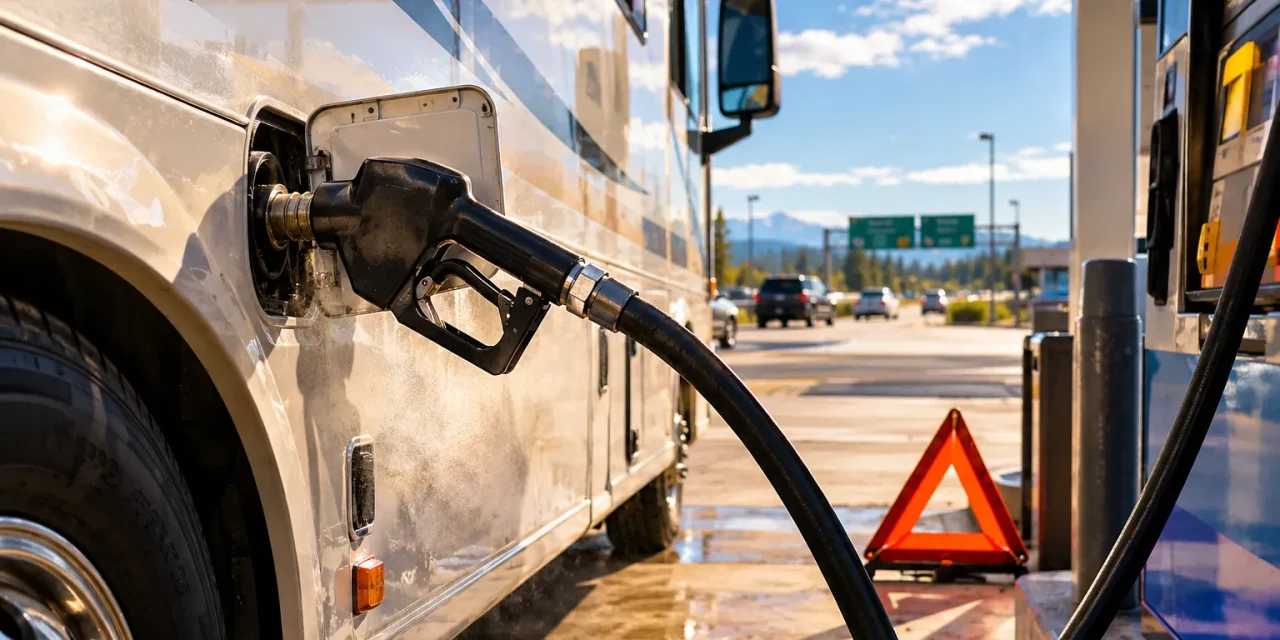
RVs make this recipe easier to trigger. They are bigger than cars, so nozzles sit at odd angles. Many have pilot lights, water heaters, or refrigerators running on propane even while driving. Some have onboard generators that stay on during a fuel stop. Put fuel vapor near any of those, and you have the setup for a fire.
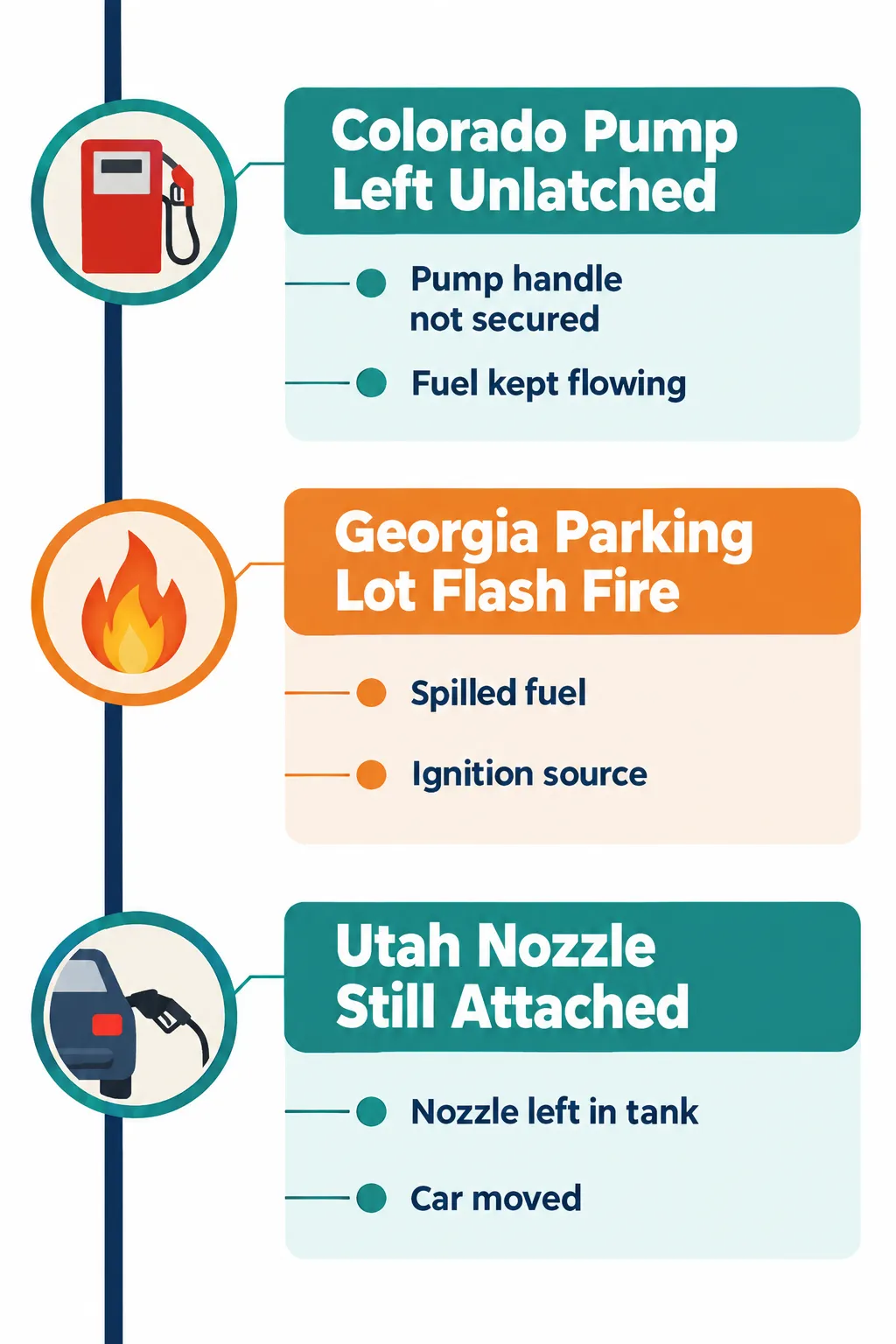
One of the clearest examples happened at a Loaf ‘N Jug station in Frisco, Colorado. Investigators believe a store clerk likely caused the explosion by mishandling pump equipment, which allowed fuel to spray out and ignite [1]. It is a sobering reminder that the mistake does not always come from the RV owner. Sometimes it is a gas station worker, a broken nozzle, or a maintenance issue that nobody warned drivers about.
Fuel expert reviews of RV incidents point to the same conclusion again and again: nozzle malfunctions combined with an ignition source onboard the RV are one of the most common causes of pump-area explosions [3]. That ignition source could be a pilot light, an electrical spark, or even a lit cigarette nearby.
Real Cases Behind The Gas Station Mistake That Led to an RV Explosion
Reading about a single accident can feel like a fluke. Reading about several similar ones in a row makes the pattern impossible to ignore.
Doraville, Georgia, August 2026
Security footage captured an RV bursting into flames in a gas station parking lot in Doraville, Georgia. The fire spread fast enough that bystanders had only seconds to move away before the vehicle was fully engulfed [2]. Details are still being reviewed, but the location and speed of the fire point straight back to fueling activity nearby.
Salt Lake City, Driver Error at the Pump
In December 2021, fire crews in Salt Lake City responded to a fuel pump fire caused by driver error while an RV was still attached to the hose. The driver pulled away from the pump before disconnecting properly, tearing the hose and igniting fuel at the pump [9]. This is one of the most common and most preventable gas station mistakes RV owners make, forgetting the hose is still connected before driving off.
Pennsylvania Turnpike Service Plaza
Not every gas station incident starts with gasoline. At a Pennsylvania Turnpike service plaza, investigators confirmed the explosion came from a propane leak inside the RV itself, not from the fuel pump [3]. This shows that the danger zone around an RV extends beyond the nozzle, the whole vehicle can be a risk if propane systems are not maintained.
Tahlequah, Oklahoma and Peabody, Massachusetts
A mother and daughter were seriously burned in an RV explosion in Tahlequah, Oklahoma, tied to a gas leak [5]. In Peabody, Massachusetts, three men were injured in a similar RV explosion linked to leaking gas [8]. Both cases add to a growing list of incidents that share one theme: undetected leaks meeting an ignition source.
If you want to see how serious these outcomes can be, our coverage of a fatal RV explosion that left investigators with more questions than answers and the tragic story of a woman who died from an RV explosion show just how high the stakes are when fuel systems fail.
“It only takes one spark and one leak. The tragedy is that both are almost always preventable.”
Propane, Rodents, and Hidden Dangers Beyond the Fuel Pump
Gasoline and diesel are not the only threats at a fuel stop. Propane systems create a second, quieter danger, and one that often starts long before the RV ever reaches the gas station.

A 2026 investigation from Technical Safety BC found that rodents had chewed through an uncapped gas line, and an open valve allowed propane to build up inside the RV before it ignited [7]. The official contributing-factor analysis pointed to a mix of design issues, aftermarket modifications, and a missing gas detector as the reasons the leak went unnoticed [7].
This is not an isolated case. In Abbotsford, British Columbia, rodents were blamed for an RV explosion that sent a woman to the hospital in August 2026 [4]. Similar rodent-damage incidents have been reported in the same region around the same time, suggesting this is a growing seasonal problem, especially for RVs stored outdoors for long stretches.
Earlier warnings back this up. A February 2024 RV explosion in Penticton, B.C. sent one man to the hospital and prompted officials to issue public gas-safety messaging that is still referenced today [6]. The Airstream Club has also published detailed guidance on detecting propane leaks before they become catastrophic, reminding owners that propane is heavier than air and pools in low spots like cabinets and floor compartments where it can sit undetected for hours [10].
Why rodents matter more than most owners realize:
- Rodents chew rubber and plastic lines for nesting material, not because they want to cause damage.
- Storage lots, wooded campgrounds, and driveways near grass are common entry points.
- Damage often happens underneath the RV, out of sight during a normal walk-around.
- A tiny gap in a propane line can leak enough gas to fill an RV interior in under an hour.
If your RV sits unused for weeks at a time, this is one more reason to check under the chassis before every trip, not just before a big road trip season.
How to Avoid The Gas Station Mistake That Led to an RV Explosion
You cannot control what a gas station clerk does or whether a mouse got into your RV last winter. But you can control your own habits, and habits are what stop most of these accidents before they start.
Before You Even Reach the Pump
- Turn off propane appliances. Shut off your fridge, water heater, and furnace pilot lights before fueling. Most stations require this by law.
- Check for leaks at home. Use a soapy water test on propane fittings, bubbles mean a leak.
- Install and test a propane detector. Missing or dead detectors were flagged as a contributing factor in the Technical Safety BC case [7].
- Inspect for rodent damage seasonally. Look under the RV for chew marks on lines and wiring, especially after storage.
While You’re At the Pump
- Turn off the engine and generator completely.
- Stay outside the RV during fueling. Do not run the microwave, AC, or any electrical appliance.
- Never smoke or use a lighter near the pump.
- Watch the nozzle. If it sticks open or fuel sprays out, stop the flow at the pump’s emergency shutoff and step back immediately.
- Double-check the nozzle is fully removed and the cap is on before pulling forward.
Knowing which stops are built to handle bigger rigs safely also helps. Our guide to gas stations every RVer needs to know covers stations with wider lanes, higher canopies, and pumps designed for large vehicles, all of which reduce the chances of a nozzle mishap.
After Fueling
- Pull forward slowly and confirm the hose is fully disengaged before accelerating, unlike the Salt Lake City case where the driver pulled away too soon [9].
- Recheck that all propane appliances stay off until you are safely away from the pump area.
What To Do If You Smell Gas or See a Leak
Every second matters once fuel or propane is loose in the air. Here is the simple order of steps:
- Stop the engine and any pump immediately.
- Get everyone out of and away from the RV. Move at least 100 feet away if possible.
- Do not flip any switches. Electrical sparks, even from a light switch, can ignite fumes.
- Call 911 and alert gas station staff.
- Do not go back inside until fire crews or professionals confirm it is safe.
Gas leaks often show warning signs before they explode. Learn to watch for:
| Warning Sign | What It Means |
|---|---|
| Rotten-egg smell | Propane leak (added scent for detection) |
| Hissing near tanks or lines | Escaping gas under pressure |
| Fuel pooling on pavement | Nozzle or tank overflow |
| Detector alarm sounding | Gas concentration reaching danger levels |
| Frost or ice on propane lines | Rapid gas expansion, possible leak point |
This same mindset applies to everyday RV upkeep, not just fuel stops. Many of the mistakes RV owners make that lead to bigger problems start small, a skipped inspection, a rushed hookup, or ignoring a strange smell. The same is true for couples sharing RV duties on the road; small RV mistakes couples make together, like assuming “someone else checked that,” can add up fast when nobody double-checks the basics.
Frequently Asked Questions
Can an RV really explode at a gas pump like in a movie?
Yes, but it usually looks different than the movies. Most real fires start small, a fuel spray or leak catching a spark, and then spread quickly across the vehicle rather than one giant blast.
Is propane or gasoline more dangerous at a gas station?
Both are dangerous, but propane is sneakier. Gasoline vapor is easier to notice by smell, while propane can leak quietly inside cabinets and floor spaces for a long time before anyone notices.
How often should I check my RV for rodent damage?
Check before every trip if your RV has been parked for more than a week, and do a full underside inspection at the start of each camping season.
Do all gas stations require me to turn off propane before fueling?
Most do, and it is required by fire code in many states. Even where it is not posted, turning it off is the safest habits.
What should I do if a fuel nozzle sticks open?
Hit the emergency stop button on the pump island right away, step back from the spray, and alert station staff immediately.
Conclusion
The gas station mistake that led to an RV explosion is rarely one dramatic failure. It is almost always a small thing, a nozzle left open, a hose still attached, a chewed propane line nobody noticed, that turns deadly when it meets fire or a spark. The good news is that every single cause covered in this article has a simple prevention step behind it.
Before your next fuel stop, make a habit of these three things: turn off propane appliances, stay near the pump while fueling, and check your RV’s underside for damage before long trips. These few extra minutes are the difference between a normal gas stop and a headline. Stay alert, trust your nose and ears for warning signs, and treat every fuel stop with the seriousness it deserves.
References
[1] Loaf N Jug Clerk Likely Caused Colorado Explosion – https://csnews.com/loaf-n-jug-clerk-likely-caused-colorado-explosion
[2] RV Explodes in Doraville Gas Station Parking Lot – https://www.wsbtv.com/news/local/dekalb-county/video-rv-explodes-doraville-gas-station-parking-lot/XCEZSGIVMJENDMYNO7QE53VSQE/
[3] RV Propane System Explode – https://rvlife.com/rv-propane-system-explode/
[4] Rodents Blamed For RV Explosion That Hospitalized An Abbotsford Woman – https://vernonmorningstar.com/2026/08/11/rodents-blamed-for-rv-explosion-that-hospitalized-an-abbotsford-woman/
[5] Tahlequah Mother And Daughter Recover After RV Explosion Leaves Them Seriously Burned – https://ktul.com/news/local/tahlequah-mother-and-daughter-recover-after-rv-explosion-leaves-them-seriously-burned-08-24-2026
[6] Penticton RV Explosion Sends One Man To Hospital – https://globalnews.ca/video/10301476/penticton-rv-explosion-sends-one-man-to-hospital
[7] Technical Safety BC Incident Investigation Report – https://files.technicalsafetybc.ca/v3/assets/bltdec2ded849740f4d/blta4ba94e29d9b609e/6a67ea238793002e606aa878/II-2038643-2026_(_61809)-2.pdf
[8] RV Explosion In Peabody MA Leaves Three Men Injured – https://www.firehouse.com/operations-training/video/55093362/rv-explosion-in-peabody-ma-leaves-three-men-injured
[9] SLC Fire Crews Investigating After Fuel Pump Goes Up In Flames – https://kjzz.com/news/slc-fire-crews-investigating-after-fuel-pump-goes-up-in-flames
[10] Dangers Of Propane Leaks – https://airstreamclub.org/sites/default/files/Dangers-Of-Propane-Leaks.pdf