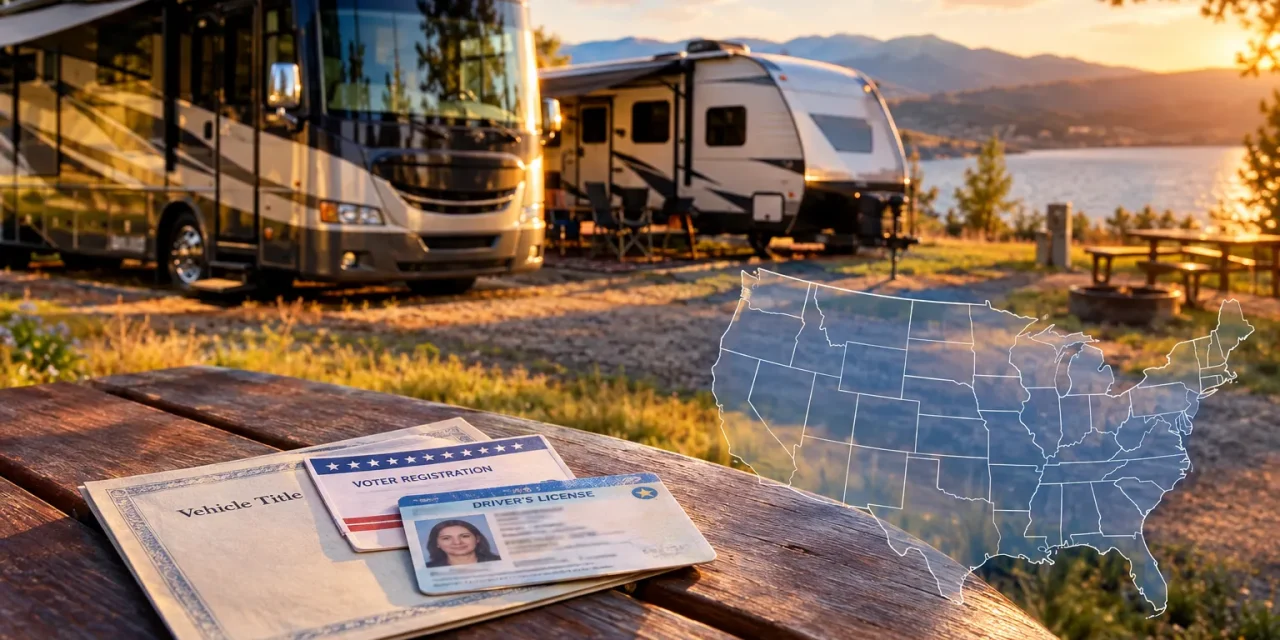
Nine out of ten full-time RVers think they have their legal home base figured out. Most of them are wrong. The Legal Trap That Snags 1,000s of RVers Every Year (Are You Guilty?) is not a scam or a shady dealer. It is something much sneakier: living everywhere on the map, but not being legally “home” anywhere at all.
This mistake feels harmless at first. You get mail at a friend’s house. You use a P.O. box. You tell your insurance company “I’m not sure, we move a lot.” Then one day, a state pulls your registration, your insurance denies a claim, or the IRS sends a letter asking where you actually live. That is when RVers find out the hard way that “living nowhere” is not a legal option in the United States.
This guide breaks down exactly how this trap works, why it snags so many RVers, and how to fix it before it costs you money, coverage, or peace of mind.
Key Takeaways
- ✅ The Legal Trap That Snags 1,000s of RVers Every Year (Are You Guilty?) happens when RVers assume a mailing address counts as a legal home. It does not.
- 📬 Mail forwarding services and “street addresses” are helpful tools, but only when paired with real proof of domicile.[2]
- 🚗 Misrepresenting your address on vehicle registration or insurance can void your coverage and lead to fines.[1]
- 🏡 Living in an RV on your own land can trigger zoning violations, even on property you fully own.[7]
- 📍 Some states are far easier for full-time RVers to legally claim as home, but “easy” still means following strict rules.[8][10]
What Is The Legal Trap That Snags 1,000s of RVers Every Year?
At its core, The Legal Trap That Snags 1,000s of RVers Every Year (Are You Guilty?) comes down to one confusing word: domicile.
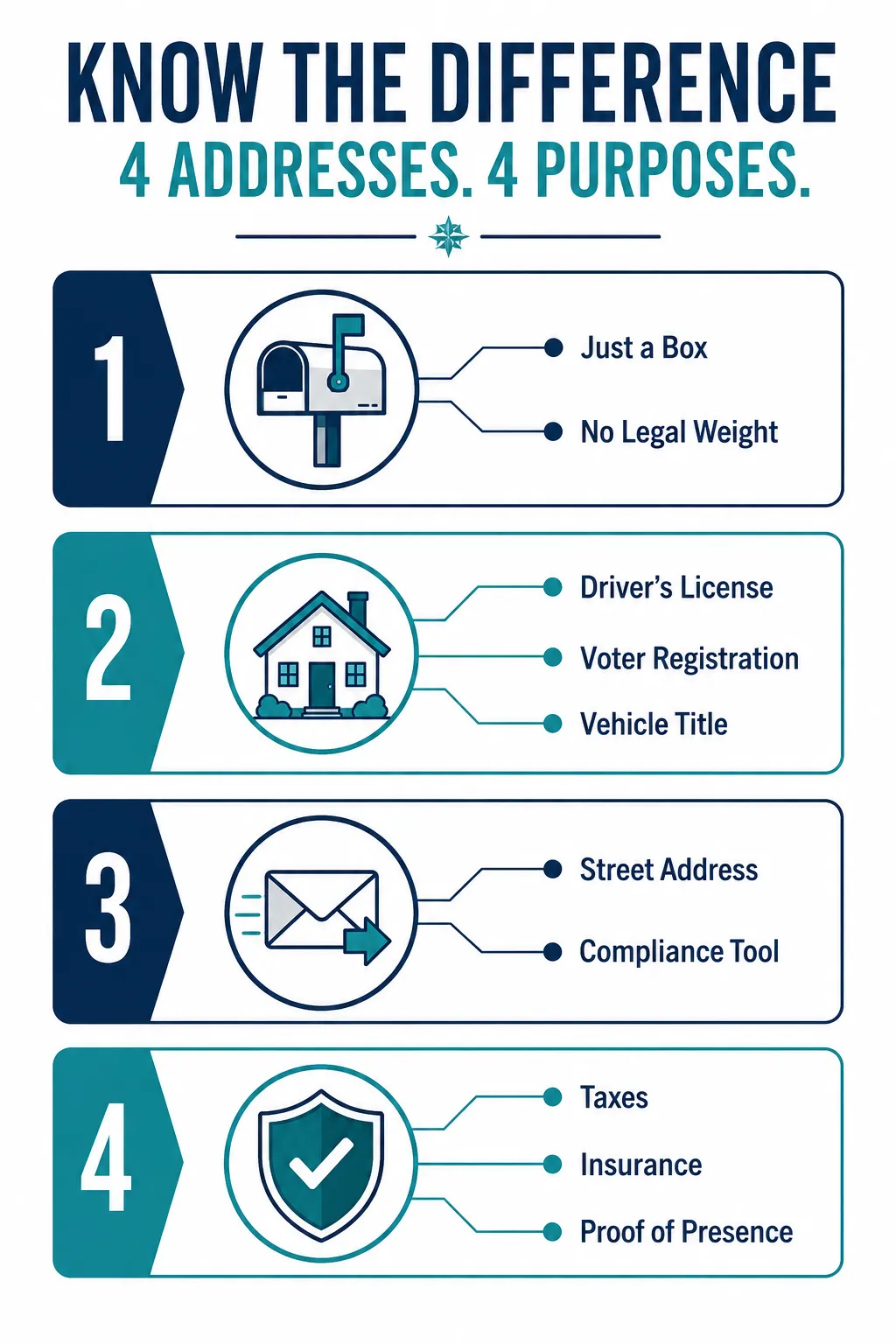
A lot of RVers think domicile just means “where my mail goes.” It does not. Domicile is your true, fixed, legal home. It is the place you intend to return to, the place tied to your driver’s license, your voter registration, your taxes, and often your insurance rates.[2][6]
Here’s the problem. Full-time RVers often:
- Get mail at a mail-forwarding service in one state
- Register their vehicle in another state (because it’s cheaper)
- Spend most of the year physically parked in a totally different state
- Never update their voter registration or tax filings to match any of it
That patchwork feels flexible. But legally, it can look like you are dodging taxes, lying on official forms, or claiming a home you don’t actually have ties to. States and insurance companies have gotten much sharper at spotting this pattern going into 2026, and RV organizations have updated their guidance to match.[4][6]
Why This Trap Is Getting Worse, Not Better
Older RV guides used to say, “just pick a state with no income tax and get a mailbox there.” That advice is outdated. In 2026, agencies increasingly require formal proof of domicile, not just a mailing address.[2] That means:
- Utility or lease records tied to your domicile state
- A real intent to return, sometimes documented with a lease or property deed
- Consistent paperwork across your license, registration, taxes, and voter roll
The bar has gone up. Genuinely, this is one of the sneaky laws that will ruin your RV trip if you don’t catch it early.
Why Mail Forwarding Services Aren’t Enough on Their Own
Mail forwarding services and “street address” providers are genuinely useful. Many domicile-friendly states even require a physical street address (not a P.O. box) to register a vehicle or get a license.[3][5] But here’s the trap: RVers sign up for one of these services, get a real street address, and assume the job is done.
It isn’t.
A mail-forwarding address proves you can receive mail somewhere. It does not, by itself, prove domicile. States want to see a fuller picture:
| What You Need | What a Mailbox Alone Proves |
|---|---|
| Driver’s license from that state | ❌ Nothing |
| Vehicle registered there | ❌ Nothing |
| Voter registration matching | ❌ Nothing |
| Tax filings matching the state | ❌ Nothing |
| Physical presence for required days | ❌ Nothing |
Treat your mail service as one piece of a bigger puzzle, not the whole answer. Escapees and similar RV-focused organizations have specifically refreshed their domicile guidance to stress this point heading into 2026, because so many members were caught relying on the mailbox alone.[2][6]
The Vehicle Registration and Insurance Side of The Legal Trap That Snags 1,000s of RVers Every Year
Here’s where things get expensive fast.
Some RVers register their motorhome or truck in a state they’ve never actually lived in, just because it has lower fees or no emissions test. On paper, that seems like a smart money move. In reality, it can be considered misrepresentation.[1]
Why does that matter so much? Because insurance policies are built around where you say you live and where the vehicle is “principally garaged.” If you file a claim and the insurer discovers your registered address doesn’t match your real living pattern, they can:
- Deny the claim entirely
- Cancel the policy retroactively
- Refuse to pay for a totaled RV after an accident
That’s a nightmare scenario nobody wants to learn about after a crash. This is one reason tips every RVer should know almost always include a warning about matching your registration address to your real domicile, not just the cheapest option.
🚨 Reality check: An insurance company doesn’t need to prove you lied on purpose. They just need to prove the address doesn’t reflect your actual situation. That’s enough to void coverage in many cases.[1]
Quick Self-Check: Are You at Risk?
Ask yourself these honest questions:
- Is your vehicle registered in a state where you’ve spent less than a few weeks all year?
- Does your insurance policy list an address you don’t actually use?
- Would you struggle to prove where you “live” if asked by a government agency?
If you answered yes to any of these, you may already be caught in The Legal Trap That Snags 1,000s of RVers Every Year (Are You Guilty?) without realizing it.
Taxes, Voting, and the “No State” Myth
Some full-timers try to get clever and essentially claim no state at all. They figure if they’re always moving, no single state can tax them or hold them accountable.
That is a myth, and it is a risky one.
States and the IRS don’t accept “nowhere” as an answer. Every driver’s license, every vehicle title, every voter registration form requires a real state. If you claim residency loosely or inconsistently, you open yourself up to:
- Back taxes from a state that decides you actually owed them money
- Being registered to vote in a state you no longer have ties to
- Confusion over jury duty, healthcare enrollment, or even Social Security paperwork
Domicile rules exist specifically so everyone has one clear legal home, even if they travel constantly.[4][6] The goal isn’t to punish RVers for moving around. It’s to make sure someone, somewhere, is accountable for your taxes and legal obligations.
This tax confusion is also a quiet contributor to why 80% of RVers fail at budgeting, unexpected back taxes or penalty fees blow up carefully planned travel budgets fast.
The Zoning Trap: Living in Your RV on Your Own Land
Here’s a twist a lot of RVers don’t expect. Even if you own your land outright, parking your RV there and calling it home can still be illegal.
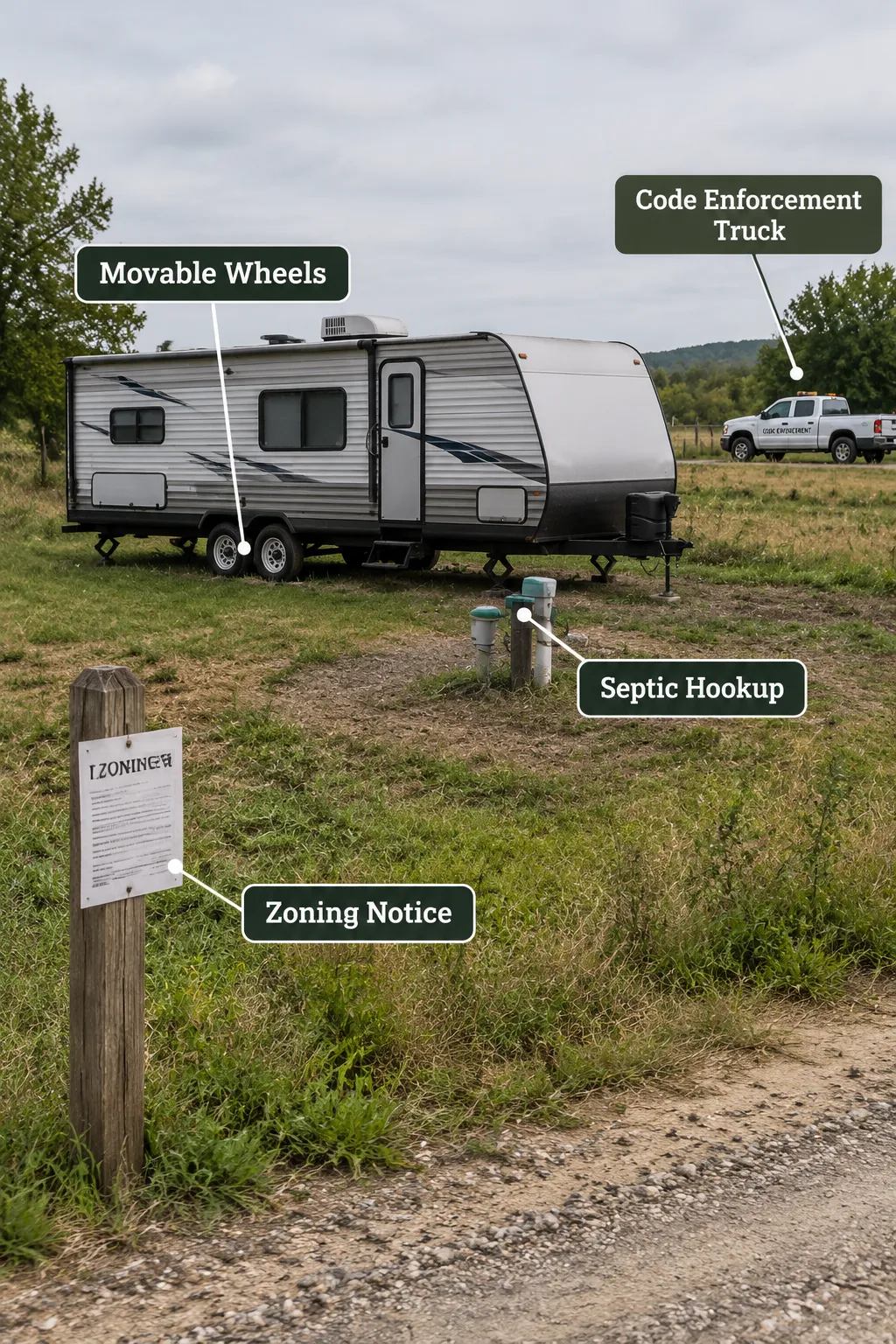
Many counties have zoning codes that separate “recreational use” from “residential use.” That means:
- You might legally camp on your land for short stints
- But living there full-time, hooking up permanent utilities, or staying past a set number of days can trigger a violation[7]
Code enforcement complaints often come from neighbors, not random inspections. And fines can stack up fast if you ignore a notice.
Roadworthy and Movable: A Growing Enforcement Focus
Another piece of this trap involves whether your RV is truly “roadworthy and movable.” Some jurisdictions require that an RV used as a residence remain capable of being driven or towed away, not permanently set up like a mobile home.[9] Enforcement of this rule has tightened heading into 2026, especially in areas dealing with a rise in RVs parked long-term on private and public land.
If your RV hasn’t moved in over a year, has skirting built around it, or is hooked to permanent sewer lines without a permit, you may be crossing from “camping” into “unpermitted residential structure” in the eyes of local code enforcement.
This is exactly the kind of frustration that shows up in stories about things that will make you quit RVing, not the RV itself, but the legal headaches nobody warned you about.
Best and Worst States for Full-Time RV Domicile in 2026
Not all states treat full-time RVers the same way. Some are genuinely built for it. Others make the process painful.
States commonly recommended for RV domicile tend to share these traits:[8][10]
- No state income tax (or very low)
- Straightforward vehicle registration for RVs
- Insurance markets that understand full-time RV living
- Clear rules for using a mail-forwarding street address
States that tend to be harder for full-time RVers usually have:
- Strict physical-presence requirements (you must actually be there a certain number of days)
- Complicated vehicle inspection or emissions rules
- Higher insurance costs tied to full-time RV use
- Less flexible voter registration rules for non-traditional addresses
Even in the “easy” states, compliance still matters. Analysts point out that “easy” doesn’t mean “no rules”, it just means the rules are simpler to follow correctly.[8][10] Skipping steps, even in a friendly state, can still land you in the exact trap this article is warning about.
How to Know If You’re Guilty of The Legal Trap That Snags 1,000s of RVers Every Year
Take this simple checklist. Be honest with yourself.
- My driver’s license state matches my vehicle registration state
- My insurance address matches where I actually keep and use my RV
- I am registered to vote in the same state as my license
- I file state taxes in a state that matches my documented domicile
- I can prove physical presence in my domicile state if asked
- My RV can legally be classified as movable, not a permanent structure
- I have documentation (lease, deed, utility bill) tied to my domicile address
If you checked fewer than five boxes, it’s worth taking a closer look at your setup this year. Many RVers who eventually run into trouble later say they wish they’d caught the gap sooner, a regret that echoes through stories shared in what’s your biggest RV purchase regret discussions across the RV community.
How to Fix It: A Step-by-Step Plan
Good news: this is fixable, and it doesn’t require a lawyer for most RVers.
- Pick one domicile state. Choose based on tax rules, insurance costs, and how friendly the state is to full-time RVers.[8]
- Get a real street address there. Use a reputable mail-forwarding or domicile service that provides an actual street address, not just a P.O. box.[3][5]
- Update everything to match. Driver’s license, vehicle registration, voter registration, and insurance should all list the same address and state.
- Keep proof of ties. Save copies of leases, mail-forwarding contracts, or property documents that show intent to return.
- Track your physical presence. If your chosen state has a minimum-day requirement, keep a simple log or calendar of where you actually are.
- Review your insurance policy yearly. Make sure your address and “vehicle use” details still reflect reality, especially if your travel pattern changes.[1]
- Ask before parking long-term on private land. Check local zoning rules before treating any lot, even one you own, as a permanent RV residence.[7]
Small issues in your setup can turn into real problems the way small mechanical issues can snowball, similar to how minor neglect adds up in stories like everything that broke in this 23-year-old RV. Catching the small stuff early saves major headaches later.
Conclusion
The Legal Trap That Snags 1,000s of RVers Every Year (Are You Guilty?) isn’t about breaking the law on purpose. It’s about drifting into a gray zone where your mail, your registration, your taxes, and your actual travel life all point in different directions.
The fix is simpler than it sounds: pick one true domicile state, line up every piece of paperwork to match it, and keep proof that shows you actually have ties there. Do that, and you turn a legal liability into a rock-solid foundation for full-time RV life.
Next steps: Pull out your driver’s license, insurance card, and voter registration right now. Do they all point to the same state and address? If not, start making a plan this week to bring them into alignment before it becomes a costly problem instead of a quick fix.
References
[1] Can You Legally Live In A Motorhome – https://legalclarity.org/can-you-legally-live-in-a-motorhome/
[2] Establishing Domicile For Rvers – https://www.escapees.com/blog/establishing-domicile-for-rvers
[3] Full Time Rv Domicile Registration By State – https://www.wackywolfexplorer.com/rules/full-time-rv-domicile-registration-by-state/
[4] Domicile – https://boondockmaps.com/rv-living/domicile/
[5] State Residency – https://rvshare.com/blog/state-residency/
[6] Domicile For Rvers – https://www.escapees.com/blog/domicile-for-rvers
[7] Can You Live In A Camper On Your Own Land – https://www.landmodo.com/blog/938/can-you-live-in-a-camper-on-your-own-land
[8] Best States For Full Time Rver Domiciles – https://rvlife.com/best-states-for-full-time-rver-domiciles/
[9] Is It Legal To Live In An Rv – https://www.ankersolix.com/blogs/portable-power-station/is-it-legal-to-live-in-an-rv
[10] Best Worst States Full Time Rv Living – https://www.ecoflow.com/us/blog/best-worst-states-full-time-rv-living