Every year, thousands of RVers pack up their rigs and hit the road without ever checking one important number: their destination’s traffic death rate. Headlines claiming “This State Has the Highest Fatality Rate for RVers” have been popping up across social media and travel forums, and they’re worth a closer look. The short answer? There’s no official government report that tracks RV-only deaths state by state. But when you dig into the real crash data, one state keeps showing up at the top of every dangerous-driving list, Mississippi.
This article breaks down what the data actually shows, why Mississippi and a few other states keep landing near the top, and what that means for anyone planning a road trip in a motorhome, travel trailer, or fifth wheel.
Key Takeaways
- 🚫 No federal agency publishes an official “RV fatality rate by state” ranking. The claim is based on general traffic fatality data, not RV-specific numbers [1][2].
- 🏆 Mississippi currently has the highest overall motor-vehicle death rate per 100,000 residents in the country, which is likely the real source behind “highest RV fatality rate” headlines [1][4].
- 📈 Overall U.S. traffic deaths remain historically high, creating a riskier driving environment for everyone, including RVers [8][9].
- 🛣️ Rural, mountainous, and two-lane highway corridors carry extra risk for large, heavy vehicles like motorhomes and towables.
- ✅ Smart planning, rig maintenance, and route awareness can dramatically lower your personal risk, no matter which state you’re driving through.
Why People Say This State Has the Highest Fatality Rate for RVers
Search “This State Has the Highest Fatality Rate for RVers” and you’ll find dozens of blog posts and social clips pointing to one state or another. Here’s the catch: none of them are pulling from a dataset that actually separates RVs from cars, trucks, and motorcycles in state-level fatality rankings.
The Fatality Analysis Reporting System (FARS), run by the National Highway Traffic Safety Administration, does let researchers filter fatal crashes by vehicle body type, including motorhomes and travel trailers [10]. But turning that raw data into a clean “highest RV fatality rate by state” list requires a lot of manual number-crunching that hasn’t been officially published anywhere [1][2][3].
So where does the claim come from? It’s almost certainly built on general traffic fatality data, specifically, overall motor-vehicle death rates per 100,000 residents by state. And when you look at that data, Mississippi is consistently at or near the very top [1][4].
“There’s no official RV-only fatality rate. But if a state is dangerous for regular drivers, it’s dangerous for RVers too, often more so.”
This matters because RVs behave differently than passenger cars. They’re heavier, taller, harder to stop, and more sensitive to wind, tire blowouts, and sharp curves. A state with a high general fatality rate is a state where those extra risk factors get amplified.
The Real Data Behind the Claim
Let’s look at what the numbers actually say. The Insurance Institute for Highway Safety (IIHS) and NHTSA’s FARS system both track state-by-state fatality rates using a simple formula: deaths per 100,000 people and deaths per 100 million vehicle miles traveled [4][6].
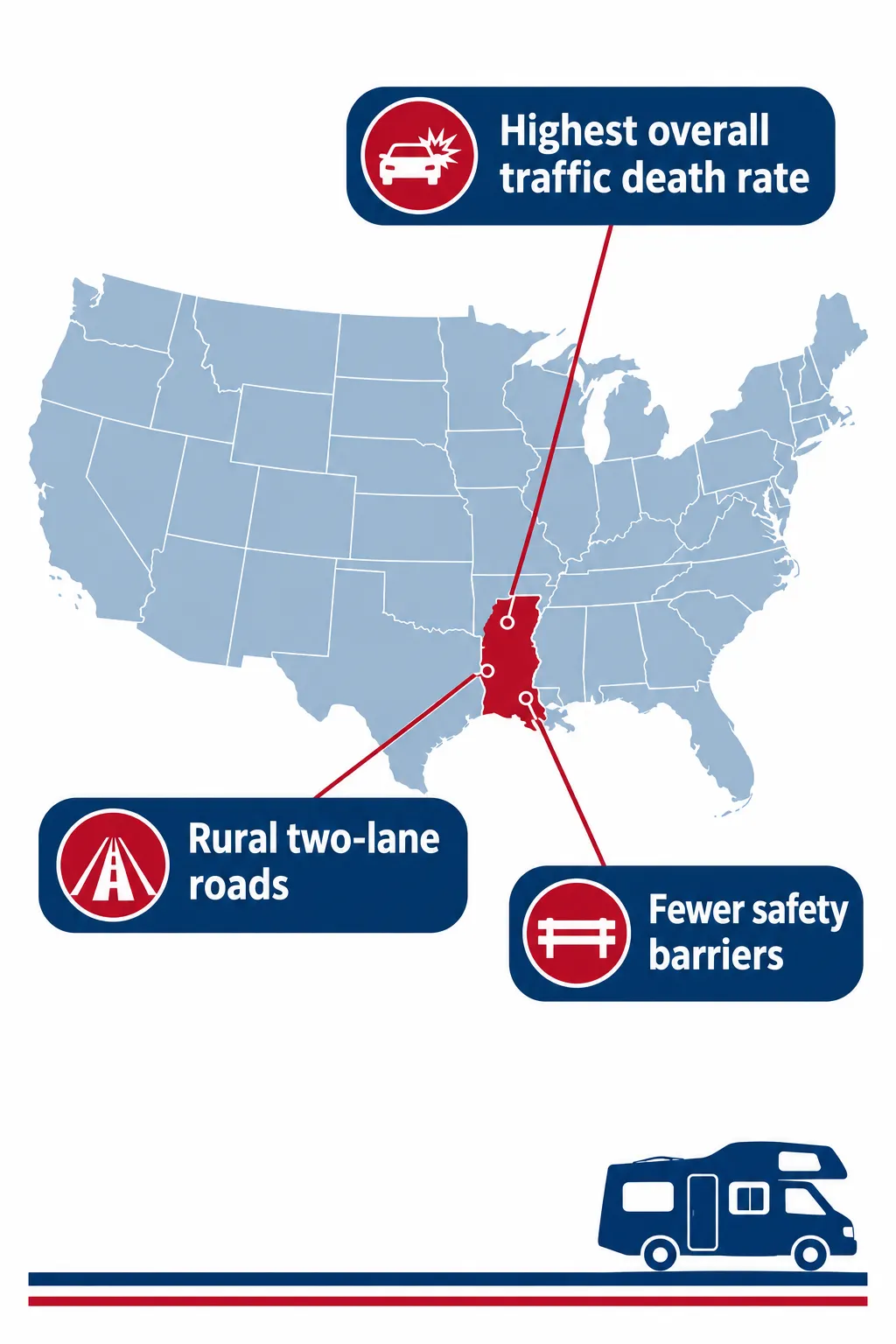
Mississippi has repeatedly ranked at or near the top of the country for overall traffic fatality rates in recent NHTSA and IIHS data [1][4][6]. That’s not a one-year fluke, it’s a pattern that’s held steady for years, driven by a mix of factors including:
- Higher rural road mileage with fewer divided highways
- Lower seatbelt use rates compared to the national average
- Longer emergency response times in remote areas
- Speed and impairment factors that show up consistently in crash reports [8][9]
Meanwhile, preliminary 2024 NHTSA estimates show that fatality rates per 100 million vehicle miles traveled are rising in some states, even as national numbers show mixed movement year to year [9]. That’s an important detail for RVers: even if the national trend looks flat, your specific route could be getting more dangerous, not less.
The CDC’s accident mortality data backs this up from a different angle. States with higher unintentional injury death rates, which include motor vehicle crashes, tend to cluster in the South and parts of the rural West [8]. Mississippi shows up here too, reinforcing the idea that whatever number you’re looking at, it tends to point to the same region.
What This Means for the “Highest Fatality Rate for RVers” Claim
Put it all together, and the picture becomes clear: This State Has the Highest Fatality Rate for RVers is really shorthand for “Mississippi has the highest overall traffic fatality rate, and RVs are not exempt from that risk.” Analysts expect Mississippi to stay near the top of these rankings unless there are major investments in road infrastructure, enforcement, and public safety campaigns [1][4].
Why Mississippi Keeps Topping Dangerous-Driving Lists
It’s worth understanding why Mississippi ranks where it does, because the same factors that put regular drivers at risk hit RVers even harder.
1. Rural road networks. Much of Mississippi’s highway system consists of two-lane rural roads without medians or shoulders wide enough for a 30-foot motorhome to safely pull over. That’s a problem if you get a flat tire, need to check a hitch, or have to stop suddenly.
2. Higher average speeds on undivided highways. Faster speeds combined with narrow lanes are a rough mix for heavy rigs that need more stopping distance than a sedan.
3. Lower seatbelt compliance. National data consistently shows seatbelt use trailing the national average in several Southern states, which raises fatality odds in any crash, RV or otherwise [8].
4. Limited emergency infrastructure in rural counties. When a crash happens far from a hospital, response time matters. Rural corridors across Mississippi and similar states often mean longer waits for help to arrive.
None of this means Mississippi is a state to avoid entirely. It means RVers driving through, or any state with similar rural, high-speed corridors, should drive with extra caution and plan routes carefully.
What Makes RV Travel Riskier in High-Fatality States
RVs aren’t just bigger cars. They handle differently, and several unique risk factors compound whatever baseline danger a state already has.
| Risk Factor | Why It Matters for RVers |
|---|---|
| Vehicle height and top-heavy design | Increases rollover risk on curves and in high wind |
| Longer stopping distance | A loaded motorhome or towable needs far more room to stop than a car |
| Tire failure | RV tires often sit for months and can fail unexpectedly on hot pavement |
| Driver fatigue | Long highway stretches encourage overdriving hours without rest |
| Unfamiliar mountain/rural roads | Sharp curves and steep grades catch inexperienced RV drivers off guard |
Media coverage of individual RV crashes often highlights mountainous and rural corridors as hotspots, not because there’s an official ranking, but because the combination of grade, curves, and vehicle size is a recipe for trouble [1][2]. Tragic incidents like the one covered in our report on a fatal RV explosion that left questions also show that mechanical failure, not just crash dynamics, can turn a routine trip deadly.
That’s one more reason routine maintenance matters so much. Older rigs in particular can develop hidden problems. Our breakdown of everything that broke in a 23-year-old RV is a good reminder that age and neglect quietly raise risk over time, even before you factor in which state you’re driving through.
How RVers Can Stay Safer No Matter Which State They’re In
You can’t control which state has the highest fatality rate. You can control how prepared you are before you cross that state line. Here’s a practical safety checklist for any RV trip, but especially for routes through higher-risk states.
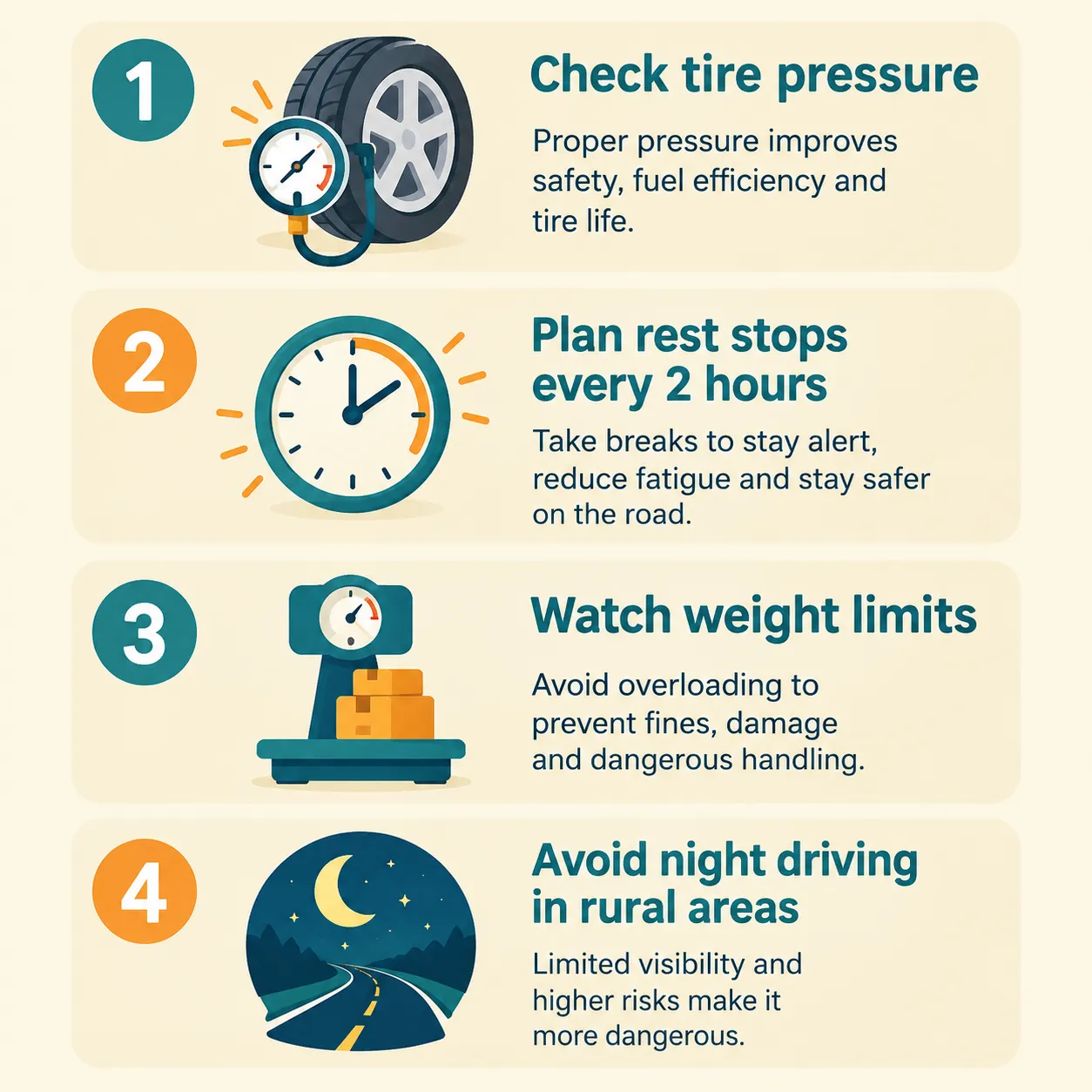
- Inspect tires before every long trip. Check pressure, tread depth, and age (RV tires older than 6-7 years should be replaced regardless of tread).
- Plan fuel and rest stops in advance. Long rural stretches in states like Mississippi can have fewer services. Knowing your gas stations every RVer needs to know ahead of time keeps you from running low in a bad spot.
- Avoid driving after dark on unfamiliar rural roads. Wildlife, poor lighting, and narrow shoulders combine badly at night.
- Know your rig’s weight limits. Overloaded RVs handle worse in emergency braking situations, especially on curvy or hilly terrain.
- Build in buffer time. Rushing to make a campground reservation is one of the most common reasons drivers push through fatigue or bad weather.
- Check weather and wind forecasts. Tall, boxy RVs are vulnerable to crosswinds, especially on open highways in the South and Plains states.
- Review basic RV safety habits regularly. Our full list of tips every RVer should know is a solid refresher even for experienced travelers.
It’s also worth thinking beyond the road itself. Costs and route choices go hand-in-hand with safety, rushing through a state to save money on fuel or campground fees can push drivers into risky decisions. If you’re budgeting a big trip, it helps to know the most expensive states to travel in your RV so you’re not tempted to cut corners on rest or route planning just to save a few dollars.
And safety isn’t only about crashes. Awareness on the road covers theft risk too, the story of a couple who had their RV stolen is a good reminder that overall road awareness, not just crash avoidance, keeps a trip safe from start to finish.
Other States RVers Should Watch Closely
Mississippi isn’t alone at the top of dangerous-driving lists. FARS and IIHS data consistently show a cluster of states with elevated fatality rates, many sharing similar risk factors: large rural road networks, higher average speeds, and lower seatbelt use [1][4][6].
States that frequently appear near the top of these rankings include:
- Mississippi, consistently highest or near-highest overall fatality rate [1][4]
- Wyoming, low population density with long rural highway stretches
- South Carolina, high speeds combined with heavy rural mileage
- New Mexico, vast open roads and long emergency response distances
- Arkansas, similar rural infrastructure challenges to Mississippi
None of these rankings are RV-specific. But the same road conditions that raise general fatality rates raise risk for RVers too, simply because motorhomes and towables are less forgiving of sudden hazards than a compact car [1][2][4].
Commercial vehicle fatality data tells a similar story. While not RV-specific, states with higher commercial-vehicle (large truck) fatality rates tend to overlap heavily with states topping general fatality lists, a pattern that matters because RVs share more handling characteristics with commercial trucks than with passenger cars [1][4].
Frequently Asked Questions
Is there an official “highest RV fatality rate” ranking by state?
No. NHTSA’s FARS database can be filtered by vehicle type, including RV-style body classes, but no agency has published a finished, official RV-only fatality rate ranking by state [1][2][3][10].
Why does Mississippi keep coming up in these headlines?
Because Mississippi has the highest overall motor-vehicle fatality rate per 100,000 residents in recent national data, and that statistic gets applied loosely to RV travel risk [1][4].
Are RVs actually more dangerous than regular cars?
Not inherently, but they handle differently, longer stopping distances, higher rollover risk, and more sensitivity to wind and tire failure make certain crash types more severe [10].
What’s the safest way to plan a route through a high-risk state?
Avoid night driving, check weather and wind conditions, take regular breaks, and stick to well-maintained highways when possible.
Conclusion
The claim that “This State Has the Highest Fatality Rate for RVers” doesn’t come from an official RV-specific ranking, because that data simply doesn’t exist yet in a clean, published form [1][2][3]. What does exist is solid evidence that Mississippi carries the highest overall traffic fatality rate in the country, and that rural, high-speed, low-infrastructure states share similar risk patterns [1][4][6][8].
For RVers, the real takeaway isn’t fear, it’s preparation. Check your tires. Plan your stops. Know your rig’s limits. Avoid pushing through fatigue or bad weather just to hit a reservation deadline. Whether you’re rolling through Mississippi, Wyoming, or your own home state, the fundamentals of safe RV travel don’t change: slow down, stay alert, and maintain your rig like your trip depends on it, because it does.
References
[1] Statesfatalitiesfatalityrates – https://www-fars.nhtsa.dot.gov/states/statesfatalitiesfatalityrates.aspx
[2] Statesfatalitiesfatalityrates – https://www-fars.nhtsa.dot.gov/States/StatesFatalitiesFatalityRates.aspx
[3] Statescrashesandallvictims – https://www-fars.nhtsa.dot.gov/States/StatesCrashesAndAllVictims.aspx
[4] State By State – https://www.iihs.org/research-areas/fatality-statistics/detail/state-by-state
[6] Fatality Statistics – https://www.iihs.org/research-areas/fatality-statistics
[8] Accidents – https://www.cdc.gov/nchs/state-stats/deaths/accidents.html
[9] Data Details – https://injuryfacts.nsc.org/motor-vehicle/overview/preliminary-estimates/data-details/
[10] Vehiclesallvehicles – https://www-fars.nhtsa.dot.gov/vehicles/vehiclesallvehicles.aspx