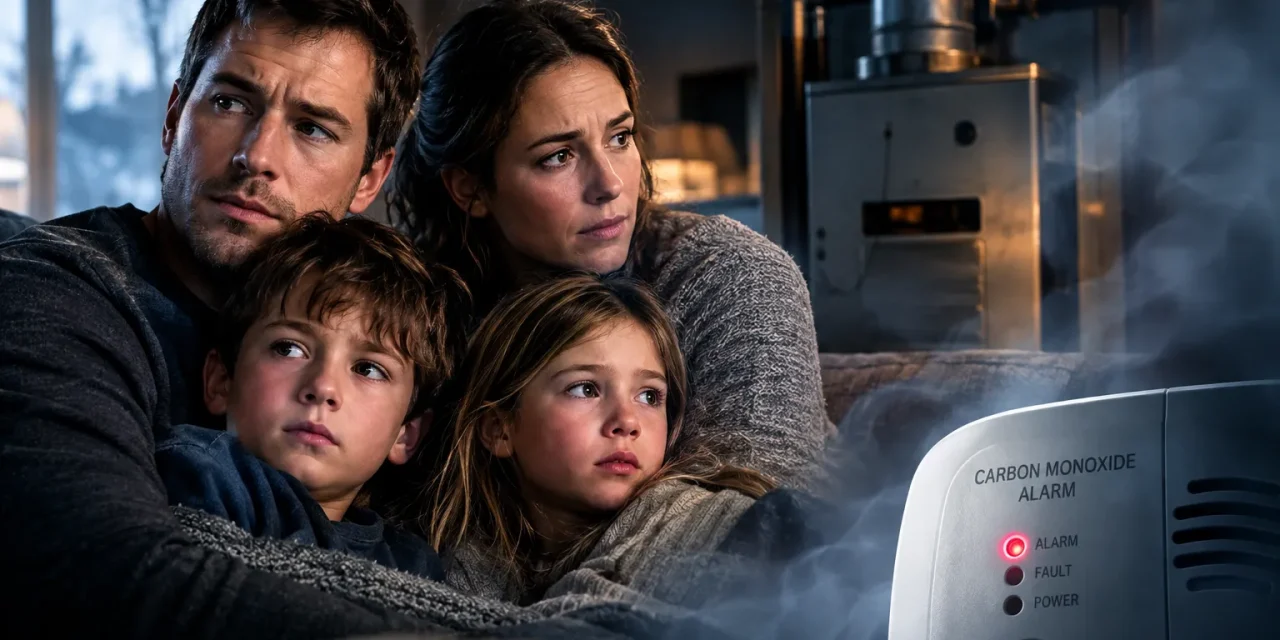
On August 28, 2026, a family thought they were just cooling off for the night. Instead, they nearly didn’t wake up. The Carbon Monoxide Mistake That Almost Killed This Family started with something small, a generator placed a little too close to a window, and turned into a race against time that most people never see coming.
This is not a rare, freak accident. Carbon monoxide (CO) poisoning sends thousands of people to the emergency room every year, and RV families are especially at risk because generators, furnaces, and vehicle engines are often running just a few feet from where people eat, sleep, and relax. This article breaks down exactly what went wrong, what the science says about CO danger, and, most importantly, how to make sure your family’s story has a different ending. 🚨
Key Takeaways
- Carbon monoxide has no smell, no color, and no taste, a battery-powered CO detector is the only reliable early warning system.
- Generators must be run far from windows, doors, and vents, even outside, CO can drift back into an RV or home.
- Keyless ignition vehicles can poison a garage or driveway area if left running accidentally, and this has caused real deaths [2].
- Symptoms mimic the flu, headache, dizziness, and nausea are often the only clues before someone loses consciousness.
- Testing detectors monthly and replacing batteries twice a year is a simple habit that saves lives.
What Actually Happened: The Carbon Monoxide Mistake That Almost Killed This Family
The family in this story was doing what thousands of RVers and lake-house travelers do every weekend. They fired up a portable generator to run the air conditioner and a few lights. It felt normal. It felt safe.
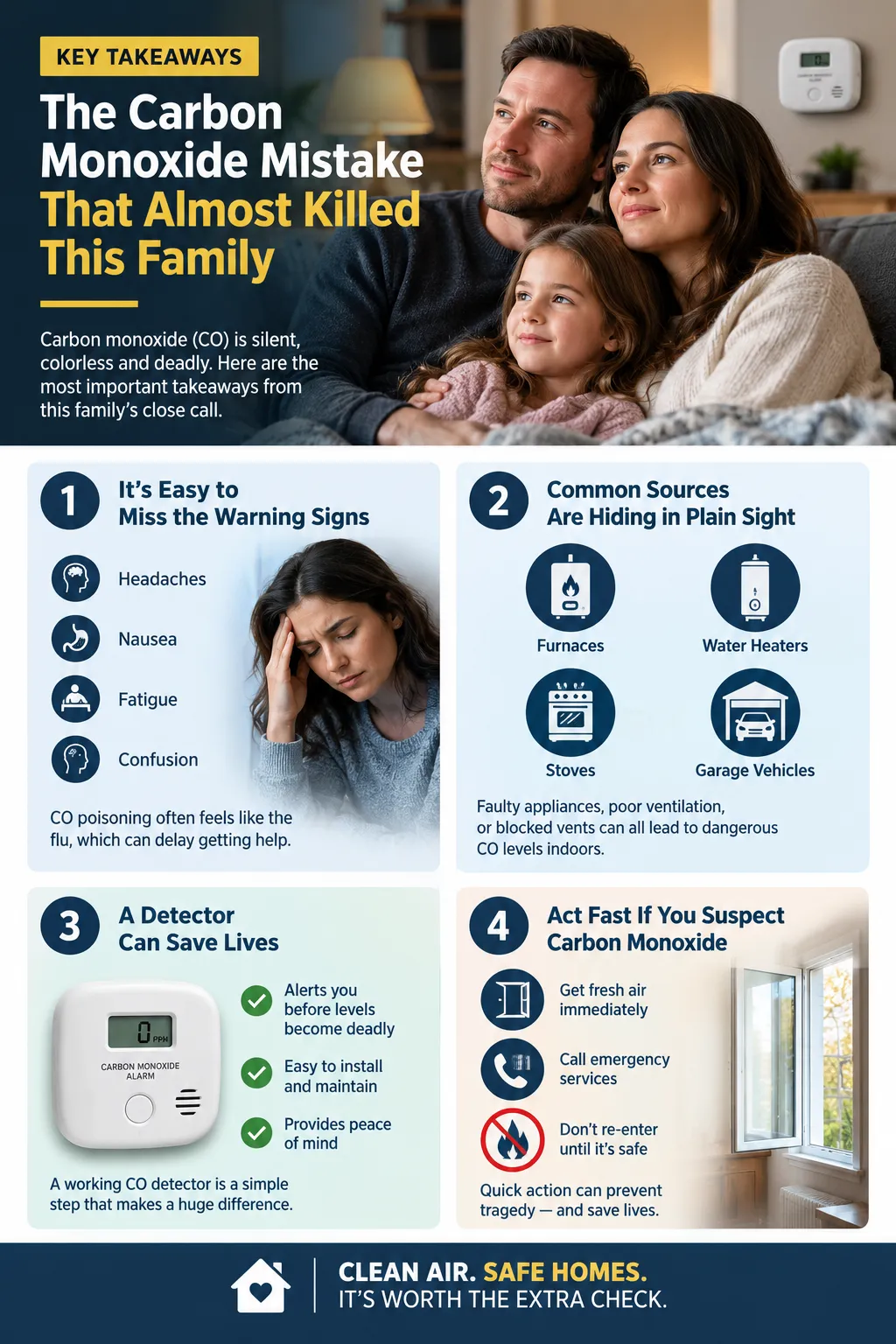
But the generator sat just below a window that was cracked open for airflow. Overnight, exhaust drifted inside. Nobody smelled anything, because carbon monoxide doesn’t have a smell. By the time one family member woke up with a pounding headache and a strange fog in their thinking, CO levels inside had already climbed to a dangerous point [3].
This is the exact pattern seen in similar cases across the country. One widely shared survivor story described a woman named Cheryl Burt, who lost someone she loved to CO poisoning and later became an advocate for detector use after realizing how quietly the gas had done its damage [1]. Another mother in Rochester shared her story publicly, urging every household, RV or brick-and-mortar, to install detectors after her own tragic loss [5].
“We didn’t hear an alarm. We didn’t smell smoke. We just felt sick, and then we didn’t feel anything at all.”, a common thread in nearly every CO survivor account.
Why This Keeps Happening
Experts who study these incidents point to a repeating pattern:
- A fuel-burning device (generator, furnace, stove, or vehicle) runs in or near an enclosed space.
- Ventilation is assumed to be “good enough” without actually being tested.
- No working carbon monoxide detector is present, or the batteries are dead.
- Symptoms are mistaken for tiredness, a cold, or car sickness.
This same chain of mistakes has shown up in home furnace tragedies, generator disasters after storms, and even hotel room poisonings during travel [6][9].
Why Carbon Monoxide Is So Dangerous
Carbon monoxide is called “the silent killer” for a reason. It is a colorless, odorless gas produced whenever fuel burns, gasoline, propane, wood, or natural gas [3]. Inside a home or RV, it can build up fast, especially in tight or poorly ventilated spaces.
Here’s what makes it so sneaky:
- You can’t see it. There’s no smoke, no haze, no warning color.
- You can’t smell it. Unlike a gas leak, CO has zero odor.
- It replaces oxygen in your blood. Once inhaled, CO binds to red blood cells far more easily than oxygen does, starving the brain and heart [9].
- Symptoms feel ordinary. Headache, dizziness, confusion, and nausea are easy to blame on the flu, dehydration, or fatigue.
- It can knock people out before they realize something is wrong. This is why so many victims are found asleep or unconscious.
Carbon Monoxide Symptoms Table
| Exposure Level | Common Symptoms |
|---|---|
| Low, short-term | Mild headache, slight dizziness 😵💫 |
| Moderate | Nausea, confusion, blurred vision |
| High | Vomiting, loss of muscle control, fainting |
| Severe | Loss of consciousness, brain damage, death ⚠️ |
Medical guidance is clear: anyone who feels sick around a running generator, furnace, or vehicle, and feels better once outside in fresh air, should suspect carbon monoxide immediately [9].
The Most Common Carbon Monoxide Mistakes RVers Make
RV living comes with more fuel-burning appliances than most homes realize. Propane furnaces, propane refrigerators, gas stoves, and portable generators are all normal parts of the lifestyle, but each one is a potential CO source if it’s misused.
Here are the mistakes that show up again and again in real-world incident reports:
- Running a generator too close to the RV. Exhaust can be pulled back inside through windows, vents, or even door seams.
- Using an oven or stovetop to heat the RV. This is one of the deadliest and most common mistakes, and it has caused real child fatalities that changed how safety officials talk about home heating [3].
- Blocking furnace exhaust vents with snow, leaves, or parked gear.
- Sleeping with the generator running all night without a working detector nearby.
- Idling the vehicle in an enclosed space, like a garage, carport, or between two RVs parked close together.
- Assuming a smoke detector also detects CO. It does not. These are two completely different sensors.
This pattern of avoidable mistakes is exactly why RV Showoff has covered safety items most RV owners get wrong, because the gap between “feels safe” and “is safe” is often invisible until it’s too late.
Keyless Ignition and Generator Dangers in RVs
One of the more surprising mistakes involves something that feels completely unrelated to camping: keyless ignition vehicles. Because these cars can be silently left running without the driver realizing it, they have contributed to a rising number of carbon monoxide deaths in garages and enclosed parking areas across the country [2].
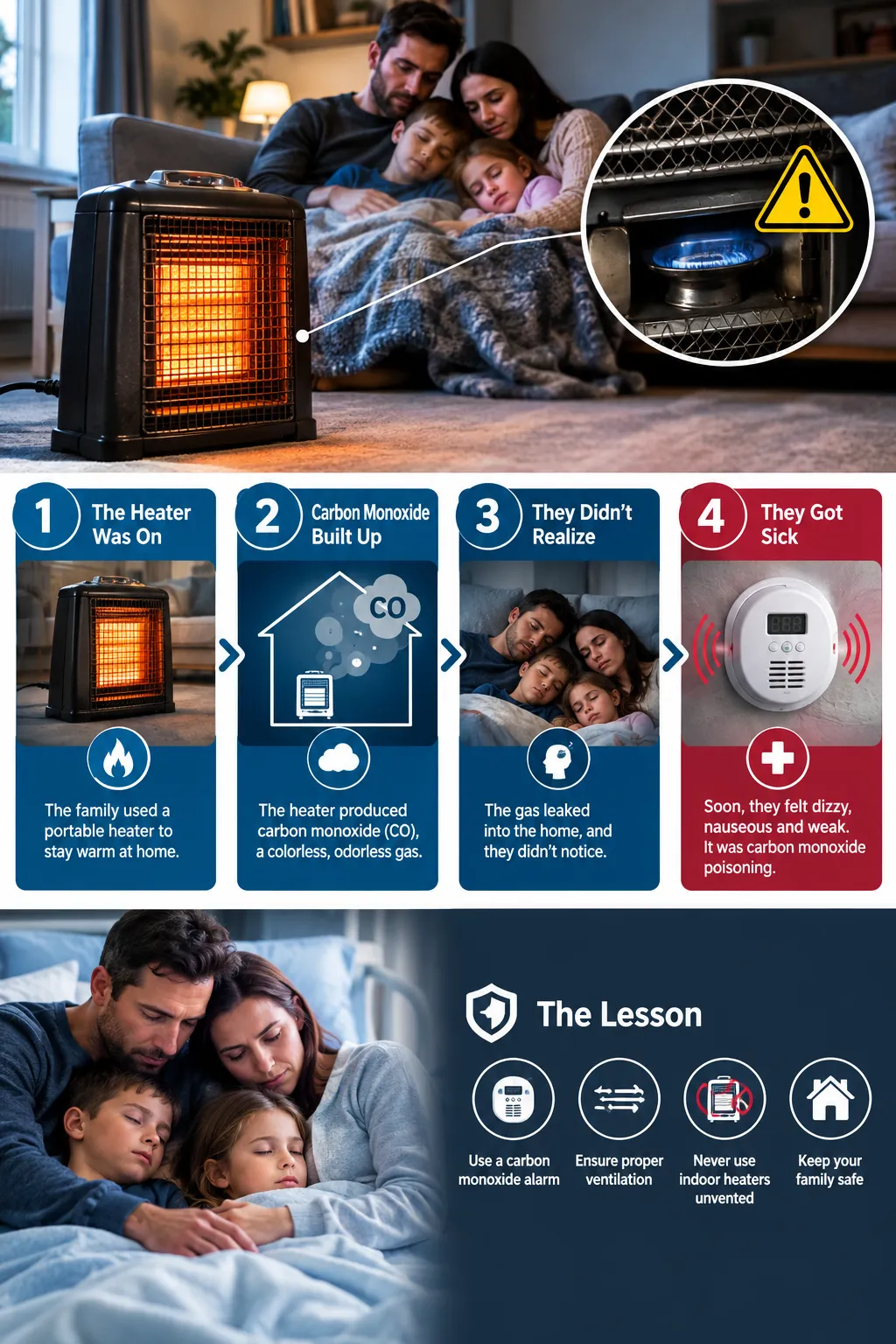
For RV families, the same risk applies to tow vehicles parked near the rig, and to generators left running in enclosed storage bays or beneath slide-outs. The lesson from both cases is identical: any engine that keeps running without a clear, obvious signal can become deadly in an enclosed or semi-enclosed space.
A Quick Comparison of Common CO Sources in RV Life
| Source | Where It Hides | Why It’s Risky |
|---|---|---|
| Portable generator | Too close to windows/vents | Exhaust drifts back inside |
| Propane furnace | Blocked or cracked vent | Fumes recirculate indoors |
| Gas stove used for heat | Enclosed cabin space | Not designed for heating, burns oxygen fast |
| Tow vehicle / keyless car | Attached garage, carport, tight parking | Can run unnoticed for hours [2] |
| Portable heaters (fuel-based) | Small RV interior | Rapid CO buildup in tight air space |
Broader reporting has also shown that policy gaps make this worse. Investigations into deadly carbon monoxide events in Texas found that inconsistent safety rules and inspection failures left families exposed to preventable risks, especially during power outages when generator use spikes [7]. The takeaway for RV families is the same: don’t wait for a law or a warning label to force better habits. Build the habit yourself.
How to Protect Your Family from Carbon Monoxide in an RV
The good news is that carbon monoxide poisoning is almost entirely preventable. It just takes consistent habits, not expensive gear.
1. Install (and Test) a Real Carbon Monoxide Detector
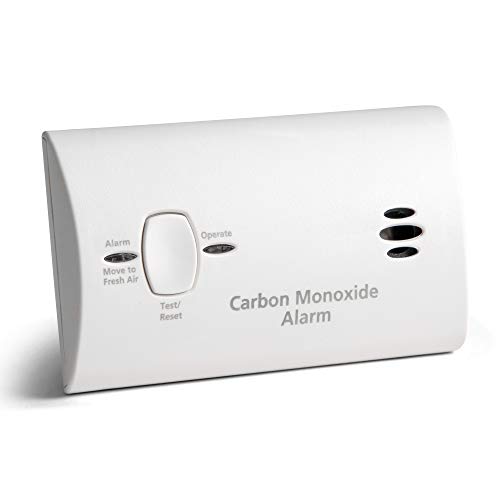
Every RV should have a dedicated battery-powered or hardwired CO detector, separate from the smoke alarm. Engineering researchers who study sensor reliability recommend testing detectors monthly and replacing them every five to seven years, since the sensors inside them degrade over time [8].
2. Never Run a Generator Near Openings
Keep generators at least 20 feet from windows, doors, and vents, and always point the exhaust away from the RV. Wind direction matters more than people think, check it before setting up.
3. Keep Vents Clear
Snow, leaves, mud, or gear can block furnace exhaust vents on the outside of the RV. A blocked vent forces fumes back inside instead of out.
4. Never Heat with a Stove or Oven
This single mistake has caused some of the most heartbreaking home tragedies on record, including cases where two children died from oven-based heating attempts that were never designed for that purpose [3][6]. RVs are even smaller and seal tighter than most homes, which makes this mistake even more dangerous in a camper.
5. Watch for “Flu-Like” Symptoms in More Than One Person
If everyone in the RV feels sick at the same time, headache, dizziness, nausea, get outside immediately and seek fresh air. One recent case involved a couple and their dog who survived extremely high CO levels only because the symptoms hit all three of them at once and someone recognized the pattern in time.
6. Don’t Idle Vehicles in Enclosed Spaces
Whether it’s a truck, tow vehicle, or a keyless-ignition car parked near the RV, never let an engine run unattended in a garage, carport, or tightly enclosed area [2].
A Simple Family Safety Checklist
- ✅ CO detector installed and tested this month
- ✅ Generator placed 20+ feet from windows and doors
- ✅ Furnace and generator exhaust vents checked for blockage
- ✅ No stoves or ovens used for heating
- ✅ Everyone knows the symptoms of CO exposure
- ✅ Plan in place to get outside immediately if the alarm sounds
Families who take RV safety seriously often make similar upgrades in other areas too, like reviewing safety items most RV owners get wrong or learning from real breakdown stories like everything that broke in this 23-year-old RV, which shows how aging systems can create unexpected hazards over time.
What Experts Say Went Wrong, And What You Can Do Differently
When safety researchers review CO poisoning cases, the same conclusion comes up over and over: it’s almost never one dramatic failure. It’s a stack of small, ordinary decisions that quietly add up.
Common expert findings include:
- Detectors were missing, expired, or had dead batteries.
- Ventilation was assumed, not verified.
- Warning signs were dismissed as tiredness or minor illness.
- Fuel-burning devices were used for a purpose they weren’t designed for, like heating instead of cooking [3].
Video documentation of real survivor stories has become an important tool for public awareness, showing families describing the confusion and fear of realizing what almost happened to them [4][10]. These firsthand accounts consistently echo the same warning: CO poisoning rarely announces itself loudly. It creeps in quietly, which is exactly why detectors and habits matter more than instinct.
Looking ahead, safety advocates expect more RV manufacturers to include built-in CO monitoring as a standard feature rather than an optional add-on, especially as awareness campaigns following incidents like this one continue to grow. This is a prediction, not a guarantee, but the direction of travel is clear.
Carbon Monoxide Risks Beyond the RV
It’s worth remembering that CO danger isn’t limited to campgrounds and driveways. Poisoning cases have also been reported in hotels, cabins, and rental homes, often linked to poorly maintained furnaces or blocked exhaust systems in guest rooms [6][9]. That means the same detector habit that protects an RV should also apply when traveling and staying in unfamiliar lodging. A portable, battery-powered CO detector packed in a travel bag is a small investment that can matter enormously.
This broader risk is part of why RV families are encouraged to stay informed about travel safety in general, from choosing good campgrounds to understanding common RV rental mistakes and how to avoid them when renting a rig instead of owning one.
Conclusion
The Carbon Monoxide Mistake That Almost Killed This Family is a story with a happy ending, but so many others have not been so lucky. The difference between a scary memory and a tragedy often comes down to a $20 detector, a few extra feet of distance between a generator and a window, and a family that knows the early warning signs.
Take a few minutes this week to check the CO detectors in your RV, test the batteries, and walk through your ventilation setup with fresh eyes. Talk to your family about the symptoms of CO exposure so everyone, including kids, knows what to watch for. It’s a small habit that takes almost no time, but it can be the single most important safety step any RV family makes.
For more ways to travel smart and avoid preventable hazards, check out RV Showoff’s ongoing coverage under RV mistakes and RV family travel, and explore real-world lessons like things that went wrong with an expensive camper to see how even well-maintained rigs can hide unexpected risks.
References
[1] Cheryl Burt Carbon Monoxide Story – https://minnesotanow.net/cheryl-burt-carbon-monoxide-story/
[2] Keyless Ignitions May Be Contributing To Deaths Across The United States – https://www.kidsandcars.org/news/post/keyless-ignitions-may-be-contributing-to-deaths-across-the-united-states
[3] The Silent Killer – https://nchh.org/2017/01/the-silent-killer/
[4] Watch – https://www.youtube.com/watch?v=WTDC06HevmY
[5] Rochester Woman Recalls Story Of Loss Urges Everyone To Install Carbon Monoxide Detectors – https://www.klobuchar.senate.gov/public/index.cfm/2017/11/rochester-woman-recalls-story-of-loss-urges-everyone-to-install-carbon-monoxide-detectors
[6] Carbon Monoxide Stories – https://www.solonohio.gov/629/Carbon-Monoxide-Stories
[7] Texas Carbon Monoxide Poisoning – https://www.propublica.org/article/texas-carbon-monoxide-poisoning
[8] Carbon Monoxide Hunting A Silent Killer – https://hackaday.com/2016/05/04/carbon-monoxide-hunting-a-silent-killer/
[9] Carbon Monoxide Poisoning – https://www.womansday.com/home/a61086/carbon-monoxide-poisoning/
[10] Watch – https://www.youtube.com/watch?v=-KITWM60TvI