Nearly one in five new RV owners reports a significant defect within the first year of ownership — yet most of them have no idea they may have powerful legal rights to demand a refund or replacement. The hidden “lemon law” loophole every RV buyer needs is not some obscure trick. It is a real, often overlooked set of protections that can save you tens of thousands of dollars. Most buyers assume they are stuck once they drive off the lot. They are wrong.
Key Takeaways
- 🏕️ Most state lemon laws do NOT fully cover RVs — many exclude the living quarters or towable units entirely.
- ⚖️ The federal Magnuson-Moss Warranty Act is a powerful backup that covers your whole RV when a written warranty exists.
- 🚌 Motorhomes and travel trailers are treated differently under the law — knowing which type you own matters a lot.
- 📝 How you buy your RV (personal vs. business name) can make or break your warranty coverage.
- 🔍 California offers some of the strongest RV lemon law protections in the country — your state may offer more than you think.
What Is the RV Lemon Law Loophole — and Why Does It Exist?
Most people know about lemon laws for cars. You buy a new car, it breaks down over and over, and the law forces the dealer or manufacturer to fix it, replace it, or give you your money back. Simple, right?
With RVs, it gets a lot more complicated. That complexity is exactly where the hidden “lemon law” loophole every RV buyer needs comes into play.
RVs Are Built by Two Different Manufacturers
Here is the big secret most dealers never tell you:
Your RV is not built by one company. It is built by two.
The chassis (the engine, wheels, and drivetrain) is made by one manufacturer — often Ford, Chevrolet, or Freightliner. The living quarters (the kitchen, bathroom, beds, and walls) are built by a completely separate RV manufacturer.
This split creates a legal gray zone. Many state lemon laws were written with regular cars in mind. They cover the chassis just fine. But the living area? That is often left out entirely. [1]
The Three Big Gaps in State Lemon Laws
| Gap | What It Means for You |
|---|---|
| Chassis-only coverage | Your broken slide-out or leaky roof may not be covered |
| Towable RV exclusion | Travel trailers and fifth wheels are often left out completely |
| Business purchase exclusion | Buying under a business name can void your warranty |
These gaps are not accidents. They are the result of laws that were never updated to keep up with the RV industry. And they leave millions of RV owners unprotected — unless they know where to look. [2]
How State Lemon Laws Handle RVs (State by State Differences)
Not all states play by the same rules. This is where things get really interesting — and where smart RV buyers can find real protection.
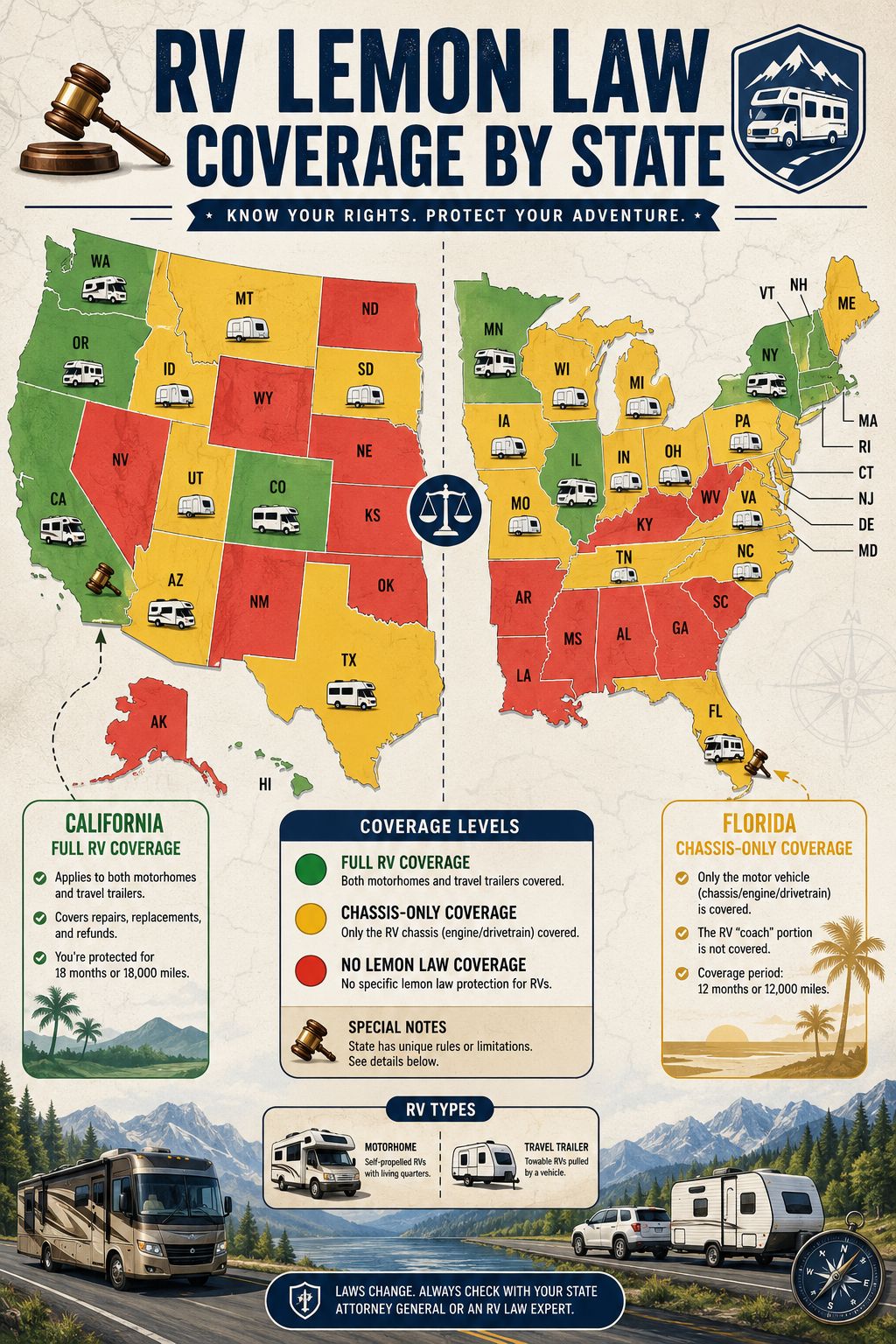
States That Cover the Full RV
A handful of states have strong lemon laws that cover both the chassis and the living quarters of a motorhome. These states recognize that an RV is more than just a vehicle — it is also a home. [1]
California is one of the best examples. California’s lemon law covers RVs and motorhomes, including the chassis and, depending on the warranties provided, portions of the living area. This makes California one of the most buyer-friendly states for RV lemon law claims. [4]
States That Cover Only the Chassis
Many states only protect the mechanical parts of your motorhome. So if your engine fails repeatedly, you are covered. But if your water heater breaks three times in the first year, or your slide-out refuses to work, you may be on your own under state law. [1]
This is the most common situation RV buyers face. It feels deeply unfair — and that is why the federal backup matters so much (more on that in a moment).
States That Barely Cover RVs at All
Some states define “motor vehicle” in their lemon laws so narrowly that most RVs do not qualify. Towable RVs — like travel trailers and fifth wheels — are especially vulnerable. Because they do not have their own engine, many states do not consider them “motor vehicles” at all. [2]
🚨 Important: If you own a travel trailer or fifth wheel, you may have zero state lemon law protection in many states. Your best bet is federal law.
Florida: A Useful Example
Florida has its own motorhome lemon law program, and the RV Industry Association actually supports this kind of state-specific approach. [3] However, even Florida’s law excludes the living facilities of RVs — things like plumbing systems, appliances, and interior components. [7]
So even in a state with a dedicated RV lemon law, your leaky pipes or broken air conditioner might not be covered.
Quick State Comparison Table
| State | Motorhome Coverage | Living Quarters | Towable RVs |
|---|---|---|---|
| California | ✅ Yes | ✅ Partial | ⚠️ Limited |
| Florida | ✅ Yes | ❌ No | ❌ No |
| Texas | ✅ Chassis only | ❌ No | ❌ No |
| New York | ✅ Yes | ⚠️ Limited | ❌ No |
| Many others | ⚠️ Varies | ❌ No | ❌ No |
Always check your specific state law — rules change and vary widely.
The Federal Loophole That Changes Everything
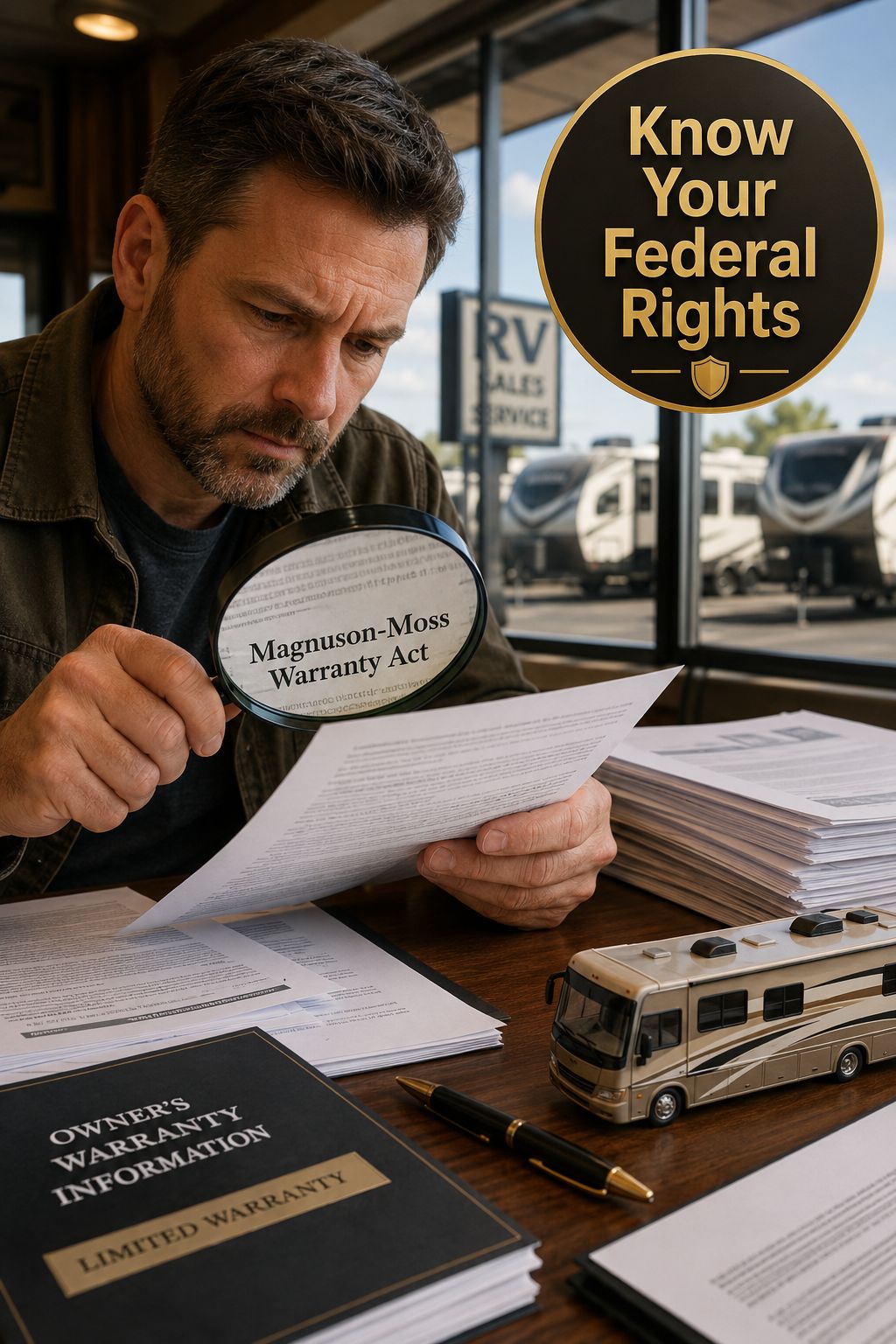
Here is the real hidden “lemon law” loophole every RV buyer needs to know: the Magnuson-Moss Warranty Act.
This is a federal law. It applies in every single state. And it can cover parts of your RV that your state law completely ignores.
What Is the Magnuson-Moss Warranty Act?
The Magnuson-Moss Warranty Act is a federal consumer protection law. It was designed to make sure that when a company gives you a written warranty, they actually have to honor it. [2]
Here is why it matters for RV owners:
- It covers the entire RV — not just the chassis
- It applies as long as there is a written warranty from the manufacturer
- It gives you the right to sue for a refund or replacement if the manufacturer cannot fix the defect after a reasonable number of attempts
- If you win, the manufacturer may have to pay your attorney fees too
That last point is huge. It means lawyers will often take these cases without charging you upfront — because they get paid when you win.
How the Federal Law Fills the Gaps
Think of it this way:
<code>State Lemon Law → Covers the chassis (engine, drivetrain)
Magnuson-Moss Act → Covers everything with a written warranty
</code>
So even if your state law ignores your broken slide-out, your leaking roof, or your faulty electrical system — if the manufacturer gave you a written warranty on those parts, the federal law has your back. [2]
💡 Pro Tip: Save every piece of paper that came with your RV. The warranty documents are your most powerful legal tool.
What Counts as a “Reasonable Number of Repair Attempts”?
This varies, but courts and state laws generally look at:
- 3-4 repair attempts for the same defect
- 30+ days out of service for repairs in a single year
- Any defect that creates a serious safety risk (sometimes just one attempt is enough)
The key is to document everything. Keep a repair log with dates, what was wrong, who fixed it, and how long it took.
Smart Steps to Protect Yourself Before You Buy
The best time to use the hidden “lemon law” loophole every RV buyer needs is before you sign anything. Here are the steps that matter most.
Step 1: Read Every Warranty Document Carefully
Before you buy, ask for all warranty documents in writing. Read them. Look for:
- What is covered and what is excluded
- How long the warranty lasts
- What the manufacturer requires you to do to keep the warranty valid
- Whether the warranty covers the living quarters separately from the chassis
Step 2: Never Buy Under a Business Name
This one surprises a lot of people. If you are self-employed or run a small business, you might think about buying your RV under your business name for tax reasons. Do not do this without checking the warranty first.
Many RV manufacturers’ warranties exclude coverage for vehicles used for business or commercial purposes. Buying under a business name can void your warranty entirely — and without a valid warranty, your Magnuson-Moss protections disappear too. [6]
Step 3: Know That RV Dealers Have Special Exemptions
In December 2025, the Federal Trade Commission announced that RV dealers are exempt from the CARS Rule — a rule designed to stop deceptive practices in vehicle sales. [5]
This means RV dealers have fewer federal restrictions on their sales tactics than regular car dealers. You need to be extra careful and extra informed when walking into an RV dealership.
Step 4: Document Every Problem From Day One
The moment you notice something wrong with your new RV:
- ✍️ Write it down with the date
- 📸 Take photos or video
- 📧 Report it to the dealer in writing (email is great for this)
- 📁 Keep copies of every repair order
- 🗓️ Track how many days your RV is in the shop
This paper trail is everything if you ever need to make a lemon law claim.
Step 5: Contact a Lemon Law Attorney Early
Many lemon law attorneys offer free consultations. Because the Magnuson-Moss Act allows attorneys to collect fees from the manufacturer when you win, many of these lawyers work on contingency — meaning you pay nothing unless you win.
Do not wait until you are frustrated and out of options. Contact an attorney as soon as you have had 2-3 failed repair attempts on the same issue.
What Qualifies as an RV “Lemon”?
Not every problem makes your RV a lemon. Here is a simple breakdown of what typically qualifies:
Defects That Usually Qualify
- 🔧 Repeated mechanical failures — engine, transmission, brakes
- 💧 Persistent water leaks that cannot be fixed after multiple attempts
- ⚡ Electrical system failures that affect safety or livability
- 🌡️ HVAC failures in extreme weather conditions
- 🚪 Slide-out failures that make the RV unusable
Defects That Usually Do NOT Qualify
- Minor cosmetic issues (scratches, small dents)
- Problems caused by owner misuse or neglect
- Normal wear and tear
- Issues that were fully repaired on the first attempt
The “Substantial Impairment” Test
Most lemon laws require that the defect substantially impairs the use, value, or safety of the vehicle. A broken cup holder probably does not qualify. A slide-out that will not retract — leaving you unable to drive — almost certainly does.
The RV Industry’s Own Position on Lemon Laws
Here is something interesting: the RV Industry Association (RVIA) actually supports stronger lemon law protections for motorhomes. The RVIA has publicly backed the creation of motorhome-specific lemon laws modeled after Florida’s program. [3]
This tells you something important. Even the industry itself recognizes that current protections are not always adequate. The patchwork of state laws creates confusion for buyers and manufacturers alike.
The push for clearer, stronger laws is ongoing. But until those laws exist in your state, you need to rely on what is available right now — which means knowing both your state law and the federal Magnuson-Moss Act.
Step-by-Step: How to File an RV Lemon Law Claim
If you believe your RV qualifies as a lemon, here is how to move forward:
Phase 1: Build Your Case
- Gather all purchase documents, warranty papers, and repair orders
- Create a timeline of every defect and repair attempt
- Calculate total days out of service
- Identify which warranty covers the defective parts (manufacturer, chassis, or component)
Phase 2: Notify the Manufacturer
Most lemon laws require you to give the manufacturer one final opportunity to fix the problem. Send a certified letter explaining:
- The defect
- How many times it has been repaired
- That you believe your RV qualifies as a lemon
- That you are requesting a refund or replacement
Keep a copy of this letter and the certified mail receipt.
Phase 3: Consult a Lemon Law Attorney
Bring all your documents to a free consultation. An attorney can tell you:
- Whether your case qualifies under state or federal law
- What remedy you are likely to get (refund, replacement, or cash settlement)
- How long the process typically takes
Phase 4: File Your Claim
Your attorney will file the claim either through:
- Your state’s lemon law arbitration program
- A civil lawsuit under the Magnuson-Moss Warranty Act
- Sometimes both, depending on your situation
Most cases settle before going to trial. Manufacturers often prefer to settle rather than face a jury and pay attorney fees.
Common Mistakes RV Buyers Make With Lemon Law Claims
Avoid these pitfalls that can sink an otherwise strong case:
| Mistake | Why It Hurts |
|---|---|
| Not documenting repairs | No paper trail = no proof |
| Waiting too long to file | Statutes of limitations apply |
| Buying under a business name | May void your warranty [6] |
| Fixing it yourself | Can void warranty coverage |
| Accepting a partial repair | Resets the “reasonable attempts” clock |
| Not reading the warranty | Miss key exclusions and requirements |
Conclusion: Take Action Before You Need To
The hidden “lemon law” loophole every RV buyer needs is not really a secret — it is just information that most dealers have no reason to share with you. Now you know it.
Here are your actionable next steps for 2026:
- ✅ Before buying: Read every warranty document. Ask specifically what is covered in the living quarters.
- ✅ At purchase: Buy in your personal name unless you have confirmed the warranty allows business use.
- ✅ From day one: Keep a detailed repair log with dates, photos, and written repair orders.
- ✅ After repeated failures: Contact a lemon law attorney — most offer free consultations and work on contingency.
- ✅ Know your rights: Your state lemon law AND the federal Magnuson-Moss Warranty Act both exist to protect you.
Your RV is likely one of the biggest purchases of your life. You deserve to enjoy it — not fight with a manufacturer over the same broken slide-out for two years. Know your rights, document everything, and do not be afraid to use the law that is already on your side.
References
[1] Do Lemon Laws Apply To Recreational Vehicles – https://legalclarity.org/do-lemon-laws-apply-to-recreational-vehicles/?utm_source=openai
[2] Rv Lemon Law What Qualifies And How To File A Claim – https://legalclarity.org/rv-lemon-law-what-qualifies-and-how-to-file-a-claim/?utm_source=openai
[3] Lemon Law – https://www.rvia.org/advocacy/policies/lemon-law?utm_source=openai
[4] Rvs Motorhomes – https://mcmillanlawgroup.com/california-lemon-law/vehicle-types/rvs-motorhomes/?utm_source=openai
[5] Rvda Regulatory Alert Rv Dealers Exempt From Ftc S Cars Rule – https://www.rvda.org/RVDA/RVDA/Media/News_Releases/NewsReleases23/December/RVDA_Regulatory_Alert__RV_Dealers_Exempt_from_FTC_s_CARS_Rule.aspx?utm_source=openai
[6] Buying An Rv Under A Business Name Is A Big No No – https://rvlemonlaw.com/buying-an-rv-under-a-business-name-is-a-big-no-no/?utm_source=openai
[7] Lemon Law For Recreational Vehicles – https://kb.frvta.org/lemon-law-for-recreational-vehicles/?utm_source=openai