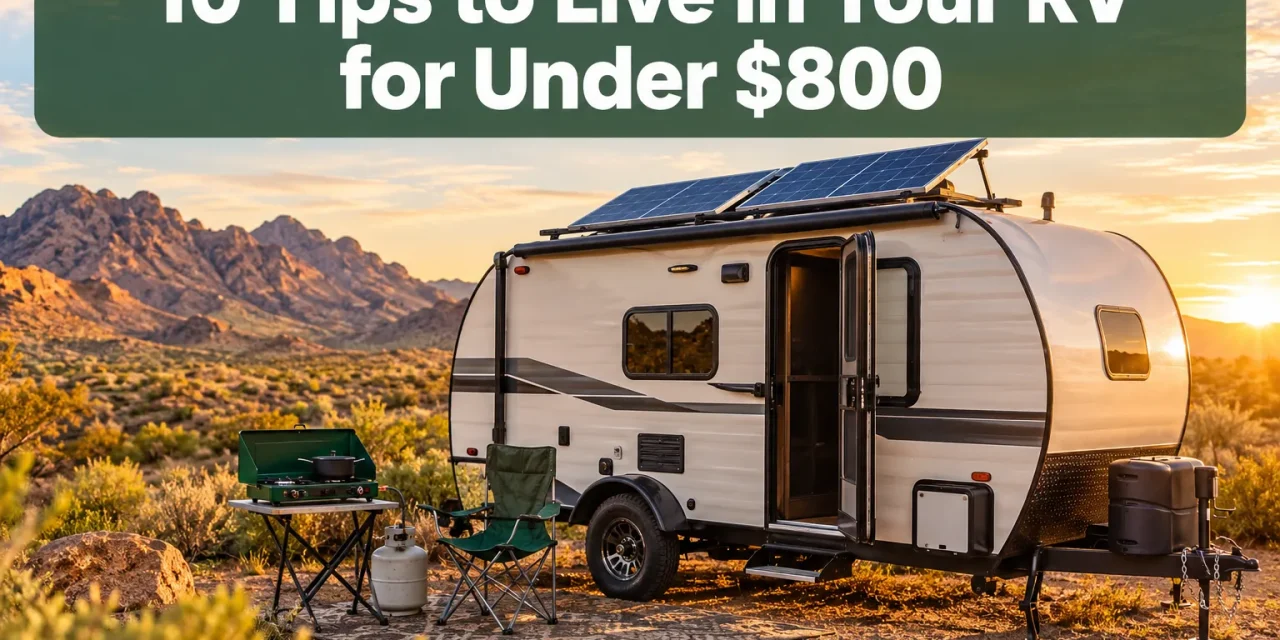
Most RV budget breakdowns say $800 a month is the bare floor of RV living, not the normal rate. MoneyDigest’s latest cost report shows average RV living starting near $800 but regularly climbing past $1,700 once real campground, fuel, and insurance costs get added in[7]. That gap is exactly why so many RV owners ask for real, tested tips to live in your RV for under $800 a month instead of vague advice.
This guide breaks down 10 tips to live in your RV for under $800 a month that actual full-timers use. Some tips are easy. Others take real commitment. Together, they show what it truly takes to hit that number.
Key Takeaways
- 🏕️ Free and cheap camping is the single biggest lever. Boondocking on BLM and Forest Service land costs nothing[10].
- 🐢 Slow travel (staying weeks at a time) cuts fuel use and campground fees dramatically[2][13].
- 🍳 Cooking almost every meal in the RV can save $400,$800 a month compared to eating out[1].
- ☀️ Solar power (400W+ with lithium batteries) removes generator fuel costs and supports long boondocking stays[1].
- 🔧 A small, paid-off rig with no slide-outs and a steady maintenance fund keeps surprise costs from wrecking the budget[1][4][8].
Why $800 a Month Is the Extreme Low End of RV Living Costs
Before diving into the tips, it helps to understand just how tight this number really is. A 2026 ownership-cost analysis from Truervs found that recreational users with a financed travel trailer typically spend $800 to $1,800 a month. Full-time motorhome owners often land between $2,500 and $8,000 or more every month[4]. That means $800 isn’t a “typical” budget. It’s the extreme low end, and it’s only possible with very specific choices.
Industry data backs this up. RVJournal reports that full-time RV living is booming in 2026, which is pushing demand, and prices, higher at many campgrounds and resorts[2]. That trend makes a sub-$800 budget harder to hit every year. But it’s not impossible. Real examples exist, including a 2026 video breakdown of a full-timer living on roughly $500 a month by boondocking heavily and keeping every other category lean[5]. Another 2026 expense video showed campground spending alone landing around $700,$800 a month when using monthly rates and slow travel[11]… but that example used nearly the whole budget on camping alone, leaving nothing for food, fuel, or repairs.
The lesson here: hitting $800 requires stacking multiple money-saving strategies at once. One or two tricks won’t cut it. That’s why this list covers all 10 tips to live in your RV for under $800 a month as a complete system, not a menu to pick from.
“The $800 number is real, but it’s the floor, not the average. It only works when every category is squeezed at the same time.”
The Full List: 10 Tips to Live in Your RV for Under $800 a Month
Here are the 10 tips to live in your RV for under $800 a month that make the biggest real-world difference, based on current 2026 cost data and full-time RVer habits.
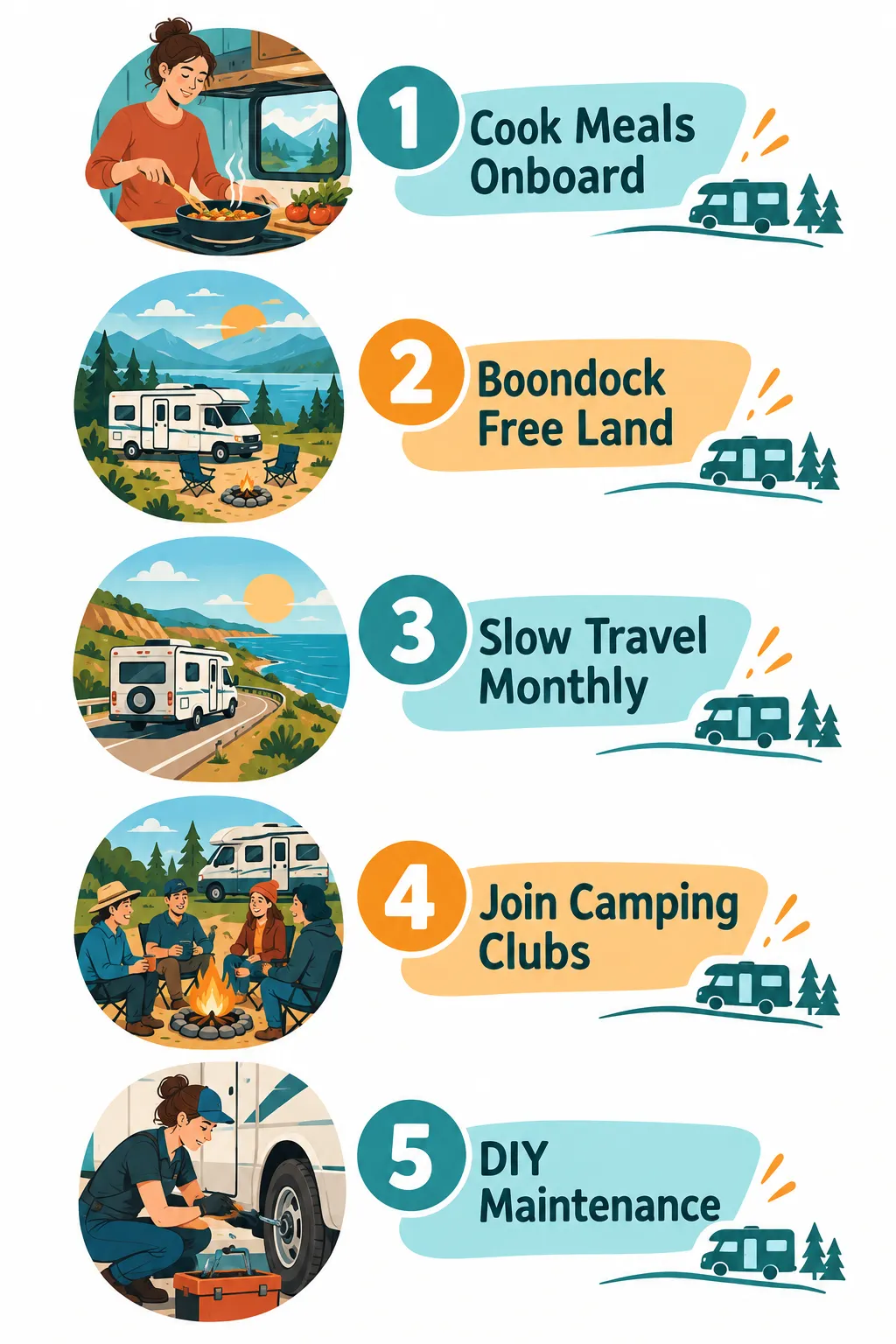
1. Boondock on Free Public Land as Much as Possible
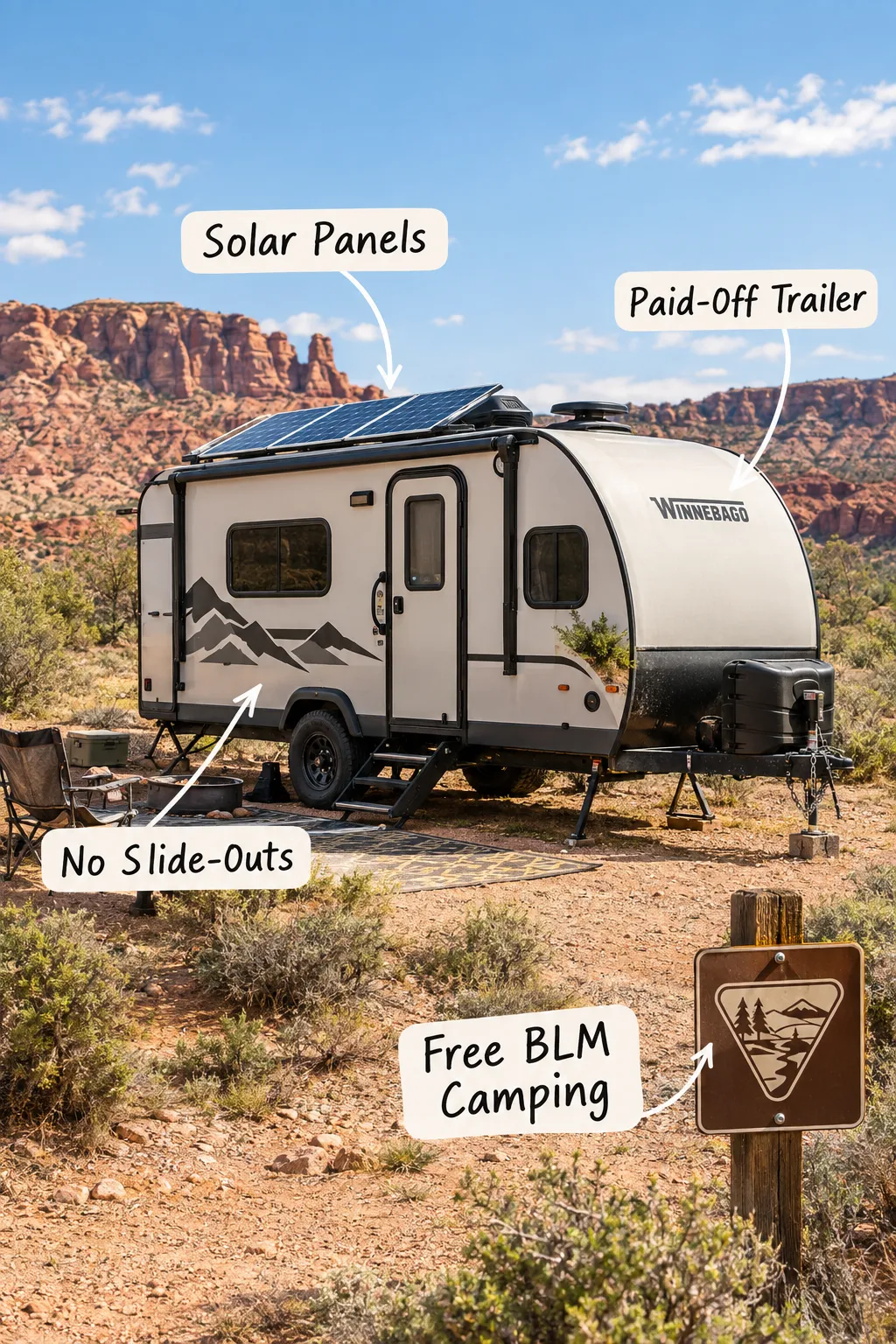
Free camping is the backbone of a sub-$800 budget. RV LIFE explains that boondocking on government-owned land such as BLM and U.S. Forest Service land is completely free, and some city parks even offer free campsites, occasionally with hookups[10].
Simple ways to find free sites:
- Use apps and sites that map BLM and Forest Service boondocking spots.
- Check city parks and county fairgrounds for free or cheap overnight stays.
- Ask fellow RVers through Boondockers Welcome for private free stays[10].
2. Travel Slowly, Weeks, Not Days
Fast travel is expensive travel. A 2026 feature on full-time RV living calls “slow travel” the single most effective way to lower a budget, because staying 2-4 weeks or more in one spot cuts fuel use, reduces wear and tear, and unlocks cheaper monthly camping rates[2].
Camping World’s 2026 budget guidance confirms many parks offer monthly rates around $800, meaning one long stay can sometimes equal an entire month’s camping budget on its own[13]. That’s why slow travel has to be paired with free boondocking nights to leave room for everything else.
3. Mix Free Boondocking With Deeply Discounted Parks
Nobody can boondock every single night forever, sometimes a hookup is needed for laundry, water, or just a break. RoverPass highlights city-run parks, county fairgrounds, and utility-company campgrounds offering full hookups for under $25 a night. Many RV resorts also drop their nightly rate to around $20 when guests commit to 30 or more nights[12].
A smart mix might look like:
| Camping Type | Typical Cost | Best Use |
|---|---|---|
| BLM/Forest Service land | Free | Most nights, when boondocking |
| City or county park | Low cost | Short stops between moves |
| Monthly discounted resort | Reduced monthly rate | Laundry, mail, rest stops |
4. Join Camping Membership Clubs
Membership programs are one of the highest-impact tools on this list. RV LIFE strongly recommends Thousand Trails, Passport America, and Boondockers Welcome, noting these memberships can significantly lower campground fees and sometimes offer free overnight stays[10]. RoverPass and RVBrands.org also point to Good Sam Club and Passport America as go-to options for campground and service discounts[12][14].
These memberships usually cost a modest yearly fee but can pay for themselves within a few nights of use.
5. Cook Almost Every Meal in the RV
This is one of the easiest categories to control, and one of the biggest. RVivy estimates that cooking in the RV instead of eating out can save roughly $400 to $800 a month for many travelers[1]. RV LIFE recommends packing lunches and skipping restaurant meals on sightseeing days[10], and RVBrands.org’s cost guide lists home-cooked RV meals as a cornerstone of frugal living[14].
Simple habits that help:
- Plan a week of meals before shopping, not day by day.
- Buy in bulk when storage allows.
- Keep easy, no-fuss recipes on hand for travel days.
For a true $800 budget, nearly every meal needs to come from the RV kitchen, not a drive-thru window.
6. Choose a Small, Simple Rig With No Slide-Outs
The RV itself is one of the biggest cost drivers. RVivy’s 2026 guide to budget travel advises picking a simpler rig with a strong dealer network and avoiding multiple slide-outs, since each slide-out can add roughly $500 to $2,000 in repair costs per incident[1]. Truervs adds that financed rigs and large motorhomes are the main reason monthly costs balloon, while smaller, paid-off trailers or vans keep payments and insurance low[4].
A heavier, larger rig also burns more fuel and needs more maintenance, according to industry cost overviews. A compact, efficient RV supports the budget in nearly every category at once, not just the purchase price.
7. Invest in Solar Power to Cut Energy Costs
Energy strategy matters more than most new RVers expect. RVivy recommends at least 400W of solar panels paired with a 100-200Ah lithium battery bank. A 400W solar kit, usually $600,$1,200 installed, can eliminate generator fuel costs entirely and open the door to long stretches of free boondocking[1].
On top of solar, RV LIFE and Camping World both suggest using electric water heaters, space heaters, and cooking appliances while hooked up to electric, which cuts propane use and helps keep monthly utility costs low enough to fit inside a strict $800 plan[10][13].
8. Manage Fuel Like a Budget Category, Not an Afterthought
Fuel can quietly eat an entire monthly budget if routes aren’t planned. Winnebago’s 2026 breakdown of full-time RV costs stresses efficient route planning to avoid unnecessary miles, along with using apps like GasBuddy to find the cheapest fuel prices nearby, which often leads to surprisingly large savings on long driving days[15]. RV LIFE also points to GasBuddy, the TSD Logistics diesel discount program, and Costco fuel, often the cheapest in a given city, as practical tools[10].
Combined with slow travel, the goal is to keep total fuel spending somewhere in the $50,$150 range for the month, which is only possible when miles driven stay low[2][15].
9. Handle Basic Maintenance Yourself and Fund a Repair Account
Skipping maintenance to save money almost always backfires. RVivy recommends learning basic maintenance tasks and resealing roof seams once a year, estimated at about $50 in materials, along with regular checks of tire pressure and slide seals to avoid expensive failures[1]. RV LIFE agrees, pointing to tire pressure checks before every trip and packing light to reduce strain on the rig and improve fuel economy[10].
RoverPass also encourages checking rig weight and doing routine maintenance personally, noting many RVers keep total costs well under $2,000 by combining DIY maintenance with slow travel and boondocking[12]. An RVT budget-prep guide goes further, advising RVers to set aside roughly $100,$200 a month in a dedicated maintenance fund[8]. That fund is what prevents one surprise repair from blowing up an otherwise careful $800 plan.
10. Track Every Category With a Real Monthly Budget Calculator
The last of these 10 tips to live in your RV for under $800 a month is simple but often skipped: actually track spending by category. A September 2026 RV budget-calculator walkthrough shows viewers how to break down costs into parks, boondocking, fuel, groceries, insurance, internet, and rig payments. It demonstrates that only combinations with paid-off rigs, heavy boondocking, and lean lifestyles come close to the $800 mark[6].
Without tracking, it’s easy to think a budget is working when one category (often camping or fuel) is quietly eating the entire allowance.
Is Living in an RV for Under $800 a Month Really Realistic?
Short answer: yes, but only for a specific type of RVer. The rig has to be small and paid off. Insurance needs to be minimal. Nights on free public land need to outnumber paid nights by a wide margin. Travel has to be slow, almost to the point of staying put. And nearly every meal has to be cooked, not bought.
Industry trends suggest this will only get harder. Truervs’ late-2026 update shows typical full-time motorhome costs at $2,500 to $8,000+ a month, driven mostly by campground rates, fuel, insurance, and loan payments[4]. MoneyDigest frames $800 as the minimum edge of the spectrum, not the middle[7]. Looking ahead to 2027, the realistic path to staying under $800 will likely still require the same formula: a small paid-off rig, heavy free camping, extremely slow travel, home-cooked meals, and steady DIY maintenance with a repair fund[1][2][4][7][8][10][12][13].
Frequently Asked Questions
Can a family of four really live in an RV for under $800 a month?
It’s extremely difficult. Most sub-$800 examples involve a single person or couple in a small rig with heavy boondocking. Larger families usually need more space, more food, and more fuel, which pushes costs higher.
What’s the single biggest money-saver on this list?
Free boondocking combined with slow travel. Together, these two tips to live in your RV for under $800 a month can eliminate the largest expense category most RVers face, campground fees[2][10][13].
Does insurance fit inside an $800 budget?
Only with a small, paid-off rig. Financed and larger motorhomes carry higher insurance premiums that can take up a big chunk of the budget on their own[4].
Is boondocking safe and legal?
Yes, on designated BLM and Forest Service land, boondocking is legal and free. Always check posted stay limits and follow Leave No Trace guidelines[10].
Final Thoughts on Tips to Live in Your RV for Under $800 a Month
Hitting $800 a month is possible, but it’s the floor, not the norm. It takes a small, paid-off rig, lots of free camping, slow travel, home-cooked meals, and steady do-it-yourself maintenance habits working together at the same time.
Start small. Pick two or three tips from this list, maybe free boondocking and cooking more meals, and build from there. Add solar power and a camping membership next. Over a few months, these tips to live in your RV for under $800 a month can stack into a real, sustainable lifestyle rather than just a one-time experiment.
References
[1] Best Rvs For Long Term Budget Travel – https://rvivy.com/rv-buying/best-rvs-for-long-term-budget-travel/
[2] Full Time Rv Living – https://rvjournal.org/full-time-rv-living/
[4] How Much Does It Really Cost To Own An Rv 2026 Breakdown – https://truervs.com/blog/how-much-does-it-really-cost-to-own-an-rv-2026-breakdown
[5] Watch – https://www.youtube.com/watch?v=nc6t318d0TA
[6] Watch – https://www.youtube.com/watch?v=b6nchtvuKVU
[7] How Much Cost Live Rv – https://www.moneydigest.com/1965564/how-much-cost-live-rv/
[8] How To Save Full Time Rv Budget – https://www.rvt.com/blog/how-to-save-full-time-rv-budget/
[10] Full Time Rv Living On A Budget – https://rvlife.com/full-time-rv-living-on-a-budget/
[12] Full Time Rving Resources Tips – https://www.roverpass.com/blog/full-time-rving-resources-tips/