
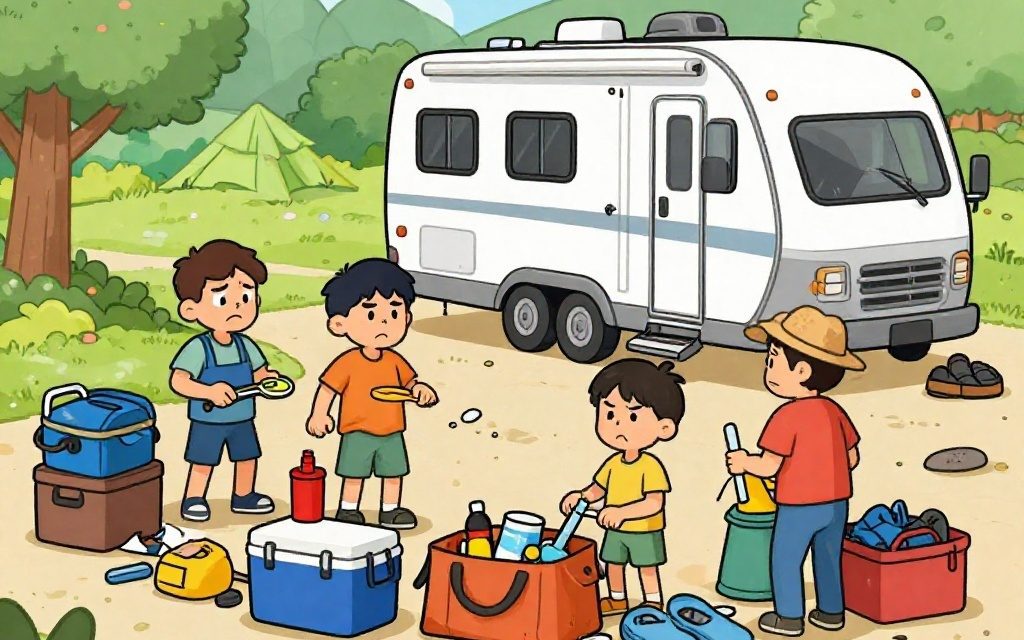
If you’ve ever wondered why leaving for a simple weekend camping getaway feels more complicated than planning a NASA space launch, you’re not alone.
RV camping preparation is an art form that transforms rational adults into obsessive list-makers and garage organizers. What should be a peaceful escape turns into a multi-day operation involving propane checks, endless packing lists, and driveway arguments that test even the strongest marriages.
According to Reddit’s RV community, most families spend at least 2 hours on their initial packing job, with some spread out over an entire day. Let’s break down the absolute chaos of RV trip preparation and why it requires more coordination than a military deployment.
Would you like to save this article?
1. The Packing Black Hole: Where Logic Goes to Die
You’ll pack for two days like you’re preparing for the apocalypse. Six cases of water, 14 bags of chips, and enough hamburger meat to feed an entire Little League team somehow make it into your rig for a simple weekend trip. The truly fascinating part is that campers prepare as if grocery stores cease to exist beyond city limits. You’ll bring enough flashlights to land aircraft at your campsite, yet somehow everyone forgot to pack socks.
According to RV packing experts, the average camping checklist includes over 100+ essential items across categories like kitchen supplies, safety gear, maintenance tools, and outdoor equipment. The real challenge isn’t the initial packing—it’s the endless loop of walking back inside your house because somebody remembered one more thing. “Oh wait, we need towels.” Five minutes later: “Did we remember the paper plates?”
Your driveway transforms into what looks like an eviction scene. Pools, bikes, firewood, dog leashes, and a random pool noodle create a landscape that concerns the neighbors. Every camper has their labeled storage totes: “miscellaneous cords,” “bug spray,” “emergency poncho.” You open one and find a dead battery, 37 mystery cords, and a single flip flop. But you better bring them anyway—that’s the official slogan of camping.
Here’s the unspoken truth: You could prep like a Special Forces operative, cross-check every list, and still realize 20 minutes down the road that you forgot something critical. That “something” is usually medication, a phone charger, or the one pillow someone can’t sleep without.
2. Hooking Up the RV: A Marriage Stress Test
Nothing tests a 25-year marriage faster than backing up to a trailer hitch. You could be best friends with your spouse, but hook up a travel trailer one time, and suddenly you’re speaking through clenched teeth while the neighbors pretend not to watch. The person guiding becomes the angriest air traffic controller on Earth: “Left! LEFT! No, your other left! STOP!”
Meanwhile, you’re trying to navigate using mirrors the size of Pop-Tarts. No matter how slowly you inch backward, the hitch mysteriously disappears. You’ll miss it by about an inch—14 times in a row. At some point, you’re moving the truck one molecule at a time while tension hangs thicker than campfire smoke.
According to RV safety statistics from Fifth Wheel Street, RVs have a relatively low fatality rate of 0.44 deaths per 100 million vehicle miles compared to 1.48 for all vehicles. But those statistics don’t measure the near-death experiences marriages face during the hitching process. That dangerous silence when nobody’s speaking and nobody’s blinking? Your marriage is hanging by a thread over that steel ball hitch.
Then comes the part nobody fully understands: safety chains, breakaway switches, and mystery cables. There’s always one cord nobody remembers plugging in. You just stare at it and think, “Huh, I guess that wasn’t important.” After connecting everything, you still need to run a full pre-flight inspection testing brake lights and turn signals—because camping is apparently the only vacation that requires FAA-level safety protocols before making hamburgers by a lake.
3. The “Leaving Early” Delusion
“We’re leaving early tomorrow” is the biggest lie told in the camping world. Campers talk about departure times like New Year’s resolutions—completely disconnected from reality. Every family has a fantasy schedule: wake up at 6:00 AM, coffee by 6:30, hit the road by 7:00. Absolutely not happening.
At 7:00 AM, you’re still in pajamas looking for extension cords. Research from camping communities shows that departure times are typically 3-6 hours behind schedule. You know things are getting desperate when somebody starts “loading the truck strategically”—code for “we’re entering hour four of this nightmare.”
Nobody can find the keys. The dog has escaped twice. Someone microwaved breakfast but forgot about it. Meanwhile, there’s always one family member who contributed absolutely nothing, standing there holding a Stanley Cup and watching the collapse of civilization unfold.
The pressure builds because nobody’s watching the clock. Suddenly the trip becomes emotional. One person’s stressed, another’s hangry, and someone else is mad about the towels. Nobody even remembers why they’re arguing anymore. You finally pull out of the driveway celebrating like you’ve summited Everest, only to turn around seven minutes later because someone forgot their medication, wallet, or phone.
The person who forgot it always says: “I thought somebody else grabbed it.” Camping is the only hobby where personal responsibility completely evaporates.
4. Food Prep Insanity: Packing Like You’re Entering a War Zone
Campers grocery shop for a weekend trip like they’re preparing for a Category 4 hurricane. You’ve seen it: three shopping carts, eight bags of ice, and enough snacks for a middle school soccer tournament—all for a 2-day getaway. Camping food math makes absolutely no sense. “How many hot dogs should we bring?” “Probably 48.” “Why? There’s only four people.”
Studies show that backpackers and campers consistently overpack food, with many bringing 50-75% more than they actually consume. Campers buy with pure optimism: fruit trays, fancy marinades, pasta salads. Then comes cooler organization that would impress a military quartermaster. “This cooler’s for drinks only. This one’s meat. This one’s snacks. And this one can only be opened twice a day.” Each weighs 900 pounds.
No matter how much you bring, the campground store still gets you. They charge $11 for mustard, and everyone just accepts it because desperation overrides logic. Camping completely destroys financial decision-making. You’ll complain about gas prices for three hours, then casually spend $42 on firewood and melted ice without blinking.
After all this meal preparation—complete with pre-portioned ingredients and detailed cooking schedules—somebody at the campsite will inevitably ask: “So, what do you guys want for dinner?”
5. The Gas Station Stop: A 3-Hour Public Event
Stopping for gas should be simple, but not when you’re towing an RV. Pulling into a gas station becomes a full-scale spectacle because every pump station looks like it was designed for bicycles. You’re creeping in at 0.3 miles per hour, analyzing angles like you’re docking a cruise ship.
The pressure intensifies because there’s always an audience. Regular drivers watch like, “Sir, this is a Sunoco.” Your trailer’s blocking pump four, half the parking lot, and probably a county road. Then everybody gets out, and the trip completely loses momentum. One person’s buying snacks, another’s walking the dog, and somebody’s been in the bathroom for 28 minutes.
You walked in for diesel. You’re walking out with beef jerky, a trucker hat, windshield wipers, and three energy drinks. Your vehicle ages approximately 11 years during the camping trip—crumbs everywhere, receipts on the floor, and sticky cup holders that’ll never be clean again.
Fourteen minutes after you finally hit the road, someone announces: “I gotta pee again.” According to camping forums, gas station stops add an average of 45 minutes to 2 hours to travel time. That’s not counting the emotional toll.
6. The Family Meltdown: When Someone Checks Out
There’s always a moment when one family member hits a wall. Could be mom, dad, or the kids—but eventually, somebody reaches their breaking point. It’s never one giant catastrophe. It’s 400 mini things stacked together like a Jenga tower of stress.
It starts subtle: “Can somebody please move this cooler?” Then escalates: “Where are the towels?” Now it’s dangerous territory. Someone asks an innocent question at the worst possible time: “Hey, did you remember the campground reservations?” The entire family freezes. Camping stress transforms normal conversations into hostage negotiations.
One person’s sweating. One person’s hungry. The dogs are barking. The neighbors are outside pretending they didn’t hear the sentence: “You can’t put that there!” “Well, where else is it supposed to go?” “Not on top of the bread!” That sentence only exists in RV life.
You’re supposed to be somewhere three hours ago. Nobody’s talking—just loading stuff angrily. Then somehow, 20 minutes later, you’re all sitting in the truck like nothing happened. Camping families recover from arguments with zero resolution whatsoever. You’ll be driving in silence, eating gas station pretzels, and acting like you didn’t almost file for divorce in the driveway.
7. The Miraculous Memory Reset at the Campground
After all the chaos—the packing disasters, the hitching nightmares, the driveway arguments, the gas station delays—you finally arrive at the campground. Fourteen minutes later, somebody says: “Oh, this is nice.” That’s the crazy part about camping.
No matter how stressful the journey, campers forget everything the minute the camping chairs come out. Suddenly the fire’s going, kids are riding bikes, someone’s making burgers, and everyone’s sitting around like, “Hey, remember when this trip almost ended three marriages?” Campers have the memory of goldfish.
According to KOA Campgrounds, the average camper spends only 1 hour packing but 3-5 business days unpacking—because nobody wants to deal with reality once the trip ends. You wake up the next morning saying, “We should plan our next trip.” Never mind that you lost the dog, your emotional stability, and the coffee somewhere between home and the campground.
Camping is the only hobby where preparation is significantly harder than the actual vacation. You spend six days preparing to eat a hot dog in a folding chair by a tree. And you know what? It’s absolutely worth it. Then it’s time to leave the campground, and that process starts all over again.
If you didn’t get into a fight in the driveway, did you even go camping?
SOURCES
- Reddit GoRVing Community – RV Preparation Time Discussions: https://www.reddit.com/r/GoRVing/comments/12g5av7/how_long_does_it_take_you_to_prep_for_a_trip/
- RV Outdoors – Essential RV Packing List: https://rvcoutdoors.com/your-essential-packing-list-for-rv-camping/
- Cruise America – RV Packing List for First Time Campers: https://www.cruiseamerica.com/trip-inspiration/ultimate-rv-camping-pack-list-for-the-first-time-c
- Campanda Magazine – RV Checklists and Printable Packing Lists: https://www.campanda.com/magazine/rv-checklists-printable/
- Good Sam Roadside – RV Camping Checklist: https://roadside.goodsam.com/resources/rv-camping-checklist
- Reddit Camping Community – Food Overpacking Discussions: https://www.reddit.com/r/camping/comments/nmeao0/do_you_over_pack_food_like_you_over_pack_underwear/
- Fifth Wheel Street – RV Accident Statistics and Safety Data: https://fifthwheelst.com/rv-accidents-statistics.html
- Emergency Assistance Plus – RV Statistics 2025: https://www.emergencyassistanceplus.com/resources/rv-statistics/
- KOA Kampgrounds – Camping Packing and Unpacking Time: https://www.facebook.com/KOAKampgrounds/posts/everyone-knows-that-packing-takes-an-hour-and-unpacking-takes-3-5-business-days/1124647196364241/
- The Camping Loop YouTube Channel – Original Video: https://www.youtube.com/watch?v=X1EYcMYw2tA


