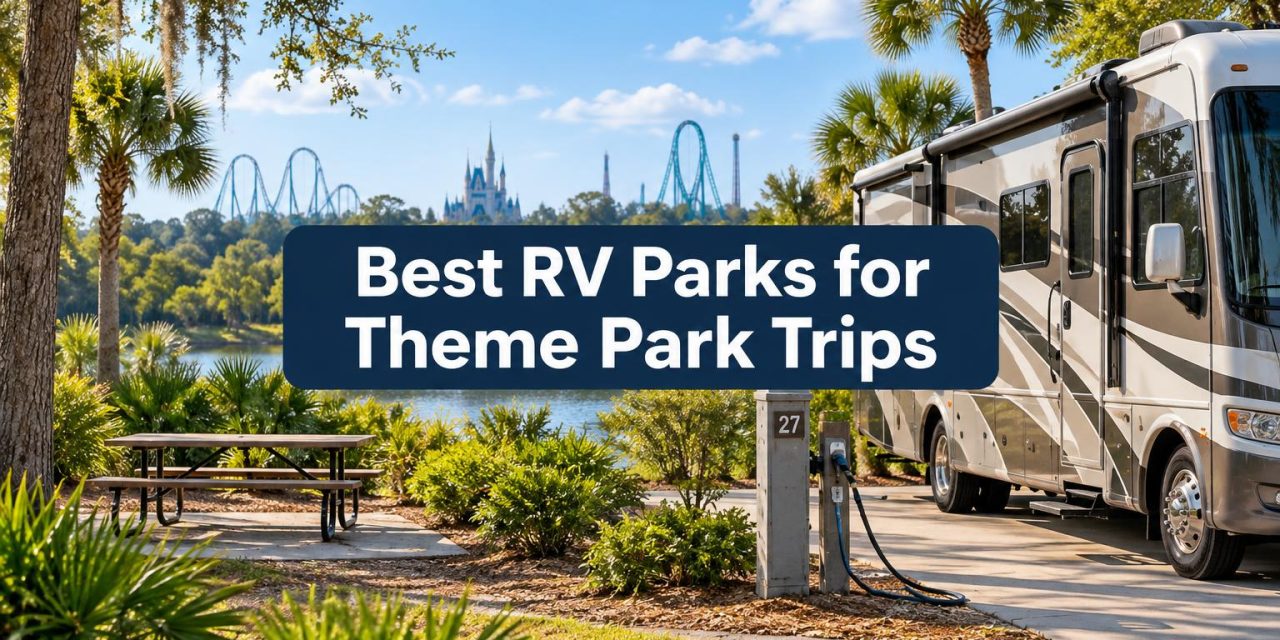
A night at Disney’s Fort Wilderness can cost more than some families’ entire weeklong trip budget. Meanwhile, a wooded RV park 25 minutes away might save hundreds of dollars and still get you to the parks on time. That gap is exactly why so many RVers get this decision wrong.
Choosing the best RV parks for theme park trips isn’t about finding the closest dot on a map. It’s about weighing five factors against each other: location, shuttle access, hookups, noise, and total cost. Get the balance right, and you’ll spend less money and more time actually enjoying the rides. Get it wrong, and you’ll burn vacation days sitting in traffic or paying for amenities you never use.
This guide breaks down a repeatable scoring system you can use for any major park, Disney, Universal, Hersheypark, Cedar Point, or anywhere else with coasters and crowds.
Key Takeaways
- Location and shuttle access matter more than straight-line distance, a park 20 minutes away with reliable transportation beats one 10 minutes away with no shuttle and nightmare traffic.
- On-property convenience comes at a steep premium. Fort Wilderness remains the benchmark for on-site RV stays, but 2026 pricing makes it one of the priciest options in the country [1].
- Off-site “value” RV resorts often cost less than half of on-property rates while staying within a 15-25 minute drive [2][3].
- Hookup quality and site length separate a good park from a frustrating one, especially for larger rigs.
- Total cost includes more than the site fee, factor in park tickets, fuel, parking, and shuttle costs before comparing numbers.
Why Location Alone Doesn’t Tell the Whole Story
It’s tempting to just search “RV parks near [theme park]” and book whatever shows up first. That’s a mistake.
Distance on a map doesn’t account for traffic patterns, toll roads, or whether the park actually has a way to get you to the gates. A site that’s 12 miles away on a highway with no congestion can beat a site 4 miles away that requires navigating stoplights and parking lots every single day [4][5].
When evaluating location for the best RV parks for theme park trips, ask three questions:
- How long does the drive actually take during peak traffic hours, not off-peak?
- Is there a direct route, or will you be weaving through surface streets?
- Does the park’s location also work for a second or third attraction, in case your trip includes more than one park?
Orlando is the clearest example. Families chasing Disney alone might ignore how close certain campgrounds also sit to Universal, SeaWorld, or ICON Park, a huge bonus if your itinerary includes multiple stops [4][6].
Shuttle Access: The Most Overlooked Factor
Here’s something many first-time RV travelers don’t realize: most “theme-park RV parks” expect you to drive yourself. Shuttle service is far less universal than marketing copy suggests.
Fort Wilderness is the gold standard here because Disney’s internal transportation system, buses, boats, and in some cases monorail connections, largely eliminates the need to drive or park at all [1]. That convenience is a major reason it still commands premium 2026 pricing [1].
Off-property, shuttle access becomes hit-or-miss:
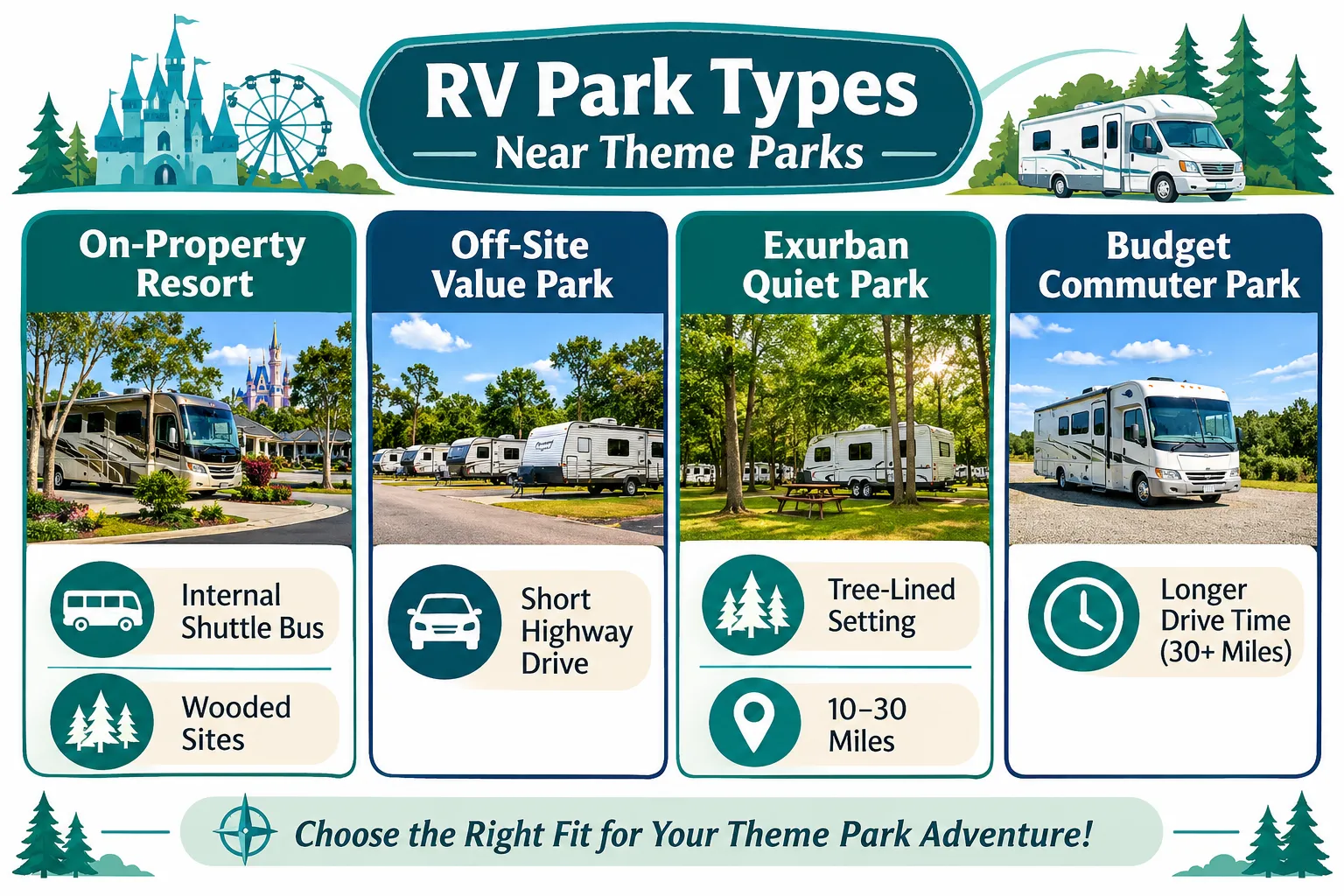
- Some Kissimmee and Orlando-area RV resorts run scheduled shuttles to Disney or Universal, often for a small fee or included in site cost [4][7].
- Many budget parks offer no shuttle at all, meaning you’re driving and paying for theme park parking daily, a cost that adds up fast over a multi-day trip.
- Cedar Point and Hersheypark have fewer dedicated RV shuttle options nationally, so most guests plan on self-driving unless staying in an on-site or adjacent campground [5].
“A shuttle doesn’t just save gas money, it saves you from fighting for a parking spot at 8 a.m. with three kids melting down in the back seat.”
Before booking, call the park directly and ask: Is the shuttle free? How often does it run? Does it go to the park gate or a drop-off lot still requiring a walk or tram ride? These details change everything about your daily rhythm.
For trips centered specifically around Disney or Universal, RV Showoff has deeper breakdowns worth reading, including RV camping near Orlando and Epcot with campground bases and transportation costs and RV camping near Universal parks in Florida.
Hookups and Site Specs: Don’t Compare Blind
Once you’ve filtered parks by location and shuttle access, hookups become the next big differentiator, especially if you’re traveling in a larger fifth wheel or Class A.
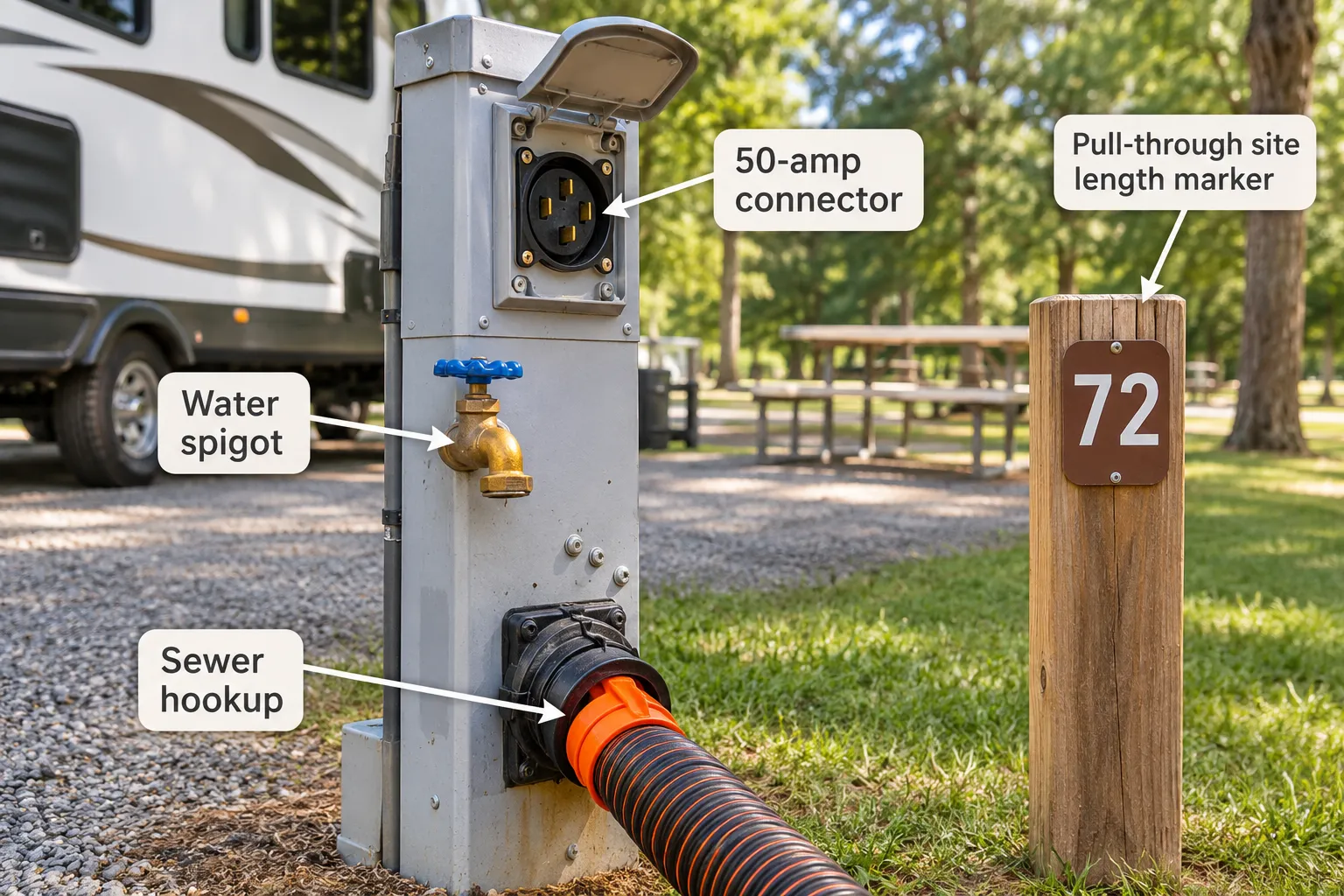
Look for these specs before booking:
- Full hookups (water, sewer, 30/50-amp electric) versus partial hookups that may only offer electric and water.
- Site length and pull-through availability. Many budget parks near attractions were built decades ago and weren’t designed for 40-foot rigs.
- Wi-Fi and cable, if you’re traveling with kids who need downtime between park days.
- Laundry facilities, which matter more than people expect on a weeklong theme park trip with sweaty, sunscreen-covered clothes piling up daily.
Fort Wilderness offers full hookups and generous site sizes, part of what justifies its price tag [1]. Off-site value resorts vary widely, some match that quality at a fraction of the cost, while others cut corners on site length or hookup reliability [4][7]. Always check recent site reviews, not just the park’s own marketing photos.
Noise and Decompression: The Factor Everyone Forgets
Theme park days are loud, crowded, and exhausting. The last thing you want is to return to a campground that feels just as chaotic.
Noise levels vary dramatically between RV parks near major attractions:
- Dense, budget-focused parks packed close to highways or parks themselves often run noisier, with less buffer between sites.
- Wooded or exurban parks trade a slightly longer drive for real quiet, tree cover, more space between neighbors, and a noticeable drop in road noise.
- On-property resorts like Fort Wilderness benefit from Disney’s own landscaping and site spacing, giving a resort feel even close to the action [1].
If your family needs a genuine decompression zone after a 12-hour park day, lean toward parks with more tree cover and spacing, even if it costs a few extra minutes of drive time. This same logic applies outside Florida, Cedar Point’s surrounding campgrounds and Hersheypark-area options both show the same tradeoff between proximity and peace and quiet [5].
Total Cost: Why 2026 Ticket Prices Change the Math
Here’s where a lot of trip budgets go sideways. In 2026, theme park ticket inflation has made total-trip cost comparisons less about shaving a few dollars off a nightly site rate and more about how many nights and park days you actually need.
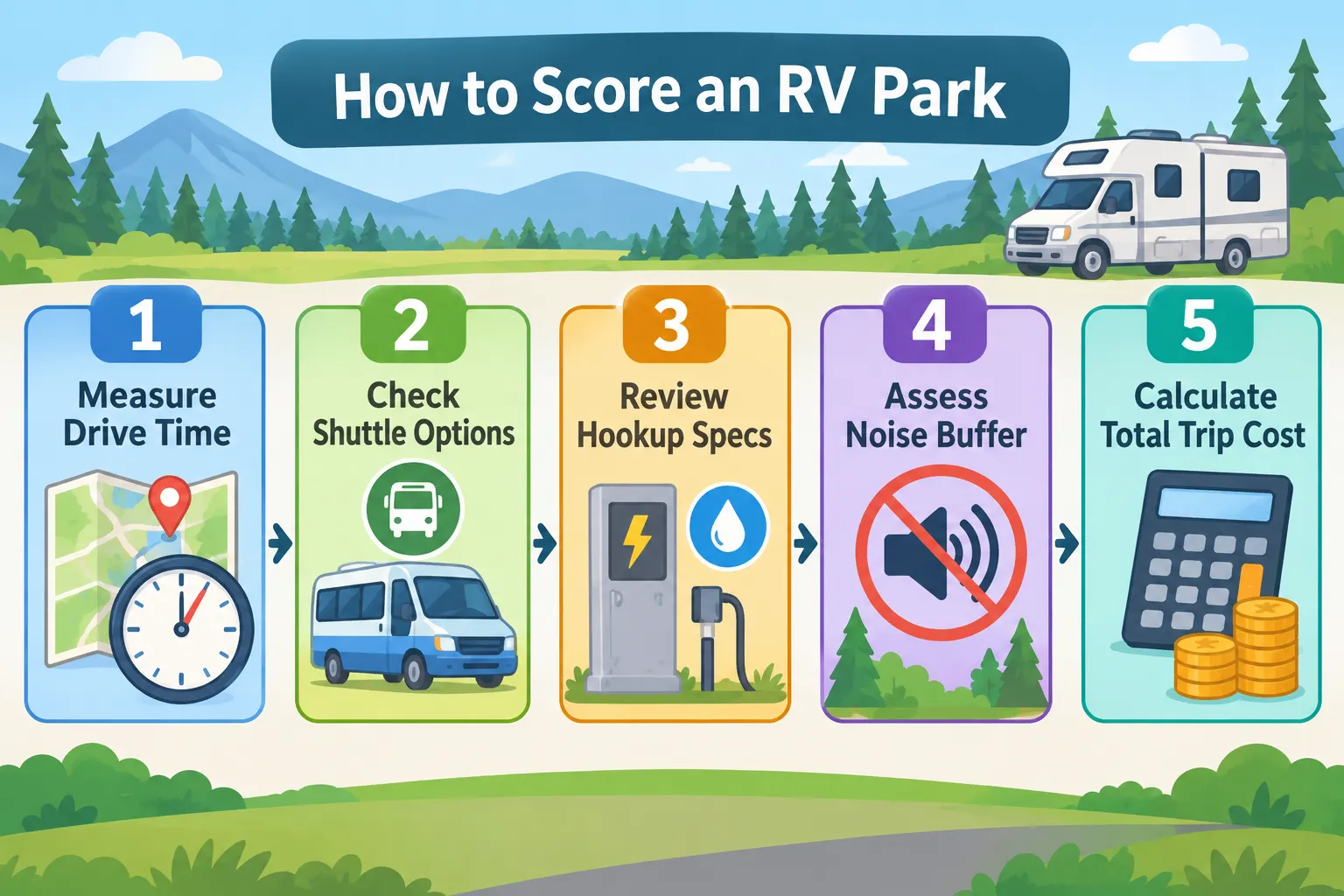
A cheaper RV park that forces you to drive 40 minutes each way, pay for daily parking, and lose an hour of park time isn’t actually cheaper once you add it up. Compare total cost using this formula:
Total Trip Cost = Site Fees + Park Tickets + Daily Parking (if any) + Fuel for Commuting + Shuttle Fees (if any)
Real-world patterns show:
- Fort Wilderness costs significantly more per night but eliminates parking fees and driving costs entirely [1].
- Off-site value resorts near Disney often run less than half of Fort Wilderness’s peak rate while staying within a 15-25 minute drive, though you’ll likely pay for theme park parking separately [2][3].
- Universal-area trips frequently rely on Kissimmee or St. Cloud RV parks, with full hookups and 30-40 minute commutes that keep nightly rates lower [7][8].
Run the math for your specific trip length. A 3-night trip might favor the convenience of on-property stays. A 7-night trip almost always favors a value park, since the savings compound with every added night [9][10].
A Simple Scoring System for the Best RV Parks for Theme Park Trips
To make this repeatable across any destination, score each RV park candidate on a 1-5 scale across five categories:
Add up the scores. The park with the highest total, not just the lowest nightly rate, is usually your best match for the best RV parks for theme park trips comparison. This same framework works whether you’re planning a Disney trip, a Universal run, a Hersheypark weekend, or a Cedar Point coaster marathon [5].
Applying This Beyond Florida
While Orlando dominates the theme-park RV conversation, the same five-factor framework applies everywhere:
- Hersheypark visitors often choose between on-site camping options and nearby independent parks, weighing the same shuttle and noise tradeoffs.
- Cedar Point guests frequently balance lakeside camping convenience against quieter, cheaper inland options a short drive away [5].
- Smaller, independently run campgrounds near regional parks sometimes outperform big corporate RV resorts on service and value, a pattern covered in detail in why mom-and-pop campgrounds beat corporate RV parks.
Whatever the destination, resist the urge to book the first result that pops up. A few extra minutes comparing shuttle schedules and hookup specs can save real money and real stress once the trip is underway.
Planning Tips for a Smoother Theme Park RV Trip
A few extra planning steps go a long way:
- Book early during peak seasons. The best-located, best-reviewed parks near major attractions fill up fast.
- Call ahead to confirm shuttle details. Website info is often outdated.
- Pack entertainment for the drive and downtime. A solid lineup of road trip games for adults keeps everyone sane during commutes and rest days.
- Build in at least one non-park day. Full-throttle theme park schedules wear families out fast, and a quiet campground afternoon helps everyone recharge.
- Double-check rig length limits. Older parks near legacy attractions sometimes have shorter sites than modern RV resorts.
Conclusion
There’s no single “best” RV park for every theme park trip, there’s only the best one for your rig, your budget, and your family’s tolerance for driving versus paying a premium. Use the five-factor scoring system, location, shuttle access, hookups, noise, and total cost, to compare candidates honestly instead of chasing the lowest nightly rate or the shortest line on a map.
Start by listing three or four candidate parks near the attraction, score each one, and run the total-cost math before booking. That extra 20 minutes of research now can mean a quieter, cheaper, far less stressful trip once the rig is parked and the park tickets are scanned.
References
- Campsites at Fort Wilderness Resort. disneyworld.disney.go.com.
- How to Go to Disney World Cheap. cruiseamerica.com.
- Hotels G1954828 C3 Oa60 Zff29 Walt Disney World Hotels. tripadvisor.com.
- Orlando Rv Parks. rv-parks-guide.com.
- A Thrill Seekers Guide to Theme Parks with Rv Campgrounds in the United States. carefreecoveredrvstorage.com.
- Orlando Rv Parks.d178294 Aarvparks.travel Guide Accommodation. expedia.com.
- Rv Parks Near Universal Studios Orlando. couchpotatocamping.com.
- Rv Camping Near Universal Parks in Florida Best Campgrounds Transportation and Multi Park Planning. rvshowoff.com.
- Rv Camping at Disney World How to Turn Americas Biggest Theme Park Into Your Outdoor Basecamp. rvshowoff.com.
- Rv Camping Near Orlando and Epcot Campground Bases Transportation Costs and Park Day Strategy. rvshowoff.com.
theme park rv camping, rv parks near disney, rv parks near universal studios, hersheypark camping, cedar point rv camping, rv hookups guide, shuttle access rv parks, orlando rv resorts, family rv travel, campground comparison, rv trip planning, fort wilderness resort