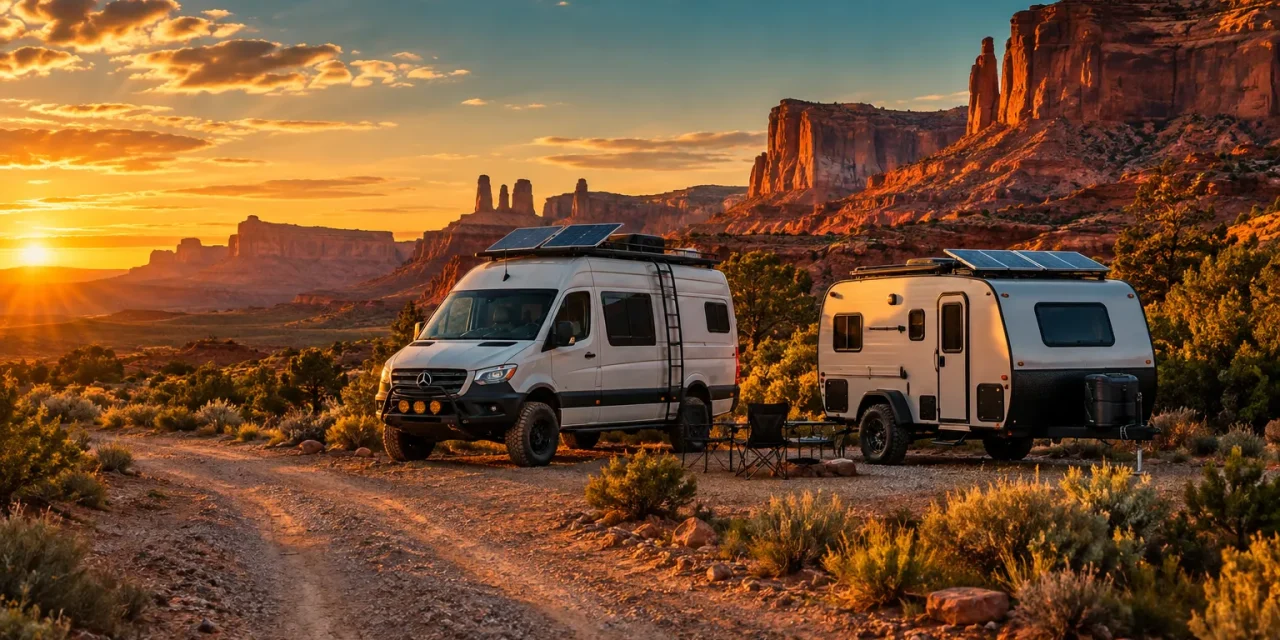
Roughly 88% of all RVs shipped in the United States are towables, not motorhomes.[9] That single number tells a big story: most people camping off-grid this year are pulling a trailer, not driving a van. But that doesn’t mean bigger is always better for boondocking. Choosing between a Class B camper van and a travel trailer for off-grid camping and outdoor adventures comes down to how you travel, who you travel with, and how far off the pavement you’re willing to go.
This guide breaks down the real differences in space, power, maneuverability, and cost so you can decide which rig actually fits your adventure style, not just which one looks better on Instagram.
Key Takeaways
- Travel trailers win on space and value. They typically sleep 4-8 people with bigger kitchens, bathrooms, and storage than a Class B van.[2][7]
- Class B vans win on access and maneuverability. They’re easier to drive, park, and squeeze down narrow forest roads and tight trailheads.[1][10]
- Modern lithium and solar systems have leveled the playing field for off-grid power, with high-end vans now capable of roughly a week unplugged.[8][14]
- Trailers usually cost less per bed, while vans often cost less to operate monthly once fuel, insurance, and towing gear are factored in.[7][10]
- Terrain and crew size matter more than brand loyalty. Off-road trailers and AWD adventure vans are both purpose-built for rough backcountry access.[12][17]
What Really Separates Class B Camper Vans From Travel Trailers Off-Grid
At a glance, both rigs promise the same thing: a bed, a kitchen, and freedom from campgrounds. But the way each one delivers that freedom is completely different.
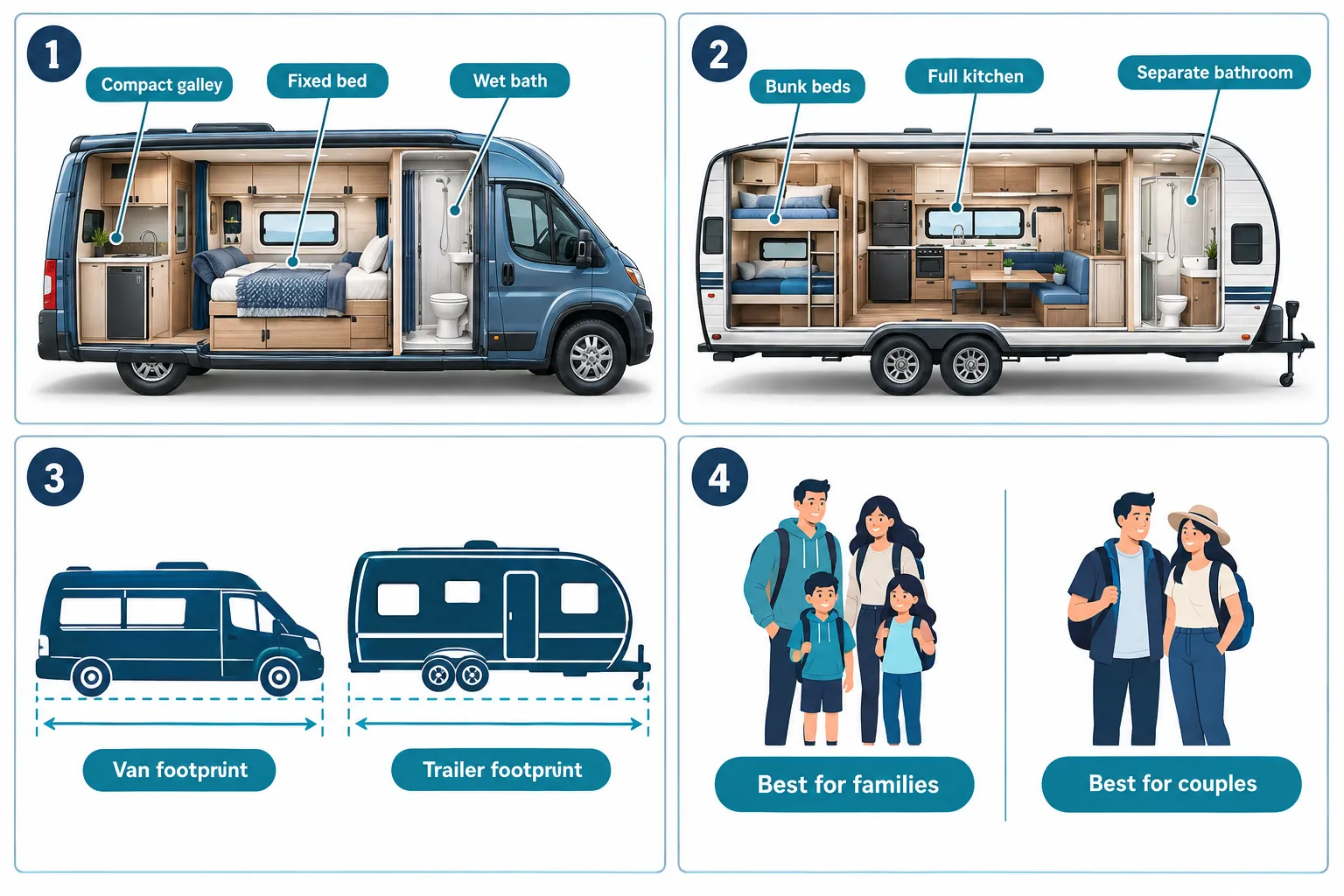
A Class B camper van is a self-contained motorhome built on a van chassis, think Mercedes Sprinter, Ford Transit, or RAM ProMaster. Everything you need is inside one vehicle. A travel trailer, on the other hand, is a separate living unit towed behind a truck or SUV. You disconnect it at camp, and suddenly you have two vehicles: a house that stays put and a rig to explore in.
That structural difference drives almost every decision in the Class B camper vans vs. travel trailers debate. Vans are built for movement. Trailers are built for staying awhile.
Space, Comfort, and Capacity: Which Fits Your Crew
If you’re traveling with more than two people, this is usually the deciding factor. Class B vans typically sleep 2-4 people in a tight footprint, while travel trailers and small RV trailers commonly sleep 4-8 with noticeably more interior storage, bigger kitchens, and full bathrooms.[2][7][10]
A 2026 buying guide pegs typical new travel trailers around $20,000,$75,000 with 4-8 berths, while camper vans carry higher per-unit costs despite sleeping fewer people.[7] That’s a meaningful gap if you’re camping with kids, a partner, and a dog.
Families planning multi-day remote stays without hookups also benefit from the sheer carrying capacity of off-grid caravans and camper trailers, which are built to haul substantial water and gear.[9][16] If you’re outfitting a trailer for long stretches away from services, it helps to plan your outdoor RV space setup and think through a functional outdoor kitchen setup before you leave pavement behind.
“Trailers give you room to breathe. Vans give you room to move.” That trade-off is the heart of this whole comparison.
Class B Camper Vans vs. Travel Trailers: Which Is Better for Maneuverability and Off-Grid Access
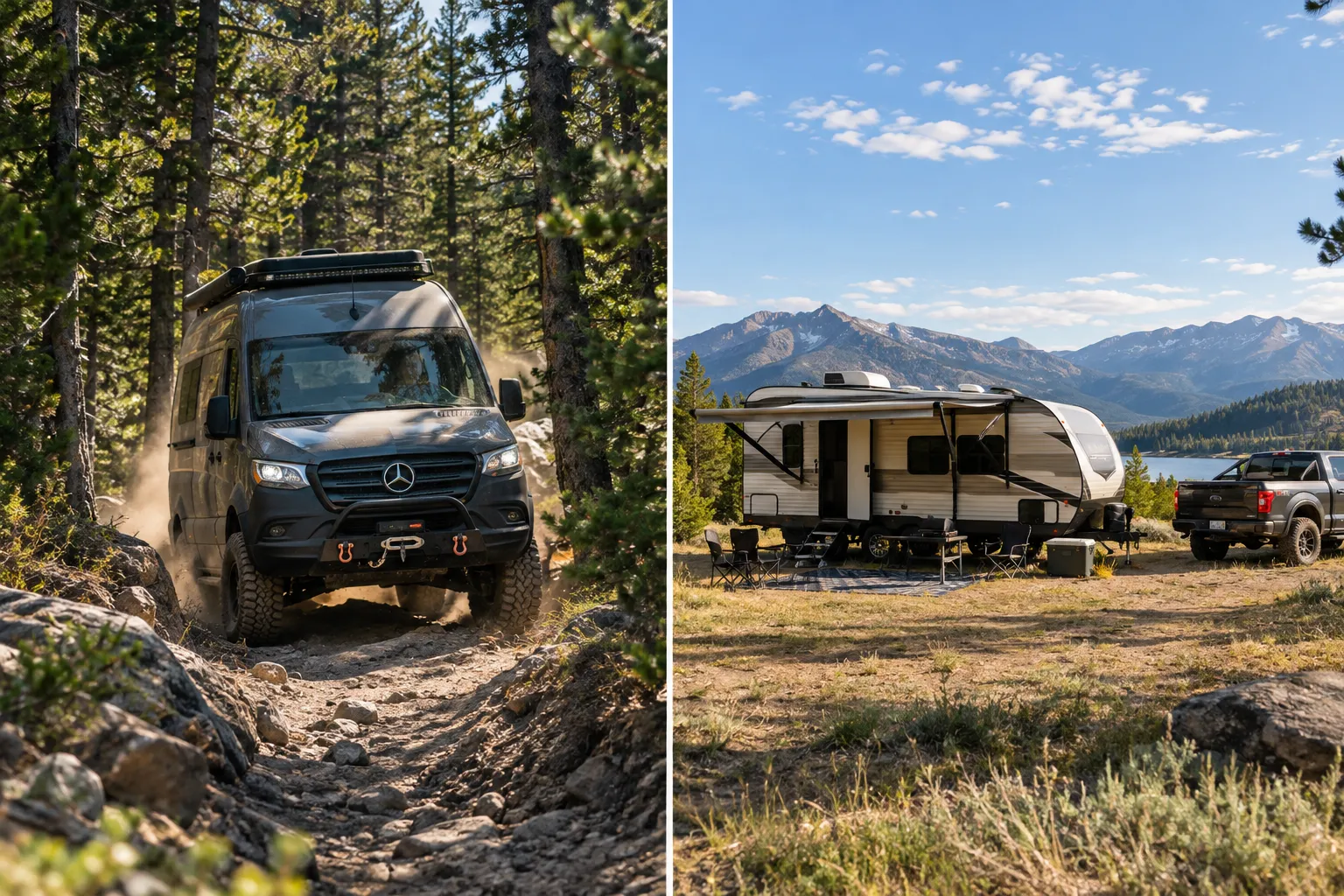
This is where camper vans genuinely shine. Winnebago’s own comparison of camper vans vs. travel trailers notes that vans are easier to drive and park, and far better suited to narrow roads, tight trailheads, and even “stealth” camping in urban settings, while trailers are best kept to paved roads and well-maintained gravel.[1]
A 2026 cost and lifestyle analysis from a camper-van builder found vans winning across maneuverability, fuel cost, stealth camping, off-road access, and monthly operating expenses, while travel trailers add towing complexity and require a capable tow vehicle.[10]
Gear-focused comparisons back this up: trailers are excellent when your plan is to park the rig and explore using your truck, but rough terrain and tight forest roads often favor a van’s smaller footprint.[3][4]
Where Travel Trailers Still Win the Access Game
Don’t count trailers out completely. Once you’re parked, a trailer becomes your basecamp, you disconnect the tow vehicle and use it to explore side roads, run errands, or reach a trailhead without breaking down camp. That physical separation between “house” and “car” is something a van simply can’t offer, and many full-time boondockers say it’s the feature they’d never give up.[4][11]
Off-grid camping guides consistently recommend scouting routes, arriving in daylight, and walking a site before committing, advice that becomes even more critical when you’re towing a trailer into uneven, rutted ground.[6][21]
Rough-Terrain Options for Both Rig Types
Not every trailer is stuck on pavement, and not every van needs 4×4 to go remote. Standard travel trailers usually offer 6-8 inches of ground clearance with minimal underbody protection, but dedicated off-road trailers push that to 12-20+ inches with extended suspension travel and heavy-duty skid plates built for extreme terrain.[12][17] Jayco’s off-grid caravan lineup similarly features independent coil suspension aimed at bush tracks rather than paved caravan parks.[9][16]
On the van side, manufacturers are matching that ambition. Winnebago’s Revel markets itself as an “ultimate adventure-ready” Class B with AWD and rugged off-road upgrades, and builders like Outside Van, Remote Vans, and Storyteller Overland are shipping AWD/4×4 adventure vans purpose-built for backcountry access.[29][36][40][42]
Off-Grid Power and Boondocking: How Long Can You Really Stay Unplugged
This used to be a clear win for trailers, and in many cases it still is. Trailers and small RVs can often fit larger fresh and gray water tanks plus more solar and battery storage at the same price point, simply because they have more physical space to work with.[4] Jayco’s off-grid caravans explicitly build in solar, generous water tanks, and rugged suspension for extended stays far from powered sites.[9][16]
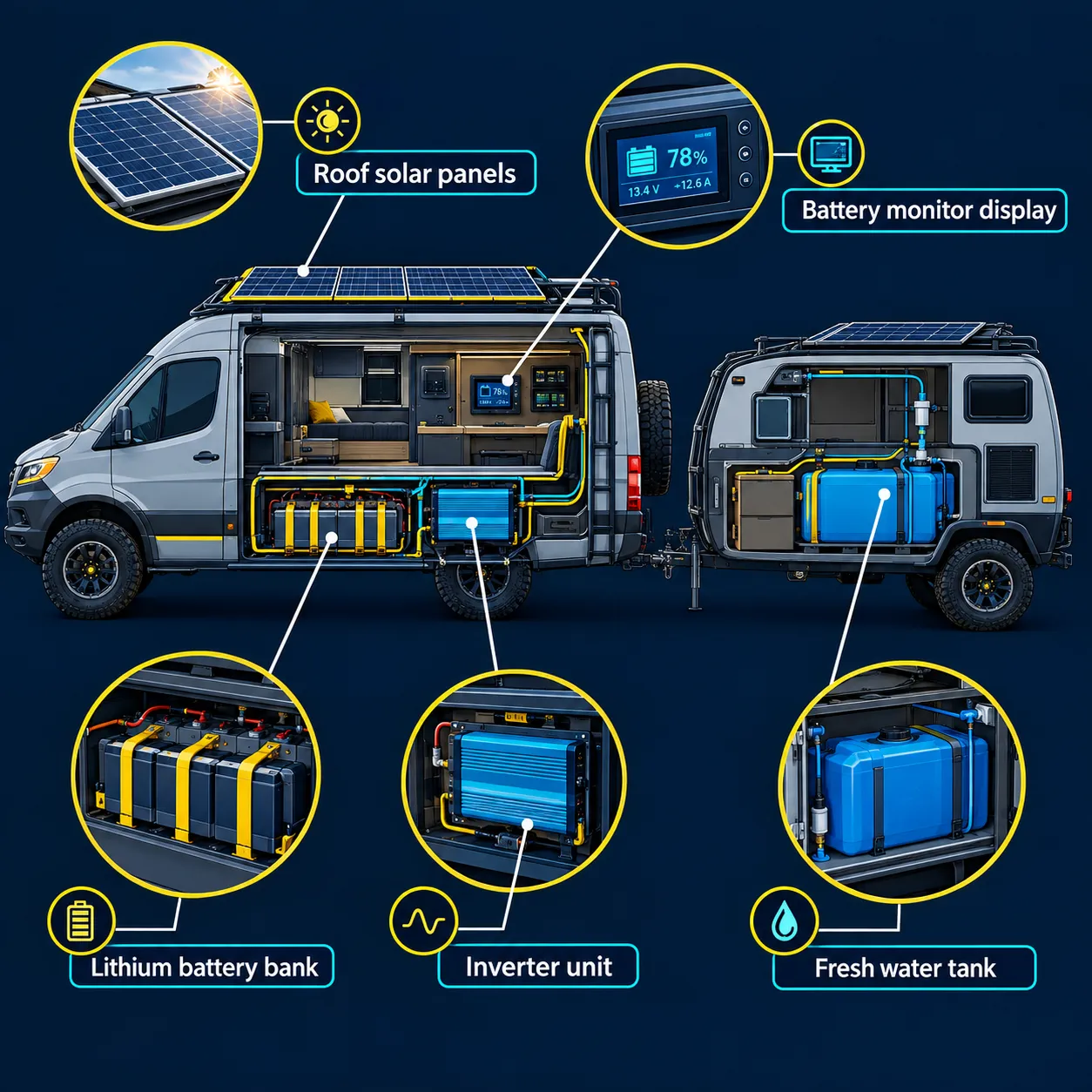
But the gap has closed dramatically. Modern Class B vans are now shipping with serious off-grid hardware straight from the factory. The 2025 Pleasure-Way Ontour 2.2 carries a 40-gallon fresh water tank, 400 watts of roof solar, and a 550 Ah lithium bank. Hymer’s Grand Canyon S CrossOver pairs four 80 Ah lithium batteries with roof solar and is marketed for up to 10 days of self-sufficient camping.[34][38] Winnebago’s Revel update adds a Power Max lithium system delivering up to 16.8 kWh, roughly a week unplugged.[29][30][41]
Why Lithium Changed Everything
A 2025 RV solar guide calls LiFePO₄ (lithium iron phosphate) essentially the only sensible choice for serious off-grid RVers today, recommending solar sized to 1.5-2× your daily energy use, with system payback typically landing between 18 and 36 months depending on how often you travel.[14] A 2025 DIY upgrade guide echoes that advice, sizing lithium banks for 2-3 days of use at roughly 80% depth of discharge, guidance that applies equally whether you’re wiring a van or a trailer.[5]
The industry is still pushing forward. 2025 coverage of solid-state “Lithium 2.0” batteries points to 7-8-year warranties and plug-and-play integration becoming standard across both RV segments, signaling that off-grid power will keep getting more reliable and less finicky for everyone.[8]
Quick tips for maximizing off-grid power in either rig:
- Size your battery bank for your worst-case day, not your average day
- Pair lithium with enough solar wattage to fully recharge during typical daylight hours
- Monitor depth of discharge, don’t run lithium below 20% regularly
- Bring a backup plan (generator or extra portable panel) for cloudy stretches
Costs, Fuel Economy, and What Ownership Really Costs
Money talks, and this is often where the Class B camper vans vs. travel trailers decision gets settled fast.
A 2026 comparison shows new travel trailers priced roughly $15,000,$80,000, versus camper vans ranging from about $20,000,$270,000 depending on the build.[7][10] Monthly insurance tends to run $50,$150 for trailers (plus whatever you’re paying to insure the tow vehicle), compared with $100,$260 for a van.[10] A broader 2026 Class B market overview tracking 16 models found most new vans priced between $98,000 and $225,000, confirming vans as the higher-ticket but fully self-contained option.[31]
Fuel economy tells a similar story. Camper vans typically get 14-20 mpg, while a trailer’s fuel cost depends entirely on your tow vehicle, and towing commonly cuts that vehicle’s fuel efficiency by 30-50%.[10] If you already own a capable tow rig, a trailer might be the cheaper path. If you’d need to buy a truck just to tow, the math shifts quickly toward a van.
Before locking in either option, run your own numbers. It’s worth reviewing budgeting strategies for RV travel and picking up a few tips for better gas mileage, since fuel costs compound fast on long off-grid trips.
| Cost Factor | Class B Camper Van | Travel Trailer |
|---|---|---|
| Typical new price | $98,000,$270,000[31] | $15,000,$80,000[7][10] |
| Monthly insurance | $100,$260[10] | $50,$150 (plus tow vehicle)[10] |
| Fuel economy | 14-20 mpg[10] | Tow-vehicle dependent[10] |
| Sleeping capacity | 2-4[2][7] | 4-8[2][7] |
Class B Camper Vans vs. Travel Trailers: Which Is Better for Your Off-Grid Adventure Style
There’s no universal winner here, only a better fit for your specific trip style.
Choose a Class B camper van if you:
- Travel solo or as a couple
- Move locations frequently and hate setup/teardown
- Want stealth camping options in cities or rest stops
- Plan routes that mix trailheads, tight forest roads, and urban stops
- Prefer one vehicle to drive, park, and maintain
Choose a travel trailer if you:
- Travel with a family or larger group
- Want a base camp you park once and explore from
- Value bigger kitchens, bathrooms, and storage
- Plan longer stationary stays in one remote spot
- Already own (or plan to buy) a capable tow vehicle
Lifestyle comparisons consistently back up this split: vans suit solo travelers, couples, and mixed-terrain routes, while trailers and off-grid caravans suit families and base-camp style travel.[2][9][10] For truly rugged, remote terrain, purpose-built off-road trailers or AWD adventure vans are the smarter call over standard versions of either rig.[12][13][17]
Whichever you choose, comfort details matter once you’re actually parked. A few cozy RV bedroom ideas and smart outdoor space enhancements go a long way toward making a small van feel bigger or a trailer feel like home.
Market Trends Shaping the Off-Grid RV Choice in 2026
Numbers help put this decision in context. RV Industry Association shipment data for 2025 shows total shipments around 342,220 units, with towables, led by travel trailers, accounting for roughly 306,191 units (up 2.5% year-over-year) and motorhomes at 36,029 units (up 3.3%).[9][10] Towables have held roughly 88-90% of total shipments since the mid-2000s, with motorhomes (including Class B vans) sitting around 10-12%.[9]
That said, manufacturers aren’t ignoring the van market. Even as overall Class B demand has cooled slightly compared to Class A and C segments, brands keep investing in high-end off-grid adventure vans with AWD chassis, integrated lithium banks, and factory solar packages.[8][10] The takeaway: towables will likely keep dominating volume because of their value for families, but the off-grid “arms race” in power systems and terrain capability is happening across both segments, not just one.
Wherever your travels take you next, it helps to know which regions suit your rig best. If you’re still mapping out your next trip, check out favorite states for RV travel for inspiration, and make sure you’ve got an emergency plan for your RV travels in place before heading off-grid, cell service and help can be scarce out there.
Frequently Asked Questions
Can a Class B camper van really handle a week off-grid? Yes, with the right setup. High-spec vans like the 2025 Ontour 2.2 and Hymer Grand Canyon S CrossOver now pack enough lithium and solar to support roughly week-long boondocking trips without hookups.[34][38]
Is towing a travel trailer harder off-grid than driving a van? Generally, yes. Rough terrain adds real complexity to towing, and many trailer owners prefer to avoid it entirely, sticking to paved or well-graded gravel roads.[1]
Which option is cheaper overall? It depends on what you’re measuring. Trailers usually cost less per sleeping berth, but vans often cost less monthly once fuel, insurance, and a separate tow vehicle are factored in.[7][10]
Do I need an off-road trailer for backcountry camping? Only if you’re heading onto rutted, rocky, or steep tracks. Standard travel trailers have limited ground clearance, so off-road-specific trailers with reinforced suspension are the safer choice for extreme terrain.[12][17]
Conclusion
There’s no single “better” rig in the Class B camper vans vs. travel trailers debate, just a better match for how, where, and with whom you camp. Solo travelers and couples chasing tight trailheads and frequent moves will likely feel more free in a van. Families wanting room to stretch out and a base camp to return to will probably feel more at home in a trailer.
Before buying, map out your typical trip: How many people are coming? How remote do you want to go? How often will you move camp versus settle in? Answer those honestly, and the right rig usually becomes obvious. Whichever you pick, invest in a solid lithium-and-solar setup, plan your routes carefully, and build your outdoor space to match your travel style, that’s what turns any rig into a genuinely great off-grid home.
References
[1] Camper Van Or Travel Trailer Comparing Two Great Ways To Hit The Road – https://www.winnebago.com/lifestyle/winnebagolife/showroom/camper-van-or-travel-trailer-comparing-two-great-ways-to-hit-the-road [2] Camper Van Vs Travel Trailer The Show Down – https://travelsandtravails.com/camper-van-vs-travel-trailer-the-show-down/ [3] Camper Van Vs Trailer A Gear Experts Comparison – https://wayfarervans.com/camper-van-vs-trailer-a-gear-experts-comparison/ [4] Small Rvs Vs Camper Vans When A Compact Rv Makes Sense – https://thevansmith.com/blogs/vans-for-sale/small-rvs-vs-camper-vans-when-a-compact-rv-makes-sense [5] Rv Solar Lithium Battery Upgrade Guide 2025 Diy Installation – https://carbonogy.com/blogs/blog/rv-solar-lithium-battery-upgrade-guide-2025-diy-installation [6] Rv Boondocking – https://rv-boondocking-adventure.com/rv-boondocking [7] Campers And Rvs – https://www.ecoflow.com/uk/blog/campers-and-rvs [8] Renogy Launches Solid State Lithium 2 0 Batteries – https://rv-pro.com/news/renogy-launches-solid-state-lithium-2-0-batteries/ [9] Touring Vs Off Grid Caravans Which One Is Right For You – https://www.jayco.com.au/community/article/touring-vs-off-grid-caravans-which-one-is-right-for-you [10] Van Life Vs Rv – https://www.brooklyncampervans.com/post/van-life-vs-rv