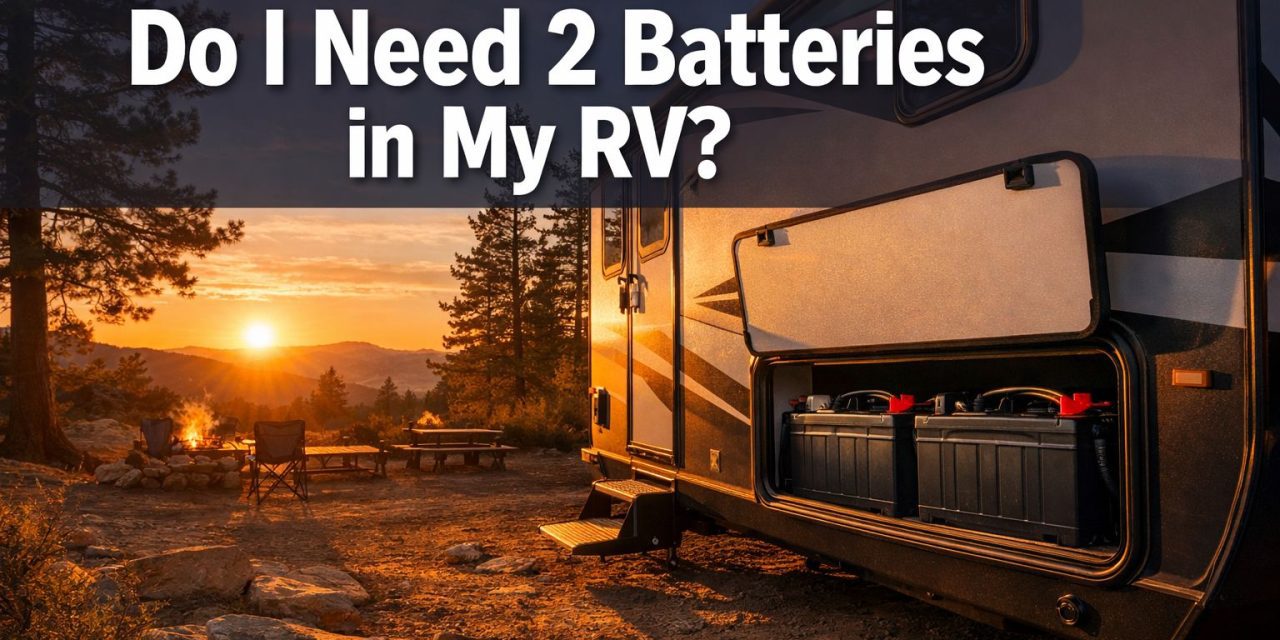
Most RVers don’t realize they’re underpowered until they’re sitting in the dark at 10 PM, miles from the nearest hookup. The question “do I need 2 batteries in my RV?” is one of the most searched — and most misunderstood — topics in the RV community. The short answer: it depends on how you camp. But the full answer could completely change how you experience life on the road. 🚐⚡
Key Takeaways
- One battery may be enough for weekend campers who mostly use full hookups.
- Two batteries significantly extend off-grid capacity, roughly doubling your usable amp hours [3].
- Wiring matters enormously — parallel connection (not series) is the only safe way to add a second battery [4].
- Battery matching is non-negotiable — both batteries must be the same type, age, and capacity [3].
- Lithium batteries can sometimes replace the need for two lead-acid batteries, offering more capacity in a single unit [2].
Understanding RV Battery Basics
Before answering “do I need 2 batteries in my RV?”, it helps to understand what your house batteries actually do. These are not your vehicle’s starter battery. RV house batteries power everything when you’re not plugged into shore power — lights, fans, water pump, refrigerator, and any electronics you bring along.
Battery capacity is measured in amp hours (Ah). A standard 12-volt lead-acid battery typically delivers around 50–100 usable amp hours. The more amp hours you have, the longer you can camp without recharging.
Here’s a quick look at common RV power consumers:
| Appliance | Approximate Draw |
|---|---|
| LED lighting (per bulb) | 1–2 amps |
| Water pump | 5–7 amps |
| 12V refrigerator | 4–8 amps |
| Furnace fan | 7–12 amps |
| Phone/tablet charging | 1–3 amps |
Add those up over a 24-hour period and it becomes clear why a single battery can run out fast — especially overnight.
Do I Need 2 Batteries in My RV? What Your Camping Style Reveals
The honest answer to “do I need 2 batteries in my RV?” is rooted in one thing: how and where you camp.
Full Hookup Campers 🔌
If most trips involve campgrounds with electrical hookups, a single battery is usually fine. Your RV’s converter keeps the battery topped up while plugged in, so capacity rarely becomes an issue.
Weekend Boondockers ⛺
For occasional off-grid weekends, one lithium battery can often handle the load. Lithium batteries are more efficient and deliver more usable capacity than lead-acid options. According to one source, a single lithium battery can match what three lead-acid batteries provide for weekend camping [2].
Extended Off-Grid Adventurers 🌲
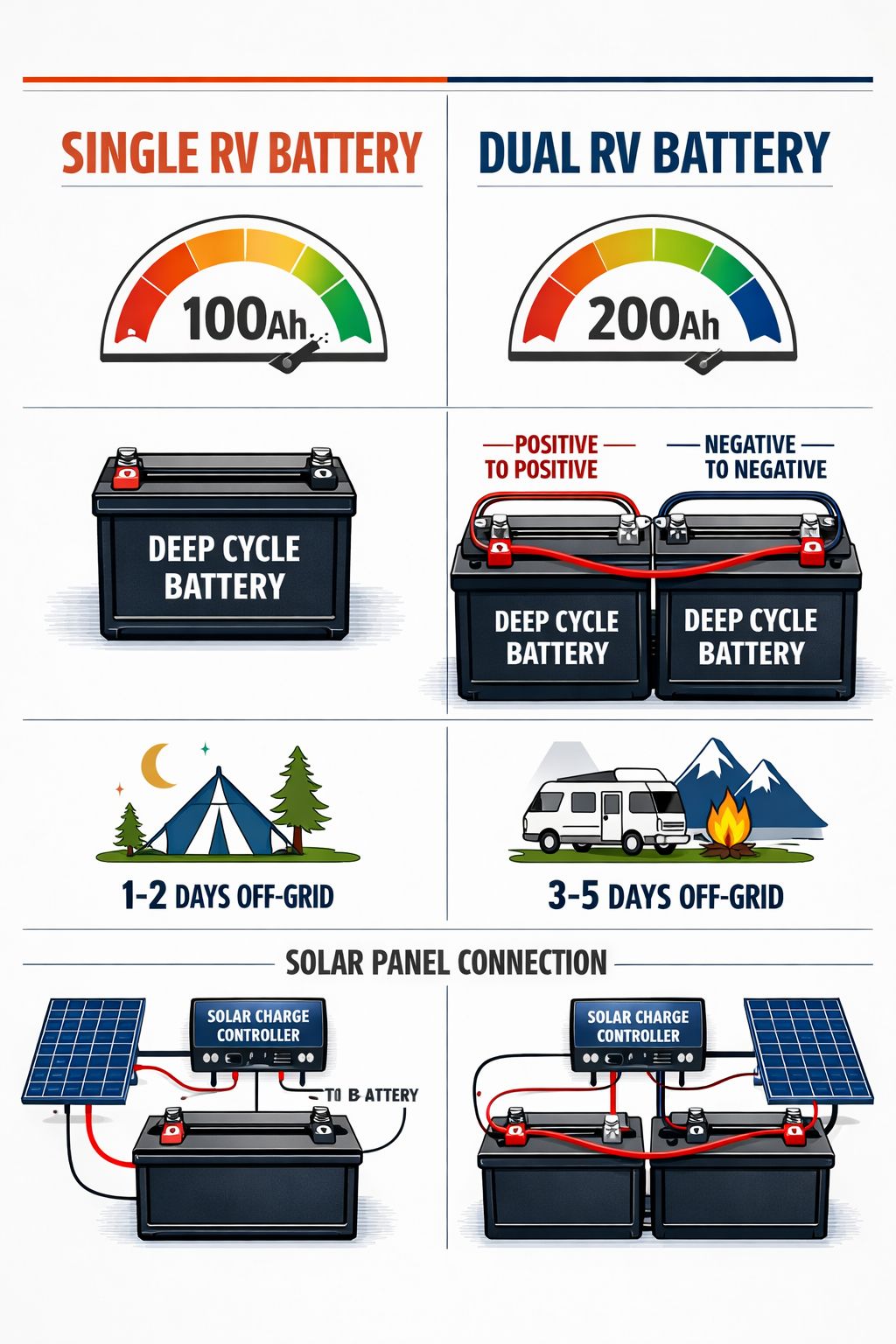
This is where two batteries become almost essential. A dual-battery setup roughly doubles your amp hour capacity, letting you stay off-grid significantly longer without scrambling for a charge [3]. If you’re running a 12V fridge, a furnace fan, and lights for multiple nights, two batteries provide the headroom you need.
“Two batteries don’t just give you more power — they give you peace of mind.”
The Redundancy Factor 🛡️
Here’s a benefit many RVers overlook: backup power. If one battery fails in a remote location, the second one keeps your essential systems running until you can get help [3]. For solo travelers or families camping far from civilization, this redundancy is genuinely valuable.
How to Properly Set Up Dual Batteries in Your RV
Once the decision is made to go dual, setup details become critical. Getting this wrong can damage your RV’s electrical system or leave you worse off than before.
Parallel vs. Series Wiring — Know the Difference
This is the most important technical point in the entire process:
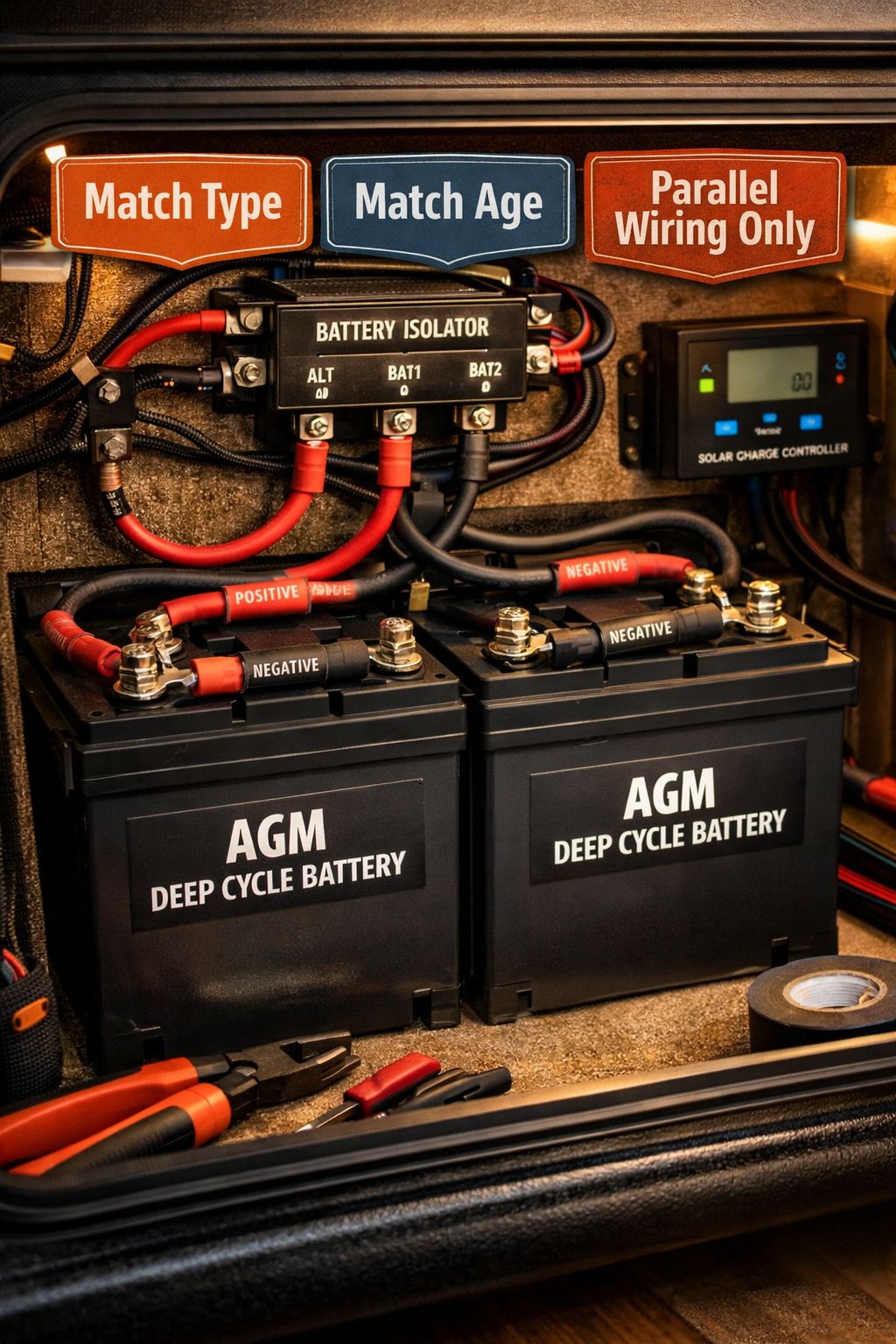
- ✅ Parallel connection (positive to positive, negative to negative) keeps voltage at 12V and doubles capacity — this is what you want [4].
- ❌ Series connection (positive to negative) creates 24 volts and will damage your RV’s 12V systems [4].
Always wire in parallel. Always.
Battery Matching Rules
Both batteries must be:
- Same type (lead-acid, AGM, or lithium — never mix types) [3]
- Same brand and model [3]
- Same age (ideally installed at the same time) [3]
- Same capacity (matching amp hours) [3]
Mixing different batteries causes uneven charging and discharging, which shortens the lifespan of both units and reduces overall performance.
Use a Smart Battery Isolator
A battery isolator is a device that manages how your batteries charge. A smart isolator automatically prioritizes your starting battery and then directs power to your house batteries [3]. This prevents the common nightmare of draining your starter battery while running house systems overnight.
Consider Adding Solar 🌞
Two batteries and a solar panel system are a natural pairing. Solar keeps both batteries topped up during daylight hours, dramatically extending your off-grid capability [3]. Even a modest 100–200W solar setup can make a meaningful difference when combined with a dual battery bank.
Weight, Space, and Practical Considerations
Adding a second battery isn’t just an electrical decision — it’s a physical one too.
Weight: A standard lead-acid battery weighs 40–70 lbs. Two of them add real mass to your trailer, which affects tongue weight and towing stability [3]. Always check your RV’s weight ratings before adding batteries.
Space: Not every RV has room for a second battery in the factory battery compartment. Some owners install a secondary battery box elsewhere on the trailer, which requires longer cable runs and careful planning [3].
Cost: Lead-acid batteries are cheaper upfront but require more of them to match lithium capacity. Lithium batteries cost more initially but often provide better long-term value, especially for frequent boondockers [2].
Here’s a quick comparison:
| Battery Type | Upfront Cost | Usable Capacity | Lifespan |
|---|---|---|---|
| Lead-Acid | Low | ~50% of rated Ah | 3–5 years |
| AGM | Medium | ~80% of rated Ah | 4–7 years |
| Lithium (LiFePO4) | High | ~95% of rated Ah | 10+ years |
Conclusion: Making the Right Call for Your RV Setup
So, do you need 2 batteries in your RV? Here’s the bottom line:
- Casual campers on hookups: Probably not — one battery is fine.
- Weekend boondockers: One lithium battery may be all you need [2].
- Extended off-grid campers: Yes — a dual battery setup is strongly recommended for the extra capacity and redundancy [3].
Actionable next steps:
- 🔍 Audit your power usage — list every 12V appliance and estimate daily amp draw.
- 🔋 Assess your current battery type — lead-acid users benefit most from going dual or switching to lithium.
- ⚡ Wire in parallel only — confirm with a qualified RV technician if unsure [4].
- 🔄 Match your batteries exactly — same type, age, and capacity [3].
- ☀️ Consider solar — pair your battery bank with panels for maximum off-grid freedom [3].
The goal is simple: never let a dead battery cut your adventure short. With the right setup, your RV becomes a true home away from home — wherever the road takes you.
References
[1] Watch – https://www.youtube.com/watch?v=z-IeJV9hM_8
[2] Watch – https://www.youtube.com/watch?v=k3_zrSH3Bl0
[3] Travel Trailer Dual Battery Setup – https://www.dfna.info/travel-trailer-dual-battery-setup/
[4] Watch – https://www.youtube.com/watch?v=3m8mkH7zCTo
[5] Need Dual Batteries In New 24 Travel Trailer – https://www.irv2.com/threads/need-dual-batteries-in-new-24-travel-trailer.1859398/
[6] Batteries To Parallel Or Not – https://www.forestriverforums.com/threads/batteries-to-parallel-or-not.362123/
[7] Advice On Adding Another Battery – https://www.mygrandrv.com/threads/advice-on-adding-another-battery.52712/