Only one company on the planet is currently selling a self-propelled electric travel trailer to regular customers, and it costs about as much as a house in some parts of the country.[1] That’s the honest starting point for anyone chasing the dream of silent, solar-powered, generator-free camping in 2026.
The good news? You don’t need a six-figure electric rig to camp sustainably off-grid. Electric and Eco-Friendly RVs: Off-Grid Camping for the Sustainable Adventurer is less about waiting for a fully electric motorhome to show up at your local dealership and more about understanding what’s actually available right now, solar, lithium batteries, and smarter route planning that let you disconnect from the grid without burning through a tank of gas for power.
This guide breaks down where electric RV technology stands today, what eco-friendly off-grid setups actually look like on current models, and how to plan a trip when charging stations are still few and far between.
Key Takeaways
- True electric motorhomes are still rare, most are prototypes, pilot fleets, or six-figure niche products, with wider dealer availability expected around 2027-2028.[1]
- “Eco-friendly” off-grid RVs already exist and are affordable-ish, many mainstream brands now offer lithium battery packages and solar prep that eliminate the need for a gas generator.[4][10]
- Solar and lithium batteries are the real workhorses of off-grid sustainability, not electric drivetrains, for the vast majority of boondockers today.[3][7][13]
- Route planning matters more with EVs and hybrid setups because charging infrastructure for RVs is thin outside major highways.
- Budget-friendly sustainability is possible through solar prep, upgraded battery banks, and efficient appliances, no need to buy a $230,000 rig to camp green.[9]
The State of Electric and Eco-Friendly RVs in 2026
Let’s clear up some confusion first. “Electric RV” can mean two very different things:
- An electric-drive motorhome, the whole vehicle runs on an electric motor instead of a gas or diesel engine.
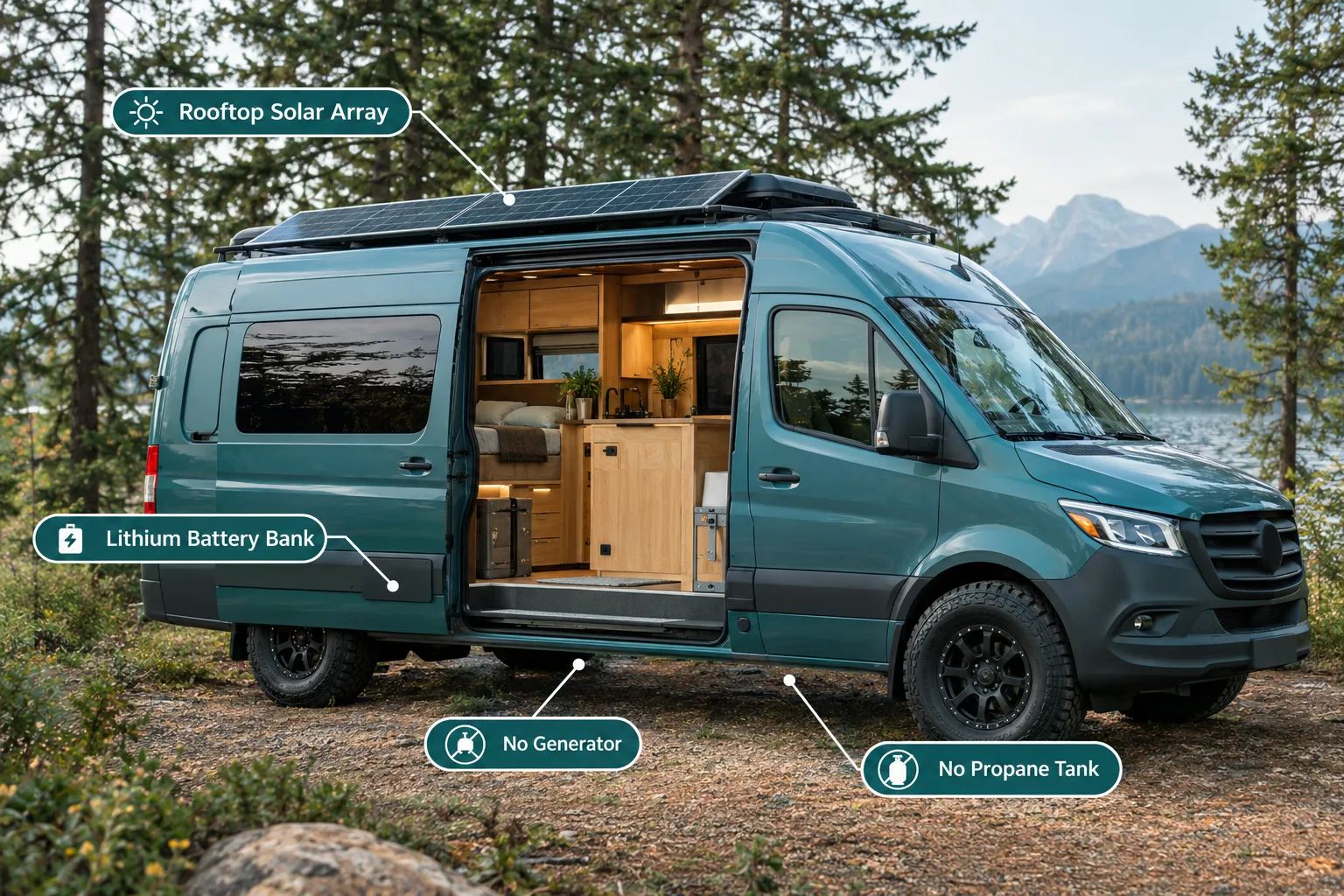
- An eco-friendly, off-grid-capable RV, a traditional gas or diesel rig with an all-electric interior (no propane, no generator) powered by solar and lithium batteries.
As of early 2026, the first category is still mostly theoretical for everyday buyers. Lightship is the only company actually delivering electric self-propelled travel trailers to paying customers, and prices start around $125,000.[1] Legacy giants like Winnebago and Thor are further behind on the drivetrain side. Thor’s all-electric Embark motorhome isn’t even hitting dealer lots yet, it’s going first into a rental fleet for real-world testing in 2026, with expected retail pricing between $300,000 and $400,000 once full production begins around mid-2026.[1]
Industry analysis is blunt about the timeline: most buyers should expect at least one to two more years before a production-ready electric motorhome sits on a typical dealership lot, pushing broad availability closer to 2027-2028.[1] Overseas, Volkswagen’s all-electric ID. California Cruise campervan, unveiled at the 2026 Düsseldorf caravan salon, is being positioned as the first in a planned wave of EV campervans, but VW has already pushed U.S. introduction of related ID. Buzz-based camper models to the 2027 model year.[1]
Meanwhile, the second category, eco-friendly, generator-free RVs, is moving much faster and is far more accessible right now. This is where the real off-grid sustainability story is happening in 2026.
A quick reality check for the sustainable adventurer:
- If you want a truly electric-drive RV today, expect a premium price tag and limited inventory.
- If you want a sustainable off-grid camping experience today, solar-plus-lithium setups on gas or diesel rigs already deliver most of what you’re after.
- If you’re patient, the next two to three years should bring meaningfully more electric and hybrid options to market.
For readers weighing gas, diesel, or hybrid platforms in the meantime, it’s worth comparing the benefits of diesel-powered RVs against emerging electric options, diesel still offers range and towing capacity that most electric platforms can’t currently match.
Building Your Off-Grid Power System: Solar and Batteries Explained
Here’s the part that actually matters for 99% of boondockers today: your electrical system, not your drivetrain, determines how “eco-friendly” and self-sufficient your camping really is.
Off-grid RV camping, often called boondocking or dry camping, means camping without hookups to electricity, water, or sewer, relying instead on onboard systems like batteries, solar panels, and stored water.[3][7][13] Solar power has become the true game-changer here, letting RVers run appliances and electronics sustainably while parked on public land or remote dispersed sites.[3][13]
🔋 Pull Quote: “The battery bank is the heart of any off-grid setup, solar just keeps it fed.”
What a Modern Eco-Friendly Power System Looks Like
Mainstream manufacturers are catching up fast. A few real examples from current model years:
| Brand & Model | Solar | Battery Storage | Notable Feature |
|---|---|---|---|
| Jayco Swift Class B (Li Package) | Solar prep available | Lithium (replaces gas generator) | All-electric coach, no propane[4] |
| AEONrv Standard | ~800 W | 5.12 kWh lithium | No generator, no propane[9] |
| AEONrv EXT | ~1,200 W | 10.24 kWh lithium | Extended off-grid stays[9] |
| Ember Overland Series | 1,200 W | 270 Ah Battle Born lithium | Multiple Victron MPPT controllers |
| Extreme off-road trailers | ~3,160 W | ~2,100 Ah lithium | Dual 3,000 W inverters[8] |
Jayco’s 2026 Swift Class B swaps a traditional 2,800-watt gas generator for a clean, quiet lithium power system, and now offers solar prep or solar panels across its entire motorhome lineup, meaning owners can add rooftop solar and expand off-grid power without needing a factory-built specialty rig.[4][10]
Step-by-Step: How the System Actually Works
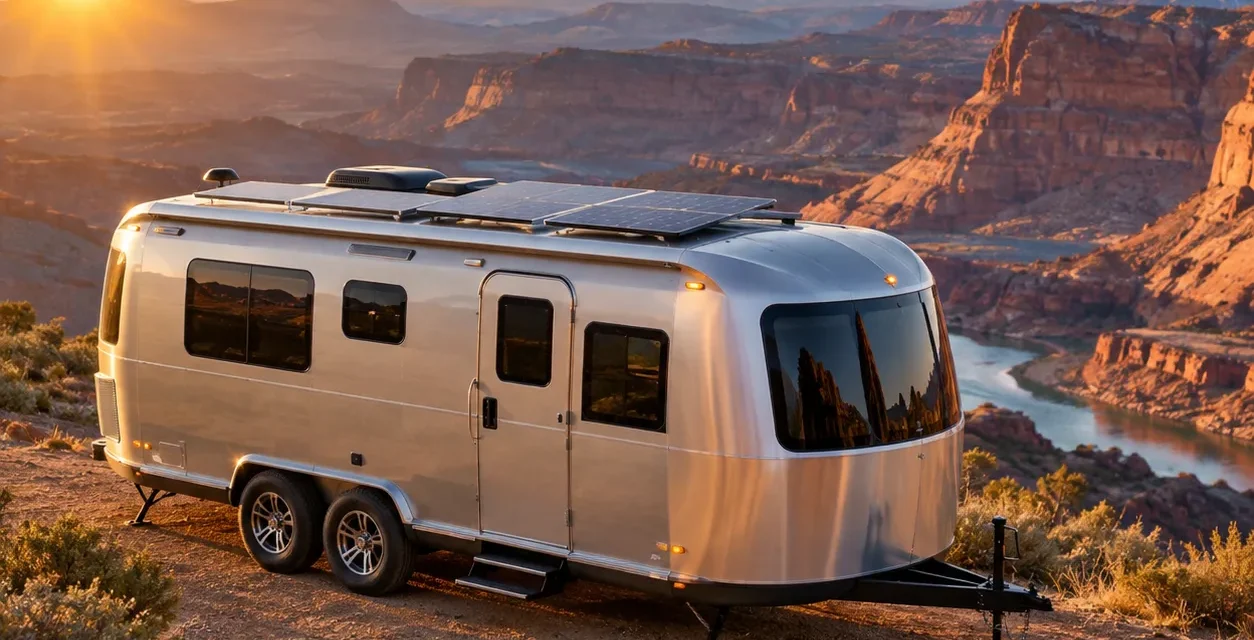
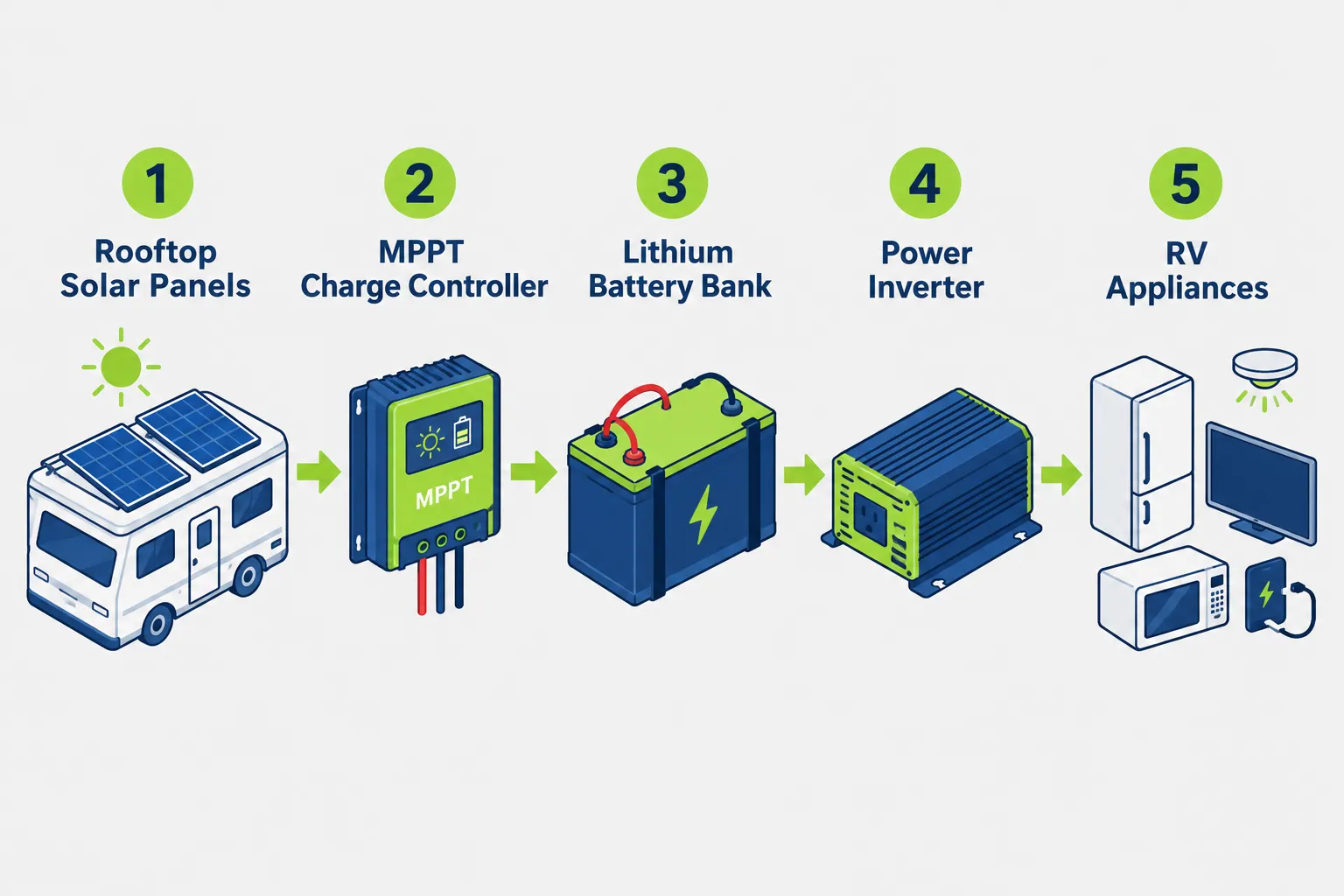
- Solar panels collect energy from sunlight on your roof.
- A charge controller (usually MPPT) regulates that energy so it doesn’t overcharge your batteries.
- Lithium batteries store the power for use day or night, rain or shine.
- An inverter converts stored DC power to AC power so you can run standard appliances.
- A DC-to-DC charger tops off batteries from your engine alternator while driving, adding backup charging beyond solar.
This is essentially the same architecture used in premium builds like Airstream’s Advanced Power System and Ember’s Overland Series, just scaled differently depending on budget and battery capacity.
Is Solar Always Worth It?
Not necessarily for every camper. Solar setups add upfront cost, require roof space, and perform poorly in shaded or cloudy conditions. Some RVers genuinely do better with generator backup or shore power access instead. It’s worth reading reasons you might want to avoid solar on an RV before you invest in a big rooftop array, sustainability should fit your actual camping habits, not just look good on paper.
If you’re adding a serious battery bank or solar system, brush up on the basics first. Check out common RV electrical questions worth understanding and make sure you’ve got a surge protector installed on your RV, even off-grid setups benefit from protecting sensitive lithium electronics.
Route Planning for Limited Charging Infrastructure
This is the section most articles skip, and it’s exactly where the “sustainable adventurer” angle gets real. Whether you own a fully electric tow vehicle, a hybrid truck, or simply a solar-heavy trailer, planning around limited infrastructure is non-negotiable in 2026.
Before You Leave: A Pre-Trip Checklist
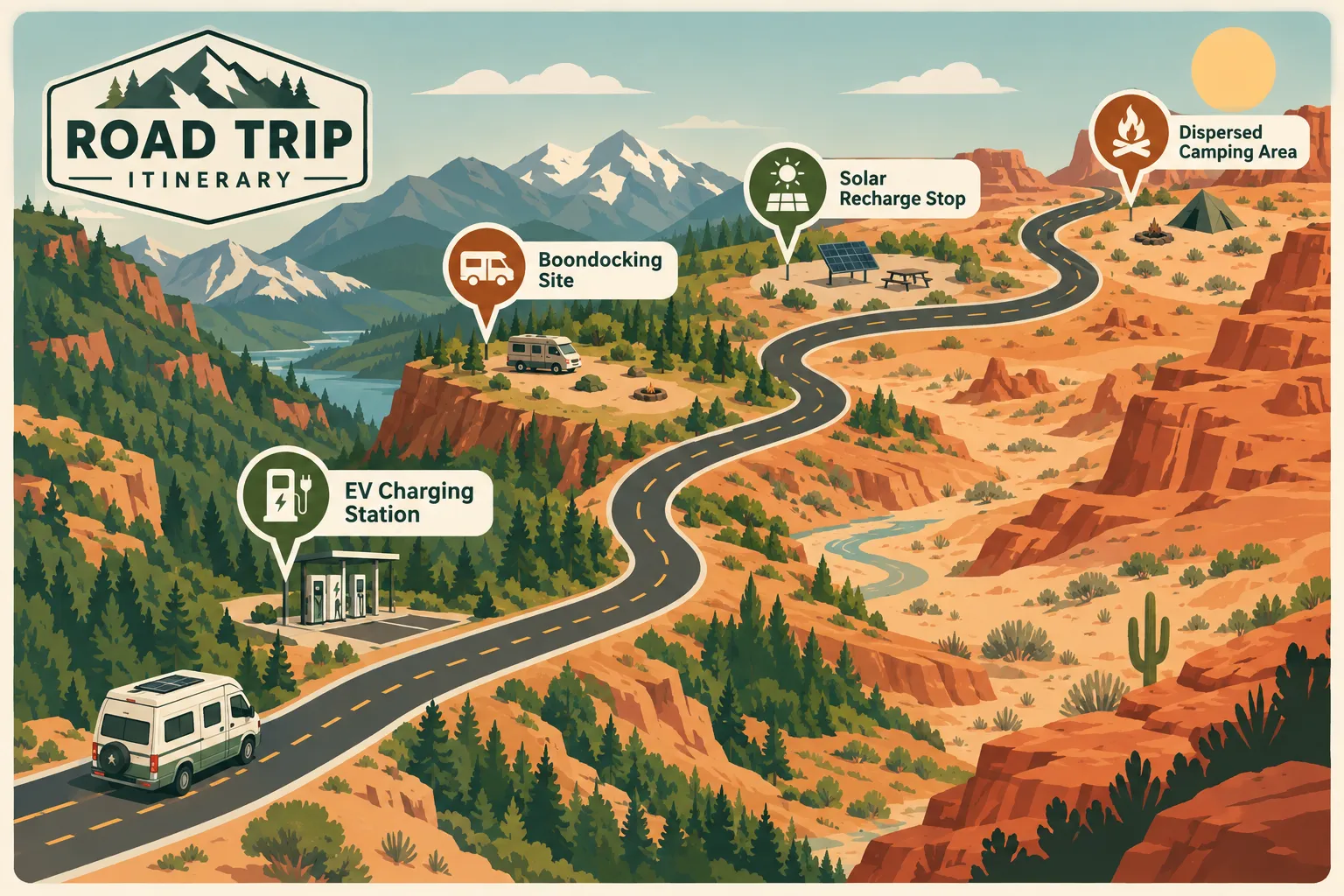
- ✅ Map charging stations if towing with an EV, apps like PlugShare help, but always call ahead for RV-compatible stalls.
- ✅ Identify boondocking sites along your route using public land maps (BLM, national forest dispersed camping).
- ✅ Check battery state of charge before departure and know your realistic range with a loaded trailer.
- ✅ Plan solar recharge windows, if you’re relying on panels, build in a day or two of stationary time for a full battery top-off.
- ✅ Pack backup power, a small portable battery or last-resort propane heater can save a trip if solar underperforms.
Why Range Anxiety Hits RVers Harder
Towing dramatically reduces EV range, sometimes by 30-40% compared to unloaded driving. That’s a critical detail electric truck and trailer owners need to plan around, especially since dedicated RV charging infrastructure is still thin outside interstate corridors. Rural boondocking destinations, the very places off-grid campers love, are often the farthest from reliable charging.
Practical route-planning tips:
- Build shorter driving legs. Instead of one 400-mile day, plan two 200-mile days with a charging or solar-recharge stop in between.
- Camp near (not at) civilization. Staying within reasonable range of a small town gives you a backup option if batteries run low.
- Track weather for solar planning. Three cloudy days in a row can drain a battery bank faster than expected, check forecasts before committing to remote sites.
- Have a non-electric backup plan. Cell service and app-based charging maps aren’t always reliable in remote areas; carry printed maps or offline downloads.
Seasonal planning matters too. Cold weather reduces both EV range and battery efficiency, so winter boondocking requires extra caution. If you’re planning a cold-season off-grid trip, it’s worth reviewing tips on how to make winter RV camping more comfortable before you commit to a remote site with limited charging or recharging options nearby.
Choosing the Right Eco-Friendly RV for Your Lifestyle
Not every sustainable adventurer needs, or can afford, a six-figure electric rig. Here’s how to think about fit based on your travel style and budget.
If You Want Maximum Off-Grid Capability Right Now
Look at rigs with large solar arrays and lithium banks already built in, like AEONrv’s electric cabin models (starting around $229,500,$239,500 as of September 2026), which run entirely on solar and lithium with no generator or propane at all.[9] These are premium products, but they represent the current ceiling of factory-built off-grid sustainability.
If You Want a Practical Upgrade on a Mainstream RV
Many manufacturers now offer solar prep or lithium package options as add-ons rather than requiring a specialty purchase. Jayco’s approach, offering solar prep across its entire motorhome lineup, is a great example of accessible sustainability upgrades that don’t require buying an entirely new category of RV.[4][10]
If You’re Buying Used or on a Budget
Retrofitting is often more cost-effective than buying new. A used travel trailer or motorhome with a solid electrical system can be upgraded with:
- A portable or roof-mounted solar panel kit
- An upgraded lithium battery bank
- A basic inverter
Before investing in upgrades, it’s smart to check whether your current rig is nearing the end of its useful life. Review signs it might be time to upgrade your RV and consider how declining RV values might affect your upgrade-versus-replace decision.
Off-Grid Water and Waste Considerations
Sustainable camping isn’t only about power. Water management matters just as much when you’re away from hookups for days at a time. A quality water filtration system for your RV reduces waste from bottled water and keeps your fresh water supply safer during extended boondocking stretches.
Frequently Asked Questions
Can I buy a fully electric motorhome today? Technically, one option exists, Lightship’s electric travel trailer, but it starts around $125,000 and production is limited.[1] Most other electric-drive motorhomes remain in pilot or prototype stages through 2026.[1]
Do I need solar panels to camp off-grid sustainably? Not strictly, but solar is widely considered the most practical way to recharge batteries without a generator, and it’s becoming standard equipment on eco-focused RV models.[3][9][13]
How long can I realistically boondock without hookups? It depends entirely on your battery capacity, solar output, water storage, and power usage habits. Rigs with 10+ kWh lithium banks and 1,000+ watts of solar can often support multi-day or even multi-week stays with careful energy management.[8][9]
Are eco-friendly RVs more expensive than traditional models? Premium off-grid packages do carry a price premium, but many mainstream brands now offer more affordable à la carte solar prep and lithium upgrades, making sustainable camping accessible without a full custom build.[4][10]
Conclusion
The fully electric motorhome revolution is coming, just not quite yet. For now, the real sustainability wins for RVers are solar panels, lithium battery banks, and generator-free “electric cabin” designs that are already available across a range of budgets. Electric and Eco-Friendly RVs: Off-Grid Camping for the Sustainable Adventurer is achievable today for anyone willing to invest in the right power system and plan routes with a little extra care around charging and recharging windows.
Next steps:
- Audit your current RV’s electrical setup and decide if a lithium or solar upgrade makes sense.
- Map out charging stations and boondocking sites before your next off-grid trip.
- Keep an eye on 2027-2028 as more electric-drive RVs reach dealer lots.
- Start small, even a portable solar panel and upgraded battery can meaningfully reduce generator dependence today.
Sustainable off-grid camping isn’t about waiting for perfect technology. It’s about making smart, practical upgrades now while staying ready for what’s coming next.
References
[1] 2aazahu5ny5vlcgvu4iidntxna – https://www.wsoctv.com/news/electric-rvs-2026/2AAZAHU5NY5VLCGVU4IIDNTXNA/?outputType=amp [3] Off Grid Rv Camping The Rise Of Boondocking In America – https://www.rvsofamerica.com/off-grid-rv-camping-the-rise-of-boondocking-in-america/ [4] 2026 Swift – https://www.jayco.com/rvs/class-b-motorhomes/2026-swift/ [7] Boondocking Power – https://www.mechman.com/boondocking-power/ [8] Top 10 Best Off Road Off Grid Camping Trailers – https://www.rvsofamerica.com/top-10-best-off-road-off-grid-camping-trailers/ [9] aeonrv – https://www.aeonrv.com/ [10] 2026 Seneca Xt – https://www.jayco.com/rvs/class-c-motorhomes/2026-seneca-xt/ [13] Off Grid Rv Camping The Rise Of Boondocking In America – https://www.rvsofamerica.com/off-grid-rv-camping-the-rise-of-boondocking-in-america/