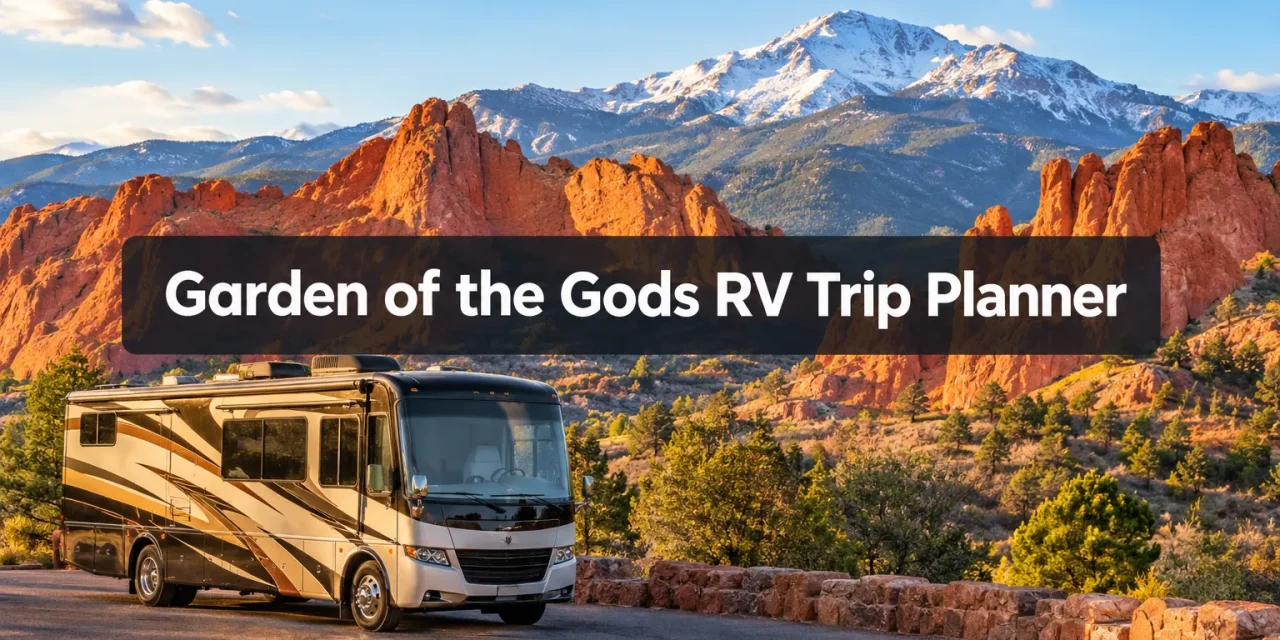
Here’s something that surprises a lot of first-time visitors: there is no campground inside Garden of the Gods park. None. Zero RV hookups, no dry camping lot, nowhere to post up for the night among those towering red rocks[8]. That single fact changes how every RV traveler needs to approach this trip.
A solid Garden of the Gods RV Trip Planner: Nearby Campgrounds & Scenic Routes has to answer three questions before a tire ever hits Colorado pavement: where can a rig actually park overnight, which roads can handle a 35-foot fifth wheel versus a 23-foot van, and what’s the smartest driving loop once the RV is parked and the tow vehicle or dinghy is doing the sightseeing. This guide breaks down all three, using the most current site information available for 2026.
Key Takeaways
- No camping exists inside Garden of the Gods park itself, RVers must base out of Colorado Springs, Manitou Springs, or the Woodland Park area[8].
- Garden of the Gods RV Resort is the closest full-hookup option, handling rigs up to 76 feet with 254 total sites, open year-round[3].
- Pike National Forest campgrounds along CO-67 (Colorado Campground, Painted Rocks, Red Rocks Group, South Meadows) sit about 25-30 miles out and offer a quieter, more rustic alternative[1][4][9][10].
- The Juniper Way Loop inside the park is the main scenic drive, but it’s built for sightseeing, not for parking oversized RVs[6].
- Watch for rig-length restrictions near Manitou Springs, where some parking areas cap out around 23 feet[2][6][8].
Why the Garden of the Gods RV Trip Planner Starts With Picking the Right Base Camp
Most national park and monument visits follow a simple formula: find a campground close to the entrance, settle in, and walk or shuttle to the main attractions. Garden of the Gods breaks that formula. Because there’s no on-site campground, every RVer has to treat this like a hub-and-spoke trip, pick a comfortable base, then drive in for the day[8].
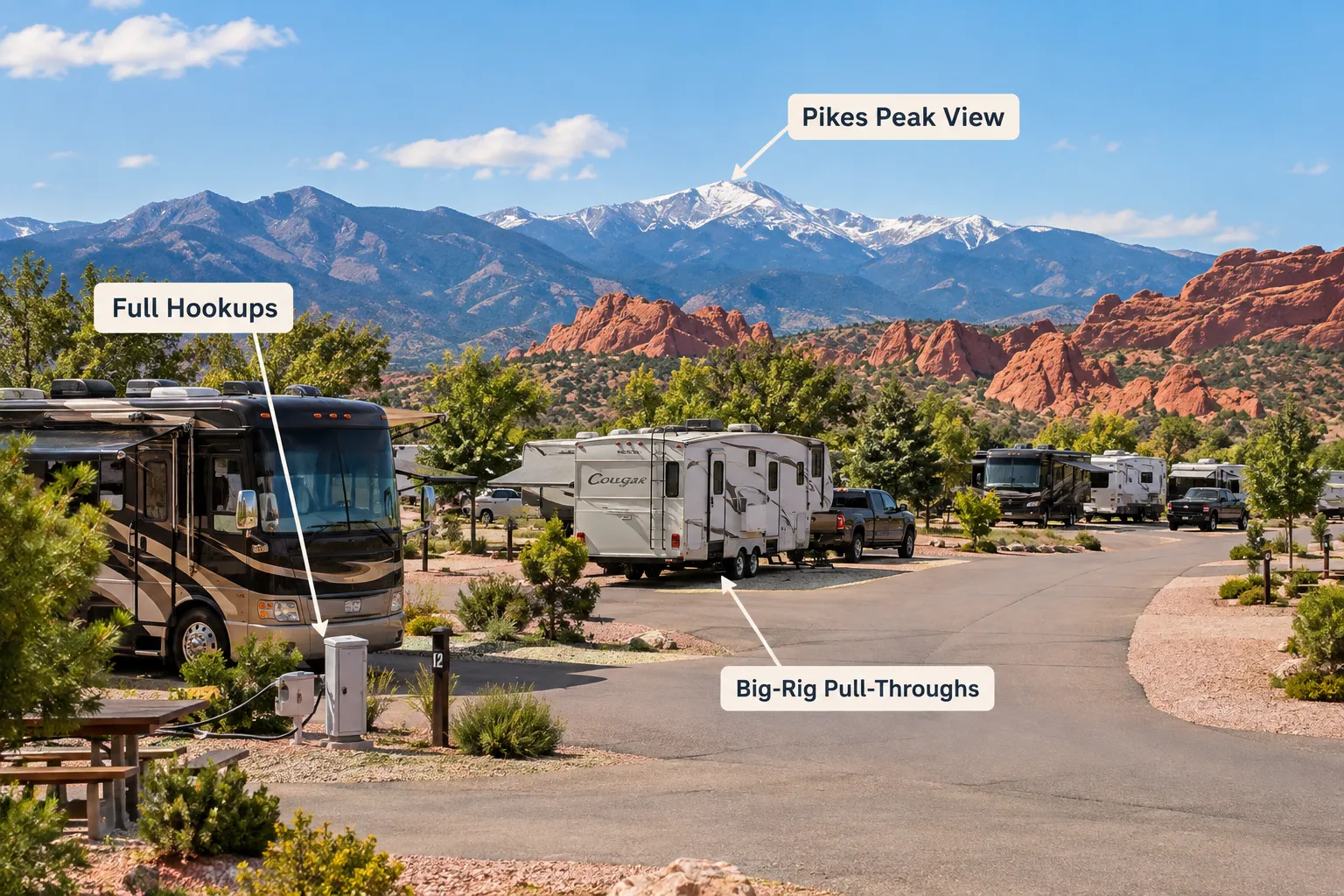
That changes the planning math in a good way, honestly. It means travelers get to choose between two very different experiences:
- Stay close and convenient. Full-hookup RV resorts near Colorado Springs put travelers minutes from the park entrance, with pools, laundry, and strong Wi-Fi.
- Stay farther out for nature. Pike National Forest campgrounds near Woodland Park trade hookups for pine trees, quiet, and lower nightly costs, with a 25-to-45-minute commute into the park.
Neither choice is wrong. It just depends on whether the priority is convenience or scenery during downtime. This is the same logic that makes mom-and-pop campgrounds a better fit than corporate RV parks for some travelers, smaller, quieter sites often deliver more character, even if they skip the resort-style amenities.
Before locking in a site, check rig length against campground specs every single time. A 2026 review of listings across Hipcamp, The Dyrt, and local RV park directories shows more platforms now flagging strict length caps, some parking areas near Manitou Springs cap out around 23 feet, which rules out most Class A motorhomes and larger fifth wheels[2][6][8]. Measure the RV bumper-to-bumper, including any rear-mounted bike racks or ladders, before assuming a site will fit.
Driving and Towing Considerations Near the Park
Garden of the Gods sits close to downtown Colorado Springs and Manitou Springs, and both areas have older, narrower streets that weren’t built with 40-foot rigs in mind. A few practical notes:
- Leave the big rig at camp. Most RVers tow a dinghy vehicle or drive a towed car for day trips into the park and surrounding towns. If towing isn’t already part of the setup, it’s worth reviewing why towing a car makes RV life easier before arrival.
- Know local parking rules. Oversized-vehicle restrictions, time limits, and no-RV-parking zones pop up more than expected near popular attractions. It’s worth a quick check of the sneaky local laws that catch RVers off guard before heading into Manitou Springs.
- Arrive early. The park’s own visitor guidance stresses getting to designated RV lots early and avoiding tighter pull-outs with oversized rigs, since parking fills fast on weekends and summer mornings[6].
Best Nearby Campgrounds for the Garden of the Gods RV Trip Planner
With the “no camping inside the park” rule settled, here’s where RVers actually stay. Three realistic zones cover nearly every budget and rig size.
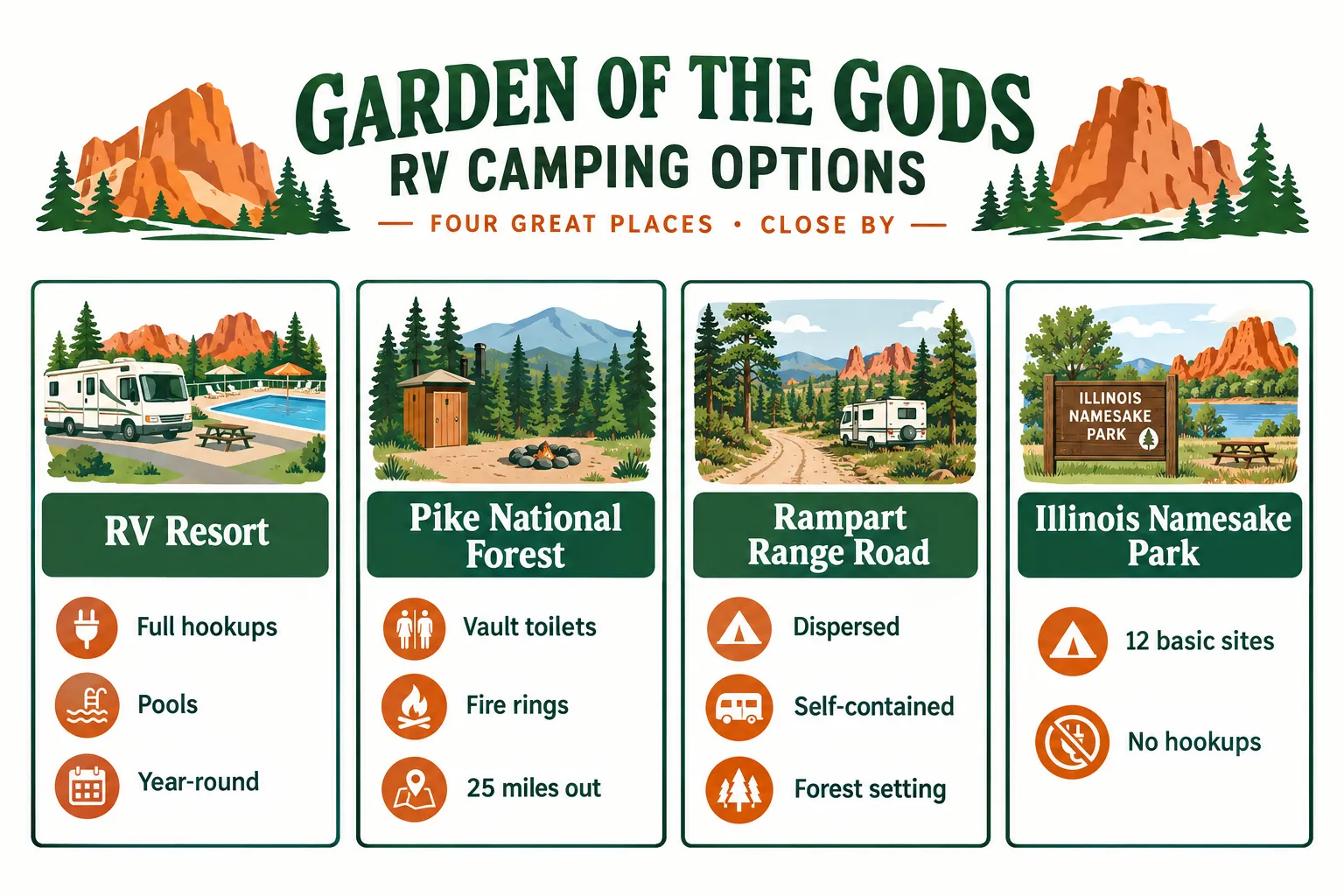
Garden of the Gods RV Resort: The Full-Hookup Standard
For travelers who want hookups, pools, and a short drive to the park, Garden of the Gods RV Resort in west Colorado Springs is the most commonly recommended base, and Colorado Springs tourism guidance continues to point visitors there as a primary RV option for both Garden of the Gods and Pikes Peak trips. Quick specs:
| Feature | Details |
|---|---|
| Max RV length | 76 feet[3] |
| Total sites | 254[3] |
| Hookups | Full hookups, 30/50 amp[3] |
| Check-in / check-out | 1:00 p.m. / 11:00 a.m.[3] |
| Amenities | Two pools, playground, dog park, game room, on-site store[3] |
| Season | Open year-round[3] |
| Typical nightly rate | About $55-$145 depending on season and site type[5] |
Booking guidance updated in mid-2026 recommends reserving up to 12 months in advance for peak April-through-October travel, since this resort books up fast with families, rallies, and retirees passing through on Colorado loops[5]. Standard amenities across similar nearby listings also include Wi-Fi (speed varies by site), showers, laundry, and pet-friendly policies[5], worth confirming directly if traveling with dogs.
Pike National Forest Campgrounds: The Natural-Setting Alternative
For RVers who’d rather fall asleep under pines than streetlights, four Pike National Forest campgrounds along CO-67 near Woodland Park sit roughly 25-30 miles from Garden of the Gods:
- Colorado Campground, about 25 miles northwest of Colorado Springs, explicitly listed as a good base for Garden of the Gods day trips[1].
- Painted Rocks, similar rustic amenities, forest setting[4].
- Red Rocks Group, geared toward larger groups needing multiple sites together[9].
- South Meadows, offers the clearest routing: from I-25/US-24 in Colorado Springs, drive 18 miles west on US-24 to Woodland Park, then about 5.5 miles north on CO-67[10].
All four offer the basics, picnic tables, fire rings, vault toilets, but skip hookups entirely[1][4][9][10]. That’s a fair trade for travelers who value quiet over convenience, and it mirrors the appeal found in budget-friendly campsites that outperform pricier options. Anyone dry camping here should also brush up on leave-no-trace basics to help keep these forest sites in good shape for the next RVer.
Rampart Range Road and Dispersed Options
Self-contained rigs with solar, decent holding tank capacity, and good ground clearance can look at dispersed camping along Rampart Range Road and Mount Herman Road, both frequently mentioned by local RVers as quieter forest alternatives to resort-style parks[2][8]. These aren’t maintained campgrounds, no toilets, no water, no services, so they’re best suited to experienced boondockers rather than first-timers. Longtime locals specifically recommend this corridor, along with Cheyenne Mountain State Park and Mueller State Park, as natural, less crowded options typically 25 to 45 minutes from the park.
A Quick Note on the Illinois “Garden of the Gods”
Search results sometimes mix up two completely different places. Illinois has its own Garden of the Gods Recreation Area inside Shawnee National Forest, and it’s not the Colorado destination most RV trip planners mean. If that’s the actual target, the Illinois site offers Pharaoh Campground (12 basic sites, open year-round) and Pounds Hollow Recreation Area (13 electric and 41 non-electric sites), with overnight parking also permitted at the Backpacker’s Parking Trailhead[7]. These sites fit smaller RVs and boondock-style stays rather than big resort rigs, since there’s no electric or sewer hookups at Pharaoh[7]. Double-check the state before booking, it’s an easy mix-up with a 700-mile consequence.
Scenic Routes & Driving Restrictions for the Garden of the Gods RV Trip Planner
Once the campsite is locked in, the fun part starts: figuring out the best way to actually see the park and the surrounding Front Range without white-knuckling a big rig through narrow switchbacks.
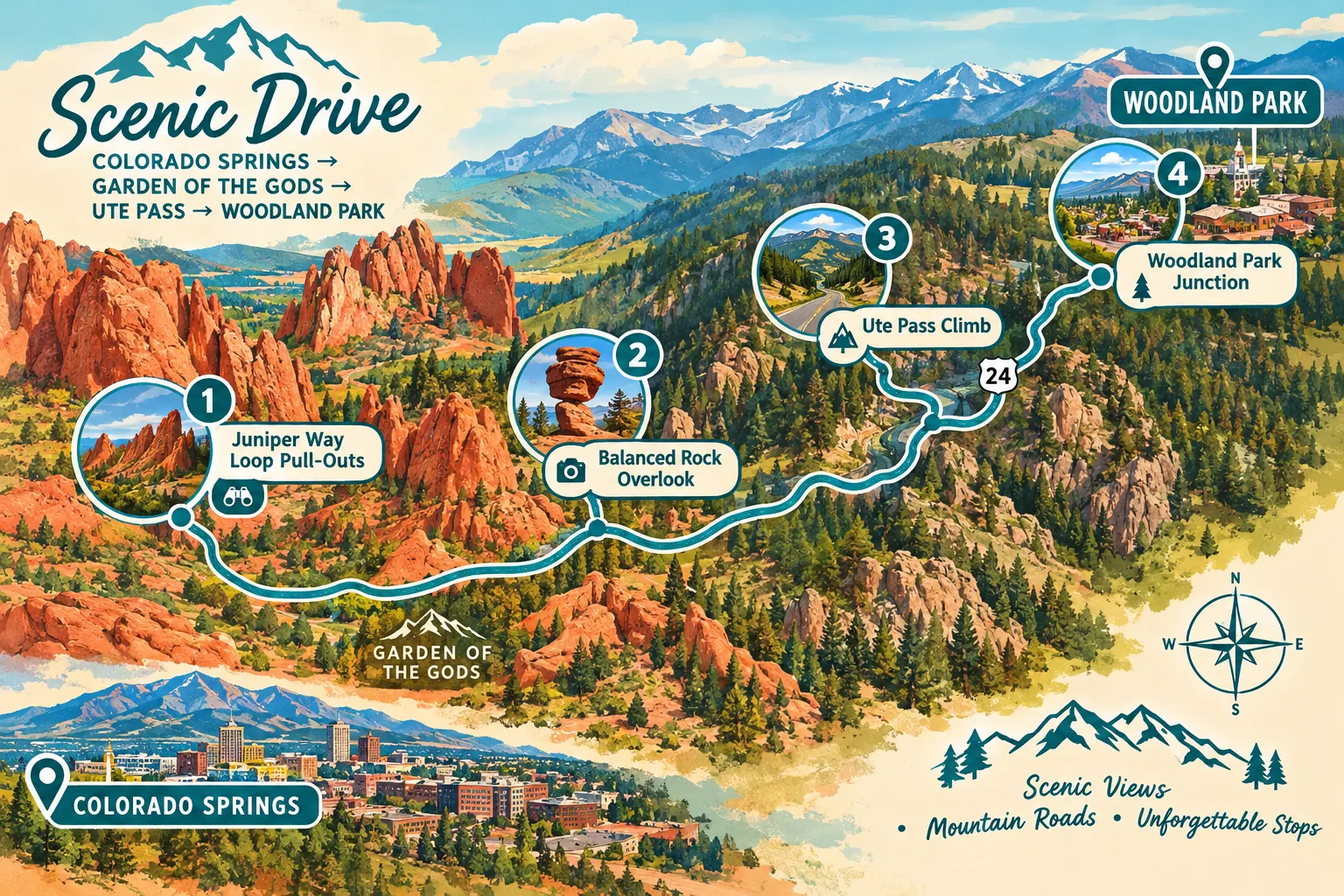
The Juniper Way Loop
Inside the park, the main scenic corridor is the Juniper Way Loop, a one-way paved road that passes most of the major rock formations and includes multiple pull-outs for photos and short viewpoints[6]. It’s genuinely one of the best short drives in Colorado, but it’s designed for passenger vehicles and smaller RVs, not 40-foot Class A motorhomes trying to squeeze into a tight pull-out. Local guidance is blunt about this: arrive early, use the designated parking lots, and keep oversized rigs out of the tighter interior pull-outs[6].
The practical move for most travelers towing or driving anything over 25-30 feet: park the RV at the base campground, then take a smaller tow vehicle or dinghy car into the park for the loop drive itself.
Ute Pass: The Scenic Link Between Town and Forest
For anyone splitting time between a Colorado Springs base and the Pike National Forest campgrounds, US-24 west through Ute Pass is the connector route, and it happens to double as one of the prettiest drives in the region. The route climbs steadily with views of Pikes Peak and the Front Range before reaching Woodland Park, then connects north on CO-67 to reach South Meadows and the other forest campgrounds[10]. It’s a legitimate scenic drive in its own right, not just a commute, which makes the forest-campground option more appealing for RVers who enjoy the journey as much as the destination.
Length and Access Restrictions to Know Before Arriving
A noticeable trend across camping platforms updated through late 2026 is more explicit flagging of rig-length limits and tight local access near Garden of the Gods[2][6][8]. Before finalizing a route:
- Confirm rig length against every parking lot and campground spec, don’t assume “RV-friendly” means big-rig-friendly.
- Check clearance on Rampart Range Road if planning to explore it, it’s unpaved in sections and not ideal for low-clearance rigs or long trailers.
- Plan tow-vehicle day trips for the interior Juniper Way Loop rather than attempting it in the main rig.
- Build in a buffer for Ute Pass grades, it’s a real climb, so check engine temps and brake condition before the drive, especially for travel trailers and fifth wheels.
Trip prep like this pairs well with having a real emergency plan in place for RV travel, since mountain routes, elevation changes, and unfamiliar roads are exactly where a little prep pays off the most.
Putting the Garden of the Gods RV Trip Planner Together
Here’s how the pieces fit for three common travel styles:
The convenience-first traveler: Book Garden of the Gods RV Resort up to 12 months ahead for peak season, use a dinghy vehicle for the Juniper Way Loop, and enjoy pool time between park visits[3][5].
The nature-first traveler: Base at one of the Pike National Forest campgrounds along CO-67, drive Ute Pass as a scenic warm-up each morning, and skip the resort fees in exchange for pine-shaded quiet[1][4][9][10].
The experienced boondocker: Dry camp along Rampart Range Road or Mount Herman Road with full self-containment, and treat the Garden of the Gods day trip as one stop on a longer Front Range exploration[2][8].
Conclusion
The biggest myth about this destination is that there’s a campground waiting at the gate, there isn’t, and planning around that fact early saves a lot of headaches later[8]. The good news is that Colorado Springs and the surrounding forest offer real variety: full hookups and pools at Garden of the Gods RV Resort, quiet pine-shaded sites along CO-67, or dispersed boondocking for self-contained rigs with the right gear[1][3][4][9][10].
Next steps before departure: measure the rig precisely, book the base campground as far ahead as the season allows, confirm length limits on any interior park parking lots, and map out whether a dinghy vehicle will handle the Juniper Way Loop while the big rig stays parked. Get those four things locked down, and the rest of the trip, the red rocks, the Pikes Peak views, the Ute Pass drive, takes care of itself.
References
[1] recreation.gov – https://www.recreation.gov/camping/campgrounds/232340 [2] hipcamp – https://www.hipcamp.com/en-US/p/united-states/colorado/point-of-interest/garden-of-the-gods/all [3] Cgid 730005495 – https://www.goodsam.com/campgrounds-rv-parks/colorado/colorado-springs/garden-of-the-gods-rv-resort/cgid-730005495 [4] recreation.gov – https://www.recreation.gov/camping/campgrounds/232341 [5] Garden Of The Gods Area Koa – https://pickrv.com/camping/campgrounds/colorado/garden-of-the-gods-area-koa [6] Visiting Garden Of The Gods In An Rv A Locals Guide To Maximizing Your Experience – https://springslocalguide.com/visiting-garden-of-the-gods-in-an-rv-a-locals-guide-to-maximizing-your-experience/ [7] Garden Gods Recreation Area – https://www.fs.usda.gov/r09/shawnee/recreation/garden-gods-recreation-area [8] Manitou Springs – https://thedyrt.com/camping/colorado/near/manitou-springs [9] recreation.gov – https://www.recreation.gov/camping/campgrounds/231873 [10] recreation.gov – https://www.recreation.gov/camping/campgrounds/232339
Garden of the Gods RV trip planner, Colorado Springs RV camping, Garden of the Gods campgrounds, Pike National Forest camping, RV scenic routes Colorado, Pikes Peak RV travel, boondocking Colorado, full hookup RV resorts, Ute Pass driving, Manitou Springs RV parking, Rampart Range Road camping, big rig RV travel