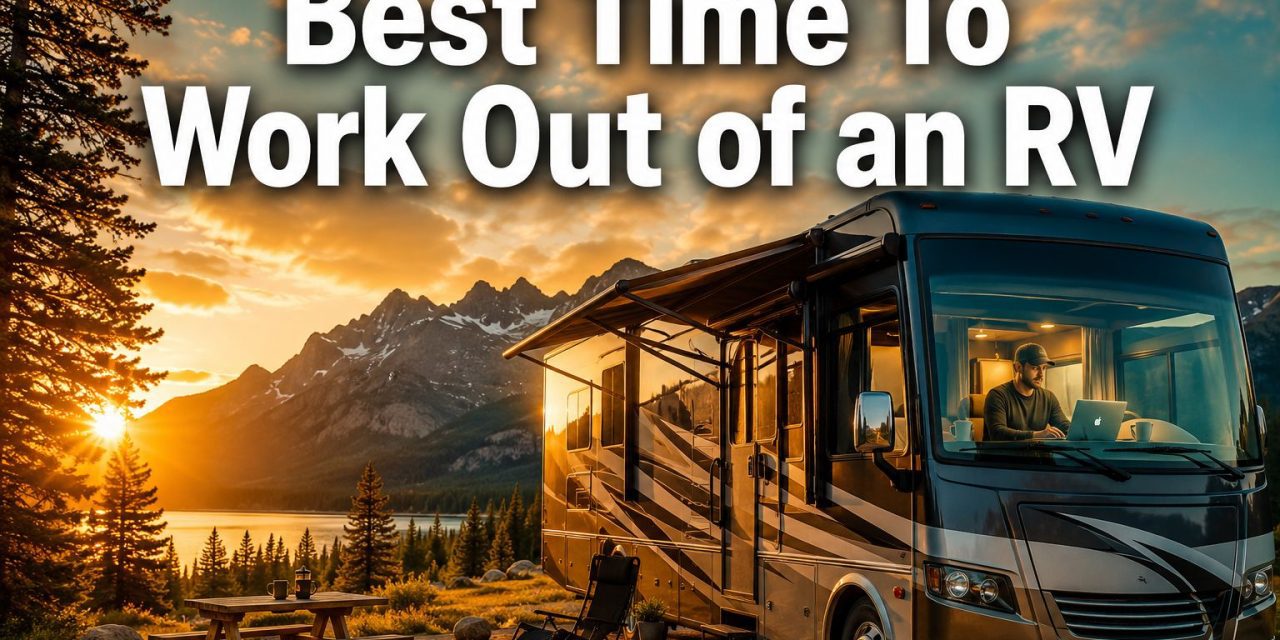
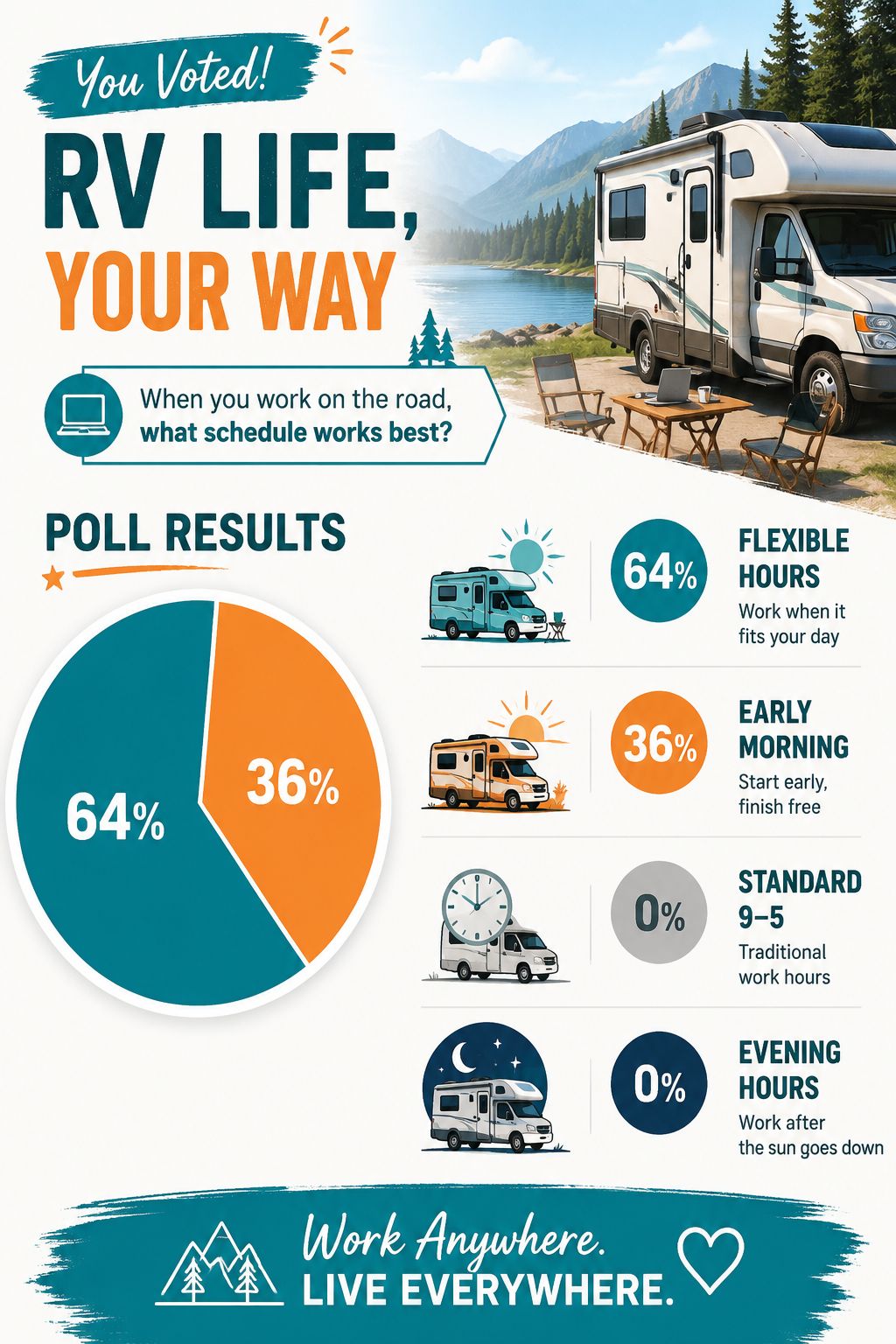
A full 64% of RV workers say flexible hours are their top choice — and zero percent would go back to a standard 9-to-5. That number tells a powerful story. A recent poll shows the best time to work out of an RV is not locked to a clock at all. It’s about freedom, flow, and finding what works on the open road.
Whether you’re a full-time RVer, a weekend warrior, or someone dreaming of trading the office cubicle for a campsite view, this data matters. It shapes how you plan your day, set up your workspace, and stay productive while living your best RV life.
Key Takeaways
- 🏆 64% of RV workers prefer flexible hours — the clear winner in our poll
- 🌅 36% choose early morning as their ideal work time in an RV
- ❌ 0% voted for standard 9-5 or evening hours — traditional schedules don’t fit RV life
- ☕ Early risers enjoy quiet campgrounds, better Wi-Fi, and cooler temperatures
- 🔑 The best RV work schedule is the one that fits YOUR lifestyle and location
Would you like to save this article?
What the Poll Results Really Tell Us
The poll asked one simple question: What’s your preferred RV work schedule? The results were crystal clear.
| Schedule Option | Poll Result |
|---|---|
| Flexible Hours | 64% ✅ |
| Early Morning | 36% ✅ |
| Standard 9-5 | 0% ❌ |
| Evening Hours | 0% ❌ |
These numbers are not just interesting — they’re life-changing data for anyone working from an RV in 2026.
Why Flexible Hours Won by a Landslide
Sixty-four percent is a huge majority. That means nearly two out of every three RV workers want the freedom to set their own schedule. This makes total sense when you think about the RV lifestyle.
Here’s why flexible hours work so well on the road:
- You move around a lot. Time zones change. Campground check-out times shift your day. Flexibility lets you adapt.
- Nature calls the shots. A perfect hiking trail or a stunning sunset doesn’t wait for your lunch break.
- Wi-Fi is unpredictable. Some campgrounds have great internet in the morning. Others are better at noon. Flexible hours let you work when the connection is strongest.
- Your energy levels vary. Some days you wake up ready to conquer the world. Other days, you need a slow start. Flexibility honors that.
💬 “The best schedule is the one that bends around your life — not the other way around.”
Flexible hours also mean you can batch your work. Do all your calls on Tuesday. Write all your content on Wednesday. Take Thursday off to explore a new town. This style of working is called time blocking, and it’s a favorite among remote RV workers.
Why 36% Love Early Morning Work Sessions
Early morning came in strong at 36%. That’s more than one in three RV workers. And there are very good reasons why the crack of dawn is a magical time to work from an RV.
Here’s what early risers love about morning work sessions:
🌄 Quiet campgrounds. Most campers are still asleep. No generator noise. No kids playing. Just birds and coffee.
📶 Better Wi-Fi. Fewer people are online early in the morning. That means faster speeds and fewer dropped video calls.
🌡️ Cooler temperatures. In summer months, mornings are the most comfortable time to sit inside your RV and focus.
⚡ Natural energy. Many people feel their sharpest right after waking up. Getting work done early leaves the rest of the day free for adventure.
🎯 Clear focus. The brain hasn’t been distracted yet by social media, news, or campground chatter. It’s prime thinking time.
Early morning workers often follow a simple routine:
- Wake up before the campground stirs (usually 5:30–7:00 AM)
- Make coffee ☕
- Work for 3–5 focused hours
- Wrap up by noon
- Spend the afternoon exploring 🏕️
This schedule is sometimes called the “RV Half-Day” method. Work hard in the morning, play hard in the afternoon.
Why Nobody Chose 9-5 or Evening Hours
Zero percent. That’s a bold statement from the RV community.
Standard 9-5 got no votes because it clashes with everything the RV lifestyle stands for. It locks you to a desk during the best daylight hours. It ignores time zones. It treats every day like a Monday in a cubicle.
Evening hours also got zero votes. Why? A few reasons:
- Campfire time is sacred 🔥
- Evenings are for socializing with fellow campers
- Working at night can mess up sleep schedules
- RV lighting isn’t always great for screen work after dark
- Many campgrounds get noisy in the evening with families and music
The message is clear: RV workers want their evenings free. That’s part of why they chose this lifestyle in the first place.
Poll Shows The Best Time To Work Out of an RV: A Deeper Look

Now that the poll results are on the table, it’s time to go deeper. What does it actually look like to build a work schedule around these findings? How do you make flexible hours or early mornings work in real life on the road?
Setting Up for Flexible Hour Success
Flexible hours sound amazing. But without some structure, they can turn into chaos. Here’s how to make them work:
Step 1: Know your deadlines. Flexible doesn’t mean deadline-free. Write down every task that has a hard due date. Work backward from there.
Step 2: Communicate with clients or employers. Let people know your general availability window. Something like “I’m available 7 AM–7 PM in whatever time zone I’m in” works well.
Step 3: Use a simple task management tool. Apps like Trello, Notion, or even a paper planner help you stay on track without a fixed schedule.
Step 4: Set a “core hours” window. Even flexible workers benefit from 2–3 hours per day when they’re always available. This makes collaboration easier.
Step 5: Protect your adventure time. Block out time for hikes, drives, and campground exploration. Treat it like a meeting you can’t cancel.
💬 “Flexibility without intention is just procrastination with a scenic view.”
Setting Up for Early Morning Work Success
If the poll’s 36% early morning crowd speaks to you, here’s how to build that routine in an RV:
Prep the night before. Lay out your laptop, chargers, and notebook before bed. Morning you will thank evening you.
Use a battery-powered coffee maker. No generator noise to wake up your campground neighbors. ☕
Close the blackout curtains. Keep the RV dark while you sleep so you wake up refreshed, not groggy from early sunrise.
Start with your hardest task. Use that fresh morning brain for the work that needs the most focus.
Set a hard stop time. Decide when work ends. Noon is popular. Stick to it.
The Role of Location in Your RV Work Schedule
Here’s something the poll doesn’t capture but every RV worker knows: where you are changes everything.
| Location Type | Best Work Time | Why |
|---|---|---|
| National Park Campground | Early Morning | Quiet, fewer people, great views |
| Urban RV Park | Flexible Hours | More noise, unpredictable schedules |
| Beach Campsite | Early Morning | Avoid afternoon heat and crowds |
| Mountain Retreat | Flexible Hours | Weather changes fast, adapt as needed |
| Full Hookup Resort | Flexible Hours | Reliable power and Wi-Fi all day |
Smart RV workers scout their campground before committing to a schedule. Check reviews for Wi-Fi quality. Ask about generator hours. Look at the campground layout to find the quietest spots.
Tech Tools That Support Any RV Work Schedule
No matter if you’re a flexible-hours fan or an early bird, the right tech makes RV work smoother:
- 📡 Mobile hotspot device — Don’t rely on campground Wi-Fi alone
- 🔋 Portable power station — Work anywhere without being plugged in
- 🎧 Noise-canceling headphones — Block out campground sounds
- 💡 Good task lighting — Essential for early morning and cloudy days
- 📱 Time zone app — Critical for flexible workers crossing state lines
- 🌐 Signal booster — Boost weak cell signals in remote areas
How to Handle Time Zone Challenges
This is one of the trickiest parts of working from an RV. As you travel across the country, time zones shift. A client in New York is three hours ahead of a client in Los Angeles.
Tips for managing time zones like a pro:
- Set your phone to show two time zones — your current location and your client’s location
- Schedule meetings in the client’s time zone to avoid confusion
- Use Google Calendar — it automatically adjusts for time zones
- Build buffer time into your schedule when crossing time zones
Flexible hours make this much easier. Early morning workers need to do a bit more math when they cross a time zone boundary.
What Full-Time RVers Say About Work Schedules
The full-time RV community — sometimes called “fulltimers” — has a lot of wisdom to share. Here’s what experienced road workers recommend:
💬 “Stop trying to replicate your office schedule in your RV. The whole point is that you left that behind.”
💬 “Early mornings changed my life on the road. I get more done in three quiet hours than I used to in eight noisy office hours.”
💬 “Flexible hours work best when you treat your RV like a business. Know your numbers, know your deadlines, and the rest takes care of itself.”
These voices echo the poll results perfectly. The RV community has figured out what works — and it’s not the traditional schedule.
Productivity Tips Specifically for RV Workers
Working from an RV comes with unique challenges. Here are the top productivity tips that match the poll’s findings:
For Flexible Hours Workers:
- ✅ Use a weekly review every Sunday to plan the week ahead
- ✅ Batch similar tasks together (all calls one day, all writing another)
- ✅ Keep a “not-to-do” list to avoid time-wasting habits
- ✅ Set location-based goals (“While at this campground, I’ll finish X project”)
For Early Morning Workers:
- ✅ Use the Pomodoro technique (25 min work, 5 min break)
- ✅ Eat breakfast AFTER your first work block for maximum focus
- ✅ Keep a simple paper to-do list — screens can be harsh on early morning eyes
- ✅ End your work session with a quick review of tomorrow’s priorities
The Mental Health Benefits of the Right Schedule
This part often gets overlooked. Working at the wrong time doesn’t just hurt productivity — it hurts your mental health.
When you work at a time that feels natural to you:
- 😊 Stress levels drop
- 🧠 Focus improves
- 💪 Motivation stays higher
- 🌟 Work feels less like work
The poll shows the best time to work out of an RV is deeply personal. But the data suggests that flexibility and early mornings are the winning combination for most RV workers. Both options share one thing: they leave the best parts of the day open for living.
Building Your Ideal RV Work Week
Here’s a sample week that blends both poll favorites — flexible hours with an early morning lean:
| Day | Work Time | Adventure Time |
|---|---|---|
| Monday | 6 AM – 11 AM | Afternoon hike |
| Tuesday | 7 AM – 12 PM | Afternoon kayaking |
| Wednesday | Flexible (calls/meetings) | Evening campfire |
| Thursday | 6 AM – 10 AM | Full afternoon off |
| Friday | Flexible (wrap up week) | Early weekend start |
| Saturday | OFF | Full exploration day |
| Sunday | 1 hour planning only | Relax and recharge |
This kind of schedule honors both poll results. It uses early mornings for deep focus work and flexible hours for meetings, collaboration, and catch-up tasks.
Common Mistakes RV Workers Make with Their Schedule
Even with the best intentions, RV workers fall into traps. Here are the most common ones — and how to avoid them:
❌ Working too many hours. Freedom can become a trap. Without a commute, it’s easy to work all day. Set hard stop times.
❌ Ignoring campground Wi-Fi quality. Always check signal strength before planning a video call.
❌ Skipping breaks. A small RV can feel cramped. Step outside every hour. Stretch. Breathe.
❌ Not telling family about work hours. If you travel with a partner or kids, communicate your work windows clearly.
❌ Trying to stick to a home schedule. You’re not home anymore. Embrace the difference.
Conclusion
The data is in, and it speaks loudly. A poll shows the best time to work out of an RV is either during flexible hours (the choice of 64%) or early in the morning (the choice of 36%). Nobody wants evenings. Nobody wants a standard 9-to-5.
That’s the beauty of the RV lifestyle — it’s built for people who refuse to be boxed in.
Here are your actionable next steps:
- 🗓️ Try a one-week experiment. Work early mornings for a week. Then try flexible hours for a week. See which one feels better.
- 📶 Upgrade your mobile internet setup. A reliable connection makes any schedule work better.
- 📝 Write down your ideal work day. Be specific. What time do you start? When do you stop? What do you do after work?
- 🤝 Talk to your clients or employer. Most are more flexible than you think, especially in 2026.
- 🏕️ Protect your adventure time. Put it on the calendar. Treat it as seriously as any work meeting.
The road is calling. The work will get done. The only question left is: are you an early bird or a flexible flyer? Either way, the RV community has your back — and the poll proves it.