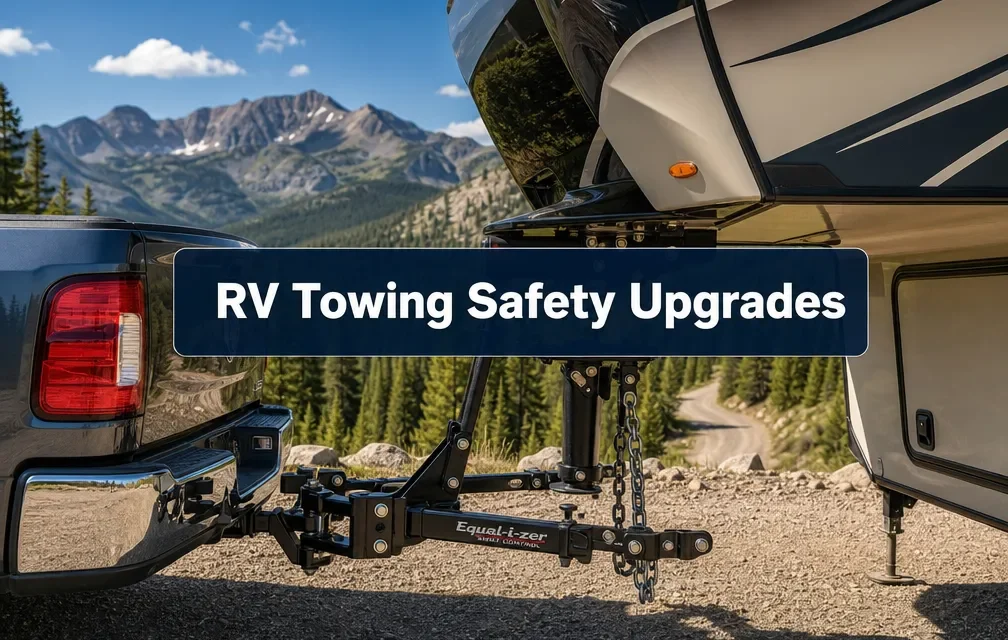
A loose trailer sway at 65 mph lasts less than three seconds before a driver loses control. That short window is why RV Towing Safety Upgrades: New Hitch and Suspension Systems That Make Adventure Trips More Stable have become one of the biggest conversations in the towing world for 2026. New hitch adapters and suspension designs are not just comfort add-ons anymore, they are being built specifically to keep RVs steady on mountain switchbacks, gravel forest roads, and rough off-grid trails.
This guide breaks down exactly what’s changed, which upgrades matter most, and how to pick the right combination for the kind of adventure travel most RVers actually do.
Key Takeaways
- 4-point sway-control hitches are now mainstream, offering far more stability than older friction-sway bars [9][8].
- New integrated weight-distribution/sway-control hitches in 2026 catalogs combine two safety systems into one unit [6].
- A hitch is generally required once the trailer’s loaded weight passes roughly 50% of the tow vehicle’s unloaded weight, but always check your owner’s manual [2].
- The 80% capacity rule and 60/40 load balance are the updated gold standards for safe RV towing weight distribution.
- Coil-spring and independent suspension upgrades cut interior shaking, reduce sway, and lower driver fatigue on rough terrain [1][10].
Why Towing Safety Upgrades Matter for Every Adventure RVer
Towing a travel trailer or fifth wheel is physics in motion. Wind gusts, uneven pavement, steep grades, and sudden braking all put stress on the connection between the tow vehicle and the RV. When that connection is weak or mismatched, the trailer can start to sway, and sway feeds on itself unless something interrupts it.
This is exactly why the RV industry has pushed hard on RV Towing Safety Upgrades: New Hitch and Suspension Systems That Make Adventure Trips More Stable heading into 2026. Manufacturers have noticed that more RVers are chasing boondocking spots, national forest campsites, and mountain destinations that sit far off smooth interstate pavement. That kind of travel demands equipment that does more than just connect the trailer, it needs to actively manage weight and motion.
The stakes are real. Poor weight distribution and worn-out suspension components are directly tied to blowouts, axle damage, and the kind of catastrophic failures covered in these RV explosions and the safety lessons they teach. Towing safety isn’t a side topic, it’s foundational to RV ownership.
New Hitch Technology Leading the 2026 Towing Safety Upgrade Trend
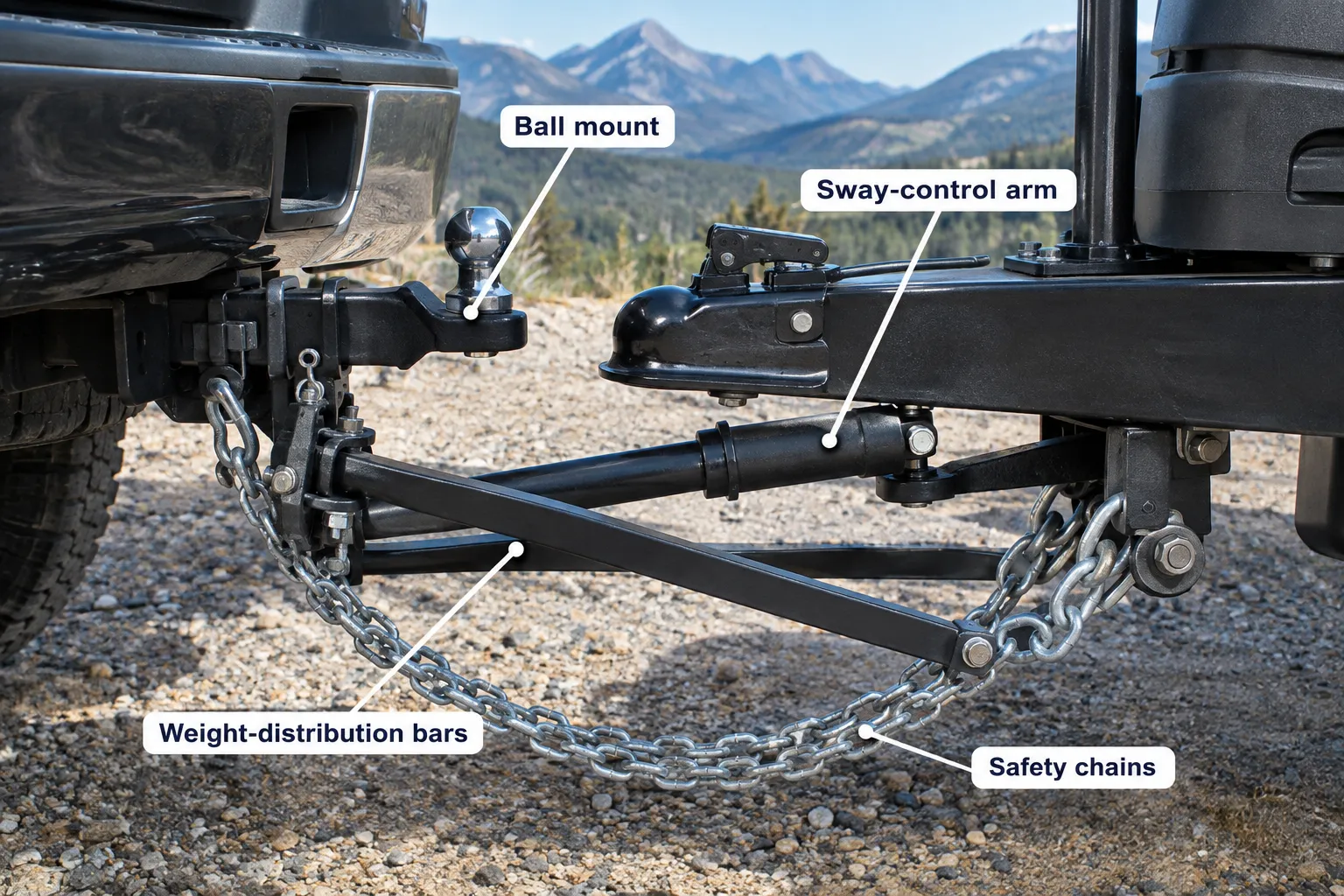
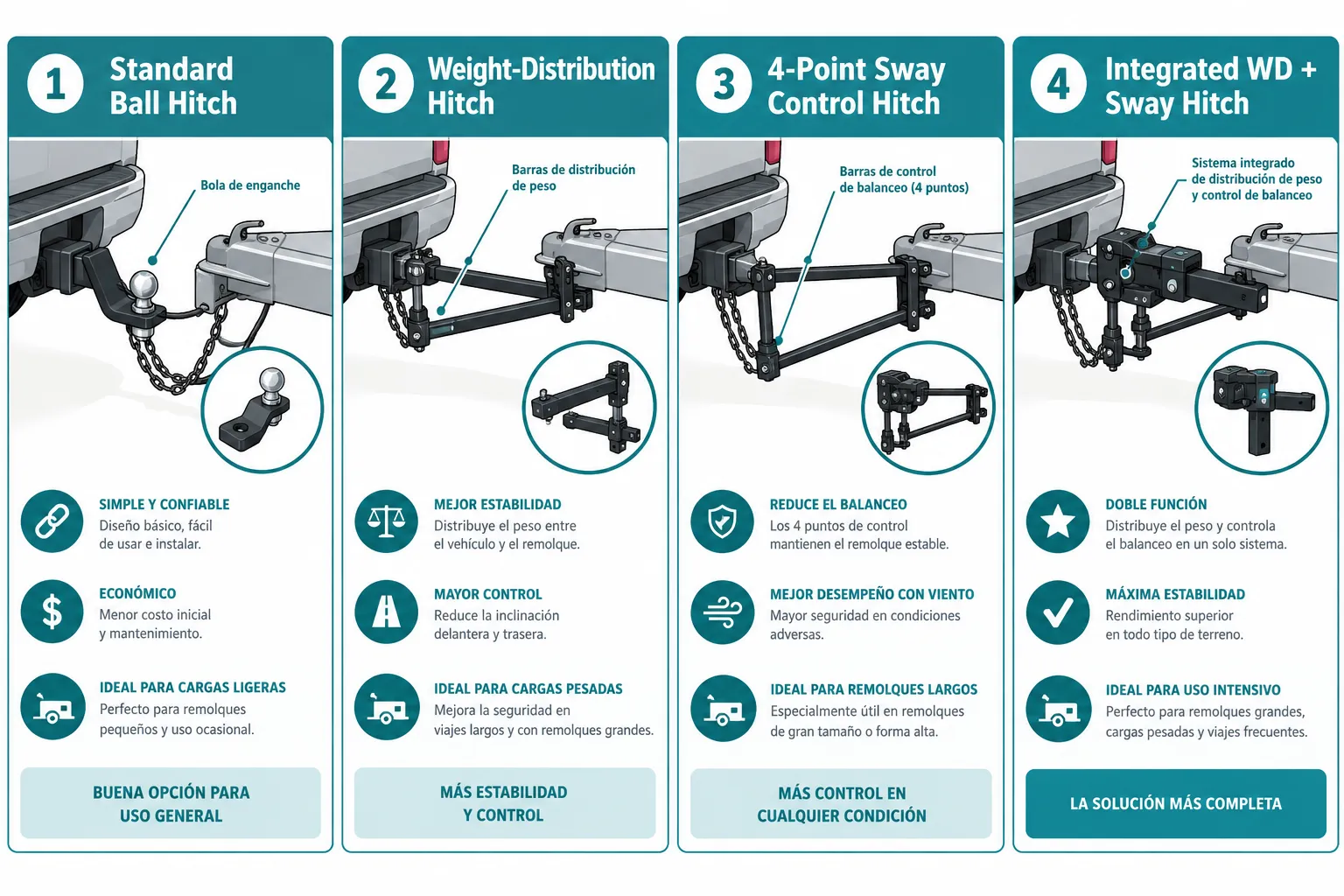
The biggest shift in hitch design is the move toward systems that do two jobs at once: distribute weight evenly across all axles and actively resist sway before it starts.
4-Point Sway Control Hitches
Older sway control relied on a single friction bar that only reacted after sway had already begun. The newer 4-point sway-control hitches now sold widely at major retailers use multiple contact points to resist sway from both sides simultaneously [9][8]. That means less wandering on crosswind-heavy highways and more confidence through tight canyon roads.
Integrated Weight-Distribution and Sway-Control Hitches
2026 product catalogs are showing a clear trend: hitches that combine weight distribution and sway control into a single, award-recognized unit [6]. Instead of running two separate systems, RVers get one hitch that levels the trailer, spreads tongue weight across the front and rear axles, and dampens sway in real time. Reviewers evaluating the best weight distribution hitches for 2026 consistently rank these integrated designs above older standalone setups for mixed-terrain towing [2].
Do You Actually Need One?
Not every setup requires a weight-distribution hitch, but the threshold is lower than many RVers assume. Industry guidance generally points to needing one once the loaded trailer weight exceeds about half the tow vehicle’s unloaded weight [2]. Vehicle manufacturers reinforce this in their own towing guides, which stress matching hitch type, brake controllers, and safety chains to the specific trailer being pulled, not just the vehicle’s maximum rating [7].
Quick hitch upgrade checklist:
- ✅ Confirm your tow vehicle’s actual unloaded weight (not the brochure number)
- ✅ Weigh your loaded trailer at a certified scale
- ✅ Choose a hitch rated above your actual tongue weight, with margin
- ✅ Verify safety chains and brake controller settings match your new hitch [7]
- ✅ Test sway behavior in a parking lot before hitting mountain roads
Suspension Upgrades That Reduce Bounce and Driver Fatigue
Hitches control the connection between vehicle and trailer. Suspension controls how both of them handle the road itself, and that’s where a lot of RVers are leaving safety and comfort on the table.
Why Stock Suspension Falls Short
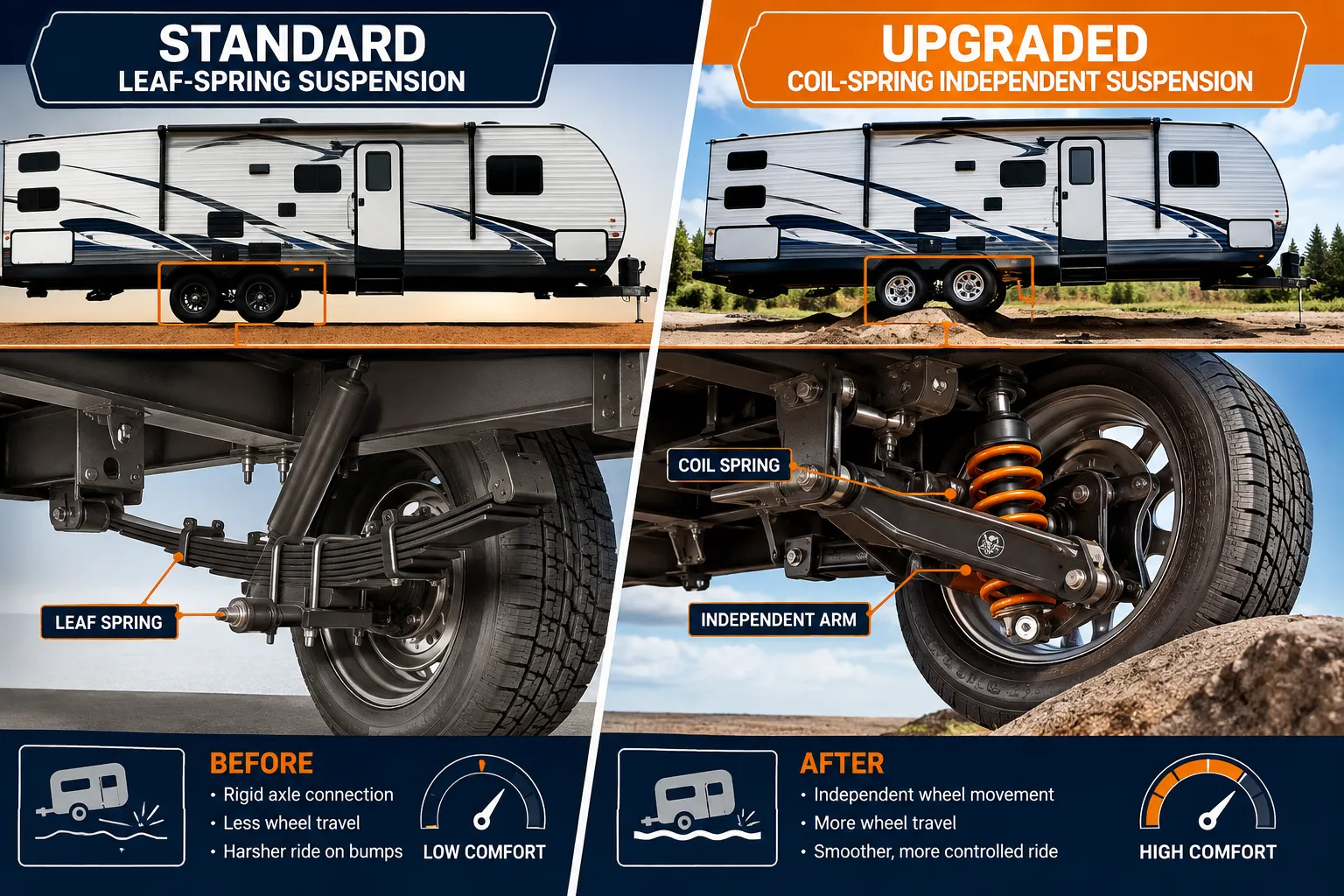
Most factory RV suspension systems use basic leaf springs designed for cost, not comfort. On smooth highways, that’s tolerable. On washboard forest roads or gravel campground approaches, stock leaf springs transmit every bump straight into the cabin, rattling cabinets, stressing axles, and wearing down the driver over a long travel day [10].
Coil-Spring and Independent Suspension Options
RV-specific suspension upgrades now offer real alternatives. Coil-spring systems absorb impact more evenly than leaf springs, cutting down on the shaking that makes long drives exhausting [1]. Some newer systems also add independent wheel control, letting each wheel react to bumps separately instead of transferring shock across the whole axle [4].
Here’s a simple comparison of what changes with a suspension upgrade:
| Suspension Type | Ride Feel | Sway Resistance | Best For |
|---|---|---|---|
| Stock leaf spring | Stiff, bouncy | Lower | Flat highway travel |
| Upgraded leaf spring | Smoother | Moderate | Mixed pavement/gravel |
| Coil-spring system | Cushioned | Higher | Mountain and forest roads |
| Independent wheel suspension | Most controlled | Highest | Off-grid, rough terrain |
Experts generally agree that a well-matched suspension upgrade directly improves handling, not just comfort [1][4]. That’s a meaningful distinction for anyone planning serious off-grid travel, since a trailer that handles better is a trailer that’s easier to keep in its lane during sudden wind gusts or steep descents.
Matching Truck Suspension to Trailer Weight
It’s not just the trailer that needs attention. Tow vehicles benefit from suspension upgrades too. 2026 guidance on truck suspension upgrades for towing organizes recommendations into weight bands, lighter trailers need modest spring or shock upgrades, while heavier fifth wheels often call for airbag assist systems or upgraded leaf packs to keep the truck level and controlled [5]. A sagging rear end on the tow vehicle throws off headlight aim, reduces steering precision, and makes the whole rig less stable.
“A trailer that bounces less is a trailer that sways less, suspension and stability are directly connected.” [1]
The Weight Rules Every Towing Upgrade Depends On
New hitches and suspension systems only work as well as the math behind them. Skipping the weight-check step is one of the most common, and most dangerous, mistakes RVers make.
GVWR Isn’t the Whole Story
Many RVers assume staying under the Gross Vehicle Weight Rating (GVWR) is enough. It isn’t. Safety upgrades need accurate measurements of actual tongue weight and individual axle loads, not just the vehicle’s maximum rated capacity [2][7]. Two rigs can share the same GVWR and tow completely differently based on how weight is actually distributed.
The 80% Rule and 60/40 Loading
Updated towing safety guidance now centers on two simple numbers:
- 80% capacity rule, Keep total loaded weight at or below 80% of your tow vehicle’s maximum towing capacity, leaving a safety buffer for hills, wind, and cargo shifts.
- 60/40 loading rule, Distribute cargo so roughly 60% of the weight sits toward the front half of the trailer and 40% toward the rear, which helps keep tongue weight in a stable range.
What Happens When These Rules Are Ignored
Overloading doesn’t just risk a ticket, it accelerates real mechanical damage. Excess weight overworks suspension components, increases sway tendency, and shortens the life of axles, bearings, and tires [1][4]. Combine an overloaded trailer with worn suspension and a mismatched hitch, and the risk of a serious highway incident climbs fast.
For RVers still learning the ropes, these weight rules are worth mastering early, especially for anyone planning a first RV trip that involves highway towing or mountain routes.
Choosing Upgrades for Mountains, Forests, and Off-Grid Routes
Not every RVer needs every upgrade. The right combination depends on where the adventure is actually headed.
For mountain and switchback travel:
- Prioritize a 4-point sway-control hitch to handle crosswinds and sharp grade changes [9]
- Add an upgraded truck suspension package matched to trailer weight for braking stability on descents [5]
For forest roads and gravel campsites:
- Coil-spring or independent trailer suspension reduces cabinet damage and cargo shifting [1][4]
- Double-check tire pressure and axle alignment before rough-road travel
For off-grid boondocking trips:
- Combine an integrated weight-distribution/sway-control hitch with reinforced suspension for the heaviest, most self-contained loads [6]
- Scout ahead using resources like these signs a campground is worth avoiding to anticipate rough access roads before committing the rig
On a budget? Full suspension overhauls aren’t always necessary right away. Many RVers start with a quality hitch upgrade first, since it delivers the biggest sway-control improvement per dollar. For shoppers comparing overall ownership costs, it’s also worth browsing budget-friendly RV brands that won’t drain your bank account when planning future upgrades into the total cost of ownership.
There’s a bonus benefit to all of this, too. A smoother, more stable tow isn’t just safer, it’s less physically draining. Reduced bounce and sway translate to less fatigue behind the wheel, which lines up with broader research on how road trips can support overall health when travel stress is kept low.
Frequently Asked Questions
Do I really need a weight-distribution hitch for a small travel trailer? Possibly not. Lighter trailers under the general 50% threshold of the tow vehicle’s unloaded weight may tow safely with a standard hitch [2]. Always verify with your trailer and vehicle manuals.
Can suspension upgrades void my RV’s warranty? Some can, depending on the manufacturer and installer. Always confirm compatibility and warranty terms before installing aftermarket suspension parts [4].
How often should hitch and suspension components be inspected? A full check before any long trip is smart, with a deeper inspection at least once a year or every 10,000-12,000 miles, especially after rough-road travel.
What’s the fastest sign my current setup isn’t stable enough? Noticeable trailer sway in moderate wind, excessive bounce on bumps, or a tow vehicle that feels light in the rear are all red flags worth addressing immediately.
Conclusion
Stable towing isn’t about one perfect product, it’s about matching the right hitch, the right suspension, and the right weight management to the kind of trips being planned. For RVers chasing mountain overlooks, forest campsites, and off-grid freedom, RV Towing Safety Upgrades: New Hitch and Suspension Systems That Make Adventure Trips More Stable aren’t optional extras. They’re the difference between a confident drive and a stressful one.
Next steps:
- Weigh the rig loaded, not estimated.
- Compare current hitch specs against the 80% and 60/40 rules.
- Research a 4-point sway-control or integrated hitch upgrade.
- Evaluate suspension options based on the terrain planned for the next big trip.
Small upgrades now can prevent big problems on the next mountain pass.
References
[1] Rv Suspension Comparison – https://www.lippert.com/blog/rv-suspension-comparison [2] Best Weight Distribution Hitches 2026 – https://haulandtrail.com/towing-hauling/best-weight-distribution-hitches-2026/ [3] Best Rv Suspension Upgrade – https://rvcontext.com/rv/best-rv-suspension-upgrade/ [4] Rv Suspension Upgrades – https://www.lippert.com/blog/rv-suspension-upgrades [5] Best Truck Suspension Upgrades For Towing 2026 – https://camptow.com/best-truck-suspension-upgrades-for-towing-2026/ [6] 2026 Rvpl Catalog – https://rvflipbook.com/2026-RVPL-Catalog/ [7] 2026 Ford Rv And Trailer Towing Guide V2 – https://www.ford.com/content/dam/brand_ford/en_us/brand/towing/pdf/2026-Ford-RV-and-Trailer-Towing-Guide-v2.pdf [8] Rv Trailer Hitches – https://www.campingworld.com/c/hitch-tow/rv-trailer-hitches [9] Sway Control Hitch – https://www.ebay.com/shop/sway-control-hitch?_nkw=sway+control+hitch [10] How To Stop My Rv From Shaking – https://www.lippert.com/blog/how-to-stop-my-rv-from-shaking