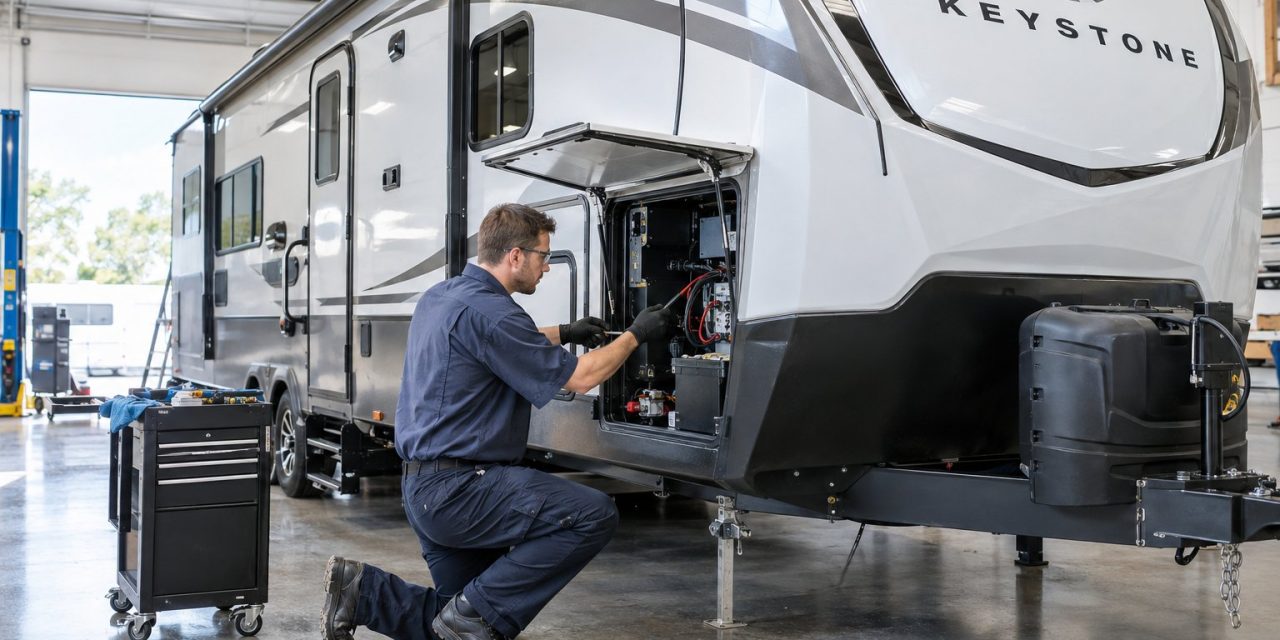
Search “RV brands mechanics hate” and one name shows up again and again: Keystone. Owners share stories of delaminating roofs, soft floors, and warranty claims that go nowhere, and some independent shops say they would rather turn the work away than deal with the headache.
Keystone is the brand most often named by mechanics and owners as difficult to service, mainly because of water leaks, slide-out failures, and slow warranty support, though its problems mirror issues found across most mass-market RV manufacturers.
Keystone builds more towable RVs than almost any other company in North America, so its sheer volume means more units on the road and more repair tickets in the system. That does not mean every Keystone is a lemon, but it does mean you need to know what to check before you sign a purchase agreement or drop off a unit for service.
This guide looks at what the complaints actually say, why a shop might turn down a repair job, and what you can do whether you are shopping for an RV or already own one with a problem.
Is Keystone Really a Brand Mechanics Avoid?
Keystone shows up on more “brands to avoid” lists than almost any competitor, but the complaints trace back to a handful of repeat issues rather than a single fatal flaw. Roof delamination, slide-out leaks, and slow warranty turnaround dominate the owner reviews and mechanic forum posts.
What Do the Online Claims Actually Show?
Owner reviews on sites like RV Insider show a mixed picture. One 2005 Keystone Montana owner reported 20 years of solid use with only a converter replacement. Another owner with a 2022 Outback found a poorly sealed rubber roof with rot and mold underneath, all within the first year of ownership.
Forum threads and YouTube videos calling out “brands mechanics won’t work on” tend to lump Keystone in with Forest River and Jayco, the other two volume leaders. All three brands, along with most of the industry, sit under a small number of parent companies that control roughly 80 percent of the market.
Why Do Model Year and Condition Matter More Than the Badge?
A well-maintained 2015 Keystone can outlast a poorly built 2024 model from any brand. Build quality on mass-market RVs varies by production run, factory, and even which shift built the unit.
A camper assembled during a high-volume sales year, when factories rush to keep up with demand, often shows more assembly defects than one built during a slower stretch.
Why Might a Shop Decline an RV Repair?
A shop turns away RV repairs for reasons that have little to do with the brand name on the front cap. Water damage, slide-out complexity, and warranty paperwork headaches drive most of these decisions.
Water Damage and Wall Delamination
Wall delamination happens when moisture gets behind the fiberglass skin and rots the wood substrate underneath. Fixing it means stripping the wall down to the frame, which can cost thousands of dollars and take a shop out of commission for a paying customer for a week or more.
Many shops will quote the job but decline to guarantee the outcome, since hidden rot often extends beyond what’s visible at intake.
Slide-Out Damage and Difficult Repairs
Slide-out mechanisms are tightly packed with motors, gears, and seals that were never designed for easy access. A repair that looks simple from the outside can require pulling interior panels just to reach the motor.
Slide-out repairs typically run from $500 to $2,500 depending on the type of motor and whether the floor underneath has water damage.
Warranty Authorization and Repair Liability
Manufacturer warranty work often pays shops slowly, sometimes eight months to a year after the repair is finished. One independent shop owner described an invoice for just over $300 that stayed unpaid for 13 months.
Add in a manufacturer’s tendency to approve less labor time than the job actually needs, and many shops simply stop accepting warranty claims, leaving the owner to hunt for a facility willing to take the work.
What Should You Inspect on a Keystone RV?
Check the roof, the slides, and the tank and plumbing systems before you buy or before a small leak turns into a rotted floor. These three zones account for most of the repair complaints tied to Keystone units and to towable RVs in general.
Roof Seams, Windows, and Soft Spots
Walk the roof if it’s rated for foot traffic and feel for soft or spongy spots, a sign of substrate rot underneath the membrane. Check the sealant around every vent, antenna, and air conditioner unit; cracked or missing sealant is an easy fix now and an expensive one later.
Ask when the roof was last resealed. Most manufacturers recommend doing this every year, and a seller who can’t answer usually hasn’t done it.
Slide Operation and Wall Alignment
Extend and retract every slide-out fully at least twice. Listen for grinding or hesitation, and check that the slide seals flush against the wall with no visible gap.
A slide that binds partway through its cycle often points to a bent rail or a motor under strain, not just a dirty track.
Tank Supports, Plumbing, and Electrical Work
Look underneath for tank straps that are rusted, bent, or missing. Run every faucet and flush the toilet to check for backups or slow drains, which can point to a mislabeled or cracked tank.
Test every outlet with a plug-in tester and check for exposed wiring near appliances, especially around the water heater and furnace.
How Can You Check an RV Before Buying?
Hire an independent inspector, pull the VIN history, and call a local shop before you make an offer. Each step catches a different type of problem that a walkthrough alone will miss.
Hire an Independent RV Inspector
A certified RV inspector brings a moisture meter and knows where water tends to hide, including behind slide seals and under floor edges near the entry step. A moisture reading above 16 to 19 percent in a wall or floor points to active water damage, even if the surface looks clean.
Expect to pay a few hundred dollars for this service, which is a small cost next to a five-figure purchase.
Check VIN Recalls and Service Records
Run the VIN through the National Motor Vehicle Title Information System (NMVTIS) to check for salvage, flood, or junk titles. Ask the seller or dealer for service records, and check the Federal Certification Label on the door jamb against the tires currently mounted on the unit.
A mismatch in tire load rating is a safety issue, not just a cosmetic one.
Ask Local Shops Whether They Service the Model
Call two or three independent RV repair shops near you and ask if they work on the brand and model you’re considering. A shop that hesitates or says it only handles that brand for existing customers is telling you something about parts availability or past experience with warranty claims.
What If You Already Own an RV with Problems?
Document every defect with photos and dates, then get repair estimates from more than one shop before you decide how to proceed. Acting early keeps a small leak or loose fitting from turning into a rotted subfloor or an electrical hazard.
Document Defects and Address Safety Risks
Take photos of every issue as soon as you spot it, including the date and a close-up of the damage. If you find exposed wiring, a gas smell, or a soft spot in the floor, treat it as a safety issue and stop using that area of the RV until it’s checked.
Written documentation also strengthens your case if you need to file a warranty claim or dispute a denial.
Compare Repair Estimates and Warranty Options
Get quotes from at least two shops, since labor time and parts markup vary widely between dealerships and independent repair shops. If your RV is still under a manufacturer or extended warranty, ask the shop directly whether they accept that warranty type, since many independent shops only take on limited warranty work due to slow reimbursement.
Judge the RV, Not Just the Badge
Keystone earns its spot on mechanic complaint lists because of real, repeated problems with leaks, slides, and warranty support. The same problems show up under other badges built by the same handful of parent companies. A specific unit’s condition, model year, and repair history tell you more than the name on the front cap.
Before you buy, run the VIN, hire an independent inspector, and call a local shop to ask about parts and service history. If you already own one, document problems as they appear and get more than one repair estimate before committing to a fix. That approach protects you whether the sticker says Keystone, Jayco, or something else entirely.