

Diesel hit $8.09 a gallon in California this fall while Gulf Coast drivers paid $3.85 for regular gas, a swing of more than $2 a gallon depending on which state line an RV crosses. That kind of gap can turn a “cheap” road trip into a budget disaster if the route isn’t planned carefully. This is exactly why more RV owners are turning to smart software for help. Using AI trip-planning tools to design budget-friendly RV adventures amid high fuel prices is quickly becoming one of the smartest moves a traveler can make before hitting the road.
Fuel prices aren’t just high, they’re unpredictable. AAA reported the national gas average dropped 12 cents in a single week to $4.10 in early November 2026.[1] Prices swing fast, and RVers who plan routes based on last year’s numbers (or guesswork) often overspend without realizing it.
Key Takeaways
- 🧭 Regional fuel gaps matter. Diesel and gas prices can differ by $2+ per gallon between states, so route choice directly affects trip cost.
- 🤖 New AI tools model fuel costs by vehicle type. Apps like Tourific and HitTheRoad estimate RV-specific fuel spend, elevation impact, and even clearance risks before a trip starts.[2][3][4]
- 🔀 A hybrid approach works best. Combining a general AI chatbot for brainstorming with specialized apps for pricing and bookings produces stronger results than relying on one tool alone.
- 🏕️ Human review is still essential. AI drafts a solid starting itinerary, but RVers should double-check campground prices, crowd levels, and seasonal timing.[5]
- 📅 Booking automation is emerging. Some AI agents can now lock in campsites directly, which may help travelers grab lower rates before they rise.
Why Fuel Costs Are Forcing Smarter RV Trip Planning
Fuel is often the single biggest line item in any RV travel budget, and 2026 has made that line item harder to predict. The U.S. Energy Information Administration data for mid-October 2026 showed national diesel averaging $6.17 a gallon and regular gas at $4.33, with California running as high as $8.09 diesel and $6.10 gas. Compare that to Gulf Coast gas at $3.85, and the math gets obvious fast: the route matters almost as much as the destination.
Diesel remains $2.51 more per gallon than it was the year before, and regular gas is up $1.27. For RVers towing a fifth wheel or driving a Class A motorhome that gets single-digit miles per gallon, those differences compound quickly over a multi-week trip. This is where RV financial tips and smarter routing tools come together to protect the travel budget.
“The route matters almost as much as the destination when fuel prices swing by dollars, not cents.”
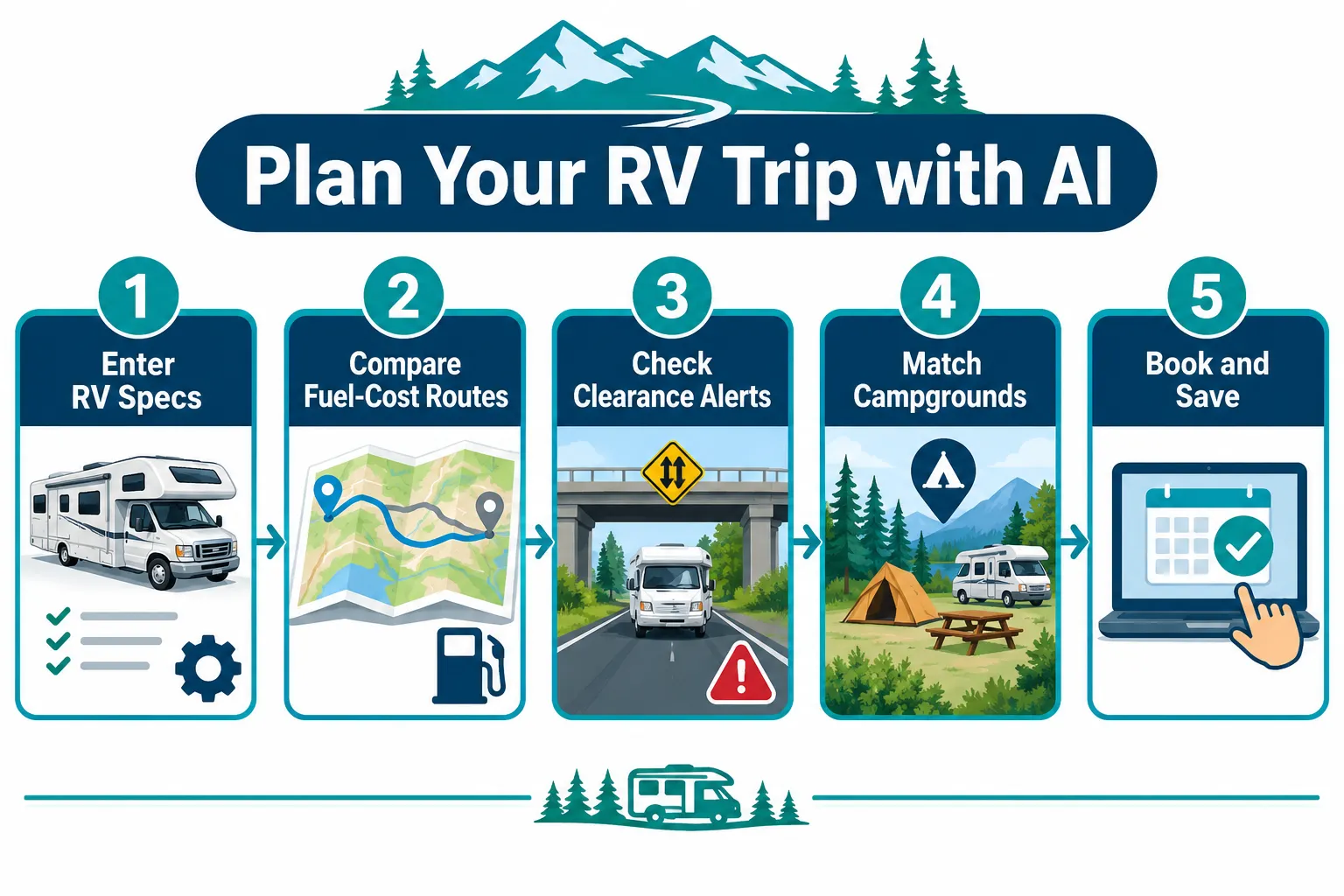
How Using AI Trip-Planning Tools To Design Budget-Friendly RV Adventures Amid High Fuel Prices Actually Works
AI trip planners aren’t just fancy map apps. The newest generation is built specifically to weigh cost, vehicle type, and road conditions together.
Tourific’s AI planner, which integrates with BestRoadTrip, uses a vehicle-specific cost engine. It estimates gas, EV, and RV fuel spend, adjusts for elevation changes, and even scores driver fatigue and route safety for each itinerary.[2][4] That means an RVer can compare two possible routes, one through mountain passes, one along flatter highways, and see which one actually costs less in fuel before ever leaving the driveway.
HitTheRoad takes a similar but slightly different approach. It bills itself as an AI itinerary builder for EVs, RVs, and campers that produces a “real, drivable plan” with genuine stops, day-by-day timing, and an honest cost estimate.[3] By tying distances, stops, and lodging into one generated route, it helps travelers see the full financial picture, fuel plus camping, before committing to a plan.[3]
These tools matter because they remove the guesswork that used to make RV budgeting a shot in the dark. Instead of estimating gas costs with a napkin and an outdated fuel average, travelers can see cost projections tied to their actual rig and route.
RV-Specific Safety Features That Also Protect Your Budget
It’s not just about fuel math. Tourific’s app listing highlights RV tunnel and bridge clearance checks, weight restriction alerts, steep-grade warnings, and campground hookup matching.[2] These features sound like safety tools, but they’re really budget protection in disguise. A wrong turn onto a low-clearance road can mean costly RV damage, and a mismatched campground hookup can mean an unexpected rebooking fee. The BestRoadTrip analysis notes that these checks, combined with elevation-adjusted fuel estimates, reduce the risk of expensive detours or last-minute scrambling.[4]
For RVers who’ve read about everything that broke in a 23-year-old RV, this kind of preventive routing is worth its weight in gold.
Comparing General AI Planners vs. RV-Specific Tools
Not every AI trip planner is built with RVs in mind, but that doesn’t mean general tools are useless. Several recently updated apps can still be repurposed for RV budgeting with a little extra manual tweaking.

| Tool Type | Examples | Best For | Limitation |
|---|---|---|---|
| RV-specific AI planners | Tourific, HitTheRoad | Fuel cost modeling, clearance checks, hookup matching[2][3][4] | Smaller stop databases |
| General AI trip planners | GoTrippy AI, Mappu, YesTrip | Fast itinerary drafts, maps, attractions[6][7][8] | No RV clearance or weight checks |
| Conversational AI chatbots | ChatGPT, Gemini, Claude | Brainstorming routes and seasonal timing[5] | Needs human fact-checking |
| Legacy RV databases | Roadtrippers | Campground hookup filtering, dump-station locators[4] | Less cost-aware than newer AI tools |
GoTrippy AI, Mappu’s free planner, and YesTrip were all refreshed in November 2026 and can generate personalized, day-by-day itineraries with maps and schedules.[6][7][8] They don’t check RV clearance, but they’re fast, and RVers can manually adjust mileage and stops to fit fuel budgets.
Meanwhile, Roadtrippers continues to offer a massive database with RV-specific overlays like Campendium integration and dump-station locators.[4] A Stardrift roundup on 2026’s best road trip planner apps actually recommends layering conversational AI on top of these established databases, get the cost-aware routing from AI, then verify campground details through trusted RV platforms.[4]
Real-World Testing: What Actually Works
It’s one thing to read a feature list. It’s another to see how these tools perform on an actual trip.
A 2026 comparative test of seven free trip planners followed a one-week winter road trip through Southern California. ChatGPT produced the strongest first draft of the route, Mindtrip paced the days most realistically, and KAYAK’s AI excelled at logistics like flights and bookings. The takeaway for RVers: no single AI tool does everything well. Brainstorm with one, then hand off pricing and booking decisions to a specialist app.
RV creators have put this into practice directly. Brighter On Wheels documented planning an entire fall foliage RV trip from Myrtle Beach to North Carolina’s Blue Ridge Mountains using four different AI models, Google Gemini, Claude, ChatGPT, and Meta’s Muse, refining the itinerary through back-and-forth prompts.[5] Their conclusion was honest: AI quickly surfaced route options, campground ideas, and seasonal timing, but a human still had to adjust for crowd levels, budget limits, and personal taste, especially during peak foliage season.[5]
In a follow-up post, the same creators described a “drastic change of plans.” After getting initial AI itineraries, they went back to their usual manual planning process to nail down specific activities, costs, and timing, while still keeping AI in the loop for ideas. This is a good reminder for anyone planning a first RV trip: AI is a planning partner, not an autopilot.
Using AI Trip-Planning Tools To Design Budget-Friendly RV Adventures Amid High Fuel Prices: A Practical Step-By-Step
Here’s a simple process RV travelers can follow right now.
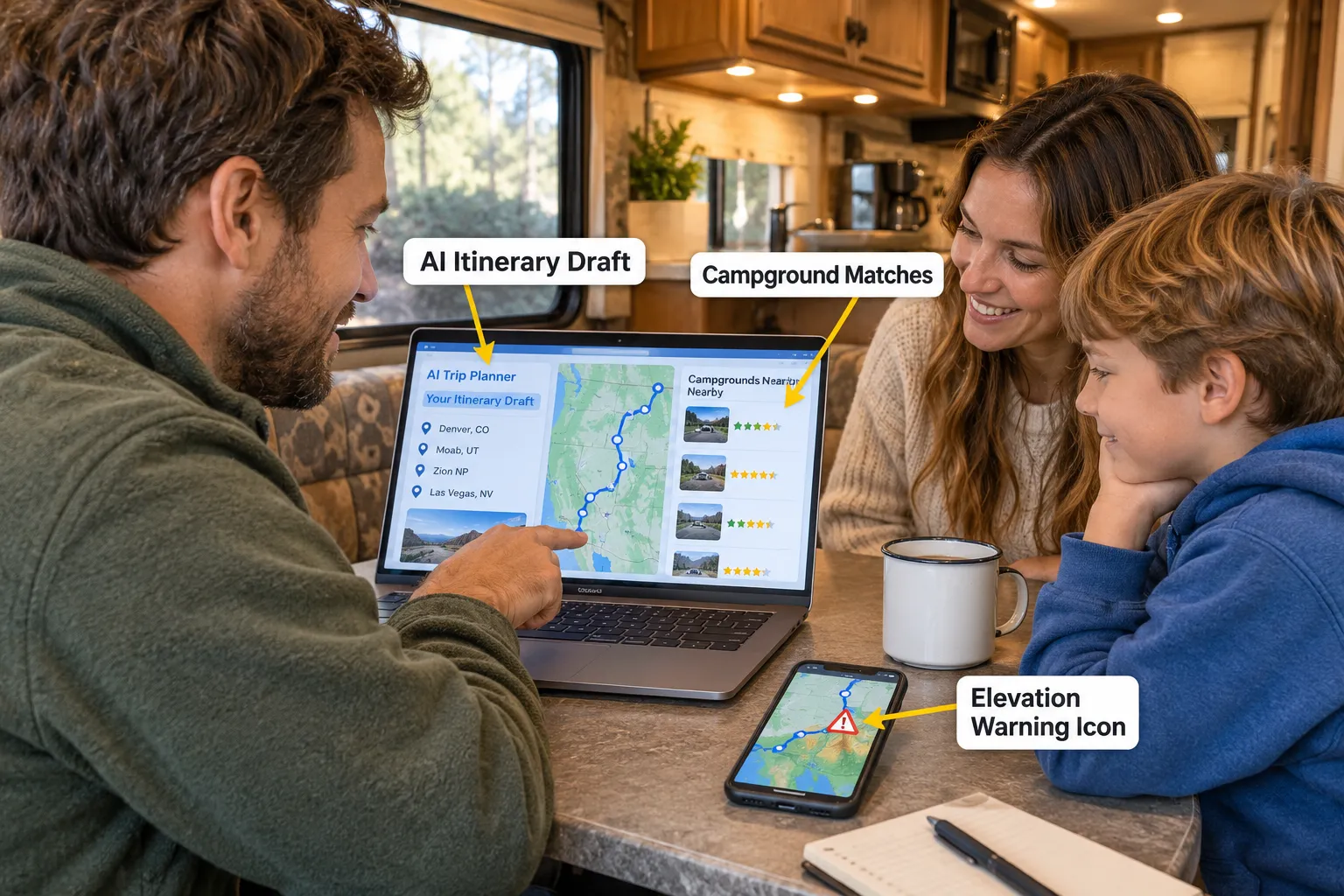
- Start with a general AI chatbot (ChatGPT, Gemini, or Claude) to brainstorm regions, seasonal timing, and rough stops based on fuel budget goals.[5]
- Move to a vehicle-specific planner like Tourific or HitTheRoad to model actual fuel costs for an RV’s size, weight, and mileage.[2][3]
- Check regional fuel averages before finalizing a route, favor lower-cost regions like the Gulf Coast or Lower Atlantic over pricier zones like California when routes allow.
- Cross-check campgrounds through Roadtrippers or Campendium-style databases for hookup availability and real pricing.[4]
- Watch for AI booking agents. Tools like Muse are beginning to handle actual campsite bookings on a traveler’s behalf, which can help lock in lower rates before they rise.
- Do a final human review. Confirm clearance restrictions, weight limits, and crowd-heavy dates before committing.[2]
This approach pairs nicely with boondocking tips for travelers who want to skip paid campgrounds altogether on high-fuel-cost legs of a trip.
Where AI Booking Automation Is Headed
One of the more interesting developments in late 2026 is AI agents that don’t just plan, they book. Brighter On Wheels used Meta’s Muse to actually reserve a campsite for their AI-generated RV trip, noting it was the only consumer AI agent they knew of at the time that could complete bookings on a user’s behalf. Their process involved co-planning with multiple AI models first, then letting Muse finalize the reservation.
This points to where budget RV planning may be headed. Industry watchers expect mainstream AI planners to deepen integration with live fuel-price feeds and campground reservation systems over the next year or two, building on the vehicle-specific cost engines and automated booking features already emerging.[2][4] That could eventually mean itineraries that automatically favor cheaper fuel regions, off-peak campground dates, and shorter daily drives, then re-optimize as prices shift in real time.
Tips for Stretching Every Fuel Dollar While Using These Tools
AI tools help with the planning side, but a few classic RV habits still make a real difference at the pump:
- Slow down. Driving 60 mph instead of 70 mph can noticeably improve fuel economy on long stretches.
- Watch tire pressure. Underinflated tires create drag and burn more fuel.
- Plan fewer, longer driving days instead of frequent short hops, fewer stops and restarts save gas.
- Time fill-ups by region. Use regional averages like the Gulf Coast’s lower prices to fill up before crossing into pricier states.
- Pack light. Extra weight in a towable or motorhome adds up in fuel consumption over a multi-week trip.
Travelers curious about the full picture of RV ownership costs, including fuel, might also enjoy the complete RV lifestyle encyclopedia for a broader budgeting reference.
Frequently Asked Questions
Can AI trip planners really save money on RV fuel? Yes, to a meaningful degree. Tools like Tourific model fuel costs by vehicle type and adjust for elevation, which helps travelers pick routes that avoid unnecessary climbing or detours.[2][4]
Are RV-specific AI tools better than general trip planners? They offer features general tools lack, like clearance checks and weight restriction alerts, which matter specifically for RVs.[2] General planners like GoTrippy or Mappu are faster for quick itinerary drafts but require manual RV-safety checks.[6][7]
Should RVers trust a single AI tool for an entire trip? No. Testing shows different tools excel at different tasks, one for route drafting, another for pacing, another for logistics. A hybrid approach performs best.
Is AI booking automation reliable for campsites yet? It’s early. Tools like Muse can complete bookings, but most RVers still use AI for planning and handle final confirmations themselves.
Conclusion
Fuel prices aren’t going to stop swinging anytime soon, but that doesn’t mean RV budgets have to swing with them. Using AI trip-planning tools to design budget-friendly RV adventures amid high fuel prices gives travelers a real edge, from fuel-cost modeling and clearance checks to campground matching and emerging booking automation. The smartest approach is layered: brainstorm with a general AI, refine with an RV-specific planner, verify with trusted campground databases, and always do a final human gut-check before locking in a route. Start small, plug an upcoming trip into one of these tools, compare the fuel estimate against current regional prices, and see how much smarter the next adventure can be.
References
- Aaa National Fuel Average Falls 12 Cents in One Week. rvbusiness.com.
- Id6749655499. apps.apple.com.
- Id6759530743. apps.apple.com.
- bestroadtrip.com.
- We Planned an Entire Rv Trip Using AI. brighteronwheels.com.
- Id6791176832. apps.apple.com.
- AI Trip Planner. mappu.ai.
- yestrip.app.