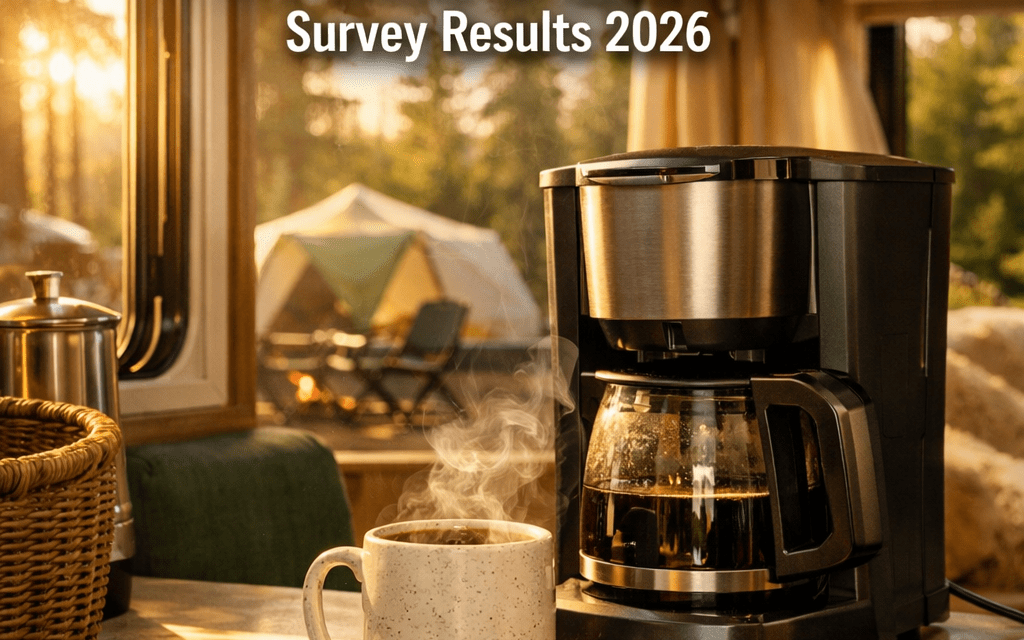
The sun rises over a misty mountain lake, birds chirp their morning songs, and you step into your RV kitchen ready for that first glorious cup of coffee. But what’s brewing on your counter? According to our latest findings on what coffee setup do RVers prefer (survey), the answer is overwhelmingly clear—and it might not be what you’d expect.
For RV enthusiasts hitting the open road in 2026, coffee isn’t just a beverage; it’s a ritual, a necessity, and sometimes the difference between a great day and a grumpy one. As more people embrace the RV lifestyle—with 39% of leisure travelers planning an RV trip this year[4]—understanding the perfect mobile coffee solution has never been more important.
The question of what coffee setup do RVers prefer (survey) reveals fascinating insights into how modern nomads balance convenience, quality, and the practical realities of life on wheels.
Key Takeaways
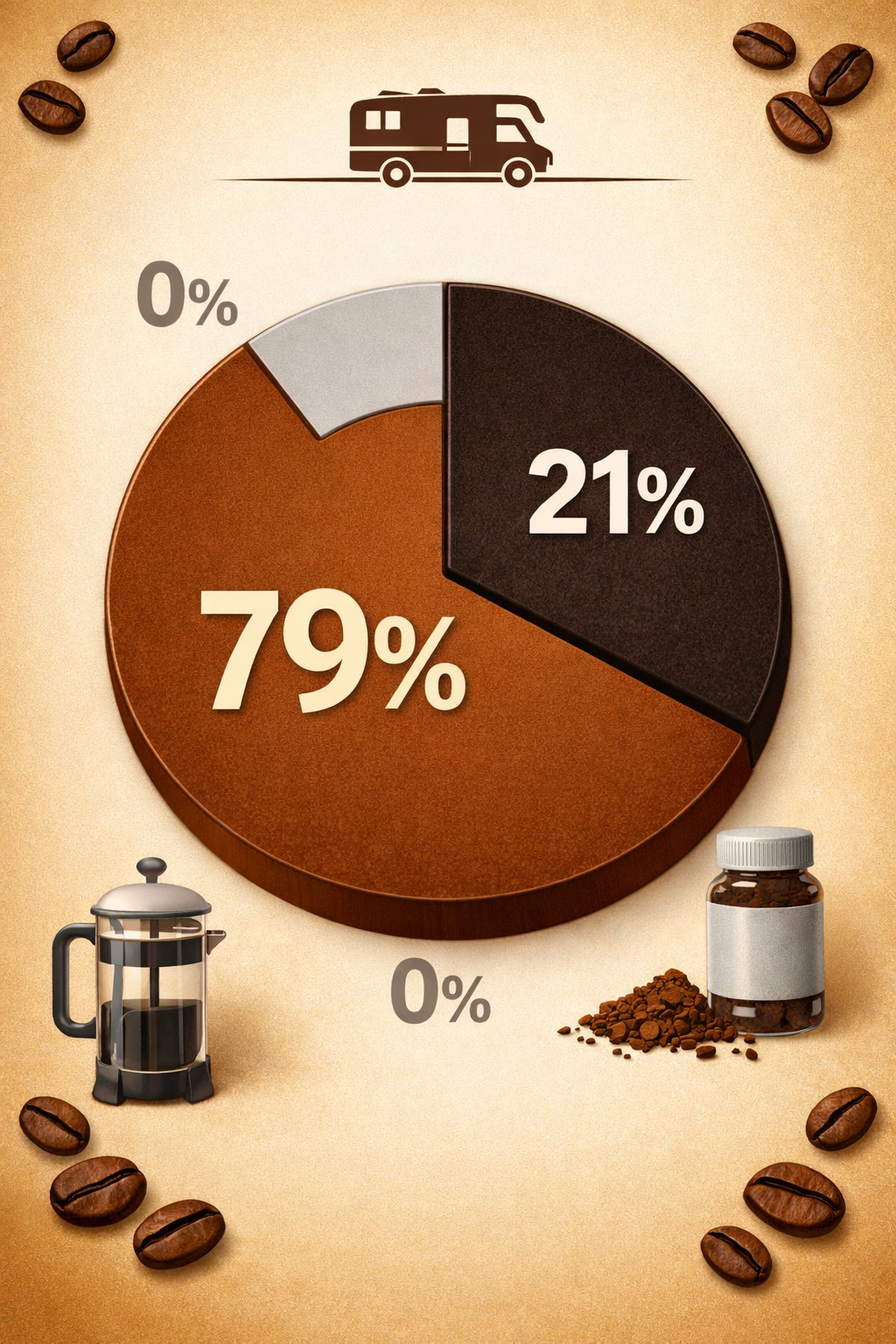
- 79% of RVers prefer drip coffee makers as their go-to brewing method, prioritizing convenience and capacity over specialty brewing techniques
- Espresso machines claim 21% of the market, reflecting a growing segment willing to invest in premium coffee experiences on the road
- French press and instant coffee received 0% in our survey, despite their portability advantages
- Space efficiency and power consumption are the primary factors influencing RV coffee setup decisions
- The RV coffee market is evolving alongside trends in remote work and digital nomadism at campgrounds[2]
Understanding What Coffee Setup Do RVers Prefer (Survey Breakdown)
Would you like to save this article?
The results of our survey on what coffee setup do RVers prefer paint a clear picture of RV coffee culture in 2026. With 79% choosing drip coffee makers, the traditional brewing method dominates the RV landscape by a landslide. This overwhelming preference tells us something important about the RV lifestyle: practicality often trumps novelty.
The Numbers Don’t Lie
Here’s the complete breakdown of our survey results:
| Coffee Setup | Percentage | Votes |
|---|---|---|
| Drip Coffee Maker | 79% | Majority |
| Espresso Machine | 21% | Minority |
| French Press | 0% | None |
| Instant Coffee | 0% | None |
What makes these results particularly interesting is what they reveal about RVer priorities. Despite the romance of French press coffee or the convenience of instant options, neither method captured a single vote. This suggests that RVers are looking for something specific: a balance between quality, convenience, and familiarity.
Why These Results Matter
The coffee setup you choose for your RV isn’t just about caffeine delivery—it’s about establishing home on the road. As one full-time RVer shared: “My morning coffee routine is the one constant no matter where I park. It grounds me, literally and figuratively.”
With Gen Z campers now spending approximately $266 per day on RV trips—nearly double what Boomer campers spend[2]—there’s clearly a willingness among younger travelers to invest in quality experiences, including premium coffee setups. Yet even this demographic leans heavily toward the tried-and-true drip method.
The Drip Coffee Maker Dominance: Why 79% Choose This Classic Setup
The drip coffee maker’s overwhelming 79% preference isn’t accidental. This brewing method has earned its place as the RV coffee champion through a combination of practical advantages that align perfectly with life on the road.
Space-Saving Design Meets Capacity
Modern RV drip coffee makers are engineered specifically for compact living. Unlike their residential counterparts, these units typically feature:
- Compact footprints that fit on limited counter space
- Secure brewing mechanisms that prevent spills during travel
- 12-volt options that run directly off RV batteries
- Programmable features for wake-up coffee without effort
The beauty of a drip coffee maker in an RV is its ability to brew multiple cups at once—perfect for couples or families traveling together. When you’re parked at a scenic overlook and everyone wants coffee simultaneously, a 10-cup drip maker becomes the hero of the morning.
The Convenience Factor
Let’s be honest: RV life involves enough complexity without making your morning coffee a production. Drip coffee makers offer:
✅ Simple operation – Add water, add grounds, press start
✅ Consistent results – Same great coffee every time
✅ Easy cleanup – Minimal parts to wash
✅ Familiar interface – No learning curve required
“After a long day of driving and setting up camp, the last thing I want is to fuss with complicated coffee equipment,” explains Sarah, a full-timer who’s been RVing for three years. “My drip maker is ready in five minutes, and I can make enough for my husband and me in one go.”
Power Consumption Considerations
One often-overlooked advantage of drip coffee makers is their reasonable power draw. Most RV-specific models consume between 600-900 watts, making them manageable even when boondocking with solar panels or generator power. This energy efficiency becomes crucial when you’re camping off-grid and every watt counts.
The Best RV Drip Coffee Makers in 2026
According to industry reviews[3], the top-rated RV drip coffee makers share common features:
- Anti-spill technology for rough roads
- Thermal carafes that keep coffee hot without a warming plate
- Compact designs under 12 inches tall
- Durable construction to withstand travel vibrations
The drip coffee maker’s dominance in our survey on what coffee setup do RVers prefer reflects a community that values reliability over trendiness—and there’s something beautifully practical about that choice.
The Espresso Enthusiasts: Understanding the 21% Who Choose Premium Brewing
While drip coffee makers dominate, the 21% who prefer espresso machines represent a growing and passionate segment of the RV community. These coffee connoisseurs aren’t willing to compromise on quality, even when living in 200 square feet.
The Rise of Portable Espresso Technology
The espresso market for RVers has exploded in 2026, with manufacturers developing increasingly sophisticated portable solutions. As demonstrated in recent outdoor coffee tests[1], modern portable espresso machines can now deliver “countertop machine quality espresso” in vehicles and wilderness settings.
These innovations include:
- Battery-powered espresso makers that don’t require shore power
- Compact designs smaller than a toaster
- Manual lever machines requiring zero electricity
- Pressurized systems that work with pre-ground coffee
“I spent 20 years as a barista before hitting the road full-time. For me, espresso isn’t negotiable—it’s part of who I am. My portable machine takes up minimal space but delivers maximum joy every morning.” – Marcus, full-time RVer and coffee professional
The Investment Mindset
Espresso enthusiasts in the RV community tend to view their setup as an investment in daily quality of life. While a decent portable espresso machine might cost $200-$500 (compared to $40-$100 for a drip maker), these users calculate the value differently:
- Savings on coffee shop visits – At $5 per latte, the machine pays for itself in 100 uses
- Emotional satisfaction – The ritual of pulling a perfect shot
- Social currency – Impressing fellow campers with café-quality drinks
- Skill development – Mastering the art of espresso on the road
Challenges Espresso Lovers Face
The 21% who choose espresso setups aren’t ignoring the challenges—they’ve simply decided the benefits outweigh the drawbacks:
Space Requirements 🏠
Even compact espresso machines need storage for the machine itself, grinder, tamper, milk frother, and specialty cups.
Power Demands ⚡
Most espresso machines draw 1200-1500 watts, requiring careful power management when boondocking.
Complexity 🎯
Dialing in the perfect shot takes practice, and variables change with altitude and water quality.
Cleaning Requirements 🧼
Espresso machines demand regular descaling and maintenance to prevent calcium buildup.
The Campground Coffee Culture
Interestingly, the rise in espresso preference among RVers coincides with upgraded amenities at RV parks. Many campgrounds are now installing coffee stations as part of amenity upgrades[2] to accommodate remote workers and digital nomads. KOA campgrounds and similar facilities feature co-working spaces with coffee stations, desks, and high-speed Wi-Fi—with 48% of campers rating internet access as “very important” when choosing campgrounds[2].
This infrastructure evolution means espresso lovers can sometimes satisfy their cravings at the clubhouse, reducing the pressure to maintain a full setup in their rig.
The Surprising Absence: Why French Press and Instant Coffee Got 0%
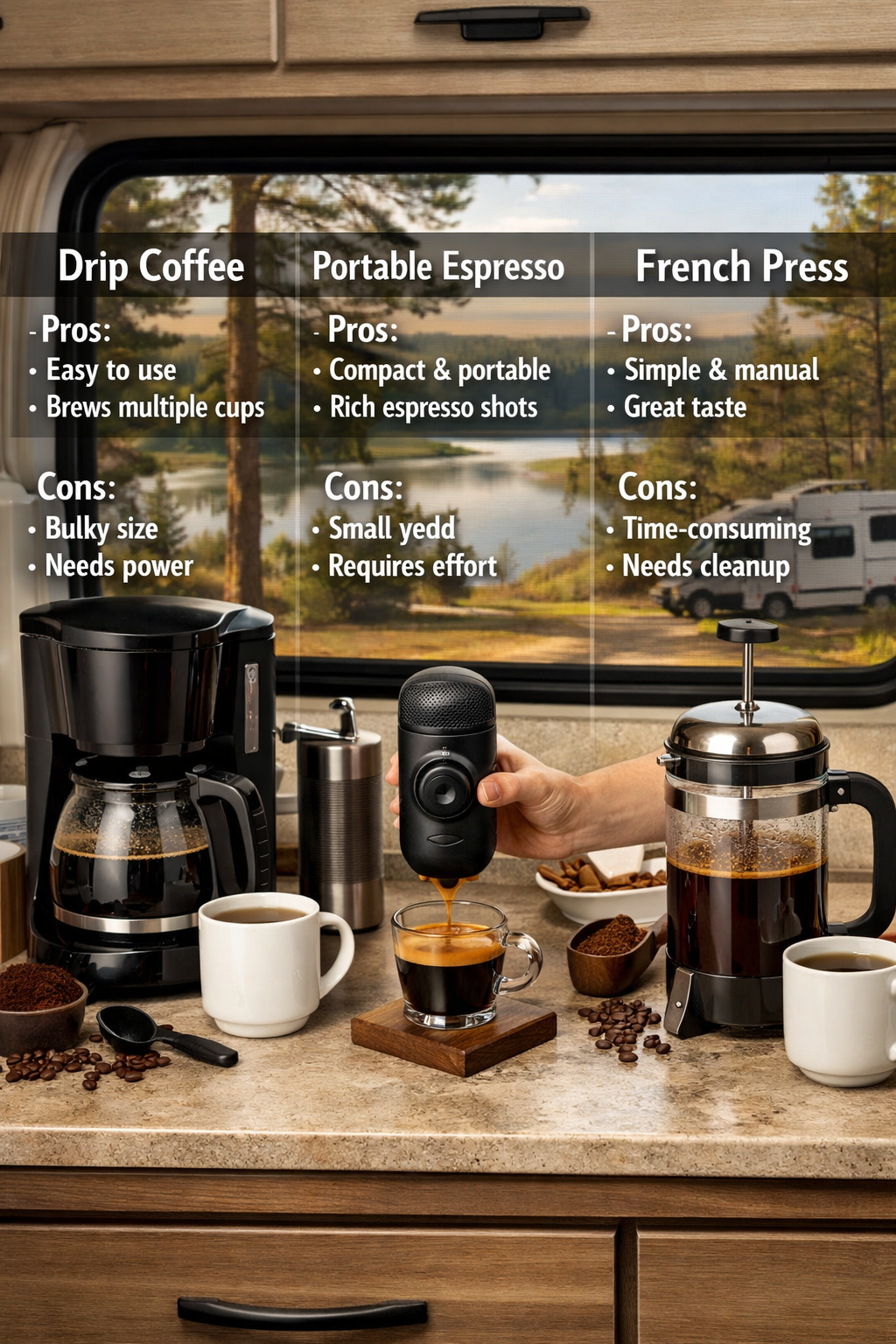
Perhaps the most intriguing aspect of our survey on what coffee setup do RVers prefer is what didn’t get votes: French press and instant coffee both received 0%. This absence is worth examining because both methods seem ideally suited for RV life.
The French Press Paradox
On paper, French press should be an RV coffee champion:
- ✅ No electricity required – Perfect for boondocking
- ✅ Compact storage – Takes up minimal space
- ✅ Lightweight – Easy to transport
- ✅ Rich flavor – Produces excellent coffee
- ✅ Affordable – Often under $30
So why did it receive zero votes? The answer likely lies in practical inconveniences:
The Grit Factor ☕
French press coffee contains sediment that many drinkers find unpleasant, especially when you’re trying to enjoy a peaceful morning.
The Cleanup Challenge 🚰
Disposing of wet coffee grounds in an RV is messier than tossing a paper filter. Many campgrounds prohibit dumping grounds on the ground, and RV sinks aren’t ideal for this task.
The Temperature Issue 🌡️
French press requires precise water temperature (195-205°F), which means boiling water and waiting—adding complexity to the morning routine.
The Batch Limitation 📏
Making coffee for multiple people requires multiple brew cycles or a very large press.
The Instant Coffee Mystery
Instant coffee’s complete absence is equally puzzling. Modern instant coffee has improved dramatically, with premium freeze-dried options rivaling brewed coffee quality. Yet RVers rejected it entirely.
Possible explanations include:
Quality Perception 🏆
Despite improvements, instant coffee still carries a stigma as inferior, and RVers apparently aren’t willing to settle.
The Ritual Factor 🎭
The act of brewing coffee—hearing it percolate, smelling it brew—provides psychological benefits that instant coffee can’t replicate.
Value Proposition 💰
Per-cup costs for quality instant coffee often exceed the cost of ground coffee in bulk.
Community Standards 👥
RV culture has developed its own coffee standards, and instant coffee may simply fall outside accepted norms.
What This Tells Us About RV Coffee Culture
The complete rejection of these two methods reveals something profound about RV coffee priorities in 2026:
- Convenience must not sacrifice quality – RVers want easy, but not too easy
- Familiarity matters – Drip coffee replicates the home experience
- Volume is important – Single-serve methods don’t meet community needs
- The brewing process has value – The ritual matters as much as the result
As one survey respondent noted: “I didn’t leave my stick-and-brick house to drink worse coffee. I left to drink the same great coffee in better locations.”
Factors Influencing RV Coffee Setup Choices
Understanding what coffee setup do RVers prefer (survey) requires examining the decision-making factors that guide these choices. RV coffee selection isn’t random—it’s a carefully considered decision based on multiple variables.
Space Constraints: The Ultimate Decider
Limited counter and storage space is the primary constraint for most RVers. A typical RV kitchen offers:
- 12-24 inches of usable counter space
- Cabinets that must hold dishes, food, and appliances
- Weight restrictions affecting what you can carry
- Vibration concerns requiring secure storage
Coffee equipment must justify its footprint. A drip coffee maker that produces 10 cups might occupy the same space as an espresso setup that makes one shot at a time—making the drip maker the obvious choice for many.
Power Availability and Management
Your coffee setup choice depends heavily on how you camp:
Shore Power Campers 🔌
With full hookups, power isn’t a constraint. These RVers can run any coffee maker without concern, explaining why some choose power-hungry espresso machines.
Solar/Battery Boondockers ☀️
Off-grid campers must carefully manage their power budget. A 900-watt drip maker running for 10 minutes consumes roughly 150 watt-hours—manageable with a modest solar setup. A 1500-watt espresso machine is more challenging.
Generator Users ⚙️
Those relying on generators must balance coffee quality against fuel consumption and noise concerns (nobody wants to wake the campground at 6 AM).
Lifestyle and Usage Patterns
Solo Travelers typically need different solutions than families or couples:
- Solo RVers might prefer single-serve methods (though our survey suggests they still choose drip makers with smaller capacities)
- Couples benefit from 4-6 cup drip makers
- Families need 10-12 cup capacity or multiple brewing cycles
Full-timers versus weekend warriors also show different patterns:
- Full-time RVers invest in quality equipment they’ll use daily
- Occasional campers might prioritize simplicity and storage efficiency
Budget Considerations
Coffee setup costs vary dramatically:
| Setup Type | Initial Investment | Ongoing Costs |
|---|---|---|
| Drip Coffee Maker | $40-$150 | $0.25-$0.50/cup |
| Espresso Machine | $200-$800 | $0.75-$1.50/shot |
| French Press | $20-$60 | $0.25-$0.50/cup |
| Instant Coffee | $10-$30 | $0.50-$1.00/cup |
The 79% choosing drip makers likely appreciate the sweet spot of reasonable initial cost and low per-cup expenses.
Climate and Travel Destinations
Where you travel affects coffee setup preferences:
Hot Climates ☀️
RVers in warm regions might prefer cold brew options or iced coffee capabilities.
Cold Weather Camping ❄️
Winter campers need reliable hot coffee, often favoring methods that keep coffee hot longer.
High Altitude ⛰️
Mountain campers face boiling point changes that affect brewing—espresso machines handle this better than manual methods.
The Social Dimension
RV coffee culture has a surprising social component. Many RVers report:
- Sharing morning coffee with neighboring campers
- Hosting “coffee hours” at their site
- Bonding over coffee equipment discussions
- Judging campground quality partly on coffee amenities[2]
This social aspect favors setups that can produce multiple servings quickly—another point for drip coffee makers.
The Future of RV Coffee: Trends Shaping 2026 and Beyond
The landscape of what coffee setup do RVers prefer (survey) continues evolving as technology advances and RV demographics shift. Several trends are reshaping mobile coffee culture:
Remote Work Revolution at Campgrounds
The explosion of remote work from RV parks[2] is transforming coffee expectations. Campgrounds now feature:
- Dedicated co-working spaces with premium coffee stations
- Quiet lounges equipped with espresso machines and Wi-Fi
- Coffee bars rivaling urban cafés
- Subscription coffee services delivering beans to your campsite
This infrastructure means RVers can sometimes outsource their coffee needs, potentially reducing onboard equipment requirements. However, most remote workers still prefer having their own setup for early mornings and late nights when clubhouses are closed.
Technology Integration
Smart coffee makers are entering the RV market with features like:
- 📱 Smartphone control – Start brewing from bed via app
- ⏰ Scheduling capabilities – Wake to fresh coffee automatically
- 🔋 Battery monitoring – Integration with RV power management systems
- 🌡️ Precision temperature control – Optimal brewing every time
These innovations particularly appeal to the tech-savvy younger generation of RVers who spend significantly more per trip[2] and expect modern conveniences.
Sustainability Considerations
Environmental consciousness is influencing coffee choices:
- Reusable filters reducing waste
- Compostable coffee pods for single-serve machines
- Solar-compatible equipment for off-grid brewing
- Water-efficient designs conserving precious resources
RVers increasingly view their coffee setup as part of their environmental footprint, favoring methods that minimize waste and energy consumption.
The Specialty Coffee Movement Goes Mobile
As specialty coffee culture expands, more RVers are becoming coffee enthusiasts. This explains the 21% choosing espresso machines despite the challenges. Expect to see:
- Portable grinders with precise settings
- Scale-based brewing for perfect ratios
- Third-wave coffee subscriptions delivering beans to campgrounds
- RV barista communities sharing techniques online
Hybrid Solutions Emerging
The future likely includes hybrid approaches combining multiple methods:
- Drip maker for daily volume + manual espresso for special occasions
- Cold brew concentrate for convenience + French press for fresh coffee
- Instant coffee backup for boondocking + full setup for hookup camping
These flexible systems acknowledge that different situations call for different solutions.
Campground Amenity Arms Race
As RV parks compete for customers, coffee amenities are becoming differentiators[2]:
- Premium coffee bars in clubhouses
- Bean-to-cup machines in common areas
- Coffee delivery services to your site
- Barista events and coffee tastings
This trend might eventually reduce the need for elaborate personal setups, though most RVers still value the independence of their own equipment.
Practical Tips: Choosing Your Perfect RV Coffee Setup
Based on our findings about what coffee setup do RVers prefer (survey), here’s actionable advice for selecting your ideal mobile coffee solution:
For First-Time RVers: Start Simple
If you’re new to RV life, the 79% majority has wisdom worth following:
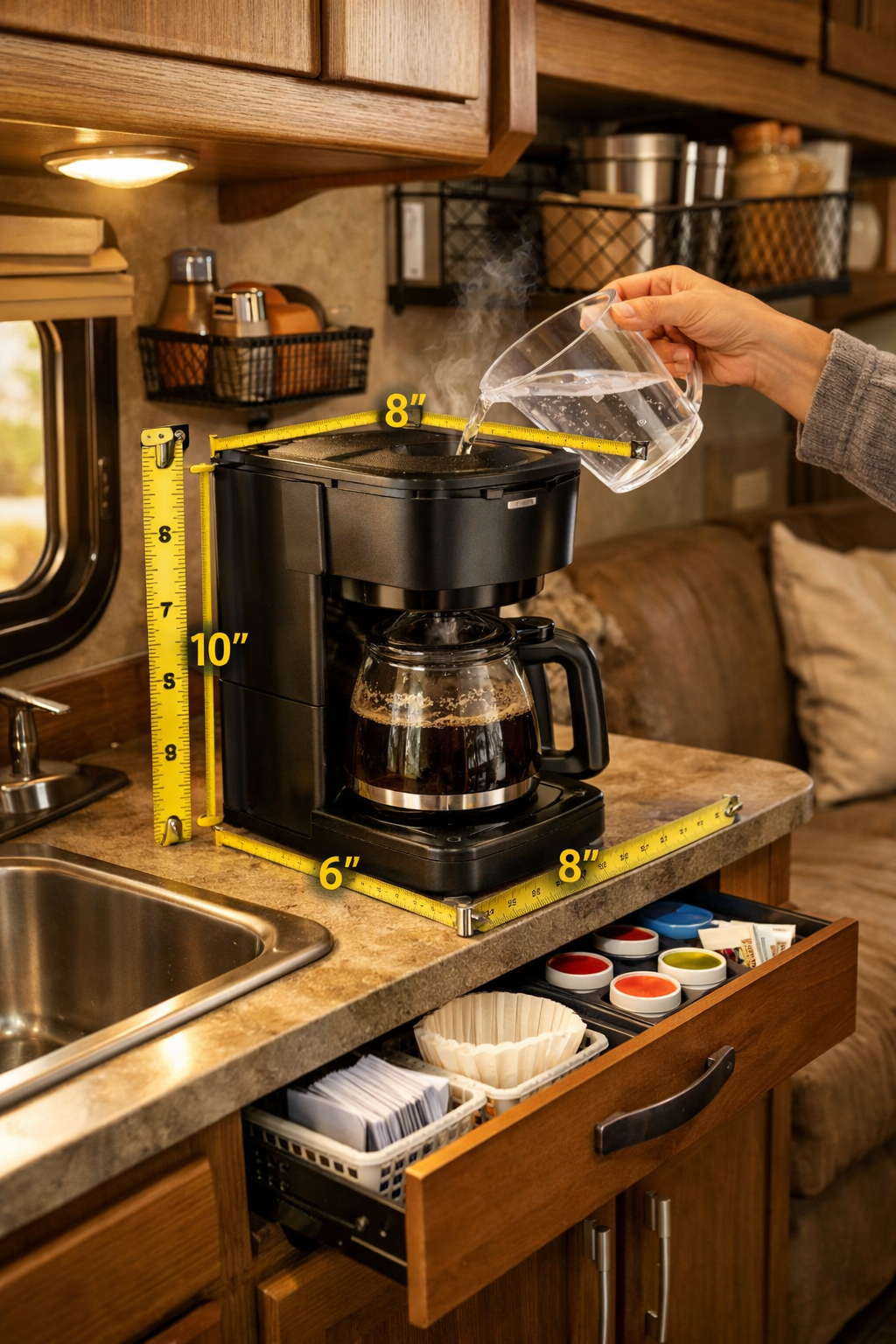
Choose a compact drip coffee maker with these features:
- ✅ Thermal carafe (no hot plate to drain power)
- ✅ Auto-shutoff for safety
- ✅ Pause-and-serve for impatient mornings
- ✅ Removable water reservoir for easy filling
- ✅ Dimensions under 12″ in all directions
Budget recommendation: $60-$100 gets you excellent quality without overspending before you know your preferences.
For Coffee Enthusiasts: Embrace the 21%
If you’re among the espresso lovers, don’t let the minority status discourage you:
Invest in a quality portable espresso maker considering:
- Battery-powered options for boondocking flexibility
- Manual machines requiring no power
- Compact automatic machines for hookup camping
- Dual-voltage models (12V and 120V)
Pro tip: Start with a manual lever machine to learn espresso fundamentals without power constraints, then upgrade to electric if you camp with hookups frequently.
Space Optimization Strategies
Regardless of your choice, maximize efficiency:
🔧 Vertical storage – Mount coffee makers on swing-out shelves
🔧 Multi-use equipment – Choose machines with hot water dispensers for tea
🔧 Collapsible accessories – Silicone pour-over cones store flat
🔧 Magnetic mounting – Secure metal components to magnetic strips
Power Management Solutions
Match your coffee setup to your power situation:
For Boondockers:
- Calculate watt-hour consumption before purchasing
- Consider 12V native equipment
- Invest in adequate solar/battery capacity
- Have a manual backup method
For Hookup Campers:
- Standard 120V equipment works fine
- Still consider energy efficiency for good camping citizenship
- Avoid running coffee maker during AC peak usage
The Seasonal Approach
Consider maintaining different setups for different seasons:
Summer Setup ☀️
- Cold brew concentrate system
- Iced coffee capabilities
- Minimal heat generation
Winter Setup ❄️
- Thermal carafe drip maker
- Insulated French press
- Maximum heat retention
Testing Before Committing
Before making a significant investment:
- Borrow equipment from RVing friends
- Test at campground coffee stations to understand your preferences
- Buy used initially to experiment affordably
- Read RV-specific reviews[3] rather than general consumer reviews
- Consider rental options for expensive espresso machines
Maintenance and Longevity
Protect your investment with proper care:
- Descale monthly in hard water areas
- Secure during travel with foam padding or dedicated compartments
- Empty completely before moving to prevent water damage
- Clean immediately to prevent mold in humid climates
- Store with lid open to allow airflow
The Backup Plan
Experienced RVers always have a Plan B:
- Instant coffee packets for emergencies
- Manual pour-over cone requiring only hot water
- Knowledge of nearby coffee shops along your route
- Campground coffee station locations
As one veteran RVer advises: “Your primary coffee setup will fail at the worst possible moment. The question isn’t if, but when. Have a backup that requires minimal equipment.”
Conclusion: Finding Your Perfect Mobile Coffee Solution
The results of our survey on what coffee setup do RVers prefer provide clear guidance: 79% choose drip coffee makers for their perfect balance of convenience, capacity, and reliability. This overwhelming preference reflects the practical realities of RV life, where space is limited, power must be managed, and morning routines need to be simple yet satisfying.
Yet the 21% who choose espresso machines remind us that RVing is about personal freedom—including the freedom to prioritize what matters most to you. If that perfect morning shot of espresso makes your day, the extra complexity and power consumption are simply the price of happiness on the road.
The complete absence of French press and instant coffee votes tells us that RV coffee culture in 2026 values both quality and convenience, rejecting methods that compromise too much on either dimension. RVers aren’t willing to settle for inferior coffee, but they also won’t tolerate unnecessarily complicated routines.
Your Next Steps
Ready to optimize your RV coffee experience? Here’s your action plan:
- Assess your camping style – How often do you boondock versus hookup camp?
- Calculate your power budget – What can your electrical system support?
- Measure your space – What will physically fit in your kitchen?
- Consider your volume needs – How many cups do you need simultaneously?
- Set your budget – What’s reasonable for equipment you’ll use daily?
- Test options – Borrow or rent before buying expensive equipment
- Plan for backup – Always have an alternative brewing method
- Join RV coffee communities – Learn from experienced mobile coffee enthusiasts
The perfect RV coffee setup is the one that gets you excited to wake up each morning, whether you’re parked at a scenic overlook, a bustling campground, or a quiet boondocking spot in the desert. As RV parks continue upgrading amenities[2] and portable coffee technology advances[1], the options will only improve.
Remember: the best coffee setup isn’t necessarily the most popular one or the most expensive one—it’s the one that fits your lifestyle, your budget, and your taste preferences. The 79% majority might be onto something with their drip coffee makers, but don’t let statistics override your personal priorities.
Whether you join the drip coffee majority, embrace the espresso enthusiast minority, or forge your own path entirely, the most important thing is that you’re enjoying great coffee in amazing places. That’s what RV life is all about. ☕🚐
Now get out there, brew something delicious, and enjoy the view from your window. The open road—and perfect coffee—awaits!
References
[1] The Ultimate 2026 Outdoor Espresso Setup (Car vs. Nature Test) – https://www.youtube.com/watch?v=qsuHfea8iJM
[2] Trends in the U.S. RV Park and Resort Sector for 2025–2026 – https://www.innowave-studio.com/post/trends-in-the-u-s-rv-park-and-resort-sector-for-2025-2026
[3] Top 5 Best RV Coffee Makers In [2026] – https://www.youtube.com/watch?v=igjKAnFL1jw
[4] Is MAJOR Change Coming Soon to RVing & Camping – RV Industry Update January 2026 – https://www.youtube.com/watch?v=Lwsqn1v0uUU