(As an amazon affiliate, we earn a commission when purchasing via our links below)
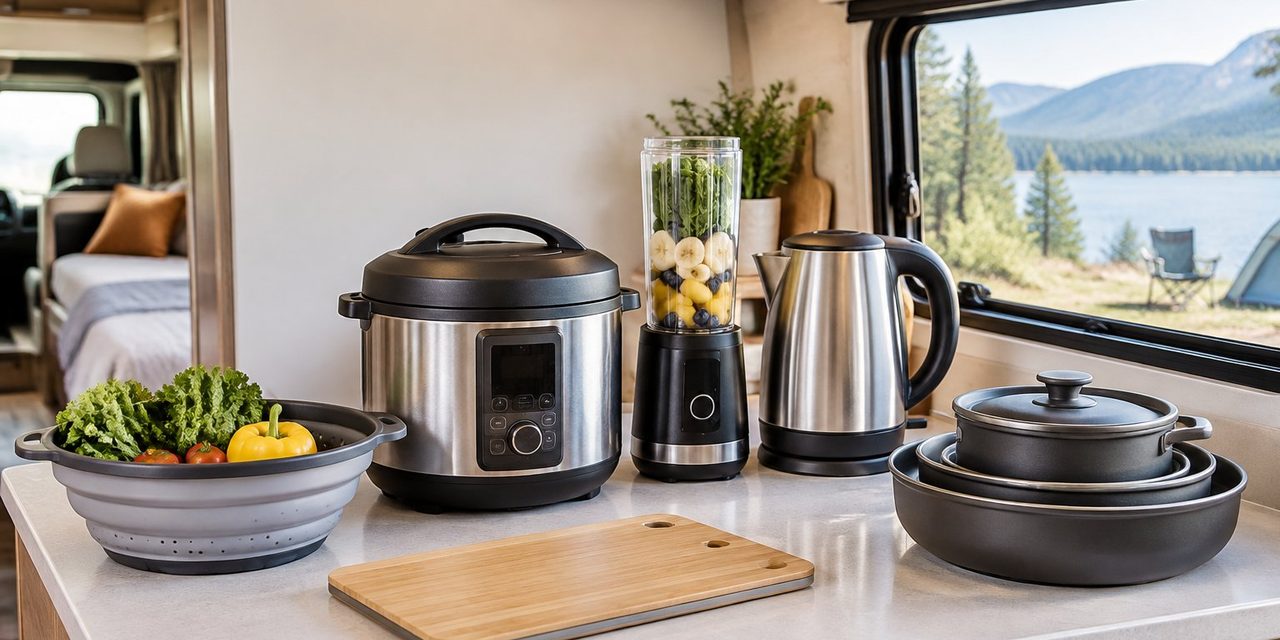
Cooking on the road shouldn’t feel like an endless battle against cramped galley countertops, weak electrical setups, and precious tank capacities. The best modern camper appliances prove you don’t need a residential kitchen to whip up great meals—they run on modest wattage, fit shallow sinks, and stow neatly before you roll out.
Our picks cover cooking, blending, ventilation, ice, and cleanup, with some clear compromises. Check operating clearance as well as storage dimensions, and compare electrical demand with your RV’s circuit and inverter limits.
We give everyday cooking tools priority; specialty appliances earn a place when you use them frequently.
1. Portable Range Hood

We recommend the CIARRA for supplemental grease and odor capture when your RV has room beside the cooking area.
Pros
- Weighs 3 pounds.
- Includes two fan speeds and a removable oil cup.
- Measures 6.3 inches square at the base.
Cons
- Recirculates air inside the RV.
- Requires counter space near your cookware.
Its 13.6-inch height makes cabinet clearance worth checking. The filter assembly combines a metal condensation screen with carbon filtration, and the removable grease-catching parts help with cleanup.
This unit is exceptional for RV living because standard rig exhaust fans are often noisy, poorly positioned, or ineffective at capturing airborne grease before it coats nearby upholstery and cabinetry. It gives you targeted extraction right next to your induction burner or stovetop without cutting new exterior vent holes.
Our biggest caution concerns ventilation: this unit returns filtered air indoors. Keep your RV’s required ventilation operating, especially when cooking with propane. Follow CIARRA’s placement instructions and keep the unit clear of flames and hot cookware.
2. Narcissus 3.5-Cup Rice Cooker

The Narcissus is our strongest everyday cooking pick for small households because its steam tray adds another cooking task within the same footprint.
Pros
- Cooks up to 3.5 cups of uncooked rice.
- Offers grain, steam, and slow-cook functions.
- Removable pot is listed as dishwasher-safe.
Cons
- Small capacity limits larger meals.
- Steam release requires overhead clearance.
At 9.4 inches wide and 7.8 inches deep, this 400-watt cooker suits compact counters. The included basket supports steaming food while rice cooks underneath, reducing the number of cooking vessels in use.
It thrives in an RV environment because its meager 400-watt draw runs effortlessly off modest battery banks, portable power stations, or small inverters while boondocking. Combining grain cooking and steaming into a single one-pot appliance also minimizes gray-tank water waste during dish cleanup.
We value that flexibility more than the long keep-warm setting. Plan portions around your meals, follow safe food-holding guidance, and let the pot cool before packing it away. Narcissus describes the removable nonstick pot as PFAS-free.
3. Wi-Fi Sous Vide Cooker

We reserve the BLITZHOME for travelers who already enjoy sous vide cooking and have space for a water-filled pot during use.
Pros
- Slim body weighs 2.6 pounds.
- Works with a stated 4- to 15-liter water bath.
- Includes onboard controls and app monitoring.
Cons
- Draws 1,100 watts.
- The cooking setup occupies substantially more space than the wand.
- App connectivity requires 2.4 GHz Wi-Fi.
This immersion cooker stores more easily than a dedicated water-bath appliance. Its screw clamp attaches to a suitable container, and the listed temperature range runs from 77°F to 198.5°F.
For RVers, sous vide is ideal because it creates tender, restaurant-quality proteins without generating ambient heat, greasy splatters, or lingering cooking smells inside a confined cabin. When finished, you simply dump the clean cooking water and stow the slim circulator in a utensil drawer.
Our reservation is the full setup: you need a stable cooking vessel and room to handle hot water safely. Follow a trusted time-and-temperature recipe, and cook only while parked. The narrow body measures about 15 inches long, so check drawer length.
4. Flex Induction Cooktop

For RV owners with compatible cookware and sufficient electrical capacity, we recommend the Nuwave Flex as a compact extra burner.
Pros
- Measures 12 inches wide by 10 inches deep.
- Low, 2-inch profile helps with storage.
- Offers adjustable heat settings from 100°F to 500°F.
Cons
- Requires induction-compatible cookware.
- A single cooking zone limits simultaneous dishes.
The 6.5-inch heating coil makes pan-base size important. A broad pan extends beyond the active heating area, so match cookware to the manufacturer’s guidance.
It shines in RV setups because induction produces almost no waste heat, preventing your tiny living quarters from turning into a sauna on hot summer days. It also lets you cook outside on a picnic table when plugged into an exterior outlet, keeping all cooking odors outside.
We like the ability to adjust heat and cooking time during a session. The smooth ceramic-glass surface also offers a straightforward wiping surface after it cools. Before buying, confirm the exact model’s electrical rating and power settings: the listing contains conflicting wattage figures.
5. Magic Bullet Personal Blender

We favor the Magic Bullet for small drinks and dips when a full-size blender’s pitcher would consume too much cabinet space.
Pros
- Compact body measures about 4.5 by 4 inches at the base.
- Includes multiple cups and storage lids.
- Cups are top-rack dishwasher-safe.
Cons
- Single-serving format limits batch size.
- Extra accessories add to the storage footprint.
The 250-watt motor and cup-based design suit modest portions. Loading and blending in the same vessel reduces the number of containers involved in preparing a drink.
This blender is a camper favorite because the blending jar doubles as your drinking mug, sparing you from washing bulky multi-quart pitcher assemblies in shallow RV sinks. The modest 250-watt motor also starts without tripping sensitive camper circuits or draining house batteries.
Our storage advice is to pack only the cups and lids you expect to use. The supplied set includes several accessories, and carrying every piece reduces its space advantage. Wash the blade as directed, and follow the manual’s ingredient and operating limits.
6. Topzee 2.1-Quart Air Fryer

The Topzee earns our recommendation for one- or two-person portions when a larger countertop oven would take up too much room.
Pros
- Offers temperature settings from 120°F to 400°F.
- Includes shake reminders and automatic shutoff.
- Basket is listed as dishwasher-safe.
Cons
- Its 2.1-quart capacity limits meal size.
- Needs ventilation space and room to pull out the basket.
This 1,000-watt appliance measures 9.4 inches square and 12 inches tall. It supports air frying, baking, roasting, and reheating, giving it useful range for a small household.
It is perfectly tailored to mobile life because it eliminates the need to fire up finicky, propane-guzzling RV ovens that take forever to heat up and roast the living area. The 1,000-watt rating is notably gentle on campground shore power connections and 15-amp circuits compared to standard 1,800-watt home fryers.
We would choose it for side dishes or small mains. Crowding the basket reduces airflow, so plan on batches when cooking larger amounts. Measure the open counter area in front of the unit as well as the space it occupies while closed.
7. Typhur Nugget Ice Maker

We would give the Typhur counter space only if nugget ice is a daily pleasure worth its weight and upkeep.
Pros
- Produces soft nugget-style ice.
- Includes a removable basket and cleaning supplies.
- Offers a seven-minute cleaning cycle.
Cons
- Weighs 17.4 pounds.
- Requires water refills and routine cleaning.
- Daily production exceeds its basket capacity.
Typhur rates production at up to 35 pounds per day, while the basket holds up to 2.6 pounds. Those figures describe different things: daily output requires repeated ice removal and water replenishment.
This unit solves a major headache for RV travelers whose compact absorption or 12-volt camper refrigerators lack built-in ice makers and have tiny freezers that can barely fit a single ice tray. Producing fresh ice on demand saves valuable freezer space for frozen rations and spares you frequent runs to camp stores for bagged ice.
Our main concern is portability. This is a substantial appliance to secure for travel, despite its countertop format. The manufacturer recommends filtered or distilled water; follow its cleaning schedule even when using the automatic cleaning cycle.
8. AIRMSEN Countertop Dishwasher

We recommend considering the AIRMSEN for longer stays with dependable utilities and enough counter space for a dedicated dishwasher.
Pros
- Built-in 5-liter tank supports manual filling.
- Includes multiple wash cycles and a drying function.
- Supplied hoses support filling and draining.
Cons
- Weighs about 29 pounds.
- Measures roughly 17 inches square and 18 inches tall.
- Large plates require angled loading.
Its tank removes the need for a permanent water inlet connection, though you still need a safe drain route. The listed 5-liter wash-water use gives you a useful figure for planning fresh- and gray-water capacity.
In an RV, hand-washing a full sink of dishes can easily drain several gallons of precious fresh water and overwhelm your gray tank. Because this machine uses a measured 5 liters (about 1.3 gallons) per full cycle, it is significantly more water-efficient than hand washing, while draining directly into your sink basin without complex plumbing modifications.
Our space-saving verdict is qualified. It occupies less room than a full-size dishwasher, yet claims a large share of an RV counter. Check loading clearance and how you will refill the tank beneath overhead cabinets.
Buying Guide
We recommend choosing equipment around the meals you cook regularly and the utilities your RV supports. A compact appliance earns its space through frequent use, manageable cleanup, and safe storage.
Match capacity to your portions. We favor smaller cooking vessels when they handle your normal meal in one batch. Repeated batches add time and reduce the convenience of a compact appliance. Check usable basket or pot capacity, especially when steaming food above another dish.
Budget power across the circuit. Divide watts by volts to estimate current draw. A 1,000-watt appliance on 120 volts draws about 8.3 amps. We recommend checking shared outlets and accounting for other running equipment, including loads supplied through your inverter.
Read material claims carefully. We treat “BPA-free” and “PFAS-free” as separate claims about different substances. Follow the maker’s instructions for coated surfaces, and use approved utensils and cleaning methods. Check each removable part’s care directions before putting it in a dishwasher.
Plan for travel before purchase. We recommend storing heavy equipment low and securing every appliance before driving. Empty water tanks and let cooking equipment cool fully before stowing it. Measure the cabinet opening itself, including any hinge or latch that narrows access.