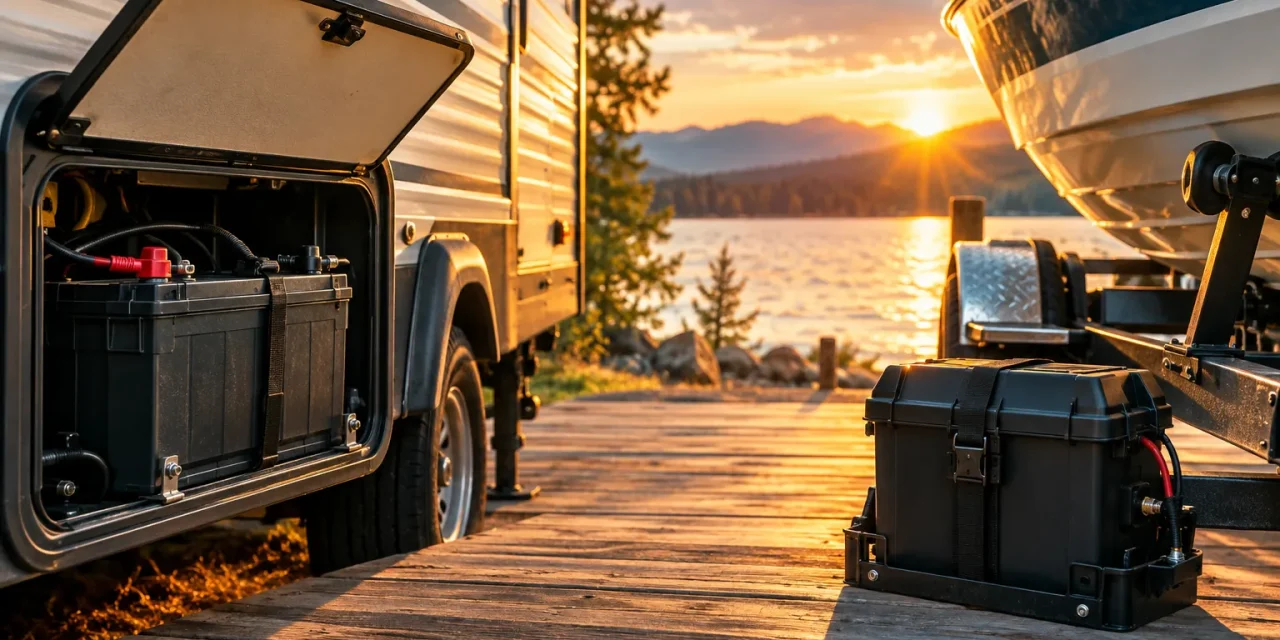
A Group31 marine deep-cycle battery can weigh more than 70 pounds, cost extra compared to a standard RV-specific version, and still end up strapped into thousands of RV battery boxes every year. That is not a mistake. It is a real trend, and it raises a fair question: are marine deep cycle batteries good for RV use, or are RV lovers just settling for whatever is on the shelf?
This guide breaks it all down in plain, friendly language. It will help decide whether a marine battery, an RV battery, or a dual-purpose option is the right fit for a camper, travel trailer, or motorhome. Along the way, this article looks at real specs, real sizes like Group24 and Group31, and real technology like Bluetooth-enabled, low-temp, and self-heating lithium batteries from brands like Redodo and Interstate.
Key Takeaways
- 🚤 Marine deep-cycle batteries can work well in an RV, especially if built tough for vibration and tilting, but they usually cost more than an RV-specific battery of the same size.
- 🔋 A true deep-cycle battery, marine or RV, has thick plates designed for slow, steady discharge, not the quick burst power a starting battery gives.
- ⚡ Not every “marine” battery is deep-cycle. Some are starting or dual-purpose batteries, so always check the label before buying one for an RV.
- 🌡️ Low-temp and self-heating lithium batteries, like Bluetooth 12V 100Ah and 12V 165Ah Group31 models, now make cold-weather RVing much easier.
- 💰 For most RV owners, a dedicated deep-cycle RV battery is still the smarter long-term buy, but a marine battery is a solid backup or budget option.
Are Marine Deep Cycle Batteries Good for RV Use? The Simple Answer
Yes, in many cases marine deep-cycle batteries are good for RV use, because they are built tough and can handle repeated deep discharges. However, a purpose-built RV battery is usually a better long-term match for cost, size, and charging compatibility.
Marine batteries live a hard life. They deal with bouncing waves, salty air, and constant tilting. To survive that, marine batteries are made with thicker cases, stronger internal bracing, and extra corrosion protection. That same rugged construction is a big reason so many RV lovers ask if a marine battery will work in a camper or motorhome too.
The honest answer is: it depends on the battery. A true deep-cycle marine battery, built to standards set for boats, can handle an RV’s daily deep-cycle demands just fine. Unlike a plain starting battery, it will not get worn out fast from powering lights, fans, and small appliances overnight. But many “marine” batteries sold at big stores are actually dual-purpose or starting batteries in disguise. Those are not built for the slow, steady drain an RV house battery has to survive night after night.
So before grabbing a marine battery for an RV, it pays to check the label closely. Look for the words “deep cycle” printed right on the case. If it just says “marine” with no mention of deep cycle, it may not be the right fit for RV house power.
What Are Deep Cycle Batteries? Key Characteristics Every RV Owner Should Know
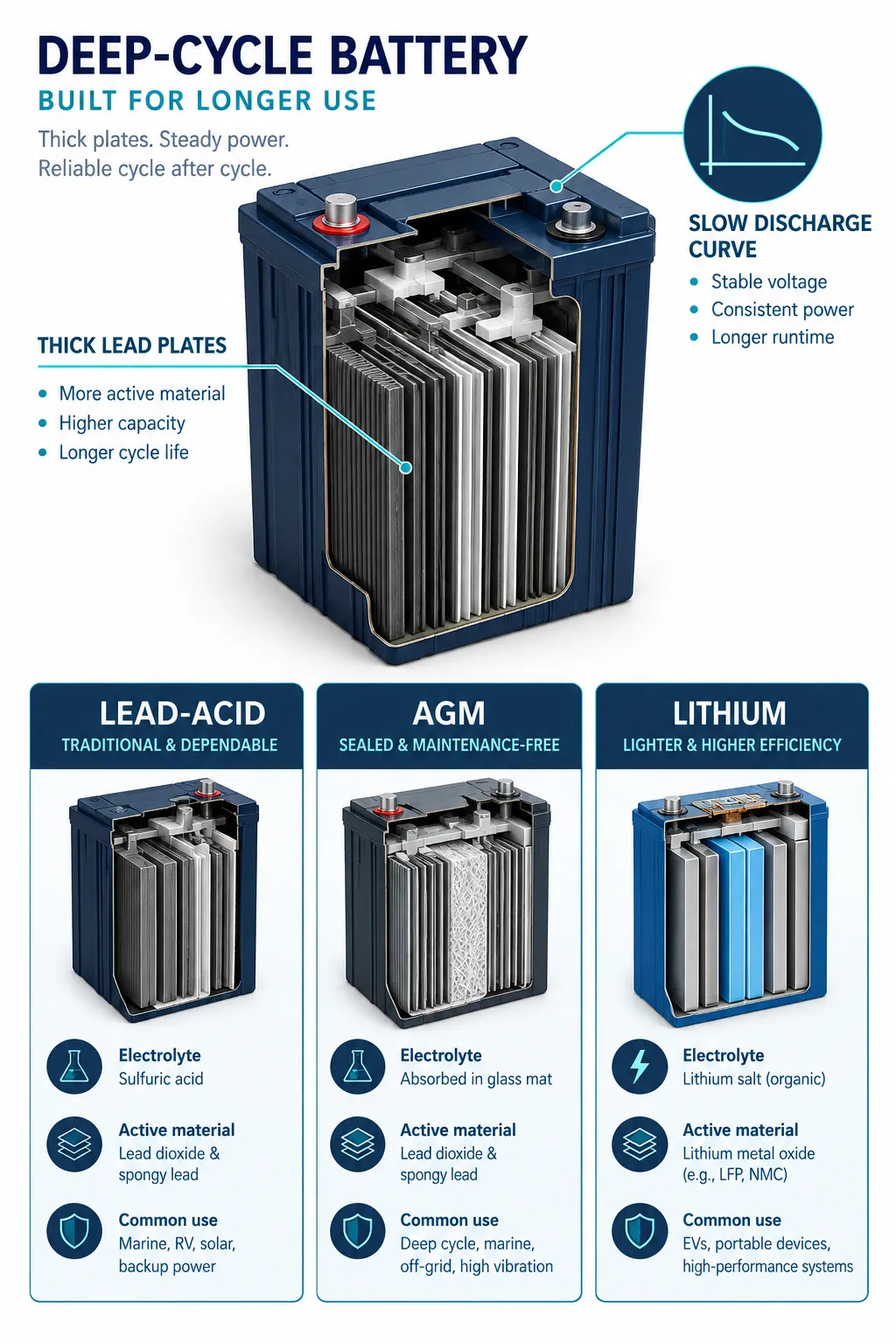
A deep-cycle battery is a battery designed to be drained down low and recharged over and over, unlike a starting battery that only gives one quick burst of power. RVs and boats both rely on deep-cycle batteries to run lights, fridges, fans, and electronics for hours at a time.
Deep-cycle batteries share a few key traits, no matter if they sit inside an RV, a boat, or a solar backup shed:
- Available in various chemistries, lead-acid, AGM (Absorbent Glass Mat), and lithium (LiFePO4) are the three main options RV lovers choose from today.
- Thick battery plates, deep-cycle batteries use thicker internal plates than starting batteries, which lets them handle deeper discharge cycles without wearing out fast.
- Designed for deep discharge, these batteries can safely drop to 50% or even 80% of their capacity (with lithium) and bounce right back after charging.
- Slow discharge rate, instead of one big jolt of power like a cranking battery, deep-cycle batteries release power slowly and steadily over many hours.
This slow, steady release is exactly what makes deep-cycle batteries so good for RV house systems. They keep the TVs, water pump, lights, and phone chargers running through a full evening without dying halfway through a movie night. A basic 12V 100Ah deep-cycle lithium battery, for example, can hold roughly 1280Wh of usable energy, enough to power small appliances for hours without breaking a sweat.
Deep Cycle Marine vs. RV Battery: What’s the Difference?
The biggest difference between a marine battery and an RV battery comes down to how each one is built and where it is expected to work. Marine batteries face saltwater, waves, and vibration, while RV batteries face road bumps, temperature swings, and long storage periods.
1. Purpose and Usage
Marine batteries are built to survive rough water and constant motion, powering trolling motors, fish finders, and cabin lights on a boat. RV batteries focus on powering house systems like lighting, water pumps, fans, and small appliances while parked or driving down the highway. Both battery types handle deep discharge well, but their day-to-day job looks a little different.
2. Design and Construction
Marine batteries usually meet Coast Guard and ABYC standards, which means extra corrosion resistance, sealed terminals, and tougher outer cases to handle spray and humidity. RV batteries are built around RVIA and NEC wiring standards, focusing more on resisting road vibration and fitting neatly into standard RV battery compartments. Group sizes like Group24 and Group31 are common in both worlds, which is part of why cross-use is so tempting.
3. Performance in Specific Environments
A marine battery’s sealed, corrosion-fighting construction helps it shrug off humid dock air and splashing water. An RV battery, meanwhile, is optimized for the vibration of highway driving and for working well with an RV’s converter, solar charge controller, and engine alternator all at once. Low-temp performance also matters a lot here, RVers who camp in cold weather often prefer batteries with built-in self-heating technology so the lithium cells stay warm enough to charge safely.
4. Cost Considerations
Marine deep-cycle batteries often cost more than a similarly sized RV battery, mainly because of that extra corrosion protection and heavier-duty case. RV lovers on a budget may find a dedicated RV deep-cycle battery gives more bang for the buck, especially in common sizes like Group24 or Group31.
"A marine battery will often survive an RV's bumps and vibration just fine, the real question is whether it's actually built for deep cycling, not just labeled 'marine.'"
Can I Use a Deep Cycle Marine Battery in My RV?
Yes, a deep-cycle marine battery can be used in an RV, as long as it truly is a deep-cycle model and fits the RV’s physical space, terminals, and charging system. This is one of the most searched RV battery questions, and the short answer is a cautious “yes, with conditions.”
Several retailers now sell batteries explicitly marketed as “Marine/RV” deep-cycle batteries, built to be interchangeable house batteries for both boats and campers. Interstate, for example, offers a Marine/RV 12V 100Ah 825 CCA battery designed as a dual-purpose unit, strong enough to help start an engine, but also steady enough to run trolling motors or RV appliances for hours. That kind of dual-purpose design shows just how blurry the line between “marine” and “RV” battery has become.
Still, a few practical checks matter before swapping one in:
- Check the group size. Group24 fits smaller RV compartments, while Group31 and larger boxes suit bigger rigs with heavier power needs.
- Confirm true deep-cycle rating. Some marine batteries are dual-purpose (starting plus light cycling), not full deep-cycle, and won’t hold up as well to nightly RV use.
- Match the terminal style. Many marine batteries use threaded posts instead of standard side or top posts, so an adapter may be needed.
- Check charging compatibility. RVs often charge batteries from three sources, a converter, an alternator, and solar, so the battery’s charging profile needs to play nicely with all three.
However, RV lovers who boondock often, run solar setups, or want steady overnight power should still lean toward a battery clearly labeled for deep-cycle RV use. Anyone weighing solar setups against generator backup might also enjoy this breakdown of reasons to think twice about solar on an RV before committing to a full battery bank.
Meet the Redodo Lineup: 12V 100Ah, Group24, Group31, and 24V Bluetooth Low-Temp Batteries
Modern lithium deep-cycle batteries have made the marine-vs-RV debate almost beside the point, because brands like Redodo now build batteries meant to work equally well in both. Bluetooth monitoring, low-temp charging protection, and self-heating cells are quickly becoming the new standard for both boats and RVs.
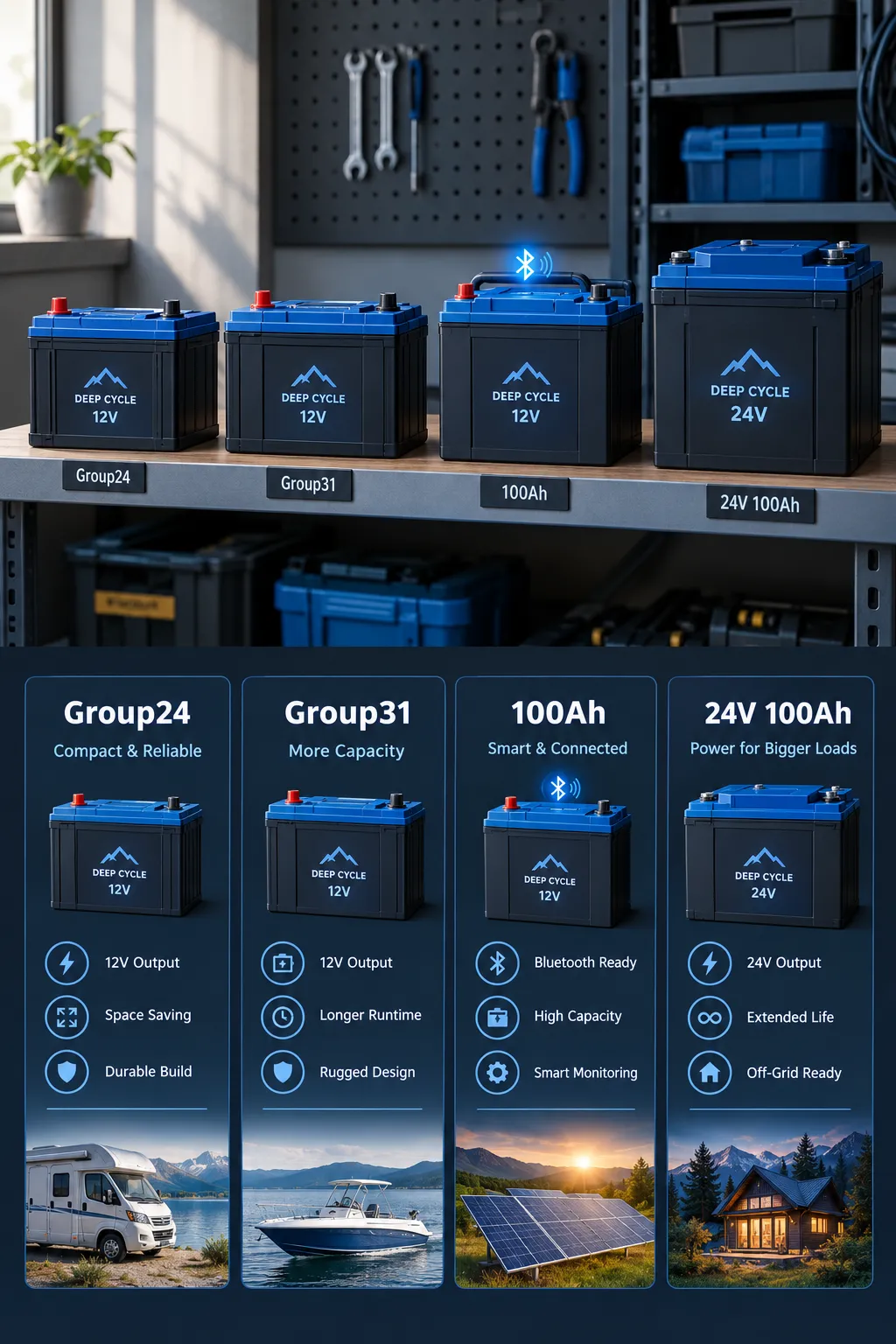
The Redodo Classic Bluetooth Low-Temp 12V 100Ah Group Basic battery is a favorite among RV lovers who want a true deep-cycle marine battery with smart features built in. This Bluetooth 1280Wh 1280W battery can deliver roughly 1280Wh 1280W 1-Night 12V power for a single night of lights, fans, and a small fridge. Hook it up to solar panels and it can climb from 1280Wh 1280W 30-70% 4-8H 12V, and on a sunny day it can reach a full 1280Wh 1280W Full Day 12V runtime for a TV, laptop chargers, and kitchen gear.
RV owners with bigger rigs often step up to the 12V 120Ah Group24 or 12V 165Ah Group31 Bluetooth Low-Temp models, both offering more amp-hours for multi-day boondocking trips. Wiring two 24V 100Ah Bluetooth Low-Temp units together can create a hefty 2560Wh 2560W bank, enough for a solid 3-6H Backup 12V power supply during a storm-related outage back home or off-grid on the road.
| Battery Model | Voltage | Capacity | Group Size | Bluetooth | Best For |
|---|---|---|---|---|---|
| Redodo Classic Bluetooth Low-Temp 12V 100Ah | 12V | 100Ah | Group Basic | Yes | Weekend RV & marine house power |
| Redodo 12V 120Ah Group24 Bluetooth Low-Temp | 12V | 120Ah | Group24 | Yes | Trolling motors, RV fridges |
| Redodo 12V 165Ah Group31 Bluetooth Low-Temp | 12V | 165Ah | Group31 | Yes | Full-time RVing, multi-day trips |
| Redodo 24V 100Ah Bluetooth Low-Temp | 24V | 100Ah | Group Basic | Yes | Large inverters, 2560Wh backup |
| Interstate Marine/RV 12V 100Ah 825 CCA | 12V | 100Ah | Group31 | No | Dual-purpose cranking & cycling |
Self-heating cell technology is worth calling out on its own. Cold weather is one of the biggest killers of lithium batteries, since charging a frozen lithium cell can permanently damage it. Low-temp protected and self-heating batteries solve this by warming the cells before allowing a charge, which matters a lot for anyone winterizing a travel trailer or camping through a cold snap.
Deep-Cycle Marine Battery Size Chart
Choosing the right physical size matters just as much as choosing the right chemistry. Group24, Group27, and Group31 are the three most common deep-cycle marine and RV battery sizes, and picking the wrong one can mean a battery that simply won’t fit the compartment.
| Group Size | Typical Ah Range | Typical CCA | Common Use |
|---|---|---|---|
| Group24 | 70-85Ah | 500-650 CCA | Compact RVs, small boats, tight compartments |
| Group27 | 85-105Ah | 600-750 CCA | Mid-size travel trailers, pontoon boats |
| Group31 | 100-165Ah | 700-900 CCA | Large motorhomes, offshore boats, heavy trolling motors |
Selecting the correct group size keeps wiring simple and avoids expensive custom battery boxes. RV lovers upgrading their electrical setup might also want to review whether their rig needs a surge protector for the RV’s electrical system at the same time, since a new battery bank often means it’s time to check the whole power chain.
How to Choose the Right Battery for Your Boat or RV
Choosing between a marine battery and an RV battery boils down to matching the battery’s build and performance to the specific environment it will live in. Both battery types can technically work in either setting, but each shines brightest in its intended home.
What to Consider When Choosing a Marine Battery
- Corrosion resistance, saltwater and humidity are constant threats, so sealed terminals matter.
- Vibration tolerance, waves and rough water mean the case needs to handle a lot of shaking.
- Dual-purpose vs. true deep cycle, check labels carefully, since many marine batteries blend starting and cycling power and end up “not great for either need.”
- CCA rating, cold cranking amps matter if the battery also needs to start an engine.
What to Consider When Choosing an RV Battery
- Reserve capacity, higher reserve capacity means more hours of steady power for boondocking.
- Charging compatibility, the battery should work well with a converter, alternator, and solar setup all at once.
- Weight and space, RV battery bays are often tighter than boat compartments, so measure twice.
- Cold-weather performance, low-temp protection or self-heating tech is a smart pick for anyone RVing outside of summer.
Ultimately, the choice comes down to trip style. Weekend campers with mild weather may do just fine with a solid marine deep-cycle battery. Full-timers and cold-climate RV lovers, on the other hand, usually get more value from a purpose-built RV lithium battery, a decision worth weighing alongside other hidden costs of RVing before locking in a budget.
Finding Your Batteries: Where to Buy Deep-Cycle Marine and RV Batteries
Deep-cycle marine and RV batteries are sold almost everywhere these days, from big-box retailers to specialty battery shops and online marketplaces. Walmart, auto parts stores, and marine supply shops all commonly stock Group24 and Group31 deep-cycle options, along with newer Bluetooth lithium models from brands like Redodo.
Local Interstate battery dealers and RV dealerships can often special-order specific sizes not sitting on the shelf. Many RV lovers also compare prices and reviews online before buying, especially for lithium options that use a phone app for Bluetooth monitoring of charge state, temperature, and cycle count. That kind of remote monitoring pairs nicely with RVers who already track other rig systems through a mobile app for managing an RV’s systems.
Before buying, it helps to measure the existing battery box, note the group size, and decide whether lead-acid, AGM, or lithium chemistry fits the budget and power needs best. Anyone building out a bigger power setup might also enjoy reading about reasons owning an RV is a good investment, since a solid battery bank often boosts resale value too.
FAQ
What type of deep cycle battery is best for RV?
Lithium (LiFePO4) deep-cycle batteries are generally best for RVs, offering more usable capacity, lighter weight, and longer cycle life than lead-acid or AGM. A 12V 100Ah or 12V 165Ah Group31 Bluetooth low-temp lithium battery gives strong, steady power with smart monitoring for boondocking trips.
Are marine and RV deep cycle batteries the same?
Not always. Both are deep-cycle by design, but marine batteries are built for saltwater, vibration, and tilting, while RV batteries are built for road shock and RV wiring systems. A true deep-cycle marine battery can work in an RV, but not every marine battery sold is actually deep-cycle rated.
How long do marine RV deep cycle batteries last?
Lead-acid deep-cycle batteries typically last 3-6 years, AGM batteries last around 4-7 years, and lithium deep-cycle batteries can last 8-10+ years or thousands of charge cycles. Actual lifespan depends heavily on how deep the battery is discharged and how well it is charged and maintained.
Can I use a marine battery on my RV?
Yes, a marine battery can be used on an RV, especially a true deep-cycle or dual-purpose AGM or lithium model. Check that it fits the compartment, matches the terminal style, and is compatible with the RV’s converter, alternator, and solar charging setup before installing it.
Conclusion: Deep Cycle Marine vs. RV Battery
So, are marine deep cycle batteries good for RV use? The honest answer is yes, often, but not automatically. A true deep-cycle marine battery, built tough for waves and vibration, can absolutely power an RV’s lights, fans, and fridge for a night or more. However, a dedicated RV deep-cycle battery, especially a Bluetooth, low-temp, self-heating lithium model like those from Redodo, usually fits better, charges smarter, and lasts longer for the price.
The smartest next step is simple: measure the current battery compartment, decide on a group size like Group24 or Group31, and pick a chemistry that matches the camping style, lithium for frequent boondocking, AGM for a solid all-around choice, or lead-acid for the tightest budget. Whichever route gets chosen, make sure the label says “deep cycle,” check the CCA and Ah ratings, and confirm it plays nicely with the RV’s charging system before hitting the road.