Six to ten miles per gallon. That’s it. That’s what thousands of RV owners get from an engine that Ford built for over two decades and put under the hood of countless motorhomes. Add in spark plugs that can shoot out of the cylinder head like tiny rockets, and you start to understand why so many RV shoppers call this the worst RV engine ever made (and why you should run from it) the moment they spot it on a used-coach listing.
This isn’t internet hype. It’s a real, well-documented pattern tied to a specific engine, a specific set of production years, and a specific set of design choices that RV mechanics still deal with today. Knowing the story could save a buyer thousands of dollars and a whole lot of roadside frustration.
Key Takeaways
- The Ford 6.8L Triton V10 is widely considered the worst RV engine ever made, mostly because of early cylinder-head defects and chronic exhaust manifold failures.
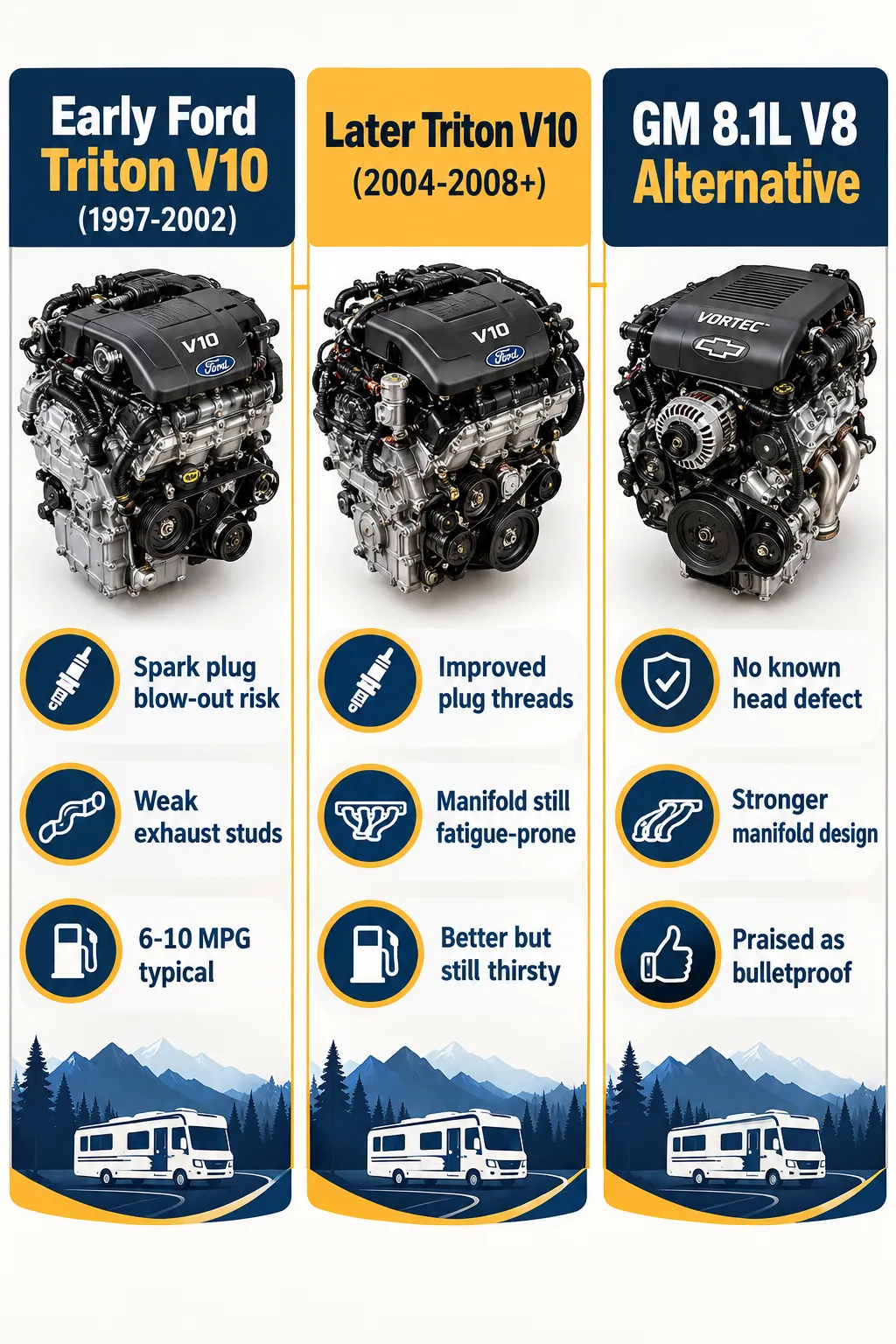
- 1997-2002 “2-valve” versions are the biggest red flag, their spark plugs can literally blow out of the head under load.
- 2004-2008 “3-valve” versions fixed that problem but created a new one: plugs that seize and snap off, making removal a nightmare.
- Fuel economy is brutal across the whole V10 lineup, often landing between 6 and 10 miles per gallon in RV use.
- Not every V10 is doomed, many owners report 250,000 to 500,000 trouble-free miles when the known issues are fixed and maintenance stays on schedule.
What Is The Worst RV Engine Ever Made? Meet the Ford 6.8L Triton V10
When RV mechanics and long-time owners talk about the worst RV engine ever made, they are almost always talking about the Ford 6.8L Triton V10. Ford built this engine from 1997 to around 2019, and it powered a massive number of Class A and Class C motorhomes from brands like Winnebago, Fleetwood, and Thor.
On paper, the V10 sounds great. It has plenty of raw power to move a heavy motorhome, and Ford sold a lot of them. But under the surface, this engine carries a reputation problem that follows it around every RV forum, every used-RV inspection checklist, and every “years to avoid” guide published in the last few years.
The short version: the V10 isn’t garbage. But specific years and specific parts of this engine have caused so many expensive failures that many experts still tell shoppers to avoid it, or at least go in with eyes wide open.
Why Early Triton V10s Earned the “Run From It” Reputation
The nickname didn’t come from nowhere. Three specific problems built the reputation of this engine over more than two decades of RV use.
The Spark Plug Blow-Out Problem (1997-2002)
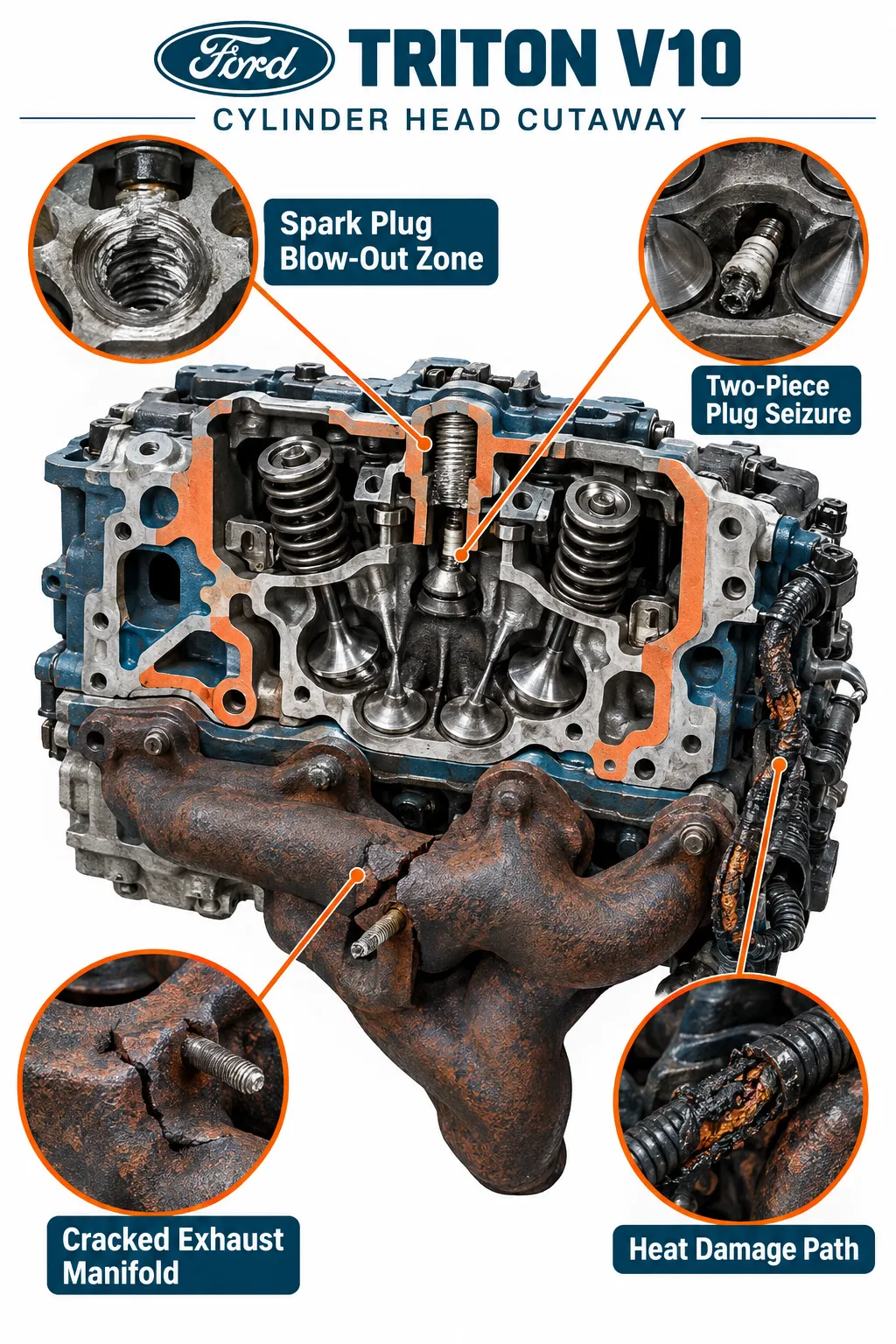
This is the big one. On early 2-valve V10s, Ford machined the aluminum cylinder heads with only about four or five threads to hold each steel spark plug in place. That’s not a lot of grip.
Under the high pressure created by towing a heavy motorhome up a grade, those threads can strip out. When that happens, the spark plug doesn’t just loosen, it can actually blow out of the engine while it’s running. RV owners online have joked that the plug leaves “at the speed of Mach Jesus.” Funny until it happens to your rig on the highway.
Once the threads strip, repair usually means:
- Removing the cylinder head
- Installing thread inserts or a repaired/replacement head
- Paying for several hours of skilled labor
This isn’t a $50 fix. It’s a job that can run into the thousands, especially on a motorhome where access to the engine is already tight.
The Seized Plug Problem (2004-2008 3-Valve Heads)
Ford fixed the blow-out issue in later 3-valve versions of the V10. Good news, right? Not entirely.
The fix introduced a new headache: two-piece spark plugs that can seize or snap off inside the cylinder head during routine spark plug changes. What should be a simple maintenance job, swap the plugs, close the hood, hit the road, can turn into pulling the head off the engine just to extract a broken plug fragment.
Specialized extraction tools exist, and experienced techs can sometimes remove broken plugs without a full head removal. But plenty of RV owners have been surprised by a routine tune-up that turned into a multi-day, high-labor repair bill.
The Exhaust Manifold Curse (Every Year, 1997-2019)
If there’s one problem that touches the entire production run of the V10, it’s the exhaust manifold. This is the most pervasive defect across all model years, and it doesn’t discriminate between 2-valve and 3-valve engines.
Here’s what happens:
- The manifold retaining studs and bolts fatigue over time from heat cycling.
- Rust builds up, especially in humid or coastal climates.
- The studs snap, sometimes one at a time, sometimes several at once.
- The manifold itself can crack under the extreme heat of hauling a 20,000-plus-pound motorhome.
The warning signs are usually a ticking noise on cold start, a loss of power, or an exhaust smell creeping into the cabin. Left unchecked, exhaust leaks near the engine bay can damage nearby wiring and other components, and in the worst cases, fumes can make their way into the passenger area.
“It sounded like someone was tapping a wrench on the engine every morning. Turned out to be a broken manifold stud. That ‘small tick’ cost me $600 to fix.”, a common story on RV owner forums
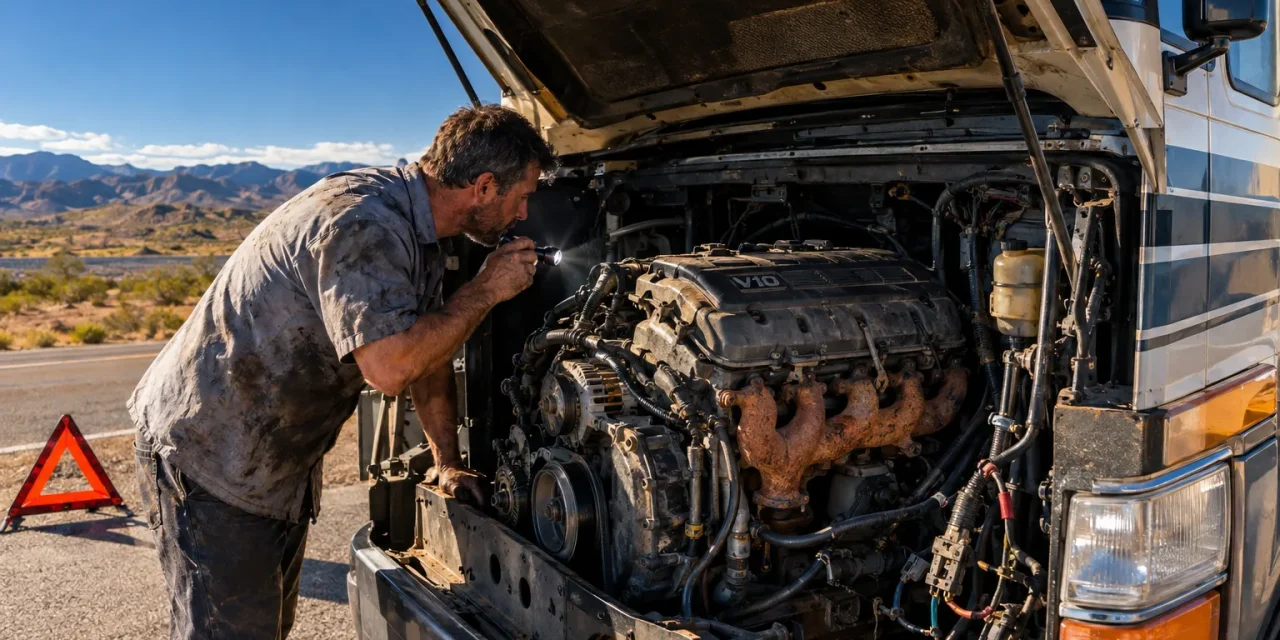
This is exactly the kind of slow-building mechanical issue that can lead to a scarier scenario down the road. Anyone who has dealt with a sudden mechanical failure understands how stressful experiencing a breakdown while on the road can be, and a neglected V10 manifold is a classic way to end up in that situation.
The Fuel Economy Problem Nobody Warns You About
Even if an RV owner never deals with a blown spark plug or a cracked manifold, there’s still one V10 problem that touches every single owner: gas mileage.
Real-world reports consistently put the 6.8L V10 in the range of 6 to 10 miles per gallon in RV service, depending on the rig’s weight, wind, terrain, and driving style. That’s on the low end even for a gas-powered motorhome.
Here’s what that actually looks like on a real trip:
| Trip Distance | MPG at 6 | MPG at 10 | Gallons Needed |
|---|---|---|---|
| 300 miles | 6 mpg | , | 50 gallons |
| 300 miles | , | 10 mpg | 30 gallons |
| 1,000 miles | 6 mpg | , | 167 gallons |
| 1,000 miles | , | 10 mpg | 100 gallons |
That’s a massive fuel bill difference over a season of travel, especially compared to modern diesel pushers or smaller, more efficient gas engines. For full-time RVers or anyone planning long-distance trips, this fuel economy penalty is a structural feature of the engine, not something a tune-up will fix.
If long-distance travel and stretching every travel dollar matter, it’s worth reading through some general tips every RVer should know before committing to a coach built around this engine.
Is Every V10 The Worst RV Engine Ever Made? Not Exactly
Here’s where the story gets more balanced, and it’s an important part of the picture.
Plenty of RV owners run V10-powered motorhomes for 250,000 to 500,000 miles with no major bottom-end issues. Forum posts are full of people calling their V10 “the most trouble-free engine I’ve ever owned.” The bottom end, the crankshaft, pistons, bearings, is genuinely tough. The rotating assembly isn’t the villain here.
The real issue is narrower than “the whole engine is junk.” It comes down to:
- Which years the engine was built (early 2-valve heads are the biggest risk)
- Whether known fixes have already been done (thread inserts, updated plugs, manifold hardware upgrades)
- How well it’s been maintained over its life
So calling this the worst RV engine ever made is really shorthand for “high-risk early Ford Triton V10 installations,” not a blanket condemnation of every V10 that ever rolled off the line. Context matters, and that context should shape how a buyer shops.
How to Spot a Problem V10 Before You Buy
Shopping for a used motorhome with a V10 under the hood? A little detective work goes a long way. Here’s a simple pre-purchase checklist:
- Ask for the build year and check the head design. 1997-2002 = 2-valve heads (highest risk). 2004-2008+ = 3-valve heads (different but real risk).
- Ask if the heads have ever been repaired. Thread inserts or updated plugs are a good sign someone already dealt with the known weakness.
- Listen for ticking on a cold start. This is the classic sign of a loose or broken exhaust manifold stud.
- Check maintenance records for manifold work. Recent stud or manifold replacement is a green flag, not a red one, it means the seller took the problem seriously.
- Watch for check engine lights tied to lean codes (P0171/P0174). These are usually caused by vacuum leaks, a cracked PCV hose, or a dirty mass airflow sensor, annoying but not catastrophic.
- Ask about fuel economy honestly. If a seller claims 14+ mpg from a V10 motorhome, be skeptical.
Buying at auction adds another layer of risk since test drives and full inspections aren’t always possible. Anyone considering that route should read up on what to expect when buying an RV at an auction before bidding on a V10-powered rig sight unseen.
It also helps to understand some basic vocabulary before shopping. A quick look at common RV terms every RVer should know makes it much easier to read listings, ask smart questions, and avoid getting talked into a bad deal.
What To Do If You Already Own One
Already own a V10-powered motorhome? Don’t panic. This engine can serve reliably for a long time with the right care. Here’s a simple action plan:
- Inspect the exhaust manifold studs at least once a year, especially before a long trip.
- Budget for manifold repair as a normal cost of ownership, not a surprise.
- Get spark plugs changed by someone experienced with this specific engine, especially on 3-valve models where extraction can go wrong.
- Fix vacuum leaks and PCV hose cracks promptly rather than ignoring a check engine light.
- Keep an eye (and nose) out for exhaust smells in the cabin, which can signal a leak that needs immediate attention.
Staying ahead of small issues is always cheaper than reacting to big ones. A solid maintenance routine, paired with some general tips for maintaining an RV engine, can add years of reliable service to a V10-powered coach.
Exhaust leaks and heat-related wiring damage are also worth taking seriously from a pure safety standpoint. Fire risk in RVs is real, and neglected engine bay problems can contribute to it, a sobering reminder found in stories like this tragic RV explosion case, which underscores why ignoring engine warning signs is never worth the risk.
Better Alternatives to Avoid the Worst RV Engine Ever Made
For shoppers who want to sidestep the V10’s known weak points entirely, a few common alternatives come up again and again in owner comparisons:
- GM 8.1L V8, Frequently praised as one of the most robust gas RV engines, with a strong reputation for avoiding chronic head and manifold problems.
- Modern diesel pushers, Generally deliver better fuel economy and torque for heavy coaches, though at a higher upfront cost.
- Newer gas platforms, Later-generation engines built after manufacturers addressed known design flaws tend to have fewer structural issues overall.
None of these are perfect, and every engine has its own maintenance quirks. But when comparing options side by side, the V10’s combination of head defects, manifold fatigue, and poor fuel economy puts it at a real disadvantage against these alternatives, especially for buyers planning serious mileage.
Frequently Asked Questions
Is every Ford V10 RV a bad buy?
No. Later, well-maintained V10s with documented repairs can run for hundreds of thousands of miles. The risk is concentrated in early, unrepaired units.
Can the spark plug blow-out issue be fixed permanently?
Yes, through thread inserts or a replacement/upgraded cylinder head. Once fixed properly, the risk drops significantly.
Why does the V10 get such poor gas mileage?
It’s a large-displacement gas engine hauling very heavy loads. That combination is inherently thirsty, regardless of maintenance.
Should a check engine light on a V10 cause panic?
Usually not. Many lean-condition codes trace back to simple issues like vacuum leaks or a dirty sensor, not engine failure.
Conclusion
The Ford 6.8L Triton V10 earned its reputation the hard way, through blown spark plugs, seized plugs, snapped manifold studs, and gas mileage that hurts every time it’s time to fill up. That’s why so many RV owners and mechanics still bring it up as the worst RV engine ever made (and why you should run from it) when someone asks which engines to avoid.
But the full story has some nuance. Later years, documented repairs, and consistent maintenance can turn a risky V10 into a dependable travel companion for hundreds of thousands of miles. The real key is knowing exactly what to look for before signing on the dotted line, and staying ahead of known weak points if already behind the wheel of one.
Before buying any used motorhome, pull the maintenance records, listen for that telltale cold-start tick, and ask direct questions about head and manifold repairs. A little homework now can prevent a very expensive surprise down the road.
rv engine problems, Ford Triton V10, worst RV engine, RV maintenance tips, buying a used RV, motorhome breakdown, exhaust manifold failure, spark plug blow out, RV fuel economy, RV buying guide, diesel vs gas RV engine, RV mechanical issues